

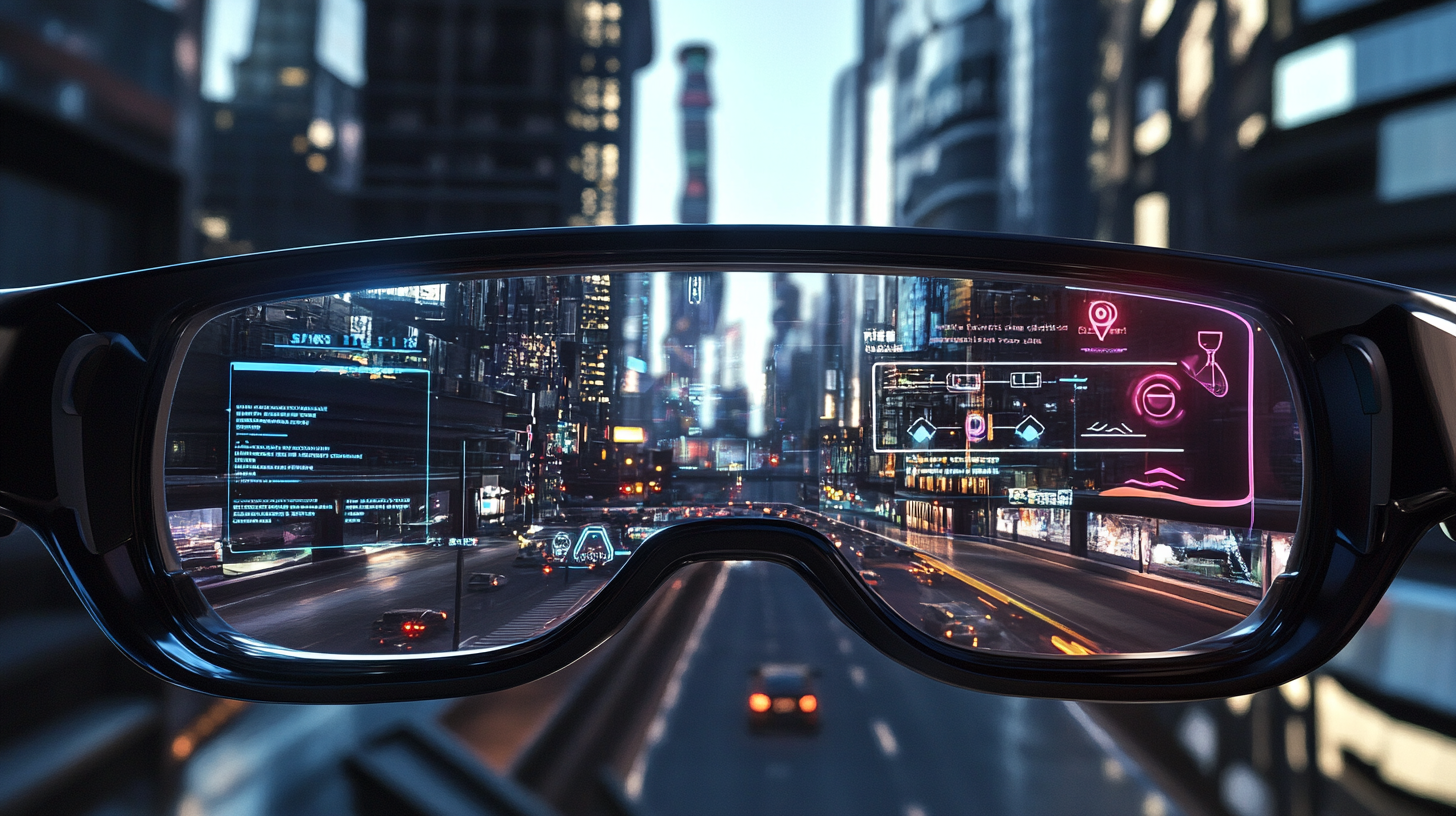
The evolution of vision: From smart to immersive glasses – The rise of modern high-tech eyewear – Image: Xpert.Digital
From science fiction to reality: The coolest innovations in smart glasses
The world of technology is constantly evolving, and few areas have garnered as much attention in recent years as the development of smart glasses. What once sounded like science fiction is now reality – a multitude of glasses that can do far more than simply correct vision or protect against the sun. Terms like "smart glasses," "AI glasses," "AR glasses," "VR glasses," "MR glasses," and "XR glasses" are circulating in the media, often raising questions about the actual differences and their respective applications. This diversity reflects the rapid development and the various technological approaches that aim to merge our interaction with the digital and real worlds.
Essentially, all these terms describe glasses equipped with sensors, processors, and displays to provide the wearer with additional information or experiences. The key to understanding them lies in how this information is presented and how the glasses interact with the user's environment. Let's start with the basics to highlight the differences and similarities between these fascinating devices.
Related to this:
- XR and AR platforms, including those for AR glasses or smart glasses from Qualcomm with Snapdragon 'XR2 Gen 2' and 'AR1 Gen 1' platforms
- Smart glasses: The return of Google Glass 2.0? Back to the future with augmented reality reloaded
Smart glasses and intelligent glasses: The umbrella term
The terms "smart glasses" and "intelligent glasses" are often used interchangeably and serve as overarching categories for eyewear that goes beyond traditional vision correction or sun protection. They possess computing power and connectivity to perform standalone functions or connect to other devices. Think of them as small, wearable computers that sit on your head. These glasses can display notifications, take photos and videos, make and receive calls, navigate, or even collect health data. Some early models focused primarily on these basic functions, essentially acting as an extension of the smartphone. It was often emphasized that these devices offered the ability to receive information and interact hands-free, which is particularly beneficial in certain professional or sporting contexts.
Artificial intelligence is making its way in: AI glasses
The term "AI glasses" highlights a specific aspect: the integration of artificial intelligence (AI). While many smart glasses already have rudimentary AI functions, such as speech recognition, dedicated AI glasses aim to significantly expand these capabilities. This means the glasses are able to actively analyze their surroundings and provide the wearer with context-related information or assistance. Imagine the glasses recognizing the object you are looking at and automatically providing you with relevant information about it. Or they translating a conversation in real time by capturing the spoken text and displaying the translation directly in your field of vision. The possibilities are diverse, ranging from everyday support, such as shopping or cooking, to complex applications in medicine or industry. This is often referred to as "situation-aware" technology, which adapts to the specific environment and the user's needs. Experts emphasize that the integration of AI has the potential to transform smart glasses into far more than just a passive display device.
Expanding reality: AR glasses
"AR glasses," or "augmented reality glasses," are a key player in this field. AR glasses overlay the wearer's real world with computer-generated images, information, or animations. Unlike virtual reality, which immerses the user completely in a digital environment, augmented reality adds digital elements to the existing reality. A simple example would be a navigation app that projects arrows directly onto the road to guide the way. In industry, AR glasses could allow technicians to see step-by-step repair instructions directly in front of their eyes while working on machinery. In education, students could view and interactively explore anatomical models in three dimensions. The focus here is on expanding perception and providing contextual information that complements and enriches the real world. It is often said that AR glasses have the potential to fundamentally change the way we interact with information.
Immerse yourself in virtual worlds: The VR headset
The "VR headset," or "virtual reality headset," takes a different approach. It completely blocks out the real world and immerses the user in a computer-generated environment. Special displays and headphones create visual and auditory stimuli that give the impression of actually being in this virtual world. VR headsets are widely used in entertainment, particularly in gaming, where they enable an immersive gaming experience. But VR headsets are also successfully used in other fields, such as architecture (virtual tours of buildings), medicine (simulations for aspiring surgeons), and therapy (treatment of phobias). Immersion is the crucial factor here, making it possible to simulate experiences that would be impossible or undesirable in the real world. This is often described as creating "presence experiences," where the user truly feels present in the virtual environment.
The merging of worlds: The MR glasses
The "MR glasses," or "mixed reality glasses," attempt to combine the best aspects of AR and VR. They not only allow the overlay of digital elements onto the real world (as with AR), but also enable realistic interaction with these digital objects. This means that virtual objects in the MR environment can be perceived as physical objects with which the user can interact. An example would be a designer viewing a virtual 3D model of a product in their real-world workspace and manipulating it with their hands. Or a team of engineers collaborating on a virtual prototype, with each participant seeing and able to manipulate the same virtual objects in their real-world environment. The interaction and interplay between the real and virtual worlds are central here. It is often emphasized that MR has the potential to revolutionize collaboration and design across many industries.
The overarching term: XR glasses
The term "XR glasses" or "Extended Reality glasses" is an umbrella term encompassing all forms of computer-generated reality, namely AR, VR, and MR. XR serves as a collective term to cover the entire spectrum of immersive technologies that augment or alter human perception. This term is often used to highlight the dynamic development and increasing convergence of these various technologies. Future devices are expected to further blur the lines between AR, VR, and MR, allowing a single device to offer different modes depending on the user's needs. XR thus represents the future of immersive technologies and the endeavor to dissolve the boundaries between the physical and digital worlds.
Related to this:
Similarities and differences in detail
Despite their different names and functions, smart glasses share many similarities. All require sophisticated sensors to perceive their surroundings and track the wearer's movements. These include cameras, gyroscopes, accelerometers, and often depth sensors. Data processing is handled by powerful processors, either integrated into the glasses or via a connection to an external device such as a smartphone or computer. Information is displayed on special screens, either positioned directly in front of the eyes or projected onto the lenses. Connectivity via Wi-Fi or Bluetooth enables communication with other devices and internet access.
The main differences lie in how the digital world is integrated into or replaces the real world. AR glasses augment reality, VR glasses replace it entirely, and MR glasses enable an interactive fusion of both worlds. AI glasses are distinguished by their ability to intelligently analyze their surroundings and proactively assist the user. Smart glasses, on the other hand, can be considered the most basic form, primarily displaying notifications and fundamental information.
Application areas and future prospects
The applications for smart glasses are incredibly diverse and constantly evolving. In the industrial sector, AR glasses can assist technicians with repairs and maintenance by displaying step-by-step instructions directly in their field of vision. In logistics, they can be used for order picking and navigation in warehouses. In healthcare, VR glasses can be used for training and simulations, while AR glasses could support surgeons during operations by displaying vital information or X-ray images directly to them. In education, AR and VR glasses offer the opportunity to make learning content more interactive and immersive. And, of course, they play a major role in the entertainment sector, particularly in gaming and immersive film experiences.
It is often emphasized that the acceptance and success of smart glasses depend heavily on factors such as design, comfort, battery life, and price. Early models were often criticized as bulky and cumbersome. However, advances in miniaturization and battery technology have brought about significant improvements in recent years. Concerns regarding data protection and privacy also play a crucial role. The cameras and microphones in the glasses can capture sensitive data, raising ethical questions and necessitating clear guidelines for the use of these technologies.
The future of smart glasses looks promising. The technologies are expected to become further refined, and the devices even more powerful and discreet. The integration of 5G and advanced AI algorithms will open up new possibilities. It is often speculated that smart glasses could one day become an integral part of our everyday lives, much like smartphones are today. They could help us navigate complex environments, gather information more quickly and efficiently, and enable new forms of communication and interaction.
The terms "smart glasses," "AI glasses," "AR glasses," "VR glasses," "MR glasses," and "XR glasses" describe different focuses and functionalities, but they all share the common goal of augmenting our perception and interaction with the world through technology. While smart glasses integrate basic digital functions into everyday life, AR glasses augment reality, VR glasses create immersive virtual worlds, and MR glasses merge both. AI glasses take intelligence and context sensitivity to a new level, and XR serves as an overarching term for this exciting development. The evolution of vision has only just begun, and it will be fascinating to see how these technologies shape our future.
Related to this: