
The EU exports massive quantities of goods to the USA? The picture changes completely as soon as you factor in US services – Image: Xpert.Digital
America's alleged weakness is a digital strength – The provoked US trade wars, strategically considered: Why America's alleged deficit is a strategic victory
Europe's digital tribute: Why we have worse cards in the trade war than we think
Hidden money flows: The invisible strategy the US uses to fleece Europe
When Donald Trump looks at Europe, he sees one thing above all: German luxury cars on Fifth Avenue and French wines in New York restaurants. For the US president, these visible goods are the ultimate proof that the European Union is "taking advantage" of the United States. His threat of massive tariffs is based on a simple calculation: We sell them more than they sell us. But this logic is not only dangerously simplistic—it is a relic of the last century that completely misunderstands the economic realities of the present.
While the world stares in awe at container ships and customs barriers, a quiet revolution has long since taken place. A deeper analysis of transatlantic accounts reveals that the supposed victimhood of the US is an illusion. While Europe continues to proudly point to its export successes in the "old economy," American corporations have long since seized control of the lucrative arteries of the digital economy. Whether cloud services, licenses, or streaming: the US is siphoning billions of dollars out of Europe, sums that don't appear in any traditional trade balance but dramatically shift the balance of power.
This article looks behind the scenes of official statistics. It reveals how the "BMW paradox" distorts the figures, why Europe is effectively paying a digital tribute to Silicon Valley, and why the real trade war is not about steel and cars, but about controlling global data flows. It's a debunking of the myth of poor America—and a wake-up call for the European economic model.
Related to this:


Trump's Big Mistake: Why the US Trade Deficit Is Actually a Lie
The trade balance between the United States and the European Union is at the heart of an economic policy controversy that goes far beyond mere number games. Donald Trump denounces the trade deficit as evidence of unfair European practices. But a comprehensive analysis of transatlantic economic relations reveals a fundamentally different picture: The supposed American weakness, upon closer inspection, turns out to be a strategic strength in the most profitable sectors of the digital economy.
The distorted perception of the trade balance
When services change the invoice
In 2024, the European Union exported goods worth approximately €197 billion more to the United States than it imported. This figure dominates public debate and forms the basis for Trump's protectionist agenda. However, this picture changes dramatically as soon as trade in services is factored in. The United States generates a services surplus of €148 billion with the EU. When both components are combined, the overall US deficit shrinks to just €50 billion, with a bilateral trade volume of €1.68 trillion.
This discrepancy between the pure goods trade balance and the overall account reveals a fundamental shift in global value creation. While Europe continues to dominate in traditional industrial sectors, American companies have captured the lucrative areas of the digital economy. Services trade between the US and the EU has grown by 169 percent over the past decade, nearly tripling in size. In 2024, the volume of trade in services, at €816.9 billion, almost reached the level of trade in goods, at €867.1 billion.
These figures illustrate the structural transformation of transatlantic economic relations. Trade in goods, on which Trump bases his argument, now represents only half the reality. The other half is dominated by digital services, intellectual property licensing fees, and technology-based business services. In 2023, digitally delivered services already accounted for 77.2 percent of total transatlantic trade in services. This dominance reflects the global supremacy of American technology companies such as Google, Meta, Microsoft, Apple, and Amazon.
The invisible hand of American multinationals in Europe
The complexity of transatlantic trade relations is further obscured by the role of American multinational corporations. Analyses by the European Central Bank show that nearly 30 percent of the European trade surplus with the US is attributable to trade by European subsidiaries of American corporations. At the same time, these companies are responsible for around 90 percent of the European deficit in services trade.
These figures reveal a fascinating paradox: American companies produce goods in Europe that are recorded as European exports, thus increasing the apparent US trade deficit. Simultaneously, these same companies generate massive service imports from the US back to their European subsidiaries – in the form of licensing fees, IT services, management services, and intellectual property rights. In 2024, the European Union paid a total of $158.4 billion for the use of intellectual property, a significant portion of which went to American companies.
These intra-company trade flows fundamentally distort the bilateral trade balance. A vehicle produced by BMW in South Carolina and exported to Europe improves the American trade balance on paper. An SUV manufactured by Volkswagen in Tennessee and sold in the US worsens it. The reality of global value chains can no longer be meaningfully represented in national trade balance statistics.
Related to this:
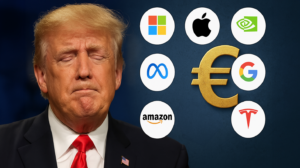
Europe's digital tribute
Technology giants as profit machines
American technology companies have become the most profitable players in transatlantic economic relations. Meta generates 62 percent of its total revenue outside the US, while for Apple it's 57 percent. In 2024, Alphabet generated around $100 billion in revenue in the Europe, Middle East, and Africa region alone, representing almost a third of its global revenue of $350 billion.
These revenues flow primarily from digital advertising, cloud computing services, software licenses, and app store fees. European consumers and businesses pay for the use of American platforms without any physical goods crossing the border. These intangible trade flows do not appear in traditional commodity trade statistics, but they form the backbone of American economic power in the 21st century.
The profitability of these business models far surpasses that of traditional industrial production. While European automakers struggle with margins of three to eight percent, the major tech companies generate operating margins of 25 to 40 percent. The scalability of digital services allows American companies to serve ever-larger markets with relatively little additional effort.
The regulatory counterattack
The European Union has responded to this digital dominance with an unprecedented regulatory push. The Digital Services Act and the Digital Markets Act aim to curb the power of the tech giants. In the first year after the DSA came into force, the European Commission initiated over 60 enforcement proceedings, including 13 against TikTok, eight against Meta, and five against X. The fines imposed total billions: In 2024 alone, Apple had to pay over €1.8 billion, while Meta and LinkedIn together paid €1.1 billion. Google was hit with a record fine of almost €3 billion.
These regulatory measures are more than mere policy. They represent a structural conflict over the distribution of economic rents in the digital economy. The American government views the European regulations as discriminatory non-tariff trade barriers. The Trump administration explicitly threatened retaliation and published a list of European service companies that could be affected by fees and restrictions, including SAP, DHL, Siemens, and Spotify.
However, the European Union has effective tools for counterattacks. The so-called Anti-Coercion Instrument allows for restrictions on licenses for American services or limitations on intellectual property rights. A Europe-wide digital tax is also under discussion, which would specifically target the advertising revenues of tech giants. France, Austria, Italy, and Spain have already introduced national digital service taxes, which together generated $1.5 billion in revenue in 2023 – primarily from American companies.
The asymmetry of mutual dependence
Investment flows as a strategic foundation
Focusing solely on trade balances overlooks far more significant investment relationships. At the end of 2022, the United States held $4 trillion in foreign direct investment in Europe—61.2 percent of total global US foreign direct investment and 21 times greater than American investment in China. Conversely, European foreign direct investment in the US totaled $3.4 trillion, representing 62 percent of all foreign capital invested in the US.
These reciprocal investment levels illustrate the depth of transatlantic economic interdependence. The sales of European subsidiaries of American companies were estimated at $800 billion in 2022, while American subsidiaries of European corporations generated $730 billion in sales. This combined output of $1.53 trillion far exceeds total bilateral trade in goods.
Investment relationships create structural interdependencies that extend far beyond short-term trade flows. American companies employ millions of workers in Europe and are firmly established in strategic sectors such as pharmaceuticals, automotive, mechanical engineering, and IT services. European corporations, in turn, are deeply integrated into the American market, particularly in the chemical, automotive, financial services, and consumer goods sectors.
The sectoral triad under pressure
Three industries dominate German-American trade and exemplify European export strength: automotive, machinery, and pharmaceuticals. These sectors together accounted for more than two-thirds of the decline in German exports to the US in 2025. Automotive exports plummeted by 17.5 percent, reaching only €26.9 billion in the first eleven months of 2025. Machinery exports fell by 9 percent to €24 billion. Only the pharmaceutical industry showed resilience, with slight growth of 0.7 percent to €26.2 billion.
The pharmaceutical industry vividly illustrates the strategic importance of the American market for Europe. In 2024, the EU exported pharmaceutical products worth €119.8 billion to the US, representing 38.2 percent of all European pharmaceutical exports outside the EU. The European trade surplus in pharmaceuticals reached a record high of €193.6 billion in 2024. The 15 percent tariffs on innovative medicines agreed upon in the trade agreement of July 2025 – while generics remain exempt – will result in estimated additional annual costs of €18 to €19 billion for the European pharmaceutical industry.
The automotive industry faces an existential challenge. In 2024, the EU exported approximately 750,000 vehicles worth €38.5 billion to the US, while conversely, only 165,000 American vehicles worth €7.7 billion entered Europe. The reduction of tariffs from the original 27.5 percent to 15 percent under the trade agreement offers only limited relief, as the burden is still six times higher than before the Trump era, when the rate was 2.5 percent. German premium manufacturers such as BMW, Mercedes-Benz, and Volkswagen, which maintain significant production capacity in Germany and export from there to the US, bear the brunt of this situation.
The mechanical engineering sector, traditionally the backbone of Germany's export economy, is struggling with the impact of the 50 percent tariffs on steel and aluminum, which affect roughly half of all machinery exports to the US. The bureaucratic requirements to document the metal content and origin of every component, down to the last screw, create additional friction. Only the fact that many German machine manufacturers offer highly specialized products with little American competition allows them to pass on a significant portion of the tariff costs to their customers.
Our US expertise in business development, sales and marketing

Our US expertise in business development, sales and marketing - Image: Xpert.Digital
Industry focus areas: B2B, digitalization (from AI to XR), mechanical engineering, logistics, renewable energies and industry
More information here:
A thematic hub offering insights and expertise:
- Knowledge platform covering global and regional economies, innovation and industry-specific trends
- A collection of analyses, insights, and background information from our key areas of focus
- A place for expertise and information on current developments in business and technology
- A hub for companies seeking information on markets, digitalization, and industry innovations
Europe's digital bazooka: How the EU could severely impact America's tech giants
The macroeconomic illusion of the trade balance
The Savings-Investment Paradox
The American trade balance reflects less unfair foreign practices than fundamental macroeconomic imbalances within the US itself. Since 1976, the United States has systematically invested more than it has saved. Between 1976 and today, investment has averaged 21.7 percent of gross domestic product, while the national savings rate has been only 19.1 percent. This gap of 2.6 percentage points is reflected almost identically in the current account deficit.
The US current account deficit amounted to $1.13 trillion in 2024, equivalent to 3.9 percent of GDP. In the third quarter of 2025, the deficit decreased to $226.4 billion, after peaking at $450.2 billion in the first quarter. These fluctuations reflect temporary effects of the announced tariffs, which led to accelerated imports, but not a structural trend reversal.
The economic equation S = I + NX (national savings = investment + net exports) illustrates that a trade deficit is the flip side of a funding gap between savings and investment. As long as the US invests more than it saves, it must finance the difference with foreign capital. The trade deficit is not the cause, but rather a symptom of this situation. Tariffs cannot override this fundamental equilibrium condition. They merely increase the cost of imports and shift trade flows without altering the underlying savings-investment dynamic.
The Trump administration never proposed policies that would either increase the savings rate or reduce investment. On the contrary, tax cuts and incentives for domestic investment widen the savings-investment gap and, consequently, the trade deficit. The dream of a double surplus—a shrinking budget deficit and a diminishing trade deficit—is unattainable without a drastic increase in the private savings rate or a collapse in investment activity. Both would be economically undesirable.
Related to this:

The allure of the dollar system
The United States benefits from a structural advantage that not only explains the trade deficit but also allows it to be interpreted as an expression of economic strength: the status of the US dollar as the dominant global reserve currency. Global investors view American assets—government bonds, corporate stocks, real estate—as a safe haven. This sustained demand for dollar-denominated assets leads to permanent capital inflows, which manifest themselves in the balance of payments as a mirror-image deficit in the current account.
Billions of dollars in foreign savings flow into the US for investment. These capital inflows not only finance the trade deficit but also enable the US to invest beyond its own savings capacity. The international financial system is based on an offshore dollar market, the so-called Eurodollar system, whose volume is estimated at over 75 trillion US dollars. Of this, 11.4 trillion US dollars comprise the core of the system in the form of loans and bonds, while 64.4 trillion US dollars are attributable to offshore dollar derivatives.
These figures illustrate that global demand for US dollars far exceeds what is generated by American foreign trade alone. The US does not need to supply the world with dollars through trade deficits – the global financial system creates dollar liquidity on a far greater scale through credit creation and derivatives markets. The so-called Triffin dilemma, according to which the US must inevitably generate current account deficits to supply the world with reserve currency, is proving to be obsolete.
Retaliation options and strategic dilemmas
Europe's underestimated leverage
The European Union possesses an arsenal of countermeasures that extends far beyond traditional retaliatory tariffs. While a prepared list of retaliatory tariffs on €93 billion worth of American goods is ready, measures in the digital sphere could prove far more effective. The threat or enforcement of restrictions in the services sector hits the US where its comparative advantages are greatest.
The EU's anti-coercion instrument, also known as the "trade bazooka," has never been activated, but it could restrict licenses for American services, exclude US companies from public contracts, or block investments by American tech giants in Europe. Specific targets could include app stores, cloud services, and the use of European data by American platforms. An EU-wide digital tax on advertising revenue would directly affect Meta, Google, and other tech giants that generate the majority of their revenue from digital advertising.
Stricter enforcement of existing regulations offers another lever. The European Commission could intensify ongoing investigations against X, Meta, Google, Amazon, and Microsoft and rigorously collect the fines imposed. The Trump administration's threat to impose fees and restrictions on European service companies demonstrates that Washington is well aware of the vulnerability of its own service sector.
The limits of protectionism
Trump's tariff policy is based on the assumption that trade flows can be politically controlled without considering the underlying economic structures. Experience from his first term fundamentally contradicts this hope. Between 2017 and 2020, the American trade deficit rose from $513 billion to $679 billion, despite Trump imposing aggressive tariffs. These punitive tariffs cost American households an estimated $1,000 per year without generating any significant economic benefits.
Tariffs make imported goods more expensive, thereby increasing the production costs of American companies that rely on imported intermediate goods. Passing these costs on to end consumers fuels inflation. At the same time, the fundamental savings-investment gap remains unchanged, so the trade deficit persists or merely shifts geographically. Countries affected by US tariffs could redirect goods originally intended for the American market to Europe, intensifying competition for European producers.
The unpredictability of American trade policy creates investment uncertainty that burdens both sides of the Atlantic. The threat of 10 percent tariffs from February 2026 and 25 percent tariffs from June against eight European countries for their alleged obstruction on the Greenland issue illustrates how trade policy is being instrumentalized for geopolitical purposes. This conflation of economic and security policy motives fundamentally undermines trust in rules-based trade relations.
The structural transformation of transatlantic relations
From goods flows to data flows
The future of transatlantic economic relations will be determined less by container ships carrying automobiles than by fiber optic cables carrying data streams. Trade in digital services is growing rapidly, having almost tripled between 2014 and 2024. This development reflects the increasing digitalization of business models and the decreasing costs of information and communication technologies.
The dominance of American technology companies in this sector is overwhelming. The seven largest US tech companies – Alphabet, Amazon, Apple, Meta, Microsoft, Nvidia, and Tesla – together have a market capitalization of over 12 trillion US dollars. The seven largest European tech companies combined have a market capitalization of only 705 billion US dollars – a difference of 20 times. This gap is directly reflected in the transatlantic services balance.
Europe faces a strategic decision: whether to continue paying digital tribute to American platforms or to build its own digital champions. Previous efforts to establish European alternatives have met with limited success. While the search engine Ecosia saw a 27 percent increase in search queries from the EU and achieved a one percent market share in Germany, these 122 million visits pale in comparison to Google's 10.3 billion. The structural advantages of the established platforms—network effects, data monopolies, and economies of scale—make catching up extremely difficult.
Investment dependency as an anchor of stability
Despite all trade tensions, mutual investment interdependence provides an anchor of stability. European companies have invested 2.4 trillion US dollars in the USA, while American corporations, conversely, maintain production capacities and distribution networks in Europe worth 4 trillion US dollars. These investment portfolios create long-term strategic ties that cannot be easily severed.
A trade war would not only hinder cross-border trade but also jeopardize the profitability of these reciprocal investments. American automakers like Ford and General Motors produce significant portions of their European sales within Europe itself. European corporations such as Siemens, SAP, BASF, and Volkswagen are deeply integrated into the American market. The threat of dismantling these structures acts as a mutual deterrent.
Interestingly, recent data shows an increased trend among European industrial companies toward acquiring American production capacity. In the last six months of 2025, interest among European industrial groups in acquiring American manufacturing companies with revenues between $2 million and $20 million rose significantly. The motivation is clear: Owning production capacity within the US secures market access and avoids tariff risks. At the same time, European buyers can contribute their technological expertise and modern production methods to modernize often underinvested American operations.
This strategy reverses the traditional trend. While in past decades American corporations acquired European companies to gain access to the EU single market, European firms are now seeking protection from tariffs by purchasing American production facilities. The irony of this development is that Trump's tariff policy is achieving precisely what it promises – not by relocating American companies back to the US, but by shifting European production to the US while retaining European ownership.
The reorganization of economic policy priorities
Germany's export-driven vulnerability
The German economy exemplifies the vulnerability of a growth model focused on export surpluses. Between January and November 2025, German exports to the US shrank by 9.4 percent to €135.8 billion, while imports from the US rose by 2.2 percent to €86.9 billion. Germany's trade surplus with the US fell to €48.9 billion in the first eleven months of 2025 – the lowest figure since the pandemic year of 2021 and a decline of almost a quarter compared to the record surplus of €64.8 billion in the same period of 2024.
This development is all the more remarkable given that the USA has become the most important market for German products in recent years. The strong dependence on a single market, now characterized by unpredictable trade policies, reveals the fragility of the German business model. At the same time, Germany is struggling with weakening demand from China, where domestic competitors have caught up technologically in key sectors such as automotive and mechanical engineering.
The solution cannot lie in hoping for a return to the old ways. Instead, Germany—and with it the entire European Union—must restructure its growth model towards stronger domestic demand. A significant increase in public and private investment in infrastructure, digitalization, climate protection, and education would not only stimulate domestic demand but also boost import demand, thereby contributing to a reduction in external imbalances. This would not be a capitulation to Trump, but a long overdue step towards a more balanced and sustainable growth path.
The illusion of decoupling
Some voices in Europe are calling for a strategic decoupling from the US, or at least a drastic reduction in economic dependencies. This position overlooks the depth of transatlantic ties. With a combined gross domestic product of over 40 percent of the global economy and nearly a third of international trade, the US and the EU together form the core of the global economic order. Decoupling would be economically devastating for both sides.
The mutual dependence is asymmetrical, but reciprocal. For the US, Europe represents a large sales market and industrial partner – a commercial dependence. For Europe, the dependence is operational, technological, and security-critical. This asymmetry gives Washington structural influence, regardless of who is president. But the US cannot afford to lose the European market, and Europe cannot easily forgo American technologies, security guarantees, and capital flows.
The strategic answer lies neither in unconditional submission nor in illusory autarky, but in strengthening our own negotiating position through targeted investments in European capacities. The Mario Draghi report on the future of European competitiveness clearly identified the shortcomings: insufficient investment in research and development, fragmented markets, bureaucratic obstacles to innovation, and structural underfunding of growth companies. Closing the funding gap for European scale-ups, estimated at US$375 billion over ten years, would reduce dependence on American venture capital.
The return of geopolitics to economic policy
The Trump era marks the transition from a rules-based international economic order to a transactional trade policy shaped by power politics. The conflation of trade issues with geopolitical concerns—from the Greenland question to NATO spending and support for Taiwan—demonstrates that economic policy has once again become an instrument for projecting national power.
Europe must adapt to this new reality. The idea that compromise and economic cooperation can keep it out of geopolitical conflicts is obsolete. The European Union will be forced to strategically deploy its own economic leverage – not out of aggression, but out of self-preservation. Digital sovereignty, securing critical supply chains, diversifying trade relations, and building its own technological capacities are no longer mere technocratic projects, but prerequisites for political action.
Transatlantic economic relations will continue to form the backbone of the Western economic order. However, the illusion of harmonious trade based on shared values has given way to a pragmatic pursuit of self-interest. Europe can only meet this challenge if it recognizes and leverages its own strengths – and if it is prepared to pay the price for greater independence. The debate about trade deficits distracts from this fundamental strategic question. The real conflict revolves around control of the value chains and data flows of the digital future.
Your global marketing and business development partner
☑️ Our business language is English or German
☑️ NEW: Correspondence in your native language!

Konrad Wolfenstein
I and my team are happy to be available to you as your personal advisor.
You can contact me by filling out the contact form here wolfenstein@xpert.digital:or simply call me at +49 7348 4088 965. My email address is
I'm looking forward to our joint project.
☑️ SME support in strategy, consulting, planning and implementation
☑️ Creation or realignment of the digital strategy and digitization
☑️ Expansion and optimization of international sales processes
☑️ Global & Digital B2B trading platforms
☑️ Pioneer Business Development / Marketing / PR / Trade Fairs
🎯🎯🎯 Benefit from Xpert.Digital's extensive, five-fold expertise in one comprehensive service package | BD, R&D, XR, PR & Digital Visibility Optimization

Benefit from Xpert.Digital's extensive, five-fold expertise in a comprehensive service package | R&D, XR, PR & Digital Visibility Optimization - Image: Xpert.Digital
Xpert.Digital possesses in-depth knowledge across various industries. This allows us to develop tailored strategies precisely aligned with the requirements and challenges of your specific market segment. By continuously analyzing market trends and monitoring industry developments, we can act proactively and offer innovative solutions. The combination of experience and expertise generates added value and provides our clients with a decisive competitive advantage.
More information here: