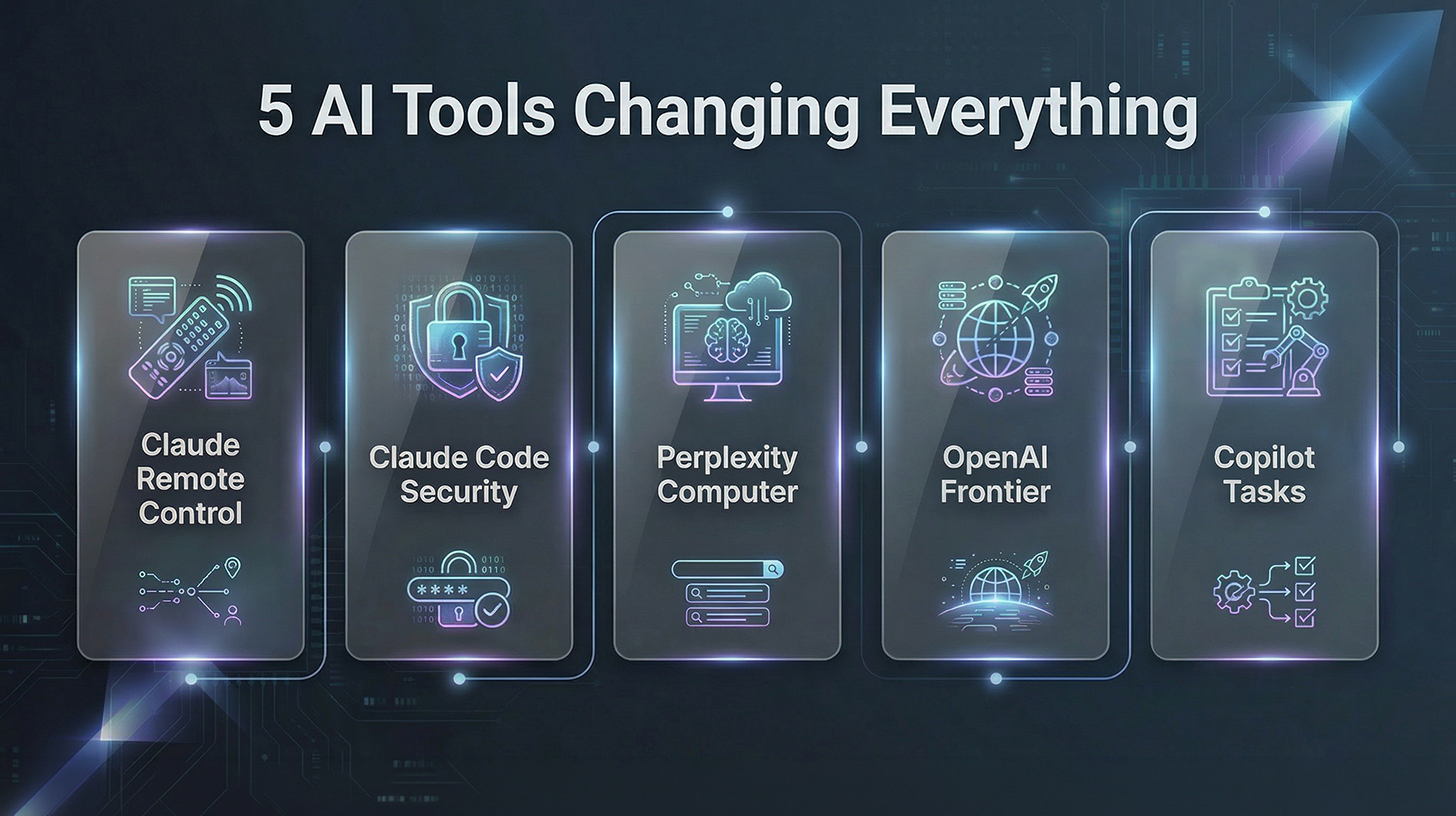
New: Claude Remote Control, Claude Code Security, Perplexity Computer, OpenAI Frontier and Microsoft Copilot Tasks – Image: Xpert.Digital
Your new digital colleague: How Microsoft, OpenAI & Co. are completely revolutionizing the world of work
The end of the SaaS era? Why these 5 new AI releases are causing panic in the software world
The era of simple chatbots is over; the age of autonomous digital colleagues has begun. Within just a few days, tech giants Anthropic, Perplexity, OpenAI, and Microsoft unveiled five groundbreaking products that herald a fundamental paradigm shift. With Claude Remote Control, Claude Code Security, Perplexity Computer, OpenAI Frontier, and Microsoft Copilot Tasks, artificial intelligence is taking the decisive step from passive information source to active workforce. These new AI agents no longer simply wait for prompts to answer questions; they independently orchestrate complex workflows, make preliminary decisions, uncover hidden security vulnerabilities, and operate computers in a way that previously only humans could.
Behind these product announcements lies far more than a technological update – it's the beginning of an industrial revolution of enormous proportions. While the major cloud and AI infrastructure providers are pumping nearly $700 billion into new data centers for 2026 alone, the traditional software industry is already faltering. The established Software-as-a-Service (SaaS) model and user-based licenses are rapidly losing value when a single AI agent can perform the work of ten human employees.
This analysis examines the five revolutionary AI tools in detail, compares their strengths, and assesses their massive economic impact. It reveals why the global software market is facing its greatest disruption since the invention of cloud computing and who will win the strategic race for the digital infrastructure of the next decade. The real revolution begins right now – and it will leave no company untouched.
February 2026: The month when AI stopped talking and started working
February 2026 marks a tectonic shift in the history of artificial intelligence. Within just a few days, five technology companies unveiled products that share a common denominator: AI ceases to merely answer questions and begins to independently execute tasks, prepare decisions, and orchestrate entire workflows. The products are called Claude Remote Control, Claude Code Security, Perplexity Computer, OpenAI Frontier, and Microsoft Copilot Tasks. Behind these brand names lies an economic paradigm shift that fundamentally alters the relationship between human labor, software, and value creation. This analysis categorizes each of these tools, assesses its economic leverage, and explores what the simultaneous release of these systems reveals about the state of the global AI market.
The market for AI agents was estimated at around $7.84 billion in 2025 and is projected to grow to over $52 billion by 2030, representing an annual growth rate of approximately 46 percent. Gartner forecasts that by the end of 2026, around 40 percent of all enterprise applications will have integrated task-specific AI agents, an eightfold increase from less than five percent in 2025. The five major US cloud and AI infrastructure providers—Microsoft, Alphabet, Amazon, Meta, and Oracle—have announced collective capital expenditures of between $660 billion and $690 billion for 2026, nearly double the previous year's figure. Against this backdrop, the five February releases are not isolated product announcements but rather harbingers of an industry revolution that will affect every business.
Your office in your pocket: How Claude Remote Control blurs the line between workplace and mobility
Anthropic has introduced Claude Code Remote Control, a feature that allows users to control an AI agent running locally on their own machine from any device, be it a smartphone, a tablet, or a web browser on another computer. The crucial aspect of this architecture is that no data is transferred to the cloud. The project files, MCP server, tools, and configurations remain entirely on the local machine. The web and mobile interfaces are simply a window into this local session.
This concept differs fundamentally from conventional cloud-based AI usage. While Claude Code on the Web runs on Anthropic's infrastructure and offers no access to the local environment, Remote Control connects the mobile device to a session that remains active on the user's computer. This means that an engineer can start a complex code analysis on their workstation in the morning, provide further instructions via their smartphone while en route to a client meeting, and present the results at the client meeting, all without sensitive company data ever leaving the company network.
The economic relevance of this approach lies less in a spectacular new capability than in eliminating one of the most persistent productivity barriers in modern knowledge work: context interruption. Studies have shown for years that switching between devices, environments, and work states incurs significant cognitive costs. Claude Remote Control reduces this friction to a minimum because the AI agent continues working in the background while the user changes their physical location.
The feature is available to users of the Claude Pro and Claude Max plans. Remote MCP servers are supported on Claude and Claude Desktop for Pro, Max, Team, and Enterprise plans, and since July also on iOS and Android. For companies that work with sensitive data, such as in the financial, healthcare, or defense industries, local data storage is not just a feature, but a mandatory requirement. Claude Remote Control provides an architecture that reconciles regulatory requirements with AI productivity.
Anthropic's business performance underscores the strong demand for such developer tools. Claude Code achieved annualized revenue of over $2.5 billion in February 2026, more than double its revenue since the beginning of the year. Business subscriptions quadrupled during the same period. Anthropic's total annual revenue, based on the current subscriber rate, is $14 billion, with a company valuation of over $30 billion following its recent Series G funding round. These figures indicate that developer tools represent the fastest-growing segment in the entire AI market.
When the machine finds the attacker before he strikes: Claude Code Security and the end of rule-based vulnerability scanning
On February 21, 2026, Anthropic introduced Claude Code Security, a capability built directly into Claude Code on the web that scans codebases for vulnerabilities. What fundamentally distinguishes this feature from traditional static analysis tools is that Claude Code Security doesn't perform pattern matching; instead, it reads and understands the code contextually. It traces data flows throughout the entire application, understands the business logic, and recognizes how different components interact.
The results of this approach are remarkable. Anthropic's internal Frontier Red team applied the Claude Opus 4.6 model to production open-source codebases and identified more than 500 high-grade vulnerabilities that had gone undetected despite decades of expert review and millions of hours of automated fuzz testing. Each finding underwent internal and external security review before disclosure was initiated. Claude filtered, deduplicated, and reprioritized its own results before human researchers even saw the findings.
The methodology differs structurally from anything traditional scanners can do. Instead of generating random inputs, Claude read old code, recognized patterns in previous bug fixes, and discovered that the same bug existed in another, never-before-checked part of the program, and then proved it. Human reviewers had missed it. Automated scanners had missed it. Claude deduced it through logical reasoning.
Each finding undergoes a multi-stage verification process. Claude re-examines his own findings, attempting to confirm or refute them to filter out false positives. Each finding is assigned a severity level so teams can focus on the most critical issues. Validated findings appear in a dashboard where teams can review them, inspect the suggested patches, and approve or reject fixes. Nothing is applied without human approval.
The economic leverage of this technology can be seen in several dimensions. According to IBM, the average cost of a data breach recently exceeded four million US dollars. Companies invest six- to seven-figure sums annually in their vulnerability management stacks. The ability to find vulnerabilities with a single AI model that human researchers and traditional tools have missed for decades challenges the entire cost structure of cybersecurity. Security directors are likely to be confronted at the next board meeting with the question of how they can deploy reasoning-based scanning before attackers do.
Claude Code Security is currently available in a limited research preview for Enterprise and Team customers. Open-source maintainers can request accelerated free access. For now, scanning is restricted to code owned by the company for which all necessary permissions have been granted.
19 models, one client: How Perplexity Computer is reinventing the division of labor in AI
On February 25, 2026, Perplexity unveiled Computer, an autonomous multi-agent system that transforms a single prompt into a structured, autonomous workflow capable of running for hours or even months. The system breaks down a high-level goal into structured subtasks, assigns each to a specialized AI agent, and selects the optimal model for execution.
Multi-model orchestration makes this computer a market first. The system utilizes 19 different AI models simultaneously: Anthropic's Claude Opus 4.6 for deep reasoning and structured analysis, OpenAI's GPT-5.2 for long-context queries and web search, Google Nano Banana for image generation, Veo 3.1 for video production, and Grok for lightweight, fast processing. This principle of using the best model for each subtask maximizes accuracy, efficiency, and contextual intelligence across various task types.
The design principle behind computers is based on specialized intelligence rather than raw computing power. Instead of routing every request through a single monolithic model, the agent dynamically selects the most suitable model from its arsenal of 19. The analogy to a well-run agency that assigns different specialists to different parts of a project is compelling, except that here the delegation happens at machine speed.
In practical terms, this means that a user can enter an instruction such as creating a competitive analysis of the three main competitors with recommendations for action, and the system works autonomously. It researches, analyzes, creates documents, and coordinates the various subtasks without requiring human intervention. Tasks that currently take a junior analyst two days could potentially be completed in hours.
Availability is limited to Perplexity Max, a $200 per month plan. The technical implications are significant. For Computer 19 to effectively coordinate different models, Perplexity must have developed robust internal APIs, sophisticated routing logic, and advanced monitoring infrastructure. This kind of invisible but performance-critical infrastructure represents a maturing layer of agent deployment architecture. Platforms that can reliably orchestrate specialized models will maintain a disproportionate advantage in the ecosystem.
The strategic importance of Perplexity Computer extends beyond the individual product. It validates the thesis that the future of AI does not lie in a single superior model, but in the intelligent orchestration of many specialized models. Perplexity's own research has shown that its users frequently switch between models: In December 2025, visual output was most often sent to Gemini Flash, software engineering to Claude Sonnet 4.5, and medical research to GPT-5.1.
The digital workforce is taking shape: OpenAI Frontier as an operating system for AI employees
In early February 2026, OpenAI unveiled Frontier, an end-to-end platform designed to treat AI agents like human employees, complete with its own identity management, onboarding processes, and the ability to continuously improve through feedback loops. The concept goes far beyond a single chatbot or API tool. Frontier is a complete enterprise solution built on OpenAI's most advanced models, including the GPT-5 series, but complemented by the surrounding infrastructure for real-world business use.
The platform is based on four core capabilities: a shared business context that connects CRM systems, data warehouses, and internal applications; an execution environment where agents can plan and act; built-in evaluation and optimization that improves quality over time; and an identity and governance system with clear permissions and boundaries. OpenAI describes Frontier as a semantic layer for the enterprise, a unified platform that empowers AI agents to navigate enterprise software, execute workflows, and make decisions across an organization's entire technology stack.
The list of early customers and partners is particularly revealing. Early adopters include Uber, State Farm, Intuit, Thermo Fisher, HP, and Oracle, while BBVA, Cisco, and T-Mobile have already conducted pilot projects using the Frontier approach. On the partner side, OpenAI has established Frontier Alliances with McKinsey, Boston Consulting Group, Accenture, and Capgemini. These consulting firms are investing in dedicated practice groups and building teams certified in OpenAI technology. OpenAI's own Forward Deployed Engineers work directly alongside these consulting teams on client projects.
The division of labor between the partners is clearly defined. BCG and McKinsey primarily position themselves as strategy and operating model partners, supporting leadership teams in deciding where and how to deploy agents at scale. Accenture and Capgemini assume the role of end-to-end systems integrators, focusing on data architecture, cloud infrastructure, and the complex task of connecting Frontier with the companies' existing systems.
The economic implications are far-reaching. Frontier poses a direct challenge to established SaaS providers like Salesforce, ServiceNow, and Microsoft. When the world's largest consulting firms actively promote an alternative platform to top executives, the balance of power in the enterprise software market shifts fundamentally. The software sector has already lost approximately two trillion US dollars in market capitalization between January and February 2026, as AI agents threaten the core business models of the SaaS industry. Seat-based pricing models, the backbone of SaaS monetization, come under pressure when one AI agent can perform the work of ten human users.
OpenAI CEO Sam Altman has positioned Frontier as an attempt to bridge the gap between what AI models can do and what companies can reliably deploy in production. McKinsey's Global Managing Partner Bob Sternfels commented that CEOs must transform their companies, innovate domains, and develop their workforce to unlock the value of agent-based AI. BCG CEO Christoph Schweizer emphasized that AI transformation must be aligned with strategy, integrated into redesigned processes, and scaled effectively.
A new dimension of digital transformation with 'Managed AI' (Artificial Intelligence) - Platform & B2B solution | Xpert Consulting
A new dimension of digital transformation with 'Managed AI' (Artificial Intelligence) – Platform & B2B solution | Xpert Consulting - Image: Xpert.Digital
Here you will learn how your company can implement customized AI solutions quickly, securely and without high entry barriers.
A managed AI platform is your all-inclusive, worry-free solution for artificial intelligence. Instead of dealing with complex technology, expensive infrastructure, and lengthy development processes, you receive a ready-made solution tailored to your needs from a specialized partner – often within just a few days.
The key advantages at a glance:
⚡ Rapid implementation: From idea to ready-to-use application in days, not months. We deliver practical solutions that create immediate added value.
🔒 Maximum data security: Your sensitive data stays with you. We guarantee secure and compliant processing without sharing data with third parties.
💸 No financial risk: You only pay for results. High upfront investments in hardware, software, or personnel are completely eliminated.
🎯 Focus on your core business: Concentrate on what you do best. We take care of the entire technical implementation, operation, and maintenance of your AI solution.
📈 Future-proof & scalable: Your AI grows with you. We ensure continuous optimization and scalability, and flexibly adapt the models to new requirements.
More information here:
No coincidence: Why 5 tech giants are simultaneously reinventing the future of work
The autonomous to-do list: How Microsoft Copilot Tasks aims to revolutionize the daily lives of millions of knowledge workers
On February 26, 2026, Microsoft unveiled Copilot Tasks, marking the company's most ambitious foray into the world of autonomous AI agents. The core idea is radically simple: The user describes their needs in natural language. Copilot creates a plan and gets to work. The system operates in the background, using its own cloud-based computer and browser, coordinating various apps and services, and reporting back when the task is complete.
The technical architecture fundamentally distinguishes Copilot Tasks from traditional automation tools. Instead of relying on simple scripts or API integrations, Copilot Tasks utilizes a cloud PC infrastructure—a virtualized Windows machine in the cloud. When a user assigns a task, the AI agent starts a secure, private cloud session. In this environment, it interacts with software interfaces just like a human: It opens a web browser, navigates to third-party websites, logs in, and manipulates screen elements.
This UI automation approach allows Copilot Tasks to work with legacy applications and websites that lack modern APIs, significantly expanding the range of tasks that can be automated. The difference from the previous Copilot is clear: while the traditional Copilot relied on conversational chat, API usage, and text generation with synchronous user participation, Copilot Tasks uses background execution, UI automation, and cloud computing, operating asynchronously and designed for long-term, multi-stage goals.
Specific use cases range from recurring routine tasks to complex logistics scenarios. Copilot Tasks can highlight urgent emails with draft replies every evening and automatically unsubscribe from promotional emails that are never opened. It can create Monday briefings about important meetings and travel. It can transform a syllabus into a complete learning plan with practice tests. It can monitor hotel rates and automatically rebook when prices drop. It can manage subscriptions and cancel unused ones.
Microsoft has implemented a strict human-in-the-loop governance model to minimize the risk of hallucinatory actions. The system is programmed to pause significant actions, such as spending money or sending messages, and explicitly request user consent. Users can pause or cancel any AI task at any time.
Copilot Tasks is currently in a limited research preview with a public waitlist. Microsoft's AI chief, Mustafa Suleyman, described the launch by saying that AI talks less and does more. The fact that Microsoft designed this product for all users, not just developers, signals that the company wants to move agentic AI from the niche of technical power users into the mainstream of office work. Given the hundreds of millions of users in the Microsoft 365 ecosystem, Copilot Tasks could be the AI technology that achieves the broadest market penetration most quickly.
Economic Tectonics: Why Five Simultaneous Releases Are No Coincidence
The near-simultaneous release of these five products within just a few days is no coincidence, but rather the result of converging market dynamics that have gripped the entire AI sector. The investment figures alone tell the story: The five largest US technology companies are collectively planning between $660 billion and $690 billion in capital expenditures in 2026, the majority of which will go toward AI data centers, GPUs, and network infrastructure. Reuters, citing Bridgewater, reports that Big Tech will invest around $650 billion in AI in 2026. According to Gartner data, total global AI spending will reach around $2 trillion in 2026, with over half of that going toward infrastructure.
These massive investments require products that justify them. The five February releases do just that: they transform infrastructure investments into marketable offerings. Anthropic's Claude Code alone already generates $2.5 billion in annualized revenue. OpenAI reaches a total annual rate of $14 billion. Microsoft notes that its AI business is already larger than some of its more established franchises. Amazon Web Services alone achieved $142 billion in annualized revenue, with a growing AI share.
Adoption rates in companies confirm that the demand is real. According to Salesforce's State of Integration and AI Report 2026, 83 percent of organizations report that most or all teams have adopted AI agents, with an average of twelve agents per organization and a projected growth of 67 percent by 2027. However, 50 percent of these agents still operate in silos rather than integrated multi-agent systems. 79 percent of organizations report having adopted AI agents in some form. 57 percent are already using AI agents for multi-stage workflows, with 16 percent running cross-functional processes across multiple teams.
A recent analysis by the Boston Consulting Group predicts that agentic AI will unlock up to $200 billion in new net value in the technology services sector within the next five years. Companies expect agentic AI to deliver productivity improvements of 30 to 40 percent, while most providers are currently only committing to 6 to 15 percent. Service providers anticipate a shrinking of the delivery pyramid by 10 to 20 percent in the next 24 months as agentic AI becomes integrated into workflows.
Five products compared to the competition: Where their strengths and weaknesses lie
| Characteristic | Claude Remote Control | Claude Code Security | Perplexity Computer | OpenAI Frontier | Microsoft Copilot Tasks |
|---|---|---|---|---|---|
| Provider | Anthropic | Anthropic | Perplexity | OpenAI | Microsoft |
| core function | Cross-device AI control | AI-based security analysis | Multi-model orchestration | Enterprise AI agent platform | Autonomous task execution |
| Target audience | Developers, technical users | Security teams, developers | Knowledge workers, analysts | large companies | All Office users |
| Data storage | Local | Cloud (GitHub integration) | Cloud (Sandbox) | Enterprise Cloud | Microsoft Cloud PC |
| Availability | Pro and Max | Enterprise and Team (Preview) | Max ($200 per month) | Limited Access | Research Preview (Waiting List) |
| Degree of autonomy | remote control | Scan and suggestion | Fully autonomous workflows | Agent management | Background execution |
| Human control | Complete | Patch approval required | Checkpoints | Governance system | Approval for important actions |
Several leading technology companies are developing new AI applications that differ significantly in function, target group, and level of autonomy.
Anthropic offers two specialized solutions. Claude Remote Control is aimed at developers and technical users, enabling cross-device AI control while keeping data local. The user retains full control, as it is purely remote. This tool is available in the Pro and Max plans. In contrast, Claude Code Security focuses on security teams and developers. It performs AI-based security analyses, processing data in the cloud via a GitHub connection. The system scans code and makes suggestions, but human approval is required to apply patches. This feature is currently in preview for Enterprise and Team customers.
Perplexity introduces the Perplexity Computer, a solution for knowledge workers and analysts. Its core feature is multi-model orchestration, enabling fully autonomous workflows in a cloud sandbox. Human oversight is ensured through checkpoints. The service is available in the Max plan for $200 per month.
OpenAI is developing OpenAI Frontier, an enterprise AI agent platform for large companies. The focus is on managing AI agents in an enterprise cloud environment. A comprehensive governance system ensures human oversight. Access is currently restricted to "Limited Access".
Microsoft is expanding its portfolio with Microsoft Copilot Tasks, which is aimed at all Office users. It executes tasks autonomously in the background, with the data stored on a Microsoft cloud PC. User consent is obtained for critical actions. The tool is currently available as a Research Preview, for which you can join a waiting list.
The disruption of the SaaS model: Why the software industry is facing its biggest upheaval since the cloud
The five February releases are accelerating a development that is shaking up the entire Software-as-a-Service (SaaS) industry. The software sector lost approximately two trillion US dollars in market capitalization between January and February 2026, as AI agents threaten the core business models of the SaaS industry. The fundamental problem for SaaS providers is that AI agents can take over tasks that previously required dedicated software tools, from project management and CRM updates to customer support triage and meeting scheduling.
The industry's pricing models are under immense pressure. Seat-based licensing, the backbone of SaaS monetization for decades, is losing its logic when an AI agent performs the work that previously required ten human users. Salesforce customers are already reducing their seat count by ten percent due to the efficiency of Einstein AI. The share of seat-based pricing models fell from 21 to 15 percent within a year, while hybrid models rose to 41 percent. Companies like Intercom have proactively switched to usage-based pricing, $0.99 per AI-resolved ticket, and have seen a 40 percent increase in adoption with stable margins.
Gartner predicts that by 2035, agentic AI could account for roughly 30 percent of enterprise software revenue, more than $450 billion—a dramatic increase from just two percent in 2025. By 2030, Gartner expects 35 percent of SaaS point products to be absorbed into larger agent ecosystems or completely replaced by AI agents. By 2028, 90 percent of all B2B purchases are projected to be facilitated by AI agents, channeling over $15 trillion in B2B spending through AI agent exchange platforms.
Deloitte predicts that by 2026, SaaS applications will become smarter, more personalized, adaptive, and autonomous, evolving into a federation of real-time workflow services that can learn from their experiences. This creates four strategic imperatives for SaaS companies: proactively cannibalize their own product base before competitors do; move beyond seat licensing to outcome-based or consumption-based models; build a trust infrastructure with security, auditability, and human-in-the-loop controls; and leverage proprietary data to create defensible AI capabilities.
The productivity boost and its price: What the economy expects
The macroeconomic implications of the agentic AI revolution are unprecedented in their potential scale. McKinsey estimates that generative AI alone could add $2.6 to $4.4 trillion in economic value annually, with 75 percent of that value generated in just four areas: customer operations, marketing and sales, software engineering, and research and development. When considering the broader integration of generative AI into existing software, the overall economic impact could double to $6.1 to $7.9 trillion annually. By 2040, AI software and services could generate up to $23 trillion in total annual economic value.
The Penn Wharton Budget Model estimates that AI will boost productivity and GDP by 1.5 percent by 2035, by almost 3 percent by 2055, and by 3.7 percent by 2075. The strongest impetus for annual productivity growth is expected in the early 2030s. US productivity data is already showing initial signs: In the third quarter of 2025, productivity rose by 4.9 percent, while hours worked barely increased. AI-related investments account for 39 percent of total GDP growth, a higher share than during the dot-com boom.
At the same time, this development carries significant risks. Economics is familiar with the productivity paradox: when transformative technologies are first introduced, measured productivity initially declines because companies invest billions while learning to reorganize their processes. The J-curve effect describes the documented pattern in which AI adoption can initially lead to productivity drops of up to 60 percentage points before a recovery takes place over four or more years, during which companies build intangible capital. This intangible capital—reorganized workflows, retrained staff, and redesigned processes—doesn't appear on balance sheets but determines whether technology actually delivers productivity gains.
A Forrester analysis commissioned by Microsoft estimates the total value of agent-based AI solutions at $16.2 million per company surveyed, distributed across go-to-market transformation, operational efficiency, personnel costs, and customer retention. Companies report a 7.2 percent increase in generated opportunities, a 7.3 percent improvement in the opportunity-to-lead conversion rate, a 5 percent improvement in closing rates, and a 3.8 percent reduction in sales cycle length.
For the labor market, these changes represent a fundamental realignment. Nine out of ten executives report that agents are changing the way their teams work, with employees spending more time on strategic activities, relationship building, and skills development rather than routine execution. At the same time, 55,000 jobs were explicitly eliminated by 2025, citing AI as the reason. BCG expects the total number of employees to increase despite the shrinking of the delivery pyramid, albeit with a changed skill mix.
The strategic race: Who will control the digital infrastructure of the next decade?
The five February releases reveal a fierce race for control of the infrastructure layer on which the digital work of the next decade will take place. Anthropic, with Claude Code, Remote Control, and Code Security, is positioning itself as the developer platform of choice, leveraging the fact that developers are increasingly influencing purchasing decisions in companies. OpenAI, with Frontier, is directly attacking the enterprise market and using the consulting industry as a sales channel—a model that SAP and Oracle have perfected over the past decades. Microsoft is playing the distribution card, targeting the hundreds of millions of users in its Office ecosystem with Copilot Tasks. Perplexity is attempting to position itself as the neutral orchestration layer that stands above the model providers.
The strategic alliances OpenAI has forged with McKinsey, BCG, Accenture, and Capgemini could prove to be its most consequential move. When the world's largest consulting firms leverage their client relationships to implement Frontier in large enterprises, a sales network emerges that no other AI provider can replicate in this way. At the same time, this creates significant tension with SaaS providers, who have traditionally relied on these very consulting firms as implementation partners.
For European and especially German companies, the question of strategic sovereignty is of particular urgency. All five products presented come from US companies. While the EU has launched a €200 billion AI action plan, comprised of €50 billion in public funds and €150 billion from private sources, and established 13 AI factories in 17 member states, Europe still lags significantly behind the US and increasingly behind China in the development of fundamental AI models and agent-based platforms. European spending on AI servers is estimated at US$47 billion in 2026, a fraction of US investment.
Chinese AI infrastructure investment is accelerating on its own model. Alibaba has committed 380 billion renminbi, roughly 53 billion US dollars, to AI and cloud computing over three years. ByteDance is aiming for 160 billion renminbi, about 23 billion US dollars, in capital expenditures by 2026. The Middle East is also investing heavily: Saudi Arabia has announced over 15 billion US dollars in new AI investments, and the UAE is developing the largest AI campus outside the US.
The next twelve months: Between euphoria and disillusionment
The simultaneous release of five transformative AI tools in February 2026 marks the beginning of a phase in which the distinction between AI as a tool and AI as a workforce is increasingly blurred. The technology has reached a level of maturity that enables autonomous action in defined areas. Claude Remote Control solves the problem of context interruption. Claude Code Security democratizes expertise that was previously reserved for a select few elite security researchers. Perplexity Computer establishes multi-model orchestration as a new paradigm. OpenAI Frontier creates the management infrastructure for digital workforces. Microsoft Copilot Tasks brings agentic AI into the daily work of hundreds of millions of users.
The challenges of the coming months lie less in technology than in organizational adaptation. 46 percent of companies cite integration with existing systems as the biggest hurdle, 42 percent data access and data quality, and 39 percent change management. According to McKinsey, only one percent of organizations have reached a mature AI deployment stage, even though 92 percent plan to increase their investments.
Deutsche Bank has described 2026 as the most challenging year yet for AI, pointing to a triad of disillusionment, disruption, and mistrust. At the same time, investment figures show that the industry is continuing to build at full speed, regardless of market fluctuations. Companies that are now handing over their first processes to AI agents, grappling with governance models and integration issues, and preparing their workforces to collaborate with digital colleagues will have a head start in twelve months that will be difficult to catch up with. The February releases are just the beginning. The real work starts now.
Your global marketing and business development partner
☑️ Our business language is English or German
☑️ NEW: Correspondence in your native language!

Konrad Wolfenstein
I and my team are happy to be available to you as your personal advisor.
You can contact me by filling out the contact form here wolfenstein@xpert.digital:or simply call me at +49 7348 4088 965. My email address is
I'm looking forward to our joint project.
☑️ SME support in strategy, consulting, planning and implementation
☑️ Creation or realignment of the digital strategy and digitization
☑️ Expansion and optimization of international sales processes
☑️ Global & Digital B2B trading platforms
☑️ Pioneer Business Development / Marketing / PR / Trade Fairs
🎯🎯🎯 Benefit from Xpert.Digital's extensive, five-fold expertise in one comprehensive service package | BD, R&D, XR, PR & Digital Visibility Optimization

Benefit from Xpert.Digital's extensive, five-fold expertise in a comprehensive service package | R&D, XR, PR & Digital Visibility Optimization - Image: Xpert.Digital
Xpert.Digital possesses in-depth knowledge across various industries. This allows us to develop tailored strategies precisely aligned with the requirements and challenges of your specific market segment. By continuously analyzing market trends and monitoring industry developments, we can act proactively and offer innovative solutions. The combination of experience and expertise generates added value and provides our clients with a decisive competitive advantage.
More information here: