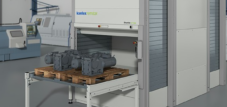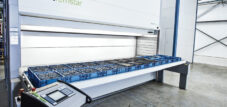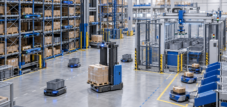
How compact storage and mobile robotics are changing the efficiency of fulfillment – creative image on the topic, with AI: Xpert.Digital
Fine Shuttle and SOTR-M: When does the combination really pay off in the warehouse?
More storage space, fewer walking distances: What mobile robots can do in fulfillment
Warehouse automation cost analysis: Where Fine Shuttle and SOTR-M offer advantages
More items, smaller orders, and high expectations for fast deliveries present warehouses with a dual challenge: they must store large quantities of goods in a space-saving manner and reliably deliver the right items to picking at the right time. Daifukus Fine Shuttle and the SOTR-M mobile transport robot address both of these challenges. The container storage system optimizes storage density and automates storage and retrieval; mobile robots transport containers between transfer points and workstations.
Whether this combination actually makes operations more economical, however, depends not only on storage density or the number of robots used. Crucially, it depends on how well storage access, transport performance, and order picking are coordinated – and whether the system is suited to the actual order profile. Additional robots are of little help if a workstation becomes a bottleneck, and high storage density can lead to additional relocations. Therefore, what matters is not the most impressive technical specification, but the effort a company puts into fulfilling orders reliably, accurately, and on time.
Fine Shuttle and SOTR-M: Those who only aim for faster order picking may be automating the wrong bottleneck
A warehouse doesn't become more efficient simply by speeding up the movement of goods through the facility. The crucial factor is whether a company can fulfill its orders with less unnecessary effort, greater reliability, and a reasonable capital investment. This is precisely where the combination of Daifuku's Fine Shuttle automated storage system and the SOTR-M mobile transport robot comes in: it combines high-density storage with more flexible delivery of goods to picking workstations. The Fine Shuttle handles automated storage and retrieval, while the SOTR-M transports containers between the warehouse transfer points and the workstations.
The economic significance of this connection extends beyond mere conveyor technology. Increasing product numbers, more fragmented orders, and varying capacity utilization are changing the demands placed on a warehouse. Companies must, on the one hand, keep more product variants in stock and, on the other hand, ensure that individual items are available for order processing in a timely manner. Therefore, storage capacity, access speed, and transport performance cannot be planned in isolation.
However, even a technically convincing solution is not automatically a profitable investment. High storage density can lead to additional relocations. More transport robots won't solve a bottleneck at an overloaded picking station. And while shorter walking distances reduce some of the workload, they don't replace reliable inventory management or well-designed process organization. Economic value only arises when the individual components are a good fit for the actual order profile.
When product range exceeds existing warehouse structures
A high SKU number initially indicates the number of different, separately managed product variants. For warehouse organization, it makes a significant difference whether a company handles large quantities of a few products or small quantities of many variants. Even with identical shipping volumes, this can result in very different requirements for storage space, replenishment, and order picking.
Each additional product variant doesn't necessarily increase sales. Often, demand is simply spread across more items. This can lead to slower turnover of individual stocks, even though their availability is still expected. The warehouse then has to stock many rarely needed products while simultaneously providing the frequently requested items quickly.
This combination becomes particularly challenging when orders consist of multiple items. An order might contain mostly readily available items and yet still be waiting for a single container that is delivered late. Therefore, the average access speed only provides limited information about the actual order completion time.
Economically, a tension arises between product range attractiveness and processing costs. A broad product range can strengthen market position, but it also leads to additional inventory and operational complexity. Automation can make this complexity more manageable. However, it does not eliminate the question of whether every variant justifies its place in the product range economically.
A high-performance container warehouse should therefore not be seen as a license for unlimited product range expansion. Its task is to reliably ensure the availability of an economically viable product range. Product policy, inventory management, and intralogistics remain interconnected.
The technical architecture behind the compact deployment
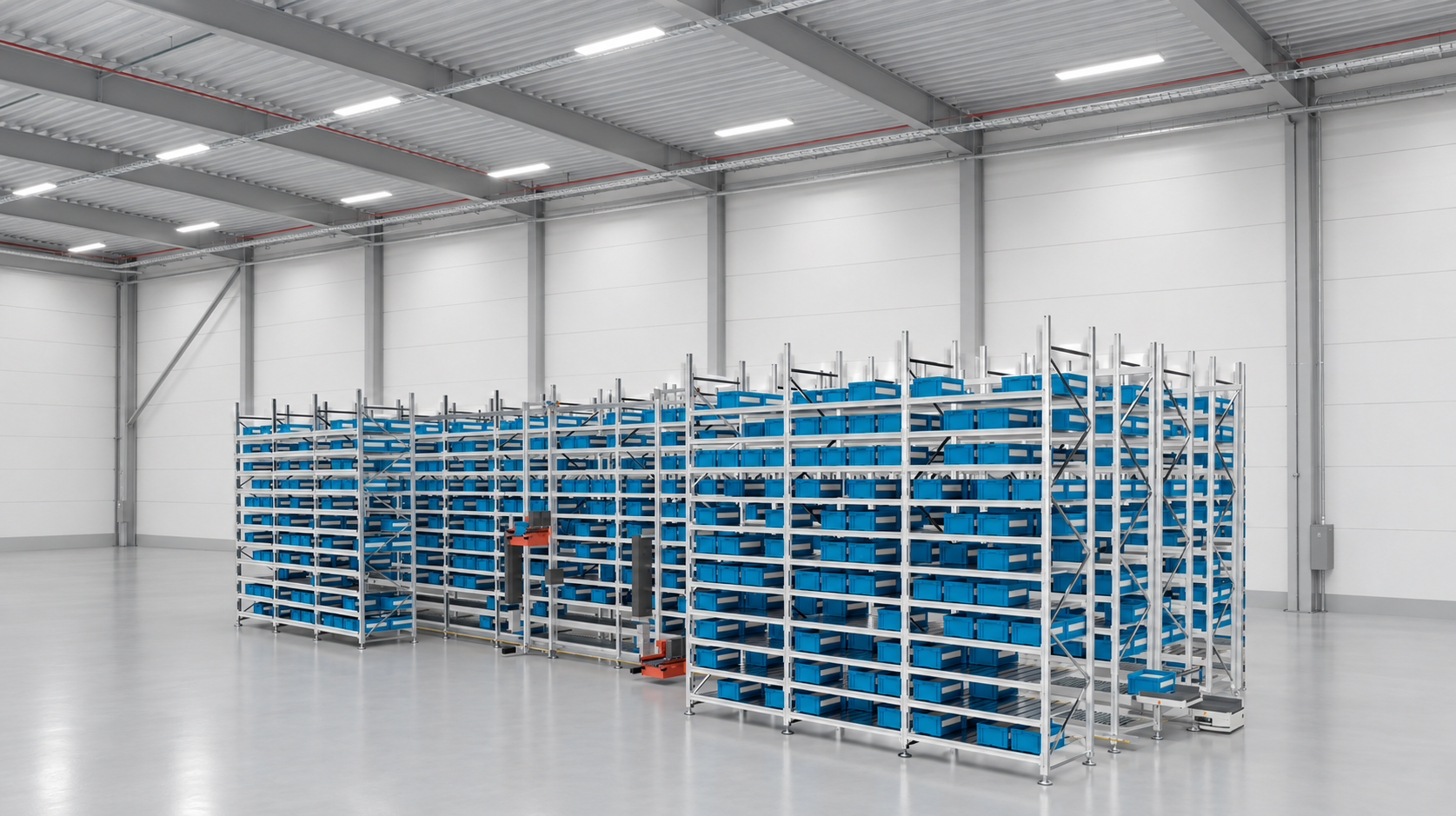
The Fine Shuttle is an automated storage system for small parts and containers, featuring a storage and retrieval machine integrated into the racking structure. Unlike conventional systems with floor-mounted rails, this machine moves along the racking structure. Storage is double-deep. Conveyor technology on the lower racking levels handles the supply and removal of containers. Up to two storage and retrieval machines can be installed per aisle.
The terminology is crucial: The product name does not imply that the system is equivalent to a classic shuttle system with numerous independent vehicles operating on different rack levels. For performance evaluation, the specific mechanics, the number of simultaneous movements, and the design of the transfer points are decisive.
The published technical specifications list special plastic containers with dimensions of 650 millimeters in length, 450 millimeters in width, and 320 millimeters in height, and a maximum load of 30 kilograms. The specified aisle width is 750 millimeters. The stated operating temperature range is from 0 to 40 degrees Celsius. These values describe the technical application range, not the performance of a complete system.
Several practical consequences can be derived from this information. Items must be compatible with the container concept in terms of dimensions, weight, and handling. Large, irregularly shaped, or particularly heavy goods may require a different storage technique. Furthermore, the temperature range does not necessarily imply general suitability for deep-freeze applications.
Similarly, the width of the aisle does not correspond to the total space requirement. Shelving, transfer points, maintenance access, workstations, and operational safety areas must also be taken into account. Therefore, a reliable comparison of space requirements cannot be based solely on a narrow technical aisle.
Why double-deep storage is not automatically the cheapest storage
In a double-deep configuration, two storage positions are located one behind the other. This reduces the amount of traffic area compared to an otherwise comparable single-deep configuration. More containers can be accommodated on a given footprint.
However, the economic viability depends on how often rear positions need to be accessed and whether containers placed in front of them obstruct access. If a front container first needs to be moved, this creates an additional process. This consumes time and machine capacity without directly advancing a customer order.
This makes warehouse space allocation an economic management task. Frequently needed items should not be stored solely based on available space. Access frequency, stock levels, common order patterns, and expected replenishment also play a role.
A sensible approach can be to distribute fast-moving items across multiple containers or storage areas. This reduces reliance on a single access point. However, this distribution requires additional containers and can make inventory management more complex.
The optimal storage density is therefore not necessarily where the most containers can theoretically be accommodated. It lies where space costs, access costs, and required delivery performance combine to yield the most favorable result. A slightly less densely populated warehouse can be more economical if it reduces relocations and enables more reliable order processing.
Mobile transport offers flexibility, but not unlimited capacity
The SOTR-M handles transport and sorting tasks with mobile robots equipped with conveyor technology. Instead of continuously installed conveyor lines, the vehicles move between defined transfer points. This allows for more flexible material flows and the expansion of transport capacity through the addition of more vehicles.
For the combination with the Fine Shuttle, this means a functional division of labor: The warehouse consolidates the inventory, while the robots establish the connection to the picking stations. The warehouse structure remains largely stationary. The transport level outside the racking becomes particularly flexible.
This distinction is important for investment decisions. Mobile robotics does not make the entire warehouse arbitrarily changeable. Transfer heights, container standards, station layout, and traffic areas must still be compatible. Charging stations, maintenance areas, and technical communication also require robust planning.
Additional robots only increase throughput as long as sufficient free routes and transfer capacities are available. If a transfer station becomes a bottleneck, additional vehicles can only lengthen the queue. The same applies to heavily congested intersections or poorly positioned workstations.
The economic advantage therefore lies less in unlimited scalability than in finer adaptability. A company can gradually expand its transport capacity under suitable conditions, instead of having to install all conveyor lines for a distant final expansion from the outset.
The actual product is a coordinated flow of materials
The key challenge lies in coordinating warehouse access, transport, and order picking. A container retrieved quickly is useless if it then sits in front of an occupied workstation. Conversely, a high-performance station operates below its capacity if the required containers arrive irregularly.
This results in a significant difference between maximum and economically usable performance. Maximum performance describes what a single component can achieve under specific conditions. Economically usable performance, on the other hand, takes into account waiting times, malfunctions, order structure, and necessary ancillary processes.
For planning purposes, several units must therefore be distinguished. A container movement is not an order item. An order item can comprise multiple units. A container, in turn, can provide material for multiple orders. Mixing these concepts easily leads to inflated productivity expectations.
A purely mathematical example illustrates the relationship: If 500 inventory containers are delivered to workstations per hour, and an average of three order items can be processed from each container, this results in a potential of 1,500 items per hour. If the average usage drops to two items, only 1,000 items remain with the same transport performance.
These figures are not performance data for Fine Shuttle or SOTR-M. They show why order bundling and container utilization can be just as important for profitability as travel speed and mechanical cycle time.
What data is actually needed for a reliable interpretation?
Sound planning begins with the transaction data of the existing business. Annual quantities alone are insufficient. Time-resolved information is needed on when which items are ordered, restocked, returned, or transferred, and in what quantities.
Particularly revealing are order items per hour, quantities per item, container accesses per item, and the frequency of joint orders. Inventory ranges, item dimensions, weights, and the distribution of demand across different times of day are also important.
Peak loads also need to be considered in a differentiated manner. A short order peak before the daily shipping deadline presents different requirements than several weeks of consistently elevated volume. The first scenario can sometimes be managed through buffering and early provisioning. The second requires more readily available capacity.
Equally important is the development of the product range. If product sizes, packaging, or order patterns change, a system optimized for historical data can lose its accuracy. A sensible design therefore incorporates several plausible business scenarios.
For management, what matters is not the supposedly precise individual forecast, but the robustness of the decision. A solution should remain economically viable even if growth is slower or demand is distributed differently than expected.

Expert partner in warehouse planning and construction

How mobile robotics makes fulfillment more flexible
The investment calculation must reflect the entire operation
The acquisition costs of an automation solution represent only a portion of its economic burden. Integration, software, project planning, commissioning, and potentially structural modifications must also be considered. During operation, expenses arise for maintenance, energy, spare parts, training, and technical support.
On the benefits side, there are potential savings in operational workload, reduced space requirements, and avoided error costs. Furthermore, additional capacity can create economic value if it allows for the acceptance of profitable orders that would otherwise not be reliably fulfillable.
These items must be clearly separated. Additional revenue is not the same as additional profit. What matters is the remaining profit contribution after variable costs. Similarly, vacated space only represents a real saving if it can be used for other purposes or its associated costs avoided.
A hypothetical example illustrates the scale of the relationship. Let's assume an integrated solution costs €4.5 million, including integration. It enables annual savings of €850,000 in operational personnel costs and avoids a further €150,000 in space and error costs. At the same time, it incurs additional ongoing costs of €250,000.
Under these assumptions, the annual net effect would be €750,000. The simple amortization period would be six years. This does not yet include financing costs, taxes, residual values, or the timing of cash flows.
The figures are explicitly a calculation example and not price or economic information for the products mentioned. Their purpose is to reveal the evaluation logic: only the net effect makes technical improvements economically beneficial.
Why capacity utilization determines capital productivity
Automation partially replaces variable expenses with long-term fixed costs. Personnel hours can be adjusted to the workload within certain limits. In contrast, an installed system incurs financing, depreciation, and a portion of its operating costs even during periods of low demand.
This makes capacity utilization considerably more important. If the same fixed costs are spread across more order items, the corresponding cost share per item decreases. If the volume falls short of expectations, the supposed cost advantage can diminish significantly.
In the previous calculation example, a 25 percent reduction in gross benefit from labor, space, and error prevention would reduce the annual benefit from one million euros to 750,000 euros. If the additional operating costs remain at 250,000 euros, the net benefit is 500,000 euros. The simple amortization period thus extends from six to nine years.
This sensitivity demonstrates why an investment should not be based solely on optimistic sales forecasts. Especially with seasonal business models, it is crucial to determine whether the plant is utilized sufficiently on average throughout the year and how economically it operates outside of peak periods.
A modular transport level can partially reduce this uncertainty. However, it does not replace a viable base load for the core storage area. Anyone building a large automated container warehouse still ties up capital in a specific location and a particular process concept.
Workload reduction is more valuable when it has an impact on the business
The goods-to-person principle shifts movement from employees to technology. Instead of covering long distances between storage locations, employees process the provided goods at a single station. This can reduce travel times and make workflows more consistent.
The resulting time savings, however, do not automatically translate into a correspondingly high reduction in personnel costs. Freed-up minutes must be usable from an organizational perspective. If they are spread across many workstations and short time windows, they may not be fully attributable to fewer shifts or lower external staffing costs.
Therefore, what is economically relevant are the actual working hours that are eliminated or can be used productively in other ways. This also includes avoided overtime, a reduced need for short-term temporary staff, and the ability to handle additional orders with an existing team.
At the same time, the job profile is changing. Fewer manual transport tasks are being offset by a greater need for plant monitoring, troubleshooting, and process understanding. Training is therefore not an add-on, but an integral part of the investment.
Ergonomics also requires a differentiated approach. Fewer walking distances can reduce strain, while a poorly designed workstation creates new strains. Reaching heights, container weight, repetitive movements, and work rhythm remain important planning factors. Productivity and good working conditions should not be treated as opposites, but rather integrated into the station design.
Space efficiency must be measured across the entire site
Compact storage is particularly advantageous when an existing building is reaching its capacity limits. If additional volume can be accommodated within the existing site, an expansion or relocation may be avoided.
The value of this option lies not only in the saved rent. It can also eliminate duplicate location structures, additional transport between buildings, and organizational inefficiencies. However, such benefits must be specifically demonstrated.
The decisive factor is the total usable capacity of the site. A warehouse can hold more containers and still be limited in goods receiving, packaging, or shipping. If these areas are neglected during planning, the investment merely shifts the bottleneck.
Furthermore, a distinction must be made between geometric and economically usable capacity. A container space may technically exist, but cannot be permanently occupied due to the necessary freedom for relocation. Conversely, many small items may only partially fill a container.
A meaningful assessment therefore considers not only container spaces per square meter. It also examines the actual fill level, the required reserves, and the order output that can be reliably delivered across the entire site area.
Reliability arises from the interaction of the components
Mobile robots can create a degree of redundancy: If a single vehicle fails, other vehicles can take over some of the tasks. This feature is a significant advantage over material flows, where a single failure immediately interrupts an entire transport connection. However, it does not guarantee uninterrupted overall performance.
A fulfillment system consists of several interdependent elements. Transfer conveyors, storage and retrieval machines, networks, control systems, and workstations can all limit availability. A robust fleet of vehicles is of little use if a central transfer point isn't functioning.
A simplified calculation example illustrates the effect of such dependencies. If a serial process consists of four essential subsystems, each with a temporal availability of 99 percent, the resulting combined availability, assuming independent failures, is approximately 96.1 percent.
This value is not a prediction for the solution under consideration. Real-world systems have buffers, backup strategies, and varying operating states. This example merely illustrates why high individual availability levels cannot be automatically extrapolated to the entire system.
For economic efficiency, restart times, spare parts supply, and emergency processes are therefore essential. It must also be determined which orders should be prioritized in the event of a disruption and which manual backup procedures are actually practical.
The control software determines the quality of the mechanics
Mechanical performance can only be utilized when the right containers are available at the right time. This requires inventory management, order processing, and plant control to exchange consistent information.
A physically present but incorrectly recorded container is hardly more economically advantageous than having no inventory at all. Similarly, incorrect prioritization can lead to technically rapid movements being used to process the wrong orders.
The control system must therefore do more than simply shorten transport routes. It must weigh different objectives against each other: urgent customer orders, necessary replenishment, available station capacity, and consistent plant utilization. A locally optimal decision can worsen the overall result.
For example, processing a single urgent order immediately might seem sensible, but it could stretch out several orders that have already been bundled efficiently. Conversely, efficient bundling must not cause time-critical shipments to miss their delivery deadlines.
Data quality and prioritization logic are therefore at the economic core of the solution. Companies should be able to understand how orders are released, storage locations are assigned, and disruptions are handled. Otherwise, a technically efficient system remains dependent on software decisions that are difficult to understand.
Where the combination is a particularly good fit for the business model
The combination of automated container storage and mobile transport is particularly advantageous where standardized containers, numerous product variants, and recurring access occur. This can include fulfillment centers, retail logistics, and the supply of industrial production processes. Fine Shuttle is designed for distribution and order picking as well as for the storage of parts, materials, and intermediate stock.
In mail order, the potential benefits lie in more compact inventory management and targeted supply to picking stations. In manufacturing, the timely provision of components may be the primary focus.
The economic evaluation criteria differ. In fulfillment, the cost per flawlessly shipped order item and adherence to shipping times are particularly relevant. In production, avoiding material shortages and ensuring a more stable supply line can be crucial.
For logistics service providers, the contract structure is an additional factor. While a high degree of automation can improve cost efficiency, it ties up capital beyond the term of individual customer contracts. Container compatibility, alternative usage options, and transferability to other customers therefore become important risk factors.
Such a solution is less convincing if the product profile frequently falls outside the technical limits, the baseline capacity utilization remains very low, or the location is only secured in the short term. In these cases, a less capital-intensive level of automation may be more economically viable.
The correct comparison is not automatically the manual warehouse
A sound decision should include several realistic alternatives. While comparing it to an unchanged manual warehouse is obvious, it can overstate the economic advantage if simple organizational measures can achieve significant improvements.
This includes improved product placement, modified replenishment rules, and smoothing out order peaks. Semi-automated transport solutions or additional picking aids can also solve part of the problem.
On the more automated side, there are other container storage concepts, different shuttle architectures, and solutions with varying footprints or performance characteristics. No single technology should be considered superior across the board. What matters is its suitability for the specific load profile.
Permanently installed conveyor technology can still be a sensible option for stable, high transport volumes. Mobile systems, on the other hand, can offer advantages when routes and capacity requirements change frequently. The most economically viable solution may therefore be a deliberately hybrid design.
The comparison must use the same performance requirements and cost items. If maintenance and integration are included in one variant but excluded in another, the result is not meaningful. The same applies to different assumptions about employee productivity and future growth.
A phased introduction limits the economic risk
Even a well-planned plant can initially fall short of target productivity during the transition to regular operation. Employees need to learn new processes, master data needs to be cleaned up, and control rules need to be adapted to real operating conditions.
Therefore, the start-up phase should be included in the financial plan. Temporary duplicate structures and additional support are not necessarily a sign of poor technology, but can represent a necessary safeguard for delivery capability.
A sensible approach is to implement the system by initially adopting suitable product groups and manageable order volumes. This allows for testing of container quality, booking logic, and station processes before converting the entire product range.
The success criteria must be defined in advance. These include not only short-term peak output, but also sustainably achievable performance, error frequency, downtime, and the actual personnel hours deployed. Performance under adverse conditions should also be evaluated.
A successful economic ramp-up is demonstrated by the increasing stability and predictability of operations. A single demonstration of high speed is less meaningful than several weeks of reliable order processing with real products and genuine fluctuations.
Energy consumption and resource requirements demand a sober assessment
Automation changes the energy requirements of a warehouse. Storage and retrieval machines, conveyor technology, robots, and IT systems all require electricity. At the same time, more compact structures and modified operational processes can reduce other expenses.
A blanket statement that the combination of Fine Shuttle and SOTR-M is automatically particularly energy-efficient would not be reliable without application-specific measurements. Actual consumption depends, among other things, on loads, travel distances, utilization, and operating times.
A sensible approach is to evaluate performance based on economically usable units, such as each fully processed order item. Simply looking at consumption per movement can be misleading if a solution requires significantly more movements to achieve the same result.
The lifespan of the system and its adaptability must also be considered in the resource analysis. A long-lasting infrastructure can be advantageous, provided it remains suitable for the business over many years. Conversely, a specialized solution that becomes unusable prematurely, despite efficient individual movements, can become economically and materially problematic.
Sustainability and economic efficiency therefore often overlap on a central question: How reliably can the installed technology be utilized, maintained, and adapted to changing requirements throughout its service life?
The crucial perspective: Cost per reliably completed order
The combination of Fine Shuttle and SOTR-M is interesting because it unites two different strengths: compact, automated container storage on the one hand, and adaptable transport to workstations on the other. Its potential lies not in a single spectacular performance indicator, but in the coordinated organization of the entire material flow.
A well-founded investment perspective is therefore neither fundamentally euphoric nor categorically skeptical. The solution can be particularly compelling where a suitable range of containers, a reliable baseline utilization, and a clearly identified bottleneck converge. The prerequisite is that the space utilization, reduced workload, and additional performance actually translate into economic benefits.
The key performance indicator is not the number of installed robots, nor is it the highest possible storage density. What matters are the total costs per order completed flawlessly and on time, supplemented by resilience to fluctuations in demand and technical malfunctions.
Those who consistently adopt this perspective do not view automation as an end in itself. It becomes an investment in a robust operational structure. This is precisely the true measure: not to deploy as much technology as possible, but to enable a more reliable and economical performance in the long term with appropriate capital investment.
Your intralogistics experts

Consulting, planning and implementation of complete solutions for high-bay warehouses and automated storage systems - Image: Xpert.Digital
More information here:
Your global marketing and business development partner
☑️ Our business language is English or German
☑️ NEW: Correspondence in your native language!

Konrad Wolfenstein
I and my team are happy to be available to you as your personal advisor.
You can contact me by filling out the contact form here wolfenstein@xpert.digital:or simply call me at +49 7348 4088 965. My email address is
I'm looking forward to our joint project.
☑️ SME support in strategy, consulting, planning and implementation
☑️ Creation or realignment of the digital strategy and digitization
☑️ Expansion and optimization of international sales processes
☑️ Global & Digital B2B trading platforms
☑️ Pioneer Business Development / Marketing / PR / Trade Fairs
Our global industry and economic expertise in business development, sales and marketing


Our global industry and economic expertise in business development, sales and marketing - Image: Xpert.Digital
Industry focus areas: B2B, digitalization (from AI to XR), mechanical engineering, logistics, renewable energies and industry
More information here:
A thematic hub offering insights and expertise:
- Knowledge platform covering global and regional economies, innovation and industry-specific trends
- A collection of analyses, insights, and background information from our key areas of focus
- A place for expertise and information on current developments in business and technology
- A hub for companies seeking information on markets, digitalization, and industry innovations