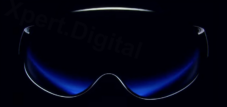
The Android Show: Google's platform for innovations in the Android ecosystem – Image: Xpert.Digital
The highlights of the Android Show: A look at the future of Android
Android Show 2025: All the new features at a glance
The "Android Show: I/O Edition" is an official Google event that traditionally takes place shortly before Google I/O and focuses exclusively on new Android features. The latest Android Show took place on May 13, 2025. It wasn't a traditional live event with an in-person audience, but rather a web presentation that was streamed live on official Google channels such as YouTube.
The Android Show has established itself as a central source of information for developers and users, where Google regularly presents new features and developments in the Android ecosystem. The current edition, "The Android Show: I/O Edition," from May 2025, offers a comprehensive look at upcoming technologies and improvements to the Android platform, one week before the annual Google I/O developer conference. The following report summarizes the most important announcements and innovations from this year's Android Show.
The Android Show: I/O Edition 2025
The “Android Show: I/O Edition” took place on May 13, 2025, exactly one week before the annual Google I/O developer conference, scheduled for May 20-21, 2025. The presentation was moderated by Sameer Samat, President of the Android Ecosystem, who, along with the Android team, showcased the latest developments. The event was streamed live and remains available online.
This year's show focused on a fresh, dynamic design, intelligent features for various devices, and improved security and privacy features. The official Android website promotes the event with the slogan "The Android Show: I/O Edition informs you about everything you need to know about Android.".
The show serves as a preview of the upcoming Google I/O developer conference and offers a detailed look at the features that will be available for Android devices in the coming months. Those interested can stream the entire show or watch the summaries to learn more about the innovative new features.
Surprise moment at the "Android Show": Sameer Samat presents Google Smart Glasses for the first time
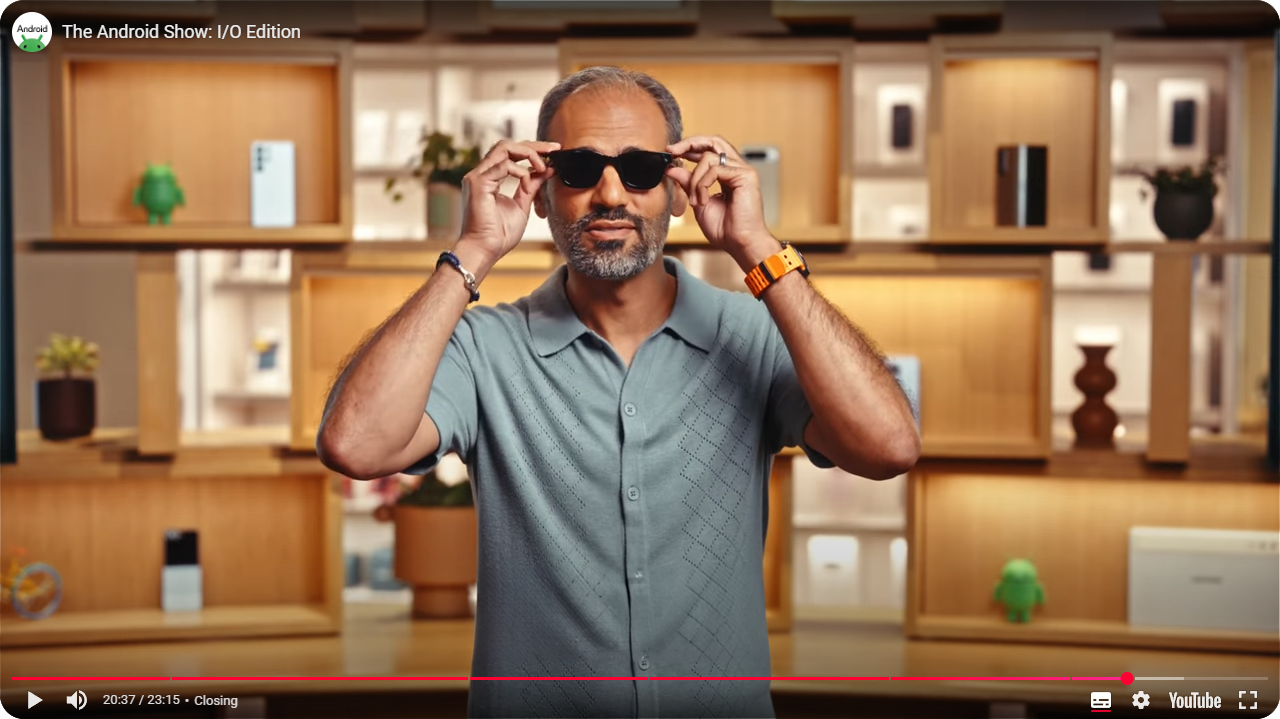
Google Android chief Sameer Samat shows off Google's smart sunglasses – Image: Google/YouTube
To conclude, Android chief Sameer Samat provided a genuine surprise. After the show had already presented numerous innovations surrounding Android 15, Android XR, and the ecosystem, Samat reached into his pocket with a seemingly casual gesture. Viewers expected another smartphone or a new gadget – but instead, he produced a pair of **smart sunglasses**. With a smile, he put them on and addressed the audience directly:
"This is no ordinary accessory. This is our new Android XR Smart Glass – and it runs on the brand new Android XR operating system."
The first public presentation
This was the first time Google publicly displayed a working model of its new smart glasses. At first glance, the glasses looked like classic sunglasses, but they were equipped with discreetly integrated technology. A small camera on the left side was particularly noticeable, accompanied by an LED indicator that signaled when the camera was active.
announcement for Google I/O
Sameer Samat used this moment to build anticipation for the upcoming Google I/O. He announced that attendees of the developer conference would have the opportunity to try out the new glasses themselves. With this, he made it clear that Google is taking a major step toward everyday, intelligent wearables with its smart glasses initiative.
Reactions and meaning
The scene was immediately picked up on social media and tech blogs, sparking plenty of speculation. Many saw it as a clear sign that Google was attempting a fresh start after the failed Google Glass project – this time with better technology, greater everyday usability, and strong integration of artificial intelligence.
Sameer Samat's appearance with the Android XR Smart Glass was not only a successful PR coup, but also a clear signal to the developer community and the public: Google is serious about the topic of smart glasses and wants to usher in a new era of mobile, intelligent devices.
Related to this:


Material 3 Expressive Design
One of the key announcements at the Android Show was the introduction of Material 3 Expressive. This evolution of the Material Design concept offers developers new ways to make their apps more appealing and user-friendly.
Material 3 Expressive is described as an "expansion pack" designed to enhance the appeal of apps by enabling emotional user experiences and making applications more intuitive and engaging. The new design system includes the following elements:
- New components
- Revised motion physics system
- New typography styles
- New color and shape concepts
The design system will be introduced with Android 16 later in 2025. Google announced that it will provide more details during the Google I/O conference.
Android 16 Features
The Android Show provided a first comprehensive look at the upcoming features of Android 16. The new version of the operating system will be equipped with numerous improvements and new functions.
Redesigned lock screen
A major focus of Android 16 is the redesigned lock screen with expanded customization options:
- Newly designed lockscreen customization page
- More customizable watch
- Effects when unlocking the device
- Weather effects on the lock screen
- Optimized notifications
- Possible integration of a Gemini button
- Double-tap gesture to lock the screen
Live Activities
One of the most innovative new features is the so-called Live Activities (live updates) directly on the lock screen. This function allows compatible apps to display their current status in mini-widgets – for example, the location of a taxi or the progress of a food delivery. Although Android doesn't have a native Live Activities feature like iOS, Notificare provides developers with tools to implement similar functionality on Android.
Further UI improvements
Furthermore, additional improvements to the user interface were presented:
- Customizable icon shapes for the home screen
- New animations when opening app folders
- New animation when closing apps with an upward swipe gesture
- Grouped notifications
- Summarized notifications specifically for conversations
- Support for freeform or floating applications
- Possible option to enforce dark mode for all apps
Cross-platform developments
The Android Show not only presented innovations for smartphones, but also showcased developments for other platforms in the Android ecosystem.
WearOS 6
During the show, WearOS 6 was announced, the next version of Google's smartwatch operating system, which will be released alongside Android 16. The new version brings numerous improvements:
- Optimized design specifically for round displays
- Improved use of screen space through redesigned tiles and controls
- Faster access to key functions
- Revised design for notifications
- Integration of Material 3 Expressive Design
Google also promises improved energy efficiency. The system is designed to reduce battery consumption and enable up to ten percent longer battery life on the same hardware. WearOS 6 will initially be available on Pixel watches before being rolled out to other compatible smartwatches.
Android Auto
Significant new features were also announced for Android Auto. Of particular note is the integration of Gemini, Google's AI assistant. Patrick Brady, VP of Android for Cars at Google, gave an exclusive interview at the Android Show, in which he discussed the implementation and benefits of Gemini in Android Auto.
Additionally, the selection of games for Android Auto has been expanded. While the vehicle is parked, even more titles such as Farm Heroes Saga, Candy Crush Soda Saga, Angry Birds 2, and Beach Buggy Racing are now available. These games can be played directly on the car's screen if they are installed on the connected smartphone.
Related to this:

Gemini integration in the Android ecosystem
A key theme of the Android Show was the expanded integration of Google's AI assistant Gemini into the entire Android ecosystem. Gemini will be available not only on smartphones, but also on Wear OS smartwatches, in Android Auto, on Google TV, and in the Android XR platform.
Gemini receives expanded functionality, particularly on Wear OS devices, and is intended not only to replace Google Assistant but also to be more deeply integrated into the system. The AI assistant gains more freedom than its predecessor and can display images in addition to text.
This comprehensive integration represents an important step towards making AI features consistently available across all Android platforms, thus enabling a seamless user experience across different devices.
Security and privacy features
The Android Show also highlighted improved security features for Android users. One of the standout innovations is AI-powered fraud detection in Google Messages. This feature analyzes incoming messages for typical patterns that could indicate fraudulent activity. If the system detects a suspicious conversation, the user receives a real-time alert and can directly block and report the sender.
Google emphasizes that the analysis takes place locally on the device to protect user privacy. This aligns with the general trend towards more local processing of sensitive data within the Android ecosystem.
Location sharing has also been improved. In the "Find My Device" app, users can now share their current location with selected contacts. Users retain full control over who can see their location and for how long, and receive regular reminders about the shared information.
Android for developers
For developers, the Android Show offers valuable insights into new tools and resources. The show is part of a broader strategy to make it easier for developers to access information and updates.
Developers can use the Android documentation and various tools to customize their apps and implement the new features. Material 3 Expressive, in particular, offers new possibilities for app designers to improve the user experience.
Google unveils: The future of the Android ecosystem at I/O 2025
The Android Show: I/O Edition 2025 showcased numerous exciting innovations for the Android ecosystem, which will be available in the coming months. With Material 3 Expressive Design, new features in Android 16 and Wear OS 6, and the comprehensive integration of Gemini, Google demonstrates its vision for the future of mobile computing.
The presented innovations indicate a stronger commitment to a consistent, cross-platform experience, enhanced and improved by AI capabilities. At the same time, security and privacy remain key pillars of the Android platform, as demonstrated by the new security features.
Detailed information on all announced features will be presented during the Google I/O developer conference on May 20th and 21st, 2025. For Android users and developers, 2025 promises to be an exciting year with numerous improvements and new possibilities.
Related to this:
Your global marketing and business development partner
☑️ Our business language is English or German
☑️ NEW: Correspondence in your native language!

Konrad Wolfenstein
I and my team are happy to be available to you as your personal advisor.
You can contact me by filling out the contact form here wolfenstein@xpert.digital:or simply call me at +49 7348 4088 965. My email address is
I'm looking forward to our joint project.