


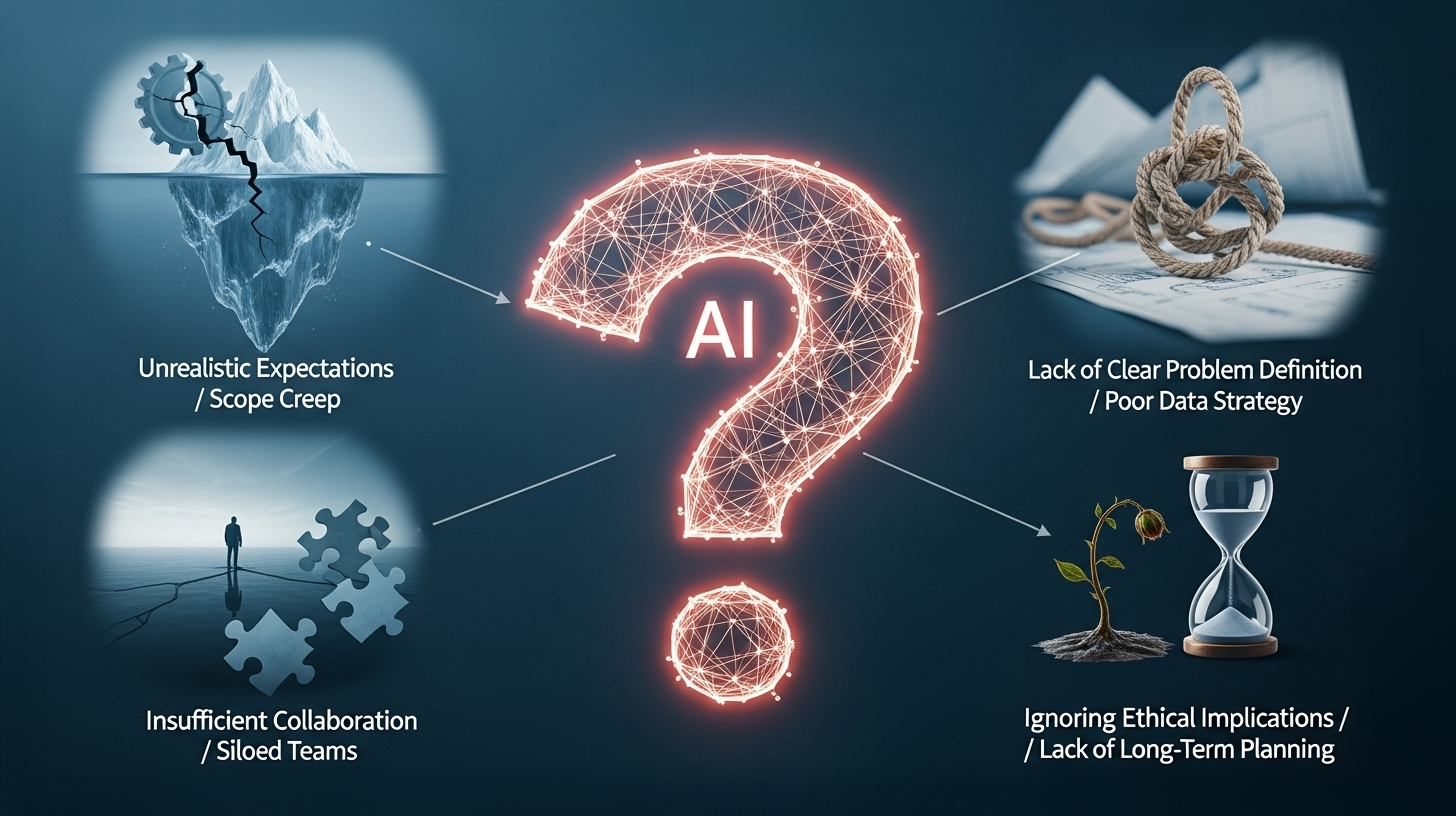
AI's added value? Before you invest in AI: Identify the 4 silent killers of successful projects – Image: Xpert.Digital
Why enterprise AI often fails: A guide to the four key challenges
What are the most common problems encountered when implementing AI in companies?
The implementation of artificial intelligence in companies paints a sobering picture: despite significant investments, most AI projects fail before they even reach productive use. Studies show that between 80 and 95 percent of all AI pilot projects never reach the scaling phase. The problem rarely lies with the technology itself, but rather with structural challenges that many companies underestimate.
The reasons for this failure are multifaceted and systematic. A recent Gartner study shows that up to 34 percent of companies identify data availability or data quality as a primary obstacle. At the same time, 42 percent of companies report that more than half of their AI projects have been delayed or completely abandoned due to data provisioning issues.
A particularly problematic discrepancy exists between technical successes in the pilot phase and practical scaling. An MIT study illustrates that almost all pilot projects involving generative AI fail to deliver sustainable value because they are not integrated into the strategic agenda and proceed as isolated experiments.
Related to this:


Why is data often not ready for AI applications?
Data issues represent one of the most fundamental hurdles to successful AI implementations. Many organizations assume that a sufficiently intelligent model can automatically create value from existing data, but this assumption proves to be deceptive in practice.
Reality paints a different picture: the larger the organization, the more chaotic its data structures often are. Data is frequently stored in isolation across various systems, is incomplete, unstructured, or follows inconsistent formats. This fragmentation leads to the paradoxical phenomenon that while companies possess large amounts of data, this data is practically unusable for AI applications.
A particularly critical aspect is data quality. Studies show that up to 80 percent of AI project time must be spent on data preparation. Common problems include inconsistent data formats, missing or incorrect labels, outdated information, and systematic biases in the training data. This poor data quality can lead to model hallucinations or a lack of context, ultimately causing users to abandon the system.
In addition, data protection laws, access restrictions, and internal silos significantly complicate access to relevant data. The GDPR and other compliance requirements create further barriers that must be considered when using data for AI purposes. Companies must therefore learn to develop AI systems that can work with scattered and incomplete data while securely processing sensitive information.
What role does IT infrastructure play in AI failure?
Integrating AI systems into existing enterprise architectures proves to be a complex technical challenge that extends far beyond simply implementing algorithms. AI is only as useful as its ability to seamlessly integrate into an organization's operational realities.
Modern enterprise architectures are characterized by a heterogeneous mix of legacy systems and cloud applications that must be interconnected across departmental and national boundaries. This complexity arises from decades of IT evolution, in which new systems were built on top of existing ones without a coherent overall architecture being planned.
Legacy systems present a particular challenge. These older systems often lack the modern interfaces and APIs required for AI integration. They frequently use outdated data formats and standards, have insufficient documentation, and lack the necessary technical expertise for integration. At the same time, these systems are deeply integrated into business processes and cannot simply be replaced without incurring significant business risks.
Security and compliance requirements further exacerbate this problem. Legacy systems may lack the robust security measures and access controls necessary to protect sensitive data. Integrating AI into these environments raises significant security and compliance concerns, particularly in highly regulated industries.
Months of trying to integrate Large Language Models into rigid environments, and endless debates between on-premises and cloud solutions, significantly hinder progress. New AI tools often introduce additional complexity instead of solving existing problems. The solution lies in developing a coherent architecture that natively connects data sources, understands organizational context, and provides transparency from the outset.
How can AI success be measured when the goals are unclear?
Measuring AI success is one of the most difficult challenges in enterprise AI, especially when clear objectives haven't been defined from the outset. Unclear goals are among the most common reasons for AI failures and lead to a vicious cycle of insufficient ROI evidence and a lack of scalability.
Too many pilot projects arise from pure technological curiosity instead of addressing real business problems. This exploratory approach may be useful in research, but in companies it leads to projects without measurable success criteria. Key Performance Indicators are often completely absent or so vaguely formulated that they do not allow for any meaningful evaluation.
A structured framework for measuring ROI begins with the clear definition of business objectives and their translation into measurable KPIs. This should include both leading indicators, which provide early signals of success or failure, and lagging indicators, which measure long-term effects. The classic ROI formula forms the foundation: Return on Investment equals total benefit minus total costs, divided by total costs, multiplied by 100 percent.
However, this simplistic view is insufficient for AI investments, as both costs and benefits exhibit more complex structures. The cost side includes not only obvious expenses for licenses and hardware, but also hidden costs for data cleansing, employee training, and ongoing system maintenance. Particularly critical are the often underestimated change management costs that arise when employees have to learn new workflows.
On the benefits side, several categories can be distinguished: Direct monetary advantages through cost savings or increased revenue are the easiest to quantify. Less obvious, but often more valuable, are indirect benefits such as improved decision quality, reduced error rates, or increased customer satisfaction. Not all benefits of AI can be directly expressed in numbers. The improved decision quality through data-driven analyses can create significant long-term value, even if this is difficult to quantify.
Even with technical successes, organizational obstacles often block the transition to scaling: budget cycles, staff turnover, unclear incentive structures, or compliance delays can bring even successful pilot projects to a standstill. The solution lies in defining expectations from the outset and setting concrete, measurable goals: increased revenue, time savings, risk reduction, or combinations of these factors. Furthermore, planning must include adoption, not just technical deployment.
Why is it so difficult to build trust in AI?
Establishing trust in AI systems is one of the most complex and critical challenges in enterprise AI. This challenge is particularly problematic because trust is difficult to build but easy to lose, and without trust, usage declines rapidly, even with accurate and useful models.
The problem of trust begins with the fundamental lack of transparency in modern AI systems. Many advanced AI models function as so-called "black boxes," whose decision-making processes are incomprehensible even to experts. This lack of transparency means that users and decision-makers cannot understand how a system arrives at certain results, which naturally generates skepticism and resistance.
Explainable AI is becoming a crucial success factor in this context. XAI encompasses methods and techniques that make the decisions and workings of AI models understandable and comprehensible to humans. Today, it is often no longer enough for an AI to simply provide the right answer – how it arrives at that answer is equally important.
The importance of explainability is reinforced by several factors: Users are more likely to accept AI decisions if they can understand them. Regulatory requirements such as the GDPR and the EU AI Act increasingly demand explainable decision-making processes. Transparency allows for the detection and correction of discrimination and systematic errors. Developers can more easily optimize models if they understand the basis for their decisions.
Even minor errors can breed significant distrust if the system is perceived as opaque. This is particularly problematic in areas where decisions can have far-reaching consequences. Therefore, explainability, feedback loops, and transparency are not optional features, but essential requirements for the successful use of AI.
Compliance teams naturally operate cautiously, which slows down approval processes. Skepticism towards black-box models, data governance requirements, and regulatory uncertainties are real and significantly hinder adoption. A lack of standards for development, deployment, and evaluation means that every project becomes a new "special undertaking" instead of building on established processes.
🤖🚀 Managed AI Platform: Faster, safer & smarter to AI solutions with UNFRAME.AI

Managed AI Platform - Image: Xpert.Digital
Here you will learn how your company can implement customized AI solutions quickly, securely and without high entry barriers.
A managed AI platform is your all-inclusive, worry-free solution for artificial intelligence. Instead of dealing with complex technology, expensive infrastructure, and lengthy development processes, you receive a ready-made solution tailored to your needs from a specialized partner – often within just a few days.
The key advantages at a glance:
⚡ Rapid implementation: From idea to ready-to-use application in days, not months. We deliver practical solutions that create immediate added value.
🔒 Maximum data security: Your sensitive data stays with you. We guarantee secure and compliant processing without sharing data with third parties.
💸 No financial risk: You only pay for results. High upfront investments in hardware, software, or personnel are completely eliminated.
🎯 Focus on your core business: Concentrate on what you do best. We take care of the entire technical implementation, operation, and maintenance of your AI solution.
📈 Future-proof & scalable: Your AI grows with you. We ensure continuous optimization and scalability, and flexibly adapt the models to new requirements.
More information here:
Why culture decides over technology — how AI succeeds in business
How do we overcome cultural resistance to AI?
The cultural challenges of AI implementation are often underestimated, yet they represent one of the most critical success factors. Organizational change management goes far beyond technical considerations and requires a systematic approach to overcome deeply ingrained resistance.
Outdated IT systems are often deeply embedded in a company's processes, and the introduction of new AI-supported processes can encounter significant resistance from employees accustomed to established workflows and methods. This resistance stems less from unwillingness and more from uncertainty and fear of the unknown.
A structured approach to cultural change encompasses several dimensions. The culture of innovation forms the foundation and should adhere to several key criteria: demonstrably open to change at all organizational levels, clear communication and transparency regarding the goals to be achieved through the use of AI, highlighting the benefits for both the company and its employees. Open dialogue across all hierarchical levels is essential to reduce existing fears and prejudices towards new technologies.
Raising awareness and providing education are the first critical steps. Employees and managers need to understand why AI is relevant to the company and how it can contribute to achieving strategic goals. Workshops, training sessions, and information events are effective means of imparting knowledge and addressing concerns. Promoting AI literacy—that is, a fundamental understanding of artificial intelligence and its applications—is a priority.
Developing AI skills requires investment in both technical expertise and an understanding of how AI is applied in specific business contexts. Tailored training programs and collaboration with external experts can be invaluable in this regard. Crucially, employees should view AI not as a threat, but as a tool to support their work.
Adapting structures and processes is unavoidable. Companies should be prepared to question traditional ways of working and pursue new, more agile approaches. This can include introducing new communication channels, adapting decision-making processes, or redesigning workflows. AI should not be viewed as an external element, but as an integral part of the corporate culture.
Leaders play a key role in the cultural transformation process. They must not only define the vision and strategy but also act as role models and embody the values of an AI-driven culture. Fostering a culture of experimentation and lifelong learning is essential. Leadership development programs can help raise the necessary awareness and skills.
Related to this:

What characterizes successful AI implementations?
Despite the numerous challenges, some companies are reaping real added value through AI: halved processing times for complex documents, secure automation of tasks requiring extensive evaluation, and modernization of decades-old codebases in just a few weeks. The crucial difference lies not in the use of generic tools, but in tailored solutions for each company's specific situation.
Successful implementations are characterized by an AI-native approach, where AI is embedded from the outset and fundamentally changes the way work is structured. These companies understand that adopting AI is not just a technological decision, but an organizational advancement that requires real solutions for the systems, structures, and people that drive growth.
A systematic maturity model identifies five critical dimensions for successful AI scaling: strategy and organization, culture and change management, resources and processes, data, and technology and infrastructure. Each dimension develops in maturity levels that progressively describe the progress toward full AI integration.
Strategically successful companies develop a clear AI strategy aligned with their business objectives. They define specific application areas and measure success using both financial and non-financial KPIs. Crucially, AI is integrated into the strategic agenda, rather than operating as isolated experiments.
In the areas of culture and change management, successful organizations foster acceptance and understanding of AI through comprehensive training and transparent communication about its benefits and risks. They cultivate a more open attitude towards collaborating with AI and reward employees who develop innovative AI solutions.
Structuring resource allocation and establishing robust processes for the efficient prioritization and scaling of AI projects are further success factors. Early involvement of IT and management can prevent bottlenecks and ensure long-term success.
How do you develop an AI-native architecture?
Developing an AI-native architecture requires a fundamental rethink of how companies design and implement their technological infrastructure. AI-native means that AI functionalities are integrated into the system architecture from the ground up, rather than being added on later.
A modular approach has proven particularly effective. Instead of developing monolithic systems, AI applications should be broken down into smaller, independent components. This allows for targeted scaling and updates of individual parts of the system without affecting the overall system. This modularity is especially important in complex enterprise environments where different departments have varying requirements.
Implementing MLOps practices is essential for the sustainable scaling of AI projects. Automated CI/CD pipelines enable the rapid and reliable deployment of models, while continuous monitoring ensures consistent performance over time. Key components of an MLOps pipeline include automated data management, version control for data, code, and models, automated training, a central model registry, and deployment automation.
Effective data management forms the foundation of any AI-native architecture. Companies must invest in modernizing their data infrastructure, including implementing cloud-based solutions, improving data quality, and establishing secure platforms for data exchange. Standardized data formats and interoperability are of central importance in this process.
Scalability must be considered from the outset. AI-native architectures must meet current needs while also enabling future growth. This requires strategic planning that clearly defines expected data volumes, user numbers, and performance criteria, and develops a scalable architecture based on these.
Related to this:

What governance structures does AI need?
Establishing appropriate governance structures is essential for the successful and responsible use of AI in companies. With the entry into force of the EU AI Act in August 2024, companies are facing increasingly complex regulatory requirements.
AI governance encompasses several critical dimensions. Data governance ensures that personal data is processed in accordance with the GDPR and other data protection regulations. This includes implementing Privacy by Design and Privacy by Default principles, conducting data protection impact assessments for high-risk AI systems, and ensuring transparency in automated decision-making processes.
The EU AI Act defines various risk categories for AI systems and sets specific requirements. Companies must transparently document the sources of training data and clearly label AI-generated content. For high-risk applications, they must actively protect their systems from manipulation and ensure continuous human monitoring. Applications with unacceptable risk are completely prohibited.
The ethical dimension of AI governance addresses issues of fairness, transparency, and accountability. This includes the implementation of bias monitoring systems, ensuring explainable decisions, and establishing feedback mechanisms for affected individuals. Maintaining a balance between innovation and responsible use is particularly important.
Compliance structures must be proactively designed. Companies must address the regulatory framework, implement robust data management frameworks, and ensure adherence to ethical AI principles. Collaboration between businesses, policymakers, and legal experts is crucial for developing clear guidelines and best practices.
How do you measure the long-term success of AI initiatives?
Measuring the long-term success of AI initiatives requires a multidimensional evaluation system that considers both quantitative and qualitative factors. The success of AI investments often doesn't manifest immediately but develops over several years.
A comprehensive measurement concept begins with the clear definition of leading and lagging indicators. Leading indicators provide early signals of success or failure and include metrics such as user acceptance, system availability, and initial productivity measurements. Lagging indicators measure long-term effects such as ROI, customer satisfaction, and market share gains.
Baseline measurement prior to AI implementation is crucial for subsequent success evaluation. Without a precise understanding of the initial situation, improvements cannot be quantified. This baseline should encompass not only operational metrics but also document cultural and organizational factors.
Operational key performance indicators (KPIs) play a central role in continuous evaluation. Process efficiency can be measured by time savings on recurring tasks. Error reduction is another important indicator, as AI systems can surpass the accuracy of human decisions in many areas. The scalability of AI solutions offers particular value, since systems implemented once can often be expanded to handle larger datasets without a proportional increase in costs.
Qualitative added value dimensions must not be neglected. Improved decision-making quality through data-driven analyses can create significant long-term value, even if this is difficult to quantify. Employee satisfaction can increase when AI takes over repetitive tasks, allowing employees to focus on more value-adding activities.
Regular reviews and adjustments to the measurement concept are necessary because both AI systems and business requirements are constantly evolving. ROI measurement should be understood as an iterative process that reacts flexibly to changing circumstances and integrates new insights.
The path to sustainable AI value creation
The analysis of the four key obstacles clearly shows that successful AI implementation goes far beyond technological aspects. It is a holistic transformation process that requires organizational, cultural, and strategic changes.
The key lies in systematically addressing all four areas of challenge: developing a data-centric architecture that can also work with imperfect data; creating a coherent, AI-native infrastructure; defining clear, measurable goals from the start of the project; and building trust through transparency and explainability.
Companies seeking genuine transformation need tailored solutions designed for their specific systems, structures, and people. This requires a strategic approach that understands AI not as an isolated technology, but as an integral part of the business strategy.
Investing in change management, employee training, and cultural transformation is just as important as technical implementation. Only through this holistic approach can companies fully exploit the potential of AI and achieve sustainable value creation.
Download the Enterprise AI Trends Report 2025 from Unframe

Download the Enterprise AI Trends Report 2025 from Unframe
Click here to download:
Consulting - Planning - Implementation

Konrad Wolfenstein
I would be happy to serve as your personal advisor.
You can contact me at wolfenstein∂xpert.digital or
Just call me on +49 7348 4088 965 .