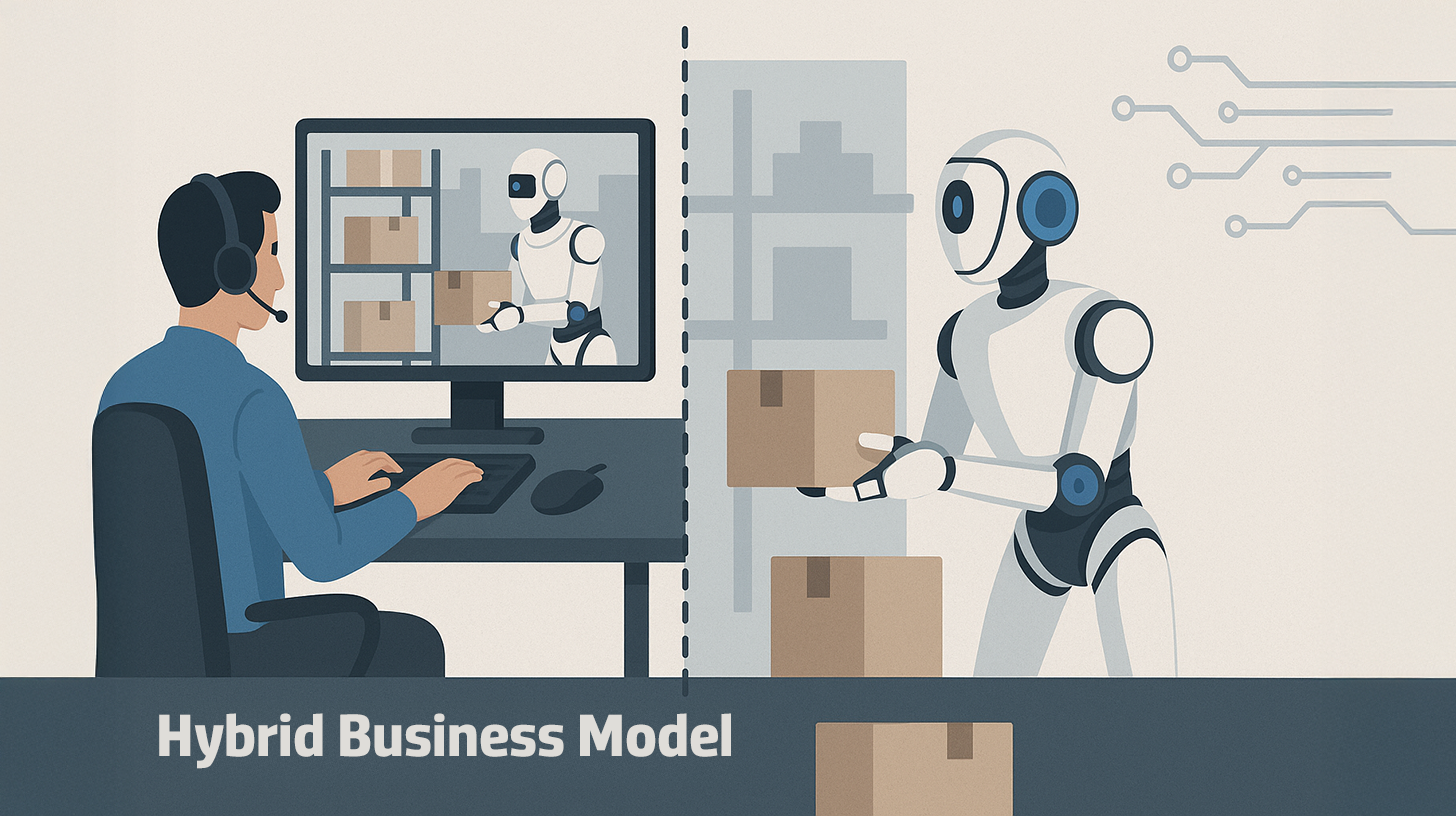
The hybrid business model of teleoperated robots as a transitional phase towards full automation – Image: Xpert.Digital
The invisible revolution of telerobotics: When humans become avatars and robots become the bridge between worlds
The birth of a dystopian trillion-dollar industry or the beginning of a new world of work?
Recent reports of Tesla's massive order for components for a reported 180,000 Optimus robots have raised a fascinating economic question that has largely gone unnoticed. While most observers focus on the technological challenges of fully autonomous artificial intelligence, a sober economic analysis points to an interim solution that appears both brilliant and deeply unsettling. Tesla has reportedly placed a $685 million order with Chinese supplier Sanhua Intelligent Controls, which industry experts say would be enough to produce roughly 180,000 humanoid robots. Deliveries of these linear actuators are slated to begin in the first quarter of 2026, suggesting accelerated mass production.
But here a fundamental paradox of current robotics development becomes apparent. The agent software necessary for these robots to independently perform most of the useful tasks that consumers would be willing to pay for simply doesn't yet exist. Even the most advanced humanoid robots currently operate at an autonomy level between two and three on a five-point scale, with level five representing complete autonomy. Tesla itself has had to reduce its originally planned 2025 production of at least 5,000 units to around 2,000, and even this figure appears to be at risk. The technical challenges are particularly focused on the robot's hands, the most complex element of the design, as well as the integration of hardware and software. Reports indicate that Tesla has accumulated a stockpile of partially completed robots lacking hands and forearms, without a clear timeline for their completion.
This discrepancy between announced production volumes and actual technological maturity raises a crucial question: What economic logic could underlie the mass production of robots that are not yet fully autonomous? The answer might lie in a hybrid business model that bridges the gap between human intelligence and machine execution in a way that could have profound implications for global labor markets.
Related to this:


The economic logic of remote control
The concept of teleoperation, the remote control of robots by human operators, is by no means new. It is already used in extreme situations such as nuclear decontamination, deep-sea exploration, and surgical robotics. What is new, however, is the potential scaling of this approach to mass-market applications for everyday tasks in homes and businesses. The global market for teleoperation and remote robotics was estimated at approximately $502.7 million in 2024 and is projected to grow to $4.7 billion by 2035, with an annual growth rate of 25.3 percent. These figures, however, do not yet capture the disruptive potential of a fully scaled model of remotely controlled humanoid robots for consumer applications.
The economic appeal of this model stems from the arbitrage of global wage disparities. While a software engineer in Los Angeles earns an average of $9,000 per month, the salary for the same qualification in India is around $900. This discrepancy is not an isolated case but reflects structural differences in the cost of living and local wage structures. Studies of global remote labor markets show that, despite the global nature of digital platforms, remote work salaries correlate strongly with the per capita income of the respective locations. A one percent increase in per capita income is associated with an average increase of 0.2 percent in remote work salaries.
If we apply this principle to physical labor performed by remotely controlled robots, an enormous economic dimension opens up. A robot purchased for a one-time cost of approximately $20,000 to $30,000 could theoretically be operated around the clock by different operators working in countries with lower labor costs. Even at an hourly wage of five to ten dollars, significantly higher than local average wages in many developing countries, this would be considerably cheaper for households in industrialized nations than local service providers. A professional cleaning service in Germany typically costs between €20 and €40 per hour. The same service could theoretically be offered by a remotely controlled robot for a fraction of this cost, while the operator in a developing country would earn an income significantly above the local average.
The mechanics of such a system would be relatively simple. Similar to existing platforms like Uber, an algorithm could match requests with available operators who possess the necessary skills. A rating system would ensure quality and reliability. The customer would book a service via an app, such as cleaning their apartment for two hours or repairing a household appliance. A qualified operator in another part of the world would log into the robot, complete the task, and then log out. The entire process would be handled through a central platform responsible for payment processing, quality control, and insurance matters.
The training data dimension
However, the economic logic of this model extends far beyond the immediate provision of services. One of the biggest challenges in developing fully autonomous robots is the lack of high-quality training data from the real world. Current estimates suggest a gap of five to six orders of magnitude between the available real-world robot data and the amount of data required to develop fundamental models. While simulations and video data can be used to supplement this, they are no substitute for comprehensive real-world data.
Large-scale teleoperation would provide precisely this data. Every movement, every decision, every adaptation to unforeseen situations by human operators would be recorded and could be used to improve autonomous systems. Projects like Humanoid Everyday have demonstrated the value of such datasets. This research project collected over 10,300 trajectories with more than three million individual images across 260 different tasks in seven categories, all through highly efficient, human-supervised teleoperation. This data included RGB images, depth perception, LiDAR scans, as well as tactile and inertial sensor data.
The economic valuation of this data dimension is difficult, but potentially enormous. Companies possessing comprehensive, high-quality datasets of real-world robot operations would have a significant competitive advantage in developing fully autonomous systems. This data would not only be valuable for their own product development but could also be licensed or sold. The global market for AI training data is growing exponentially, and robotics data from real-world environments is particularly valuable and rare.
For robotics companies, this would result in a threefold monetization strategy: First, through the sale or rental of hardware. Second, through commissions on the services provided, similar to the platform models of Uber or Airbnb. Third, through the collection and utilization of training data, which would ultimately lead to the development of fully autonomous systems that would render human operators obsolete. This transitional phase could prove exceptionally profitable, while simultaneously laying the technological foundation for the next phase.
The global wage arbitrage paradigm
To fully grasp the economic implications of this model, one must understand the mechanisms of global wage arbitrage. This economic phenomenon arises when barriers to international trade are reduced or disintegrate, and jobs migrate to countries where labor and the cost of doing business are significantly lower. Globalization over the past few decades has already accelerated this process considerably, particularly in manufacturing and digitizable services.
The rise of remote work has opened up a new dimension of wage arbitrage. While the COVID-19 pandemic accelerated this trend, all indications are that remote work will remain a permanent and essential feature of global labor markets. A 2021 study by Owl Labs found that 92 percent of European companies were considering progressive workplace policies such as four-day weeks and alternative working arrangements. Eleven percent of the companies surveyed were even planning to close their offices entirely.
This development has implications for both employers and employees. Companies can achieve significant cost savings by hiring remote workers from regions with lower living costs. At the same time, employees in these regions gain access to employment opportunities that were previously geographically inaccessible and offer salaries that exceed local standards. However, research also shows that while remote worker wages are more consistent across countries than local wages, significant geographical disparities still exist. The exchange rate penetration rate for local currency wages for remote work is around 80 percent, meaning that wages in local currency fluctuate almost one-to-one with the dollar exchange rate.
Applying this principle to physical labor through teleoperation would extend wage arbitrage, currently limited primarily to knowledge work, to a much broader sector. Domestic services, skilled trades, warehousing and logistics, care work, and many other areas that have been geographically confined could potentially be globalized. The economic impact would be enormous. Estimates of the global domestic services market alone amount to several hundred billion dollars annually. If even a fraction of this market were served by remotely controlled robotics, an industry worth tens of billions of dollars would emerge.
The market dynamics of the Robot-as-a-Service model
The Robot-as-a-Service (RaaS) business model has gained considerable importance in recent years. Instead of selling robots directly, companies offer them on a subscription or usage basis, similar to the Software-as-a-Service (SaaS) model. The global RaaS market was valued at $1.05 billion in 2022 and is projected to grow to $4.12 billion by 2030, with an annual growth rate of 17.5 percent. Another estimate puts the market at $1.80 billion in 2024, with a projected growth to $8.72 billion by 2034.
The appeal of the RaaS model lies in several factors. Customers eliminate the high initial investment required to purchase robots. Instead, they pay a regular fee for ongoing use, enabling scalability and flexibility. Maintenance, updates, and software integration are handled by the provider, ensuring operational readiness. For providers, the model offers predictable recurring revenue and better insights into usage patterns, allowing for more accurate sales forecasting and pricing.
A remotely controlled robotic model would be a perfect fit for this RaaS approach. Customers would pay monthly or usage-based fees covering both hardware usage and human service. The platform would centrally manage operator availability, monitor quality, process payments, and provide technical support. Unlike purely autonomous systems, however, such a hybrid model could reach market readiness much sooner, as it wouldn't rely on a complete solution to the autonomy challenges.
Several pricing models are conceivable. Time-based models would charge customers for usage time, approximately $15 to $25 per hour. Task-based models would bill based on completed tasks, for example, $50 for a full apartment cleaning, regardless of the time required. Subscription models could offer a fixed number of hours per month at a set price, such as $500 for 30 hours. The operator's actual cost would be only a fraction of this, typically between $5 and $10 per hour, allowing for substantial margins for the platform.
🎯🎯🎯 Benefit from Xpert.Digital's extensive, five-fold expertise in one comprehensive service package | BD, R&D, XR, PR & Digital Visibility Optimization


Benefit from Xpert.Digital's extensive, five-fold expertise in a comprehensive service package | R&D, XR, PR & Digital Visibility Optimization - Image: Xpert.Digital
Xpert.Digital possesses in-depth knowledge across various industries. This allows us to develop tailored strategies precisely aligned with the requirements and challenges of your specific market segment. By continuously analyzing market trends and monitoring industry developments, we can act proactively and offer innovative solutions. The combination of experience and expertise generates added value and provides our clients with a decisive competitive advantage.
More information here:
How remotely controlled humanoid robots could revolutionize global labor markets
The trillion-dollar vision and the reality
The vision of a multi-billion-dollar humanoid robot industry is not far-fetched. Morgan Stanley recently predicted that the humanoid robot market could reach five trillion dollars by 2050, with over one billion units in use worldwide. This projection includes hardware sales of approximately 4.7 trillion dollars, with software, data, and services contributing additional volume. Goldman Sachs estimated that the global humanoid robot market could reach a value of 38 billion dollars by 2035, with approximately 250,000 units for industrial applications and up to one million units annually for consumers within a decade.
The global market for humanoid robots was estimated to be between $1.55 billion and $2.02 billion in 2024, depending on the source, with projections ranging from $4.04 billion to $15.26 billion by 2030. These discrepancies in estimates reflect the uncertainty inherent in such a young and rapidly developing market. However, there is consensus that growth rates will be exceptionally high, with annual growth rates between 17.5 and 52.8 percent, depending on the source and underlying assumptions.
The rollout will be gradual, not explosive. Morgan Stanley expects around 13 million units to be in use by 2035, primarily in factories and warehouses. Falling prices will drive adoption. Retail prices could drop from the current $200,000 to $50,000 in wealthy countries by mid-century and to $15,000 in markets with Chinese-dominated supply chains. As G7 countries and China's workforce age, humanoids will transform from futuristic prototypes into practical necessities.
However, these projections typically assume increasing autonomy. A remotely controlled transitional model could significantly accelerate the timeline. Instead of waiting for full technological maturity, millions of robots could be deployed productively within the next five to ten years. Platform companies would build substantial market share and customer loyalty during this phase, giving them a decisive advantage when the technology finally enables fully autonomous operations.
Related to this:

The workers behind the machines
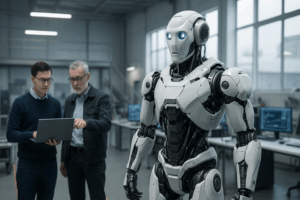
The human dimension of this model raises complex questions. Who would these operators be, and under what conditions would they work? The most likely candidates are workers in developing countries, where wage disparities are greatest. Countries like India, the Philippines, Vietnam, Bangladesh, and various African nations have large populations with sufficient digital skills but limited local employment opportunities.
For many people in these regions, remote control of robots would represent an attractive employment opportunity. The work would be less physically demanding than many local alternatives, would offer air-conditioned work environments, and could allow for flexible working hours. Salaries, while low by the standards of industrialized nations, would be above average for local conditions. An operator earning eight to ten dollars per hour would achieve a middle to upper income in many developing countries.
At the same time, this model carries significant risks of exploitation. The power dynamics between global platform companies and individual workers in developing countries are fundamentally asymmetrical. Without appropriate regulation and labor protection standards, conditions could become precarious. Studies on the existing gig economy and clickwork platforms show that workers are often confronted with unclear instructions, receive low wages, and have no social security. The work is often outsourced to third-party companies, which further obscures accountability.
Research on global wage arbitrage in the IT services industry shows that this practice has a significant impact on global labor dynamics. In high-wage countries, it leads to job losses, particularly in sectors with standardizable tasks. In low-wage countries, it creates employment opportunities but can also lead to wage pressure and poor working conditions if adequate regulations are lacking. The same dynamics would occur with remotely controlled robotics, only with potentially even greater reach, as it would not be limited to digital services.
The dystopian dimension
Particularly worrying is the possibility of using prison labor, mentioned in the original scenario. Indeed, there are already precedents for employing inmates in the digital economy. In Finland, since 2022, the company Metroc has employed prisoners in four prisons on data annotation tasks for AI training systems. The inmates receive computers and training and are paid €1.54 per hour, the same rate as for physical labor in prisons.
The ethical concerns surrounding such programs are significant. The EU Platform Work Directive, adopted in 2024, aims to protect gig economy workers and ensure fair wages, labor rights, and collective bargaining power for digital task-based workers. However, the directive does not explicitly address the specific circumstances of incarcerated digital workers. The European Convention on Human Rights prohibits forced labor but permits work necessary in the normal course of incarceration, provided it is lawful and fair.
Using prison labor for remote-controlled robotics would exacerbate these ethical dilemmas. The power imbalances within a prison environment significantly complicate the issue of voluntary work. If the work is poorly paid, offers no meaningful training, and primarily serves to provide cheap labor to private companies, it may violate fundamental principles of human rights and prison reform.
Even without prison labor, the model of remotely controlled robotics raises profound questions about exploitation and social justice. Would operators work in virtual sweatshops, with long shifts, minimal breaks, and constant surveillance? Would they receive adequate training and support, or simply be thrown into the tasks with the expectation of learning by trial and error? Would they have access to social security, or be treated as independent contractors without health insurance, vacation time, or retirement provisions?
The history of industrialization shows that technological progress without appropriate social and legal frameworks can lead to significant exploitation. The early textile factories in England, the sweatshops in the garment industry, the precarious conditions in call centers – all these examples serve as a warning. The globalization of physical labor through teleoperation could create similar or even worse conditions without proactive regulation, as the geographical distance between employers and employees significantly hinders the enforcement of standards.
Impact on local labor markets in industrialized countries
While operators in developing countries might face a form of exploitation, workers in industrialized countries would experience a different kind of threat: job loss. The service sector, particularly in areas such as cleaning, hospitality, retail, caregiving, and skilled trades, employs millions of people in Europe, North America, and other developed regions. These jobs are often poorly paid and offer limited opportunities for advancement, but they represent vital sources of income for many people with limited formal education or for immigrants.
The introduction of remotely controlled robots would directly compete with these workers. A robot operated by a human in India, working for $15 an hour, would be more attractive to most households than a local cleaning service charging $40 an hour. The economies of scale and lower labor costs would force many traditional service providers out of the market.
Research on the impact of automation on employment shows mixed results, depending on the specific technology, industry, and regulatory environment. Studies on industrial robots have found that one additional robot per thousand workers reduces the employment rate by 0.16 to 0.20 percentage points, with a significant displacement effect dominating. This displacement effect is particularly pronounced for workers with intermediate levels of education and younger cohorts, while men are more affected than women. However, other studies have found that overall employment does not decrease at the local level, as job growth in the service sector offsets the displacement effect in manufacturing.
Applying these findings to remotely controlled robotics is complex. On the one hand, it could be argued that creating new jobs for operators in developing countries provides some compensation for job losses in industrialized nations. On the other hand, this would exacerbate economic inequality between regions and increase social tensions in affected communities in industrialized countries. Goldman Sachs Research estimates that widespread adoption of AI could displace approximately six to seven percent of the US workforce, with the unemployment rate temporarily rising by half a percentage point during the transition. The effects are typically temporary and disappear after about two years as new employment opportunities emerge.
This optimistic outlook, however, rests on the assumption that new jobs will be created at a sufficient pace and in an appropriate manner. Historical experience shows that while technological change ultimately leads to more jobs, the transition can be painful for many workers. Approximately 60 percent of U.S. workers today hold jobs that did not exist in 1940, meaning that more than 85 percent of job growth since then has resulted from technologically driven job creation. Whether this historical dynamic will hold true in the coming decades is debatable, however, as the speed and scope of current technological changes may be unprecedented.
The training data as a Trojan horse
One of the most fascinating and simultaneously most disturbing aspects of the remotely controlled robotics model is its role as a transitional technology. For workers, it would offer employment opportunities; for the platform companies, however, it would be a mechanism for collecting data that would ultimately render their workforce redundant. Every action, every decision, every adjustment made by a human operator would be recorded, analyzed, and used to train the autonomous systems.
This process would be largely invisible to the workers themselves. They would carry out their daily tasks, controlling robots to clean houses, cook meals, or perform simple repairs. At the same time, their actions would be stored in vast databases, analyzed by machine learning algorithms. Over time, these systems would learn to replicate human decisions, initially for simple, repetitive tasks, then for increasingly complex activities.
The ethical implications of this practice are significant. Workers would essentially be working on their own replacements, often without being fully aware of it. While some might argue that this is a natural and efficient form of technological progress, it raises questions about transparency, informed consent, and fair compensation. Should operators be additionally compensated for the value of their training contributions? Should they be informed that their work is being used to ultimately replace them? Should they have a say in how their data is used?
These questions are not purely hypothetical. The existing AI industry already has significant problems with the exploitation of data workers. Companies frequently hire people from poor and underserved communities, including refugees, incarcerated individuals, and others with limited job opportunities, often through third-party companies as contractors rather than as full-time employees. These workers often receive as little as $1.46 per hour after taxes for the data annotation essential for training AI systems. They work under precarious conditions, with little protection and no recourse against unethical practices.
Data labeling work is often carried out far from the Silicon Valley headquarters of AI-first multinational corporations, from Venezuela, where workers label data for image recognition systems in self-driving vehicles, to Bulgaria, where Syrian refugees feed facial recognition systems with selfies labeled by race, gender, and age categories. These tasks are often outsourced to precarious workers in countries like India, Kenya, the Philippines, or Mexico. Workers often do not speak English but receive instructions in English and are threatened with termination or suspension from crowdwork platforms if they do not fully understand the rules.
The regulatory challenges
Regulating a global remotely controlled robotics platform would be exceptionally complex. The workers are located in one country, the platform in another, the customers in yet another, and the robots operate in a fourth. What labor laws would apply? Who would be responsible for accidents or damages? How would taxes be collected and distributed?
The existing legal frameworks are insufficient for this new form of global work. Most occupational health and safety laws are defined nationally or regionally and assume the physical presence of workers within the jurisdiction. The EU Directive on Platform Work is an attempt to close some of these gaps, but it does not fully capture the complexities of remotely controlled physical work. Similar challenges exist regarding taxation, social security contributions, and liability issues.
Another regulatory issue concerns data privacy. Robots operating in private homes would necessarily have access to intimate details of their owners' lives. Cameras and sensors would continuously collect data, and operators in distant countries would see this data in real time. How would this data be protected? Who would have access to it? How long would it be stored? Existing data protection laws, such as the GDPR in the EU, offer some safeguards, but their application to remotely controlled robotics is untested and potentially insufficient.
There are also questions of national security and economic sovereignty. When large parts of a country's essential service infrastructure become dependent on platforms based in other jurisdictions and employing workers from third countries, new vulnerabilities emerge. What would happen in the event of international conflicts, cyberattacks, or simply business disruptions? Would countries suddenly lose critical services?
Our global industry and economic expertise in business development, sales and marketing

Our global industry and economic expertise in business development, sales and marketing - Image: Xpert.Digital
Industry focus areas: B2B, digitalization (from AI to XR), mechanical engineering, logistics, renewable energies and industry
More information here:
A thematic hub offering insights and expertise:
- Knowledge platform covering global and regional economies, innovation and industry-specific trends
- A collection of analyses, insights, and background information from our key areas of focus
- A place for expertise and information on current developments in business and technology
- A hub for companies seeking information on markets, digitalization, and industry innovations
Autonomy vs. Teleoperation: Who will win the future of work?
The socio-psychological dimensions
Beyond the immediate economic and legal questions, there are deeper socio-psychological aspects to this development. How would it feel to be served in one's own home by a robot controlled by an invisible person in another part of the world? What kind of relationship would develop between customers and remote operators?
Research on telepresence systems suggests that people are indeed capable of interacting with remote operators through robotic avatars while maintaining a degree of social connection. The example of the Avatar Robot Cafe DAWN in Tokyo is instructive. There, cafe patrons are served by humanoid robots called OriHime, remotely controlled by people with disabilities and mobility limitations. The robots become the operator's avatar, capable of communicating, taking orders, and serving food, all from the comfort of their own home or hospital. The cafe has demonstrated that this form of telepresence can work for both operators and customers by creating employment opportunities and fostering social connections for people who would otherwise be isolated.
However, this model differs from commercial remote-controlled robotics in important aspects. At Café DAWN, the social and rehabilitative component is central to the concept. Customers know they are helping people who would otherwise have no employment opportunities. In contrast, commercial remote-controlled robotics would primarily focus on efficiency and cost minimization. The human operators would be interchangeable and largely invisible. Customers would mainly evaluate the service and the price, not the human connection.
This could lead to further alienation and atomization of social relationships. Traditional service relationships, however asymmetrical they may be, involve at least some degree of human interaction and recognition. A cleaner, a waiter, a tradesperson—all these people are physically present and perceived as human beings. A remotely controlled robot would remove this human dimension and replace it with an abstract service. For the operators, this could mean a form of invisibility, where their work is valued, but they themselves are neither seen nor acknowledged.
Related to this:

Alternative scenarios and possible developments
It is important to emphasize that the scenario outlined here—the widespread deployment of remotely controlled humanoid robots—is by no means inevitable. Several factors could prevent, slow down, or steer this development in different directions. The technical challenges of mass-producing reliable humanoid robots at affordable prices are considerable. Despite high-profile demonstrations and impressive progress with prototypes, fundamental problems remain. The battery life of most humanoid robots is currently only about two hours. Achieving a full eight-hour shift without recharging could take ten years or more. Dexterity and fine motor skills are still significantly below human levels, with considerable gaps in tactile sensitivity and precision.
Bain & Company analyzed in its 2025 Technology Report that humanoid robots are not yet ready for widespread use. Most humanoid robots are currently in pilot phases and heavily reliant on human input for navigation, dexterity, or task switching. This autonomy gap is real. Current demonstrations often mask technical limitations through staged environments or remote monitoring. Controlled environments such as industrial settings, parts of the retail sector, and select service environments are likely to be the first where humanoid robots are deployed—places where the layout and environment are well-known and tightly controlled.
It is also possible that the development of fully autonomous AI will progress faster than expected, thereby skipping or significantly shortening the remotely operated transition phase. Advances in generative AI and large language models are remarkable, and their integration into robotic systems could lead to breakthroughs that render the need for human operators obsolete sooner than anticipated. In this scenario, companies might move directly to fully autonomous systems without investing in the infrastructure for global teleoperation.
Another factor is potential social and political resistance. If the impact on local labor markets in industrialized countries becomes too severe, governments could implement regulatory measures to protect domestic jobs. This could range from tariffs on remote services and minimum wage requirements for remote operators to outright bans. Trade unions and labor organizations would likely exert significant pressure to protect their members.
On the other hand, ethical considerations and social responsibility could lead to better working conditions for operators. Companies committed to fair practices could differentiate themselves through certifications and transparency. Consumers might be willing to pay a premium for services provided under ethical conditions, similar to the fair trade model in other sectors. This would not eliminate the fundamental power imbalances, but it could at least prevent some of the worst forms of exploitation.
The long-term perspective
Taking a step back and considering the long-term perspective, remotely controlled robotics appears as a potential transitional phase in a larger technological and economic transformation. This transformation will ultimately lead to a world with a much higher degree of automation, but the path there is unclear and will be determined by many factors.
In an optimistic scenario, automation would lead to massive productivity gains that would benefit everyone. The released human workforce would move into new, more fulfilling, and better-paid jobs that machines cannot perform. Working hours would be reduced, and people would have more time for education, creativity, and personal development. The wealth created by automation would be redistributed through progressive taxation and social programs, possibly including a universal basic income. Workers in developing countries would gain skills and capital through temporary employment as robot operators, enabling them to transition to a diversified, modernized economy.
In a pessimistic scenario, automation would lead to massive job losses without creating sufficient new employment opportunities. The profits from automation would be concentrated in the hands of a small elite, while the majority of the population would face precarious employment, declining wages, and diminishing social mobility. Workers in developing countries would be exploited and then abandoned once their services were no longer needed. Social unrest, political instability, and growing inequality would characterize societies worldwide. The surveillance and control capabilities created by ubiquitous robotics would be misused by authoritarian regimes or corporations.
Reality will likely lie somewhere between these extremes, varying between different countries and regions depending on their political decisions, economic structures, and social institutions. Some societies may manage successful transitions with adequate safety nets, retraining programs, and redistribution mechanisms. Others could face crises, with growing inequality and social tensions.
The need for proactive design
The remotely controlled robotics model, if it is indeed implemented on a large scale, would embody these dynamics in a condensed form. It would take globalization to a new level by enabling physical labor across continents. It would create new forms of labor and exploitation. It would allow the collection of unprecedented amounts of data, thus paving the way for even deeper automation.
Given these prospects, proactive shaping rather than reactive adaptation is needed. Governments, international organizations, civil society, and businesses must work together to create frameworks that maximize the benefits of this technology while minimizing its risks. This requires multi-layered intervention. At the international level, treaties and agreements are needed that establish minimum standards for the employment of remote operators. These standards should include fair wages, reasonable working hours, health and safety protections, and the right to organize. The International Labour Organization could play a leading role here, similar to its efforts to regulate other forms of cross-border work.
At the national level, legislation is needed to protect the rights of both local workers and remote operators. This could include imposing taxes or levies on remotely operated services, with the revenue used to support retraining programs and social security for displaced workers. It could also include transparency and accountability requirements for platform companies, including disclosure of working conditions, data usage practices, and safety measures.
Data protection regulations must be adapted to the specific challenges of remotely controlled robotics. Clear rules are needed regarding what data may be collected, how it is stored and used, who has access to it, and under what conditions. Users should have the right to know when they are being operated by a remotely controlled system and the option to refuse. Operators should have the right to be informed about how their work data is used and, where appropriate, to share in the value created by their training contributions.
The ethical dimension of innovation
Ultimately, this discussion is not just about technology or economics, but about fundamental questions of ethics and the kind of society we want to build. Technological innovation is not value-neutral. The decisions that engineers, entrepreneurs, investors, and policymakers make today will shape the social structures of tomorrow.
The model of remotely controlled humanoid robotics embodies both the promises and the dangers of technological progress. On the one hand, it offers the potential to make services more affordable and accessible, create new employment opportunities in developing countries, and pave the way for even more advanced automation. On the other hand, it threatens to create new forms of exploitation, destabilize local labor markets, and lead to a further concentration of power and wealth in the hands of a small number of global platform companies.
The question is not whether this technology will be developed, but how. Will it be developed and deployed in a way that respects the dignity and well-being of all involved? Or will it primarily serve short-term profit interests, at the expense of social justice and sustainability? The history of technological development shows that the answer to this question is not predetermined. It depends on conscious decisions, political debates, social movements, and regulatory interventions.
In this sense, the discussion about remotely controlled robotics is also a discussion about the future of work, the nature of global economic relations, and the distribution of the profits from technological progress. It is a discussion that should not be left to technologists and business leaders alone, but must involve all parts of society. Only through a broad, informed, and democratic dialogue can we ensure that the robot revolution is not only technologically impressive, but also socially just and of human value.
The next few years will show whether Tesla's massive component order truly marks the beginning of a new global economic model, or whether alternative development paths will prevail. What is already clear, however, is that the convergence of humanoid robotics, teleoperation, and global wage arbitrage has the potential to transform labor markets in ways that are both revolutionary and deeply unsettling. The challenge lies in shaping this transformation so that it serves the common good and not just the interests of a select few.
Your global marketing and business development partner
☑️ Our business language is English or German
☑️ NEW: Correspondence in your native language!

Konrad Wolfenstein
I and my team are happy to be available to you as your personal advisor.
You can contact me by filling out the contact form here wolfenstein@xpert.digital:or simply call me at +49 7348 4088 965. My email address is
I'm looking forward to our joint project.