Revealing survey: These errors push battery storage systems to their limits – and cost operators millions – Image: Xpert.Digital
Batteries at their limit? How common mistakes jeopardize the future of energy storage – and what needs to be done now
Revealing survey: These flaws push battery storage systems to their limits – and cost operators millions
The energy transition and the growing need for stable and flexible power grids have brought battery energy storage systems (BESS) into sharp focus. These systems play a key role in integrating renewable energies, stabilizing the grid, and providing various energy services. Despite their enormous potential, the BESS industry still faces significant challenges in the daily operation and management of these complex systems. A recent study, the "BESS Pros Survey" by Twaice, has now shed light on these challenges and provides valuable insights into the industry's problem areas and areas for action.
The BESS industry (Battery Energy Storage Systems) encompasses companies and technologies focused on storing electrical energy in battery systems. These storage solutions play a central role in the energy transition, as they enable the efficient use of renewable energy sources such as solar and wind power, which are volatile and weather-dependent, by storing excess energy and feeding it back into the grid when needed.
The survey, which included over 80 industry experts such as plant managers, operations and maintenance personnel, and executives, paints a clear picture: Operating battery storage systems is more complex and prone to failure than often assumed. A key finding of the study confirms that system performance and availability are the biggest concern for operators. Over half of the respondents (58%) cited this as their primary challenge. This high figure underscores the need to further improve the reliability and efficiency of battery storage systems to maximize their economic viability and contribution to the energy transition.
Another alarming finding of the survey concerns the frequency of technical problems. Almost half of all respondents (46%) reported experiencing technical difficulties at least once a month. This figure rises even further when considering the perspectives of different professional groups within the BESS industry. Among plant managers, who bear comprehensive responsibility for the smooth operation of the systems, this figure reaches 53%. The problem becomes even more apparent from the perspective of operational staff: a staggering 73% of operations and maintenance personnel reported experiencing regular technical problems. These figures clearly demonstrate that technical malfunctions in BESS operations are not uncommon, but rather a recurring and burdensome problem that ties up significant resources and negatively impacts the overall performance of the facilities.
The study also shows that the BESS industry has not yet found the optimal tech stack, particularly in the area of software solutions. Only slightly more than half of the respondents (55%) expressed satisfaction with the technologies and tools they use to manage their systems. This relatively low level of satisfaction suggests that many of the currently available software solutions are not yet optimally tailored to the specific needs and challenges of BESS operations. There is a clear need for specialized software solutions that offer more comprehensive analytics capabilities, improve data integration, and reduce the complexity of BESS management.
Related to this:
Dr. Stephan Rohr, founder and co-CEO of Twaice, succinctly summarizes the necessity of a holistic data strategy. He emphasizes that success in the BESS industry is inextricably linked to data management. "Anyone who wants to be successful needs a holistic data strategy, must consider data from the outset, utilize it in all phases of the project, and analyze it correctly, instead of treating it as a mere add-on," says Dr. Stephan Rohr. This statement underscores that data is not just a byproduct of BESS operations, but a key asset that must be strategically leveraged to optimize performance, identify problems early, and maximize the economic efficiency of the systems.
The Twaice survey results thus highlight that the BESS industry is at a turning point. The transition from purely security-oriented operation to the active monetization of storage facilities requires a paradigm shift in how data and technology are handled. BESS operators urgently need access to reliable data and advanced analytics tools to minimize risks, maximize market opportunities, and fully utilize the capabilities of their systems.
Detailed analysis of system performance and availability issues
The “BESS Pros Survey” examined various specific problems related to the system performance and availability of battery storage in greater detail. These problems can be divided into different categories, each with different causes and effects on BESS operation.
Frequency of technical problems in detail
The aforementioned high frequency of technical problems (46% monthly on average, up to 73% for operations and maintenance personnel) is a worrying finding. It demonstrates that BESS operations in practice are often plagued by unexpected failures and disruptions. These problems can have a variety of causes, ranging from malfunctions of individual components and software errors to external factors such as extreme weather conditions. The high rate of technical difficulties underscores the need for more robust systems, improved monitoring and maintenance, and more effective troubleshooting and resolution.
Cellular imbalances: A creeping problem with far-reaching consequences
A particularly relevant problem, not explicitly quantified in the survey but widely known in the BESS industry, is cell imbalance. Battery storage systems consist of numerous individual battery cells connected in modules and strings. Ideally, all cells in a system should have identical properties and behave uniformly during operation. In reality, however, imbalances between cells are common and can worsen over time.
Cellular imbalances can have various causes, including:
- Manufacturing tolerances: Even high-quality battery cells have slight differences in their electrochemical properties.
- Temperature gradients: Different positions within the battery storage system can lead to uneven temperature distributions, which affects the aging of the cells differently.
- Current distribution: Uneven current distribution in the modules and strings can also lead to different loads and aging of the cells.
- Aging effects: As the battery ages, the differences between the cells increase due to different aging rates.
The consequences of cellular imbalances are diverse and negative:
- Energy waste: Unevenly charged and discharged cells lead to inefficient use of the storage system's total capacity. Cells with lower capacity limit the total usable capacity.
- Increased safety risks: Cells that are overcharged or undercharged are more susceptible to thermal runaway and other safety-related problems. Imbalances can compromise the stability of the entire system.
- Reduced overall capacity and performance: Cell imbalances reduce the usable capacity of the battery storage and can also impair performance, especially at high discharge or charge rates.
- Accelerated aging and reduced lifespan: Cells subjected to heavier loads or operating under unfavorable conditions age faster. Cell imbalances can therefore shorten the lifespan of the entire battery bank and lead to premature component replacement.
Cooling problems: Heat as a performance killer and safety risk
Another key challenge in BESS operation is cooling. Batteries generate heat during operation, especially during high-current charging and discharging. Effective cooling is therefore essential to maintain the cells' operating temperature within an optimal range. Overheating can lead to performance losses, accelerated aging, and, in the worst case, thermal runaway—a dangerous event where the battery overheats uncontrollably and can catch fire.
Cooling problems can have various causes:
- Inadequate sizing of the cooling system: In some cases, the cooling system may not be adequately sized to dissipate the heat generated during operation, especially at high ambient temperatures or with intensive use of the storage system.
- Failure of cooling components: Mechanical or electrical defects in fans, pumps, heat sinks or other components of the cooling system can lead to a cooling failure.
- Blockage or contamination: Cooling channels can become blocked by dust, dirt, or corrosion, which impairs cooling performance.
- Inefficient cooling strategies: Incorrect control of the cooling system or an inefficient arrangement of the cooling components can lead to uneven cooling and hotspots within the battery storage system.
The consequences of cooling problems are serious:
- Performance losses: At elevated temperatures, the performance of battery cells decreases. The internal resistance increases, leading to voltage losses and lower energy efficiency.
- Safety risks: Overheating is a major risk factor for thermal runaway. Cooling failure can drastically increase the likelihood of such an event.
- Accelerated aging: High operating temperatures accelerate the chemical degradation processes in the battery, thus shortening its lifespan.
Data management and integration: The challenge of information overload
The Twaice survey also identified difficulties in data management and integration as a significant challenge (34% of respondents). Modern battery storage systems are highly complex systems that generate a wide range of data, including voltages, currents, temperatures, states of charge, error codes, and much more. Effective acquisition, analysis, and utilization of this data is crucial for optimized operation, fault diagnosis, and lifetime prediction of BESS (Battery Energy Storage Systems).
Data management and integration challenges include:
- Data volume and variety: The sheer amount of data generated by a BESS can be overwhelming. Furthermore, the data is often available in different formats and from various sources.
- Data quality: Not all data is created equal. Measurement errors, noise, or incomplete data can complicate analysis and lead to incorrect conclusions.
- Data integration: BESS data often needs to be integrated into existing energy management systems (EMS), grid control systems, or cloud platforms. This integration can be complex and requires standardized interfaces and protocols.
- Data analysis and visualization: Raw data alone is not very informative. Advanced analysis tools and visualizations are needed to extract relevant information from the data and make it usable for BESS operations.
The consequences of inadequate data management and integration are:
- Inefficient operation: Without comprehensive data analysis, it is difficult to optimize BESS operation, adapt charging and discharging strategies, or react to changes in the grid or market.
- Delayed fault detection: Problems such as cell imbalances, cooling problems, or incipient degradation can go undetected and worsen without effective data monitoring and analysis.
- Limited lifespan prediction: Accurately predicting battery lifespan and maintenance requirements is hardly possible without comprehensive data analysis. This complicates long-term planning and cost-benefit analysis.
Degradation and lifespan management: The ticking clock of the battery
Another important problem area, mentioned by 31% of survey participants, is the degradation and lifespan management of battery storage systems. Batteries are consumable components whose capacity and performance decrease over time. This degradation process is unavoidable but is influenced by various factors, including operating temperature, charge and discharge cycles, state of charge, and current rates.
Related to this:
Challenges in the area of degradation and lifetime management include:
- Capacity loss: The usable capacity of the battery decreases over time. This capacity loss is a natural aging process caused by chemical and physical changes in the battery cells.
- Performance loss: In addition to capacity loss, the battery's performance, especially at high current rates, can also decrease over time. This is caused by an increase in the internal resistance of the cells.
- Battery life prediction: Accurately predicting battery life is complex and depends on many factors. Manufacturer specifications are often only estimates and may differ in practice.
- Optimizing lifespan: BESS operators face the challenge of designing the operation of their systems to maximize lifespan without compromising economic efficiency and the fulfillment of system requirements.
The consequences of inadequate degradation and lifetime management are:
- Reduced service life: Faster degradation leads to a shorter lifespan of the battery storage and higher replacement costs.
- Economic losses: The loss of capacity and the decrease in performance reduce the revenue from BESS operation, as less energy can be stored and provided.
- Uncertainties in long-term planning: An inaccurate lifetime forecast makes long-term planning of maintenance, replacement and investments in new battery storage systems more difficult.
Strategies for reducing degradation and extending service life
In light of these challenges, it is crucial to implement strategies and measures that slow down the degradation of battery storage systems and extend their lifespan. These strategies can be divided into several areas:
Intelligent charging management: Gentle charging for a long service life
Intelligent charging management is a key factor in reducing battery degradation. This involves designing the charging process in such a way that the battery is subjected to as little stress as possible and operates in optimal conditions.
Optimal State of Charge (SoC): It is advisable to keep the battery's state of charge within a moderate range, typically between 20% and 80%. Extreme states of charge, both full charge (100%) and deep discharge (near 0%), put stress on the battery and accelerate degradation. Avoiding these extremes significantly contributes to extending battery life. This range is often referred to as the "sweet spot" for optimizing battery life.
Avoiding extremes: Consistently avoiding full charges and deep discharges is a key aspect of intelligent charge management. Strategies such as limiting the maximum state of charge and setting a discharge depth limit can be implemented to avoid these extremes.
Reduced charging speed: Fast charging, especially at high charge levels, can put more strain on the battery than slow charging. Alternating current (AC) charging is generally gentler than fast direct current (DC) charging. For applications where charging time is not critical, a reduced charging speed can positively impact battery lifespan. Modern charging systems often offer the option to regulate the charging speed and adapt it to specific needs.
Temperature management: Cool heads for long service life
As mentioned previously, operating temperature is a crucial factor in battery degradation. Effective temperature management is therefore essential to keep the battery within an optimal temperature range.
Optimal temperature range: The ideal temperature range for lithium-ion batteries is typically between 15°C and 35°C. Maintaining this range minimizes the degradation rate and maximizes lifespan.
Avoid extreme temperatures: Both very high and very low temperatures are harmful to batteries. Charging at temperatures below 10°C should be avoided, as this can lead to lithium plating and capacity loss. Storage at temperatures above 40°C also accelerates degradation.
Active cooling: Many BESS applications require active cooling to regulate battery operating temperature, especially under high power demands or in warm climates. Various cooling technologies are available, including air cooling, liquid cooling, and phase-change materials. The choice of the appropriate cooling technology depends on the specific application requirements and environmental conditions.
Usage optimization: Gentle operating strategies for maximum lifespan
The way a battery storage system is used has a significant impact on its lifespan. An optimized usage strategy can minimize degradation and extend the lifespan.
Depth of Discharge (DoD) Limitation: Frequent deep discharges put more strain on the battery than shallow discharges. Limiting the depth of discharge, for example to 80% DoD, can significantly increase the number of charge cycles. Manufacturers often provide recommendations for the maximum depth of discharge for their batteries.
Reducing high-current discharges: High current loads, both during charging and discharging, lead to increased battery heating and higher cell stress. Limiting high-current discharges can reduce degradation and extend battery life. In many applications, it is possible to adjust the operating strategy so that peak loads are covered by the battery storage, while base load operation occurs at lower current rates.
Cycle management: The number of charge and discharge cycles is a key factor in battery lifespan. Limiting daily charge cycles, for example through intelligent storage management, can extend battery life. In some applications, it is possible to primarily use the storage for specific time windows or events and thus reduce the number of cycles per day.
Advanced technologies and software solutions: Intelligence for a long lifespan
Modern technologies and software solutions play a crucial role in optimizing BESS operation and extending its lifespan.
Battery management systems (BMS): Modern BMS are sophisticated control systems that monitor and optimize the battery's condition in real time. They record a variety of parameters such as cell voltages, cell temperatures, currents, and states of charge. Based on this data, they can control the charging and discharging process, compensate for cell imbalances, regulate cooling, and detect fault conditions. Advanced BMS feature algorithms for lifetime prediction and adaptively adjusting the operating strategy to the battery's condition.
Analytics platforms: Cloud-based analytics platforms enable the centralized collection and analysis of BESS data from various systems. They offer real-time monitoring, trend analysis, fault diagnosis, and predictive maintenance functions. By leveraging big data analytics and artificial intelligence, these platforms can provide valuable insights into battery health and performance, contributing to the optimization of operation and lifespan.
Regular software updates: The software of inverters, energy management systems, and BMS is continuously developed and improved. Regular software updates ensure that the systems operate with the latest algorithms and functions and are optimally aligned with current requirements and insights.
Maintenance and care: Regular checks for lasting performance
In addition to technological measures, regular maintenance and care are essential for the long-term performance and lifespan of battery storage systems.
Regular checks: Routine inspections should be carried out to detect wear, damage, or anomalies early. This includes checking connections, cables, cooling components, housings, and measuring cell voltages and temperatures.
Clean environment: A clean and dry location is important to prevent corrosion and contamination. The battery should be cleaned regularly to remove dust and dirt. Appropriate tools and cleaning agents should be used to avoid damage.
Innovative approaches: Beyond standard operations
In addition to established strategies, there are also innovative approaches that could play an even greater role in extending the lifespan of battery storage systems in the future.
Cycling within the optimal range (“Radical Aging Optimizer”): Some studies suggest that cycling within a very narrow state-of-charge (SoC) range, for example between 15% and 50% SoC, can significantly extend battery lifespan in certain applications. This strategy, known as the “Radical Aging Optimizer,” aims to operate the battery primarily in the range where the degradation rate is lowest.
Capacity expansion: In some cases, it can be economically advantageous to physically or virtually expand the overall capacity of the battery storage system over time. This can be achieved by replacing individual modules or by integrating additional storage capacity. Virtual capacity expansion can be achieved through intelligent management of storage usage, for example, by reducing the depth of discharge and adjusting the usable capacity to current demand.
Warranty and contract management: protection and long-term profitability
Warranty and contract management are of central importance for the economic success and long-term security of battery storage systems. Battery storage systems are long-term investments, and comprehensive warranties are essential to minimize investment risk.
Importance of the guarantee: Long-term security for investments
A comprehensive warranty for battery storage systems offers various forms of protection:
- Long-term security: Battery storage systems are typically designed for a lifespan of 10 years or more. A warranty covering this period provides long-term security for the investment. Ten-year warranty periods are common in the BESS industry, and in some cases, even longer warranty periods are offered.
- Performance Guarantee: A performance guarantee ensures that the battery retains a certain minimum capacity over a specific period. This guarantee is crucial for the system's economic viability, as it ensures that the expected performance is delivered throughout the battery's lifespan. Typically, manufacturers guarantee a capacity retention of 70% or 80% after a certain number of years or cycles.
- Product warranty: A product warranty covers material and manufacturing defects. It protects against premature failures due to production flaws and guarantees the right to repair or replacement of defective components.
Contract management and warranty conditions: The devil is in the details
- Warranty terms for battery storage systems are often complex and individualized. Careful contract management is therefore essential to maintain an overview and ensure that warranty claims can be made when needed.
- Complexity of the terms and conditions: Warranty agreements for BESS can be extensive and detailed. They often contain specific terms and clauses that must be carefully reviewed and understood. It is advisable to seek legal advice when reviewing the contract to ensure that the terms and conditions are reasonable and comprehensible.
- Compliance with operating limits: Warranties are generally contingent upon adherence to specific operating limits. These may relate to temperature, state of charge, current rates, or other operating parameters. Continuous monitoring of operating data is therefore necessary to ensure compliance with the warranty conditions.
- Documentation: Accurate documentation of operating data, maintenance work, and malfunctions is often a prerequisite for making warranty claims. It is important to systematically record and archive all relevant data in order to provide proof if needed.
Impact on operations: Warranty conditions as a guideline
The warranty conditions have a direct impact on the operating strategy and maintenance planning of battery storage systems.
- Optimizing the operating strategy: Warranty conditions often specify the operating ranges within which the system may operate to avoid jeopardizing the warranty. The operating strategy must therefore be optimized to meet both system requirements and warranty conditions. This might mean, for example, limiting the state-of-charge range or avoiding high-current discharges.
- Maintenance planning: Regular maintenance and inspections are often a prerequisite for maintaining the warranty. Maintenance planning must therefore be designed to ensure that the required maintenance intervals and procedures are adhered to. This can include performing visual inspections, measuring cell parameters, or replacing worn parts.
Financial aspects: Cost savings and planning security
Effective warranty and contract management has significant financial implications for BESS operations.
Cost savings: A valid warranty can save considerable costs on repairs or component replacements. In the event of a defect or unexpected failure, the warranty may cover the cost of repair or replacement.
Planning security: Clear warranty conditions enable better financial planning over the system's lifetime. Understanding the warranty conditions allows operators to better estimate long-term operating costs and minimize financial risks.
Technological support: Software for warranty management
Modern technologies and software solutions can also offer valuable support in the area of warranty and contract management.
Monitoring tools: Specialized software tools can automate the monitoring of warranty conditions and operating parameters. These tools can monitor compliance with operating limits, track maintenance intervals, and issue warnings when necessary.
Predictive maintenance: Analytics platforms and predictive maintenance systems can identify potential problems early and help secure warranty claims. By analyzing operational data, these systems can detect anomalies and incipient defects before they lead to a breakdown. This enables timely maintenance measures and can substantiate warranty claims.
Holistic approach to successful BESS operation
The “BESS Pros Survey” by Twaice has clearly demonstrated that operating battery storage systems presents significant challenges. Technical issues, cell imbalances, cooling problems, data management, and degradation are just some of the areas where optimization is needed. Overcoming these challenges and unlocking the full potential of battery storage requires a holistic approach that includes technological innovation, optimized operating strategies, meticulous maintenance management, and effective warranty and contract management. Only through the consistent implementation of these measures can the BESS industry realize its full potential and make a substantial contribution to the energy transition. The future of energy storage depends significantly on the success of continuously improving the reliability, efficiency, and lifespan of battery storage systems.
Plan your solar system for the most common applications conveniently online with our solar system planner!
With our user-friendly solar system planner, you can design your individual solar system online. Whether you need a solar system for your home, your business, or for agricultural purposes, our planner allows you to consider your specific requirements and develop a customized solution.
The planning process is simple and intuitive. You simply enter the relevant information. Our planner takes this information into account and creates a customized solar system that meets your needs. You can try out different options and configurations to find the optimal solar system for your application.
Furthermore, you can save your plan to review it later or share it with others. Our customer service team is also available to answer any questions and provide support to ensure your solar system is optimally planned.
Use our solar system planner to design your individual solar system for the most common applications and accelerate the transition to clean energy. Get started now and take an important step towards sustainability and energy independence!

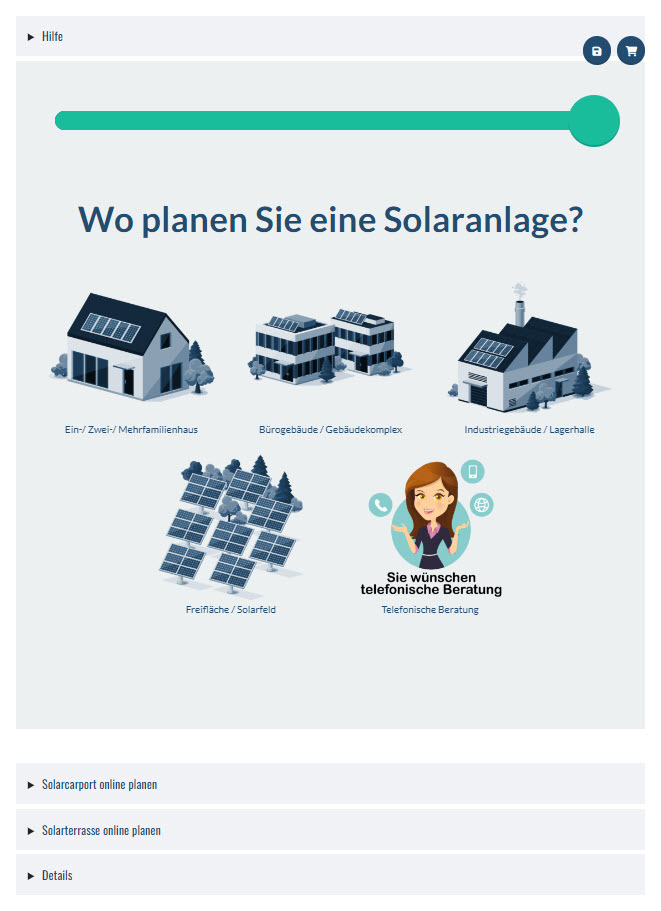
The solar system planner for the most common applications: Plan your solar system online here - Image: Xpert.Digital
More information here:
We are here for you - Consulting - Planning - Implementation - Project Management
☑️ SME support in strategy, consulting, planning and implementation
☑️ Creation or realignment of the digital strategy and digitization
☑️ Expansion and optimization of international sales processes
☑️ Global & Digital B2B trading platforms
☑️ Pioneer Business Development

Konrad Wolfenstein
I would be happy to serve as your personal advisor.
You can contact me by filling out the contact form below or simply call me on +49 7348 4088 965 .
I'm looking forward to our joint project.
Write to me


Xpert.Digital - Konrad Wolfenstein
Xpert.Digital is a hub for industry focusing on digitalization, mechanical engineering, logistics/intralogistics and photovoltaics.
With our 360° Business Development solution, we support renowned companies from new business to after-sales.
Market intelligence, smarketing, marketing automation, content development, PR, mail campaigns, personalized social media and lead nurturing are part of our digital tools.
You can find more information at: www.xpert.digital - www.xpert.solar - www.xpert.plus
Keep in touch