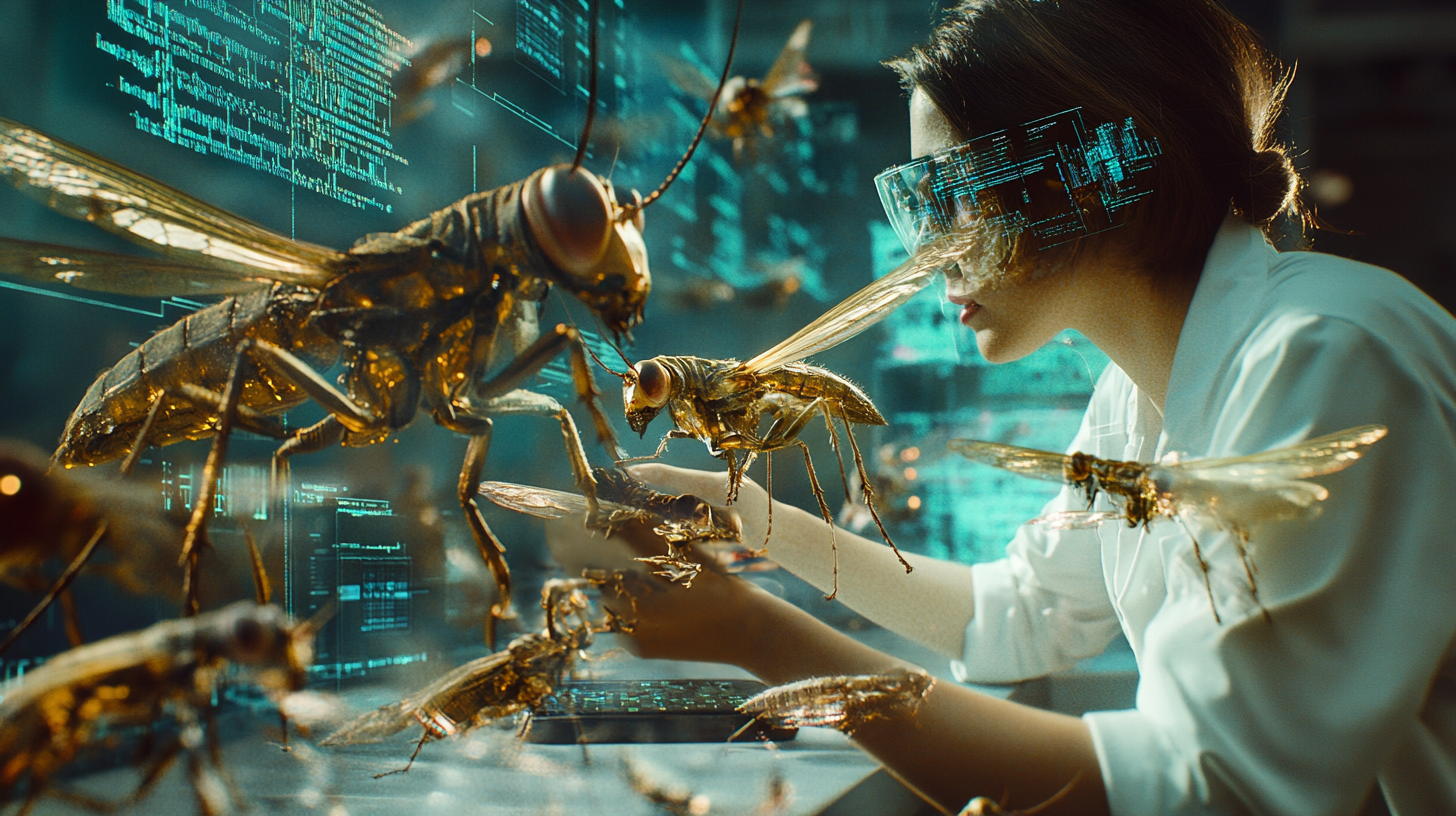
Swarm intelligence and swarm research with virtual reality: German scientists analyze locust swarms – Image: Xpert.Digital
VR research reveals new structures in locust swarms
Breakthrough in locust research: Long-standing theories refuted
The desert locust has had a fearsome reputation since biblical times. With swarms of up to 50 million individuals, this insect species can wreak havoc by devouring entire regions and thus jeopardizing food security. Now, researchers from the University of Konstanz and the Max Planck Institute of Animal Behavior have gained groundbreaking insights into the organization of these swarms, overturning long-held theories. Using innovative virtual reality technology, the scientists were able to demonstrate that locust swarms organize themselves fundamentally differently than previously assumed. This study, published in the prestigious journal "Science," turns existing explanatory models on their head and provides important insights that could contribute to better prediction and control of locust plagues.
Related to this:


The phenomenon of locust swarms and their global significance
Desert locusts (Schistocerca gregaria) are among the most impressive examples of collective behavior in the animal kingdom. The flightless young insects, called nymphs, initially live as isolated individuals. Under certain conditions, however, they congregate in enormous swarms and begin to migrate—not aimlessly, but in a coordinated movement, as if centrally controlled. These vast insect swarms can comprise up to 50 million individuals, making them one of the largest animal collectives on our planet.
The effects of such locust swarms are devastating. Researchers estimate that they threaten the livelihoods of approximately one in ten people worldwide. A concrete example of this was the massive locust plague in the Horn of Africa between 2019 and 2020, which devastated agricultural production and triggered a famine. Therefore, scientific research into the mechanisms that lead to the formation and movement of such swarms is not only of theoretical interest but also has considerable practical significance for global food security.
The previous theory: Locusts as "self-propelled particles"
For decades, the collective behavior of locust swarms has been explained using a concept from theoretical physics. In this model, the insects are considered "self-propelled particles" that align their positions and directions of movement with their immediate neighbors. This theory assumes that it is sufficient for individuals to align themselves with their immediate neighbors to generate a coherent movement across the entire swarm.
Another key element of this previous explanation was the assumption that animal density is a crucial factor in the transition from disordered to ordered swarming movement. According to this hypothesis, the transition to coordinated movement begins as soon as enough animals gather in a confined space. This theory seemed so convincing that it served as the standard model for explaining collective movements in the animal kingdom for decades.
Interestingly, previous research led by Iain Couzin, who is also involved in the current study, had already yielded other surprising insights into the swarming behavior of locusts. His team discovered that cannibalism could be a driving factor in their migratory movements – the locusts move forward to avoid being eaten from behind. This finding already suggested that more complex behaviors than mere physical reactions might be at play.
The innovative research approach: Virtual Reality reveals the secrets of the swarm.
To better understand the complex interactions within locust swarms, the research team led by Iain Couzin from the Cluster of Excellence "Collective Behavior" at the University of Konstanz and the Max Planck Institute of Animal Behavior employed a revolutionary approach: virtual reality (VR). "It is notoriously difficult to discern the mechanisms of interaction in mobile animal groups," explains Couzin. "Individuals influence each other and are simultaneously influenced by the behavior of others, in a complex interplay."
To solve this problem, the researchers developed a sophisticated VR setup. Individual live grasshoppers were placed on a moving ball, similar to a treadmill, allowing them to move freely. Around them, the scientists projected up to 64 photorealistic virtual grasshoppers, so that the real insects believed they were in a natural swarm. This innovative method enabled the researchers to precisely control what information was available to the live grasshopper—how many other animals were in its vicinity and in which direction they were moving.
In a particularly revealing experiment, the researchers placed real locusts between two virtual, three-dimensional swarms. This experimental setup allowed them to specifically test whether the animals would actually react to the behavior of their immediate neighbors, as previously assumed, and move with them as a unified swarm.
Surprising results: A paradigm shift in swarm research
The results of the experiments were surprising and fundamentally challenged existing theory. Contrary to the researchers' expectations, the real locusts did not move in the same direction as part of a large, uniform swarm. Instead, they turned towards one of the virtual swarms and moved directly towards it.
This observation showed scientists that the so-called "optomotor response"—an innate reflex that causes locusts to follow sensory impressions of movement—is not the cause of the coordinated collective movement. In fact, the researchers found no evidence that locusts align their position and direction of movement based on their neighbors at all.
“Individual animals are not particles,” explains Iain Couzin. “We must consider the locusts as cognitive, acting subjects that observe their environment and, based on this, make decisions about where to go next.” The researchers now assume that the formation of a swarm depends much more on each individual locust than previously thought.
The experiments also showed that the animals sometimes deviated from the common course, even when they had two swarms alongside them moving in the same direction. Furthermore, the team found no evidence that the density of individuals, as previously assumed, is the triggering factor for swarming movement.
Practical implications for combating locust plagues
The new findings have far-reaching practical implications. A better understanding of the fundamental mechanisms of swarming and movement could help predict insect behavior and develop more effective strategies for combating locust plagues.
Given that locust swarms threaten the livelihoods of an estimated one in ten people, the importance of this research cannot be overstated. The devastating impact of the locust plague in the Horn of Africa between 2019 and 2020, which led to crop failures and famines, underscores the urgent need for improved forecasting and control mechanisms.
The realization that locusts do not simply act as physical particles, but as individual cognitive agents with their own decision-making processes, opens up new approaches to controlling swarms. Instead of relying solely on large-scale control measures, future strategies could focus more on understanding and influencing individual decision-making processes.
Related to this:


Future research directions and the “Center for Visual Computing of Collectives”
These groundbreaking findings represent only the beginning of a new understanding of collective behavior. To further advance this field of research, Iain Couzin initiated the "Center for Visual Computing of Collectives" in Konstanz. This center, which will be among the most modern facilities for researching group behavior, will observe animal swarms in virtual holographic 3D environments and analyze their movements.
In parallel, Couzin's team is also researching spatial decision-making in various animal species. A recent study published in PNAS shows how animals process the complexity of their environment by reducing the world to successive decisions between just two options. These findings suggest that fundamental geometric principles could explain how and why animals move the way they do—an approach that might also be applied to understanding locust swarms.
A new era in the study of collective behavior
The research by scientists from the University of Konstanz and the Max Planck Institute of Animal Behavior marks a turning point in the understanding of collective behavior in the animal kingdom. By challenging the long-established theory of "self-driven particles," they open up a new perspective that views grasshoppers and other animals as individual decision-makers whose collective behavior results from complex cognitive processes.
The use of innovative virtual reality technology has proven key to success. It has enabled researchers to decipher the previously impenetrable complexity of animal collectives and gain fundamental insights into swarm organization. These findings could not only revolutionize our theoretical understanding of collective behavior but also offer practical solutions for combating locust plagues that threaten food security worldwide.
The work of Iain Couzin's team, who has already been awarded the prestigious Gottfried Wilhelm Leibniz Prize for his research in the field of collective behavior, underscores the importance of interdisciplinary research at the interface of biology, computer science, and physics. It impressively demonstrates how modern technologies can help us unlock the fascinating secrets of nature while simultaneously developing practical solutions to pressing global problems.
Related to this:
Your global marketing and business development partner
☑️ Our business language is English or German
☑️ NEW: Correspondence in your native language!

Konrad Wolfenstein
I and my team are happy to be available to you as your personal advisor.
You can contact me by filling out the contact form here wolfenstein@xpert.digital:or simply call me at +49 7348 4088 965. My email address is
I'm looking forward to our joint project.