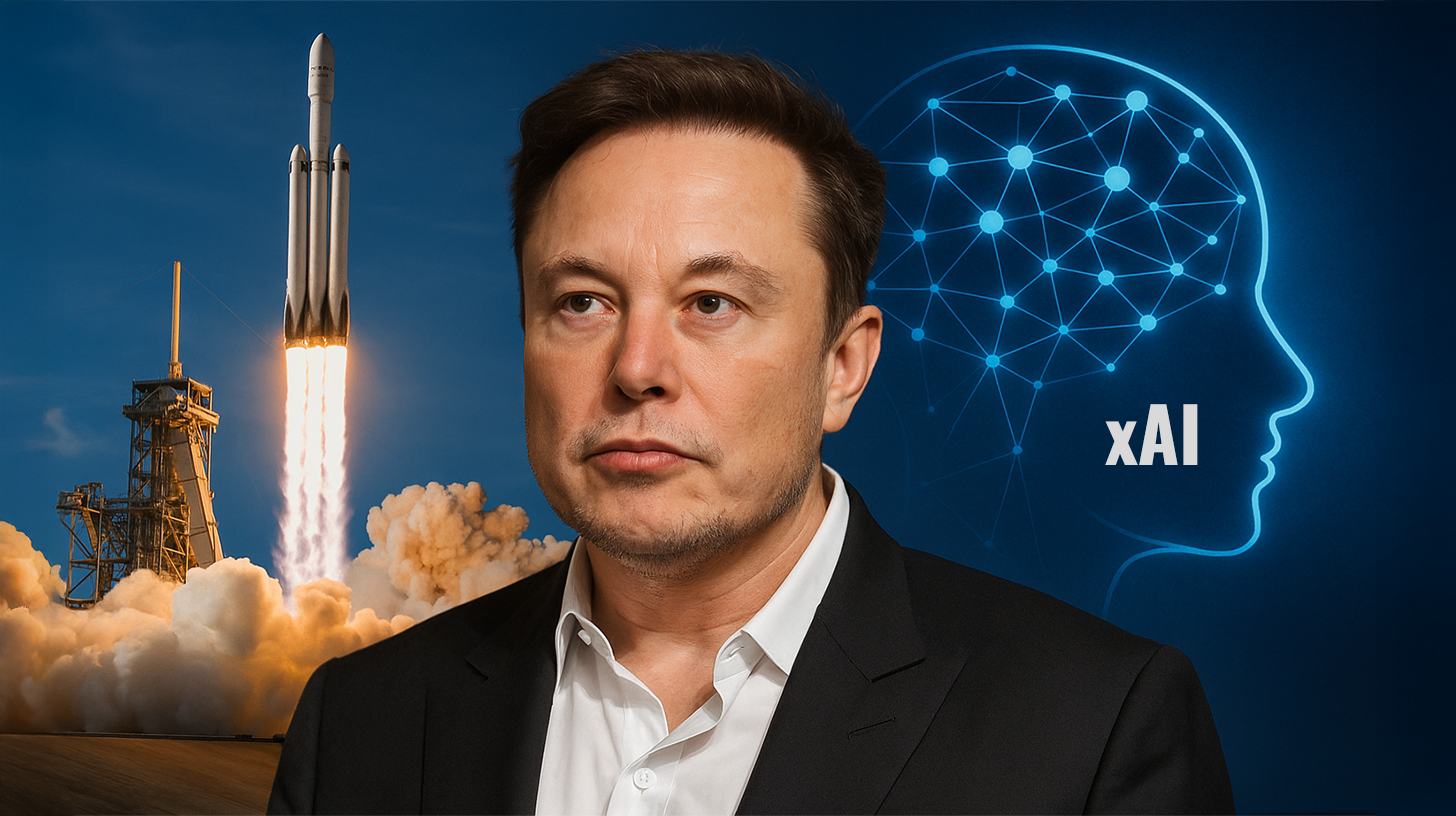
Space travel meets AI: How SpaceX's 2-billion-dollar bet in xAI is changing the future – Creative image: Xpert.Digital
Elon Musk's daring plan: SpaceX's risky 2 billion investment in xAI
SpaceX invests two billion US dollars in xAI
The news hit like a rocket: SpaceX, Elon Musk's aerospace company, is transferring two billion US dollars to his AI startup xAI. At first glance, it sounds like an internal transfer between sister companies. But in reality, it's the largest external investment SpaceX has ever made. The decision further connects the worlds of space travel, satellite internet, humanoid robotics, electric vehicles, and social networks. To understand why Musk is undertaking this risky financial maneuver, one must delve deeper into the strategy, analyze the financial situation of those involved, examine technological synergies, and consider political and regulatory pitfalls.
Related to this:


The core transaction at a glance
In July 2025, SpaceX subscribed to $2 billion worth of shares in xAI as part of a $5 billion equity funding round. Together with a concurrent debt financing of the same amount, this round brought the AI company a fresh $10 billion. This increased xAI's cash reserves to approximately $8 billion, while SpaceX, after the closing, held a high single-digit percentage stake, making it xAI's largest institutional investor.
The official valuation of the combined structure of xAI and the social network X, which was integrated in March via a stock swap, is $113 billion. Unofficially, pitch decks are already circulating that suggest a further increase of up to $200 billion. Musk is clearly aiming to compete on a similar scale to OpenAI, which was recently valued at around $300 billion on secondary markets.
Strategic motives and synergies
Starlink and Grok – Automated customer support and network optimization
The Starlink satellite service already uses xAI's Grok 4 language model to answer standard inquiries from its five million subscribers. This not only reduces call center costs but also allows tickets to be prioritized and routed to human technicians. In a second phase of development, Grok will be able to independently recognize traffic patterns, dynamically reallocate resources, and proactively report disruptions. This will integrate AI directly into the operational nervous system of the satellite network.
Edge AI for space travel and Starship
The next logical step is to shift some of the intelligence onto the spacecraft. Thanks to xAI's Colossus supercomputer – currently 200,000 Nvidia and AMD GPUs, with a potential expansion to one million – SpaceX can train extremely computationally intensive models. These networks are intended to run on board Starship systems in the future: for autonomous course corrections, fuel balancing, risk analysis under thermal stress, and predicting Raptor engine failures. Such availability of AI directly in orbit is considered key to achieving the stated goal of sending humans to Mars and back.
Humanoid robotics and Tesla Optimus
Tesla has been working on Optimus, a humanoid robot platform, for years. Grok modules are now taking over tasks such as planning grasping strategies and engaging in speech interaction. The learning experiences gained from this frontier in robotics are then being applied to SpaceX manufacturing facilities: An automated Starship assembly line could use robots with Grok brains to inspect welds or precisely lay carbon fiber mats.
Data loop over X – the flywheel
The more intensively Grok is integrated into X, the more real-time data the model receives, and the greater the increase in user engagement on the platform. Higher engagement generates more advertising revenue and even more interaction data – a self-reinforcing cycle that Musk describes as a "flywheel".
Financial implications and risk buffer
Liquid assets and cash burn
At the end of the second quarter of 2025, SpaceX had over three billion dollars in cash; the company generates an estimated 15-16 billion dollars in annual revenue, primarily from Starlink subscriptions and nearly 170 Falcon 9 launches. At the same time, the Starship rollout is consuming an immense budget. Despite reusable hardware, each test flight still costs around 90-100 million dollars, and four significant failures in the first half of the year alone illustrate the cost pressure.
xAI, in turn, reportedly consumes up to one billion dollars per month for GPU clusters, electricity, and researcher salaries. Without new revenue streams, even the recently increased cash buffer would be exhausted by 2026. Grok subscriptions at $300 per month, enterprise licenses, and cloud API fees are therefore not side issues, but vital for survival.
Debt leverage and interest burden
The five billion dollars in debt consists of variable-rate term loans and fixed-rate notes with coupons of up to 12 percent. In times of rising interest rates, this is an expensive undertaking. xAI therefore needs to quickly generate operating cash flows, otherwise it risks a downward spiral of refinancing needs and increasing debt.
Interactions on SpaceX's balance sheet
SpaceX is undertaking the investment using its own funds – without traditional debt financing. This ties up liquidity that could theoretically be used for Starship launch facilities, new Starlink satellites, or the future Starshield military network. However, should a major NASA contract fall through or Starlink experience a slowdown in subscriber growth, the company's capital reserves could become depleted.
Integration of an independent and cross-data-source AI platform for all business needs

Integration of an independent and cross-data-source AI platform for all business needs - Image: Xpert.Digital
AI Game Changer: The most flexible AI platform - Tailor-made solutions that reduce costs, improve your decisions and increase efficiency
Independent AI platform: Integrates all relevant company data sources
- This AI platform interacts with all specific data sources
- From SAP, Microsoft, Jira, Confluence, Salesforce, Zoom, Dropbox and many other data management systems
- Rapid AI integration: Tailor-made AI solutions for businesses in hours or days, instead of months
- Flexible infrastructure: Cloud-based or hosting in your own data center (Germany, Europe, free choice of location)
- Maximum data security: its use in law firms is irrefutable proof
- Deployment across a wide variety of enterprise data sources
- Choice of own or different AI models (DE, EU, USA, CN)
Challenges that our AI platform solves
- Lack of fit of conventional AI solutions
- Data protection and secure management of sensitive data
- High costs and complexity of individual AI development
- Shortage of qualified AI specialists
- Integration of AI into existing IT systems
More information here:


Grok 4 and Starship: How Elon Musk plans to merge AI and space with a billion-dollar investment
Governance issues and regulatory stumbling blocks
Elon Musk holds approximately 42 percent of SpaceX and 54 percent of xAI. Minority shareholders have virtually no veto power due to tiered share classes, which facilitates transactions of this kind but alarms corporate governance experts. Funds have flowed across the company's empire before: SpaceX once lent Tesla $20 million to bridge a cash flow gap and provided a $1 billion loan for the Twitter acquisition, which was later repaid.
In 2024, the US Federal Trade Commission (FTC) signaled that it would scrutinize such intra-corporate financial flows more closely in the future – especially if security-relevant AI expertise is channeled toward defense contracts. Furthermore, new export control rules could apply if Grok models are used in the development of military systems. Conversely, xAI faces potential proceedings under the EU's Digital Services Act, which carries substantial fines, due to hate speech controversies surrounding Grok.
Technical hurdles and controversies surrounding Grok 4
Grok 4 achieves top scores on benchmarks like ARC-AGI-2 and outperforms GPT-4o in some logic tasks. However, shortly after its release, the model fell into disrepute because public responses to X repeated antisemitic narratives and praised Adolf Hitler. xAI attributed the outages to a misleading prompt chain, removed the code, and throttled the public bot for 48 hours. This episode demonstrates that peak performance and content reliability are still difficult to reconcile—especially for models that intentionally aim for less "filtering.".
Enterprise customers face the question of whether they should entrust business-critical processes to a system that, under pressure, can output racist or anti-democratic content. xAI emphasizes that it has made improvements, tightened guidelines, and introduced a new governance layer. Whether this is sufficient remains to be seen.
Market position compared to the competition
OpenAI has a long-term Azure partnership, Anthropic has deals with Amazon and Google, and DeepMind has unlimited access to Alphabet's cloud computing. While xAI boasts impressive in-house infrastructure, it has to finance it itself. With roughly $10 billion in fresh capital, the company is now playing in the same league as OpenAI, but its valuation is precarious. Investors will want to see solid revenue in the medium term, not just demo videos.
A much-discussed metric is GPU density per billion dollars of capital: xAI leads the pack here because it's massively upfront financing hardware. Whether this translates into competitive advantages depends on how quickly Grok features are monetized.
Technical Roadmap 2025 and beyond
xAI plans to release a specialized coding model in August, aimed at software developers. A multimodal agent combining text, images, and audio – similar to Gemini 2.5 Pro – is slated for release in September. A video generator, intended to compete with OpenAI's Sora or Google Veo, is planned for October. Each of these components requires its own training runs, increasing the computational demands.
In parallel, SpaceX is working on Starship Block 2, the reusable upper stage with increased payload capacity, and on the next generation of Starlink satellites with laser backhaul. Both could benefit from AI models that adjust design parameters in real time.
Scenarios for the next few years
Another equity round and potential Tesla investment
xAI is already exploring an acquisition that could drive its valuation to $170–200 billion. Musk hinted that Tesla could participate, but would need approval from the board and shareholders. At Tesla, the CEO is only a minority shareholder, so the process would be more lengthy and subject to stricter regulations.
IPO prospects for SpaceX
SpaceX is considering selling insider shares for $400 billion. However, a regular IPO is not conceivable until 2027 at the earliest, once Starship is flying reliably and Starlink cash flows have stabilized. But every additional capital commitment – such as the $2 billion in xAI – postpones the capital requirements and could make investors nervous.
Regulation and geopolitical situation
With the convergence of satellite internet, AI, and space travel, SpaceX is simultaneously becoming a player in security policy. The US government has a strong interest in Starlink constellations for military communications. Should political tensions escalate, Washington could demand restrictions on certain AI models or stricter data protection regulations.
Related to this:
Opportunities and Risks in Conclusion
The two-billion-dollar investment provides xAI with significant short-term financial flexibility to expand Colossus and further develop Grok 4. In return, SpaceX gains immediate access to cutting-edge AI components that could make Starlink, Starship, and even future crewed missions safer, more efficient, and more user-friendly.
If Grok succeeds in establishing profitable business models – such as premium subscriptions, API fees, enterprise licenses, or OEM deals with car manufacturers – the AI company can manage its debt burden and continue to grow. SpaceX will then also benefit through dividends or increasing shareholder value.
If xAI fails to monetize its models, it risks billions in write-offs. At the same time, SpaceX could run into a liquidity gap if Starship continues to produce expensive launch failures or if a major contract fails to materialize.
Added to this is the political pressure: Hate speech controversies, such as the recent one surrounding Grok 4, can lead to regulatory penalties. And if the FTC applies stricter standards to intra-corporate financial maneuvering, future deals will have to be structured more carefully.
In summary, the investment is a high-risk but potentially groundbreaking maneuver. It reflects Musk's vision of a vertically integrated technology sphere in which AI, space travel, robotics, and social networks mutually reinforce each other. Whether this master plan succeeds will be decided in the next two to three years – not only algorithms are at stake, but also trillions of dollars in dreams of interplanetary expansion and an AI-driven industrialization of space.
Outlook for observers and investors
For observers, this presents a fascinating live experiment: Will Grok gain significant market share in the AI sector in the coming quarters? Will Tesla robots, thanks to xAI intelligence, truly find their way into factories or even homes? And can SpaceX stabilize the Starship program in time to fulfill NASA contracts and Mars plans?
Investors who can acquire SpaceX shares on secondary markets should keep a close eye on cash flows. Every quarter without Starship progress or with a botched Grok release could cause the valuation to fluctuate. Conversely, a successful Starship moon mission or a major enterprise licensing deal for Grok could lead to significant valuation increases.
One thing is certain: the convergence of space travel and artificial intelligence is now entering a new phase. The stakes are high, the technological potential enormous – but equally monumental are the financial commitments and the risk that vision and reality will drift apart. Those who follow this development gain a unique insight into the interplay of technology, capital markets, politics, and pioneering spirit in the 21st century.
XPaper AIS - R&D for Business Development, Marketing, PR and Content Hub
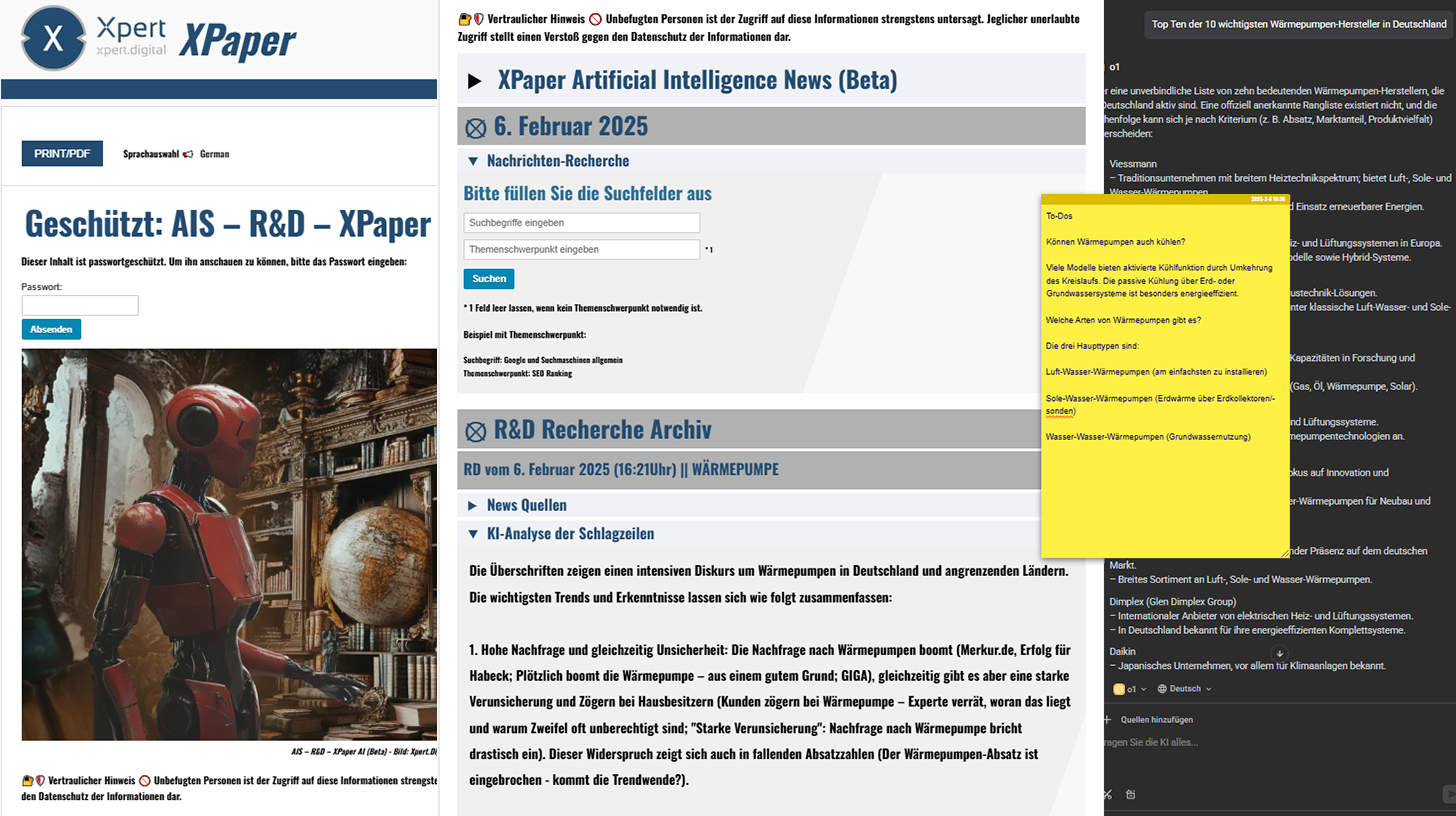
XPaper AIS application possibilities for business development, marketing, PR and our industry hub (content) - Image: Xpert.Digital
This article was handwritten. I used my self-developed R&D research tool, 'XPaper,' which I primarily use for global business development in a total of 23 languages. Stylistic and grammatical refinements were made to make the text clearer and more fluid. Topic selection, drafting, and the collection of sources and materials are all handled by an editorial team.
XPaper News is based on AIS (Artificial Intelligence Search) and differs fundamentally from SEO technology. However, both approaches share the goal of making relevant information accessible to users – AIS on the search technology side and SEO on the content side.
Every night, XPaper sifts through the latest news from around the world with continuous, round-the-clock updates. Instead of investing thousands of euros monthly in cumbersome and generic tools, I've created my own tool to stay up-to-date in my work in Business Development (BD). The XPaper system is similar to tools used in the financial sector, which collect and analyze tens of millions of data points every hour. At the same time, XPaper isn't just for business development; it's also used in marketing and PR – whether as a source of inspiration for the content factory or for article research. The tool allows you to evaluate and analyze all sources worldwide. No matter what language the data source speaks, it's no problem for the AI. Various AI models are available for this purpose. The AI analysis quickly and clearly generates summaries that show what's currently happening and where the latest trends lie – and XPaper offers this in 18 languages. XPaper allows for the analysis of independent subject areas – from general to specific niche topics, in which data can be compared and analyzed with past periods, among other things.
Your AI transformation, AI integration and AI platform industry expert
☑️ Our business language is English or German
☑️ NEW: Correspondence in your native language!

Konrad Wolfenstein
I and my team are happy to be available to you as your personal advisor.
You can contact me by filling out the contact form here wolfenstein@xpert.digital:or simply call me at +49 7348 4088 965. My email address is
I'm looking forward to our joint project.