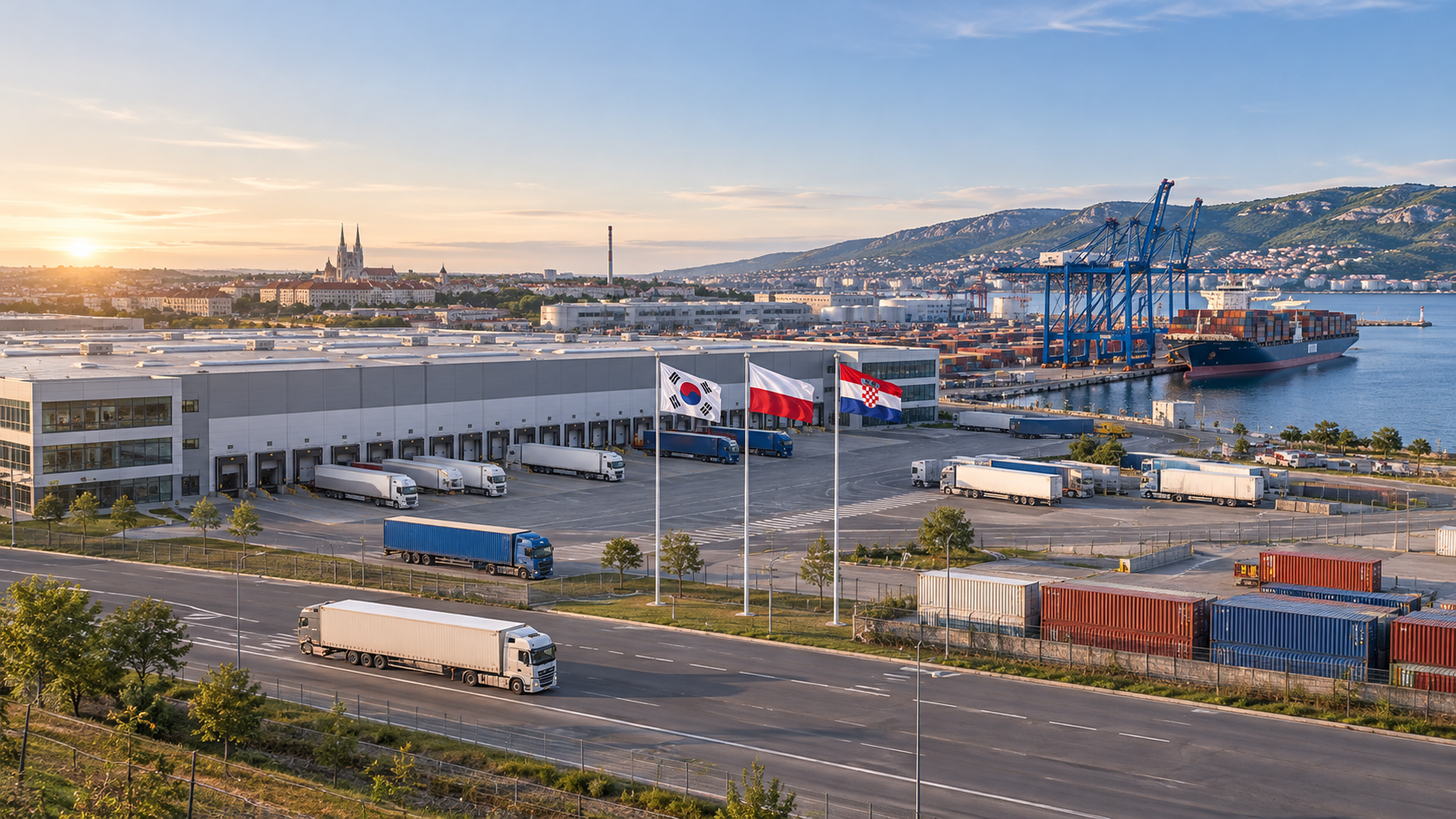
South Korea's logistics offensive in Europe: Why Poland and Croatia are becoming more important – Creative image on the topic, with AI: Xpert.Digital
From Wrocław to Rijeka: South Korea is expanding its logistics network in Europe
Greater control over trade flows: South Korea's strategic push in Europe
Logistics as a location advantage: South Korea invests in Europe's supply chains – with two different goals
South Korea is strengthening its logistics presence in Europe with an existing logistics center in Wrocław, Poland, and a planned new facility near the Croatian port of Rijeka. The two projects serve different purposes: while the Polish site aims to support the supply of a manufacturing environment, the Rijeka facility focuses on connecting maritime transport with European distribution. This is part of a broader strategy that combines public funding with entrepreneurial implementation. South Korea plans to expand its network of publicly supported logistics centers abroad from 14 to 40 locations by 2030 and is also developing an international investment fund for this purpose. However, additional warehouse space alone does not guarantee reliable supply chains. Crucially, the facilities must be reliably utilized, effectively complement transport routes, and genuinely help companies limit costs and disruption risks. Therefore, this expansion is less a gamble on square meters and more an attempt to strengthen the economic viability of Korean companies in Europe.
Anyone who wants to control Europe's supply chains needs more than cheap warehouses
South Korea is expanding its logistics presence in Poland and Croatia, combining public funding with entrepreneurial implementation. Behind these investments lies a significant economic policy development: production sites abroad are no longer to be supplied solely by international transport providers. South Korean companies and state institutions want greater control over where goods are stored, consolidated, transshipped, and distributed. This makes logistics infrastructure an integral part of industrial competitiveness and economic security.
The two locations serve different purposes. In Wrocław, Poland (the German Breslau), an already completed logistics center, currently used by a Korean company, was acquired in November 2026. In Croatia, on the other hand, a new building is planned near the port of Rijeka. While the Polish facility is directly linked to industrial supply chains, the Croatian location is intended to strengthen the connection between maritime transport and European distribution. These are therefore not two identical warehouse investments, but rather different components of a broader international logistics strategy.
The economic significance lies less in the isolated size of the two projects than in their integration into a state-supported network. South Korea aims to increase the number of its publicly supported logistics centers abroad from 14 to 40 by 2030. Simultaneously, an investment fund for international logistics facilities is being gradually expanded. The crucial question, therefore, is not simply whether a single property is profitable. It is also essential to assess whether such a network reduces transportation and inventory costs, limits production risks, and provides Korean companies with more reliable access to the European market.
Two projects, two functions: Production proximity in Poland and port access in Croatia
The logistics center in Wrocław is situated on a 347,417 square meter site and has a total floor area of 164,574 square meters. Completed in 2026, the building was subsequently acquired through the Korea Ocean Business Corporation's (KOBC) international logistics investment fund. A Korean company has already leased and is operating the facility. It is also located near a production site of a Korean battery manufacturer. The center's intended function primarily involves the transport and storage of components and finished goods.
This starting point is crucial for the economic evaluation. A property that is already rented and occupied differs fundamentally from a speculative new build without guaranteed demand. The original construction and completion risk is largely eliminated when acquiring a completed building. However, other risks remain, such as the tenant's solvency, the duration of the contractual obligation, the property's technical condition, and whether the building could be economically re-let after a change of occupant.
The Croatian project is considerably smaller. Near the port of Rijeka, a logistics center with a total floor area of 8,919 square meters is planned for a 17,709-square-meter site. The Busan Port Authority, the Korea Overseas Infrastructure & Urban Development Corporation (KIND), and the Korean logistics company E2E Logistics are involved. According to the published planning status, the agreement for the joint venture was to be signed on November 23, 2026. Construction is scheduled to begin in the first half of 2027, with the opening planned for the first half of 2028. These dates should be understood as project planning and not as milestones already achieved.
The different scales illustrate why a comparison based solely on square meters is insufficient. Wrocław represents a large-scale, production-related supply and distribution hub. Rijeka represents a smaller, port-adjacent interface. Such a facility can be economically significant despite its considerably smaller footprint: its effectiveness depends on how well it integrates incoming containers, interim storage, customs procedures, and onward transport. However, square footage alone does not reliably provide information on pallet spaces, annual throughput, level of automation, or number of employees.
From foreign investment to state-supported supply chain strategy
The expansion is supported by the South Korean Ministry of Oceans and Fisheries. Public institutions such as KOBC and the Busan Port Authority are investing in overseas locations together with Korean logistics companies. The political objective is to strengthen the stability of Korean companies' international supply chains through locally available logistics facilities. The planned expansion of the publicly supported network from 14 to 40 centers by 2030 underscores that the two European projects are part of a broader approach.
Economically, this approach can be understood as an attempt to close a coordination gap. A single company primarily assesses a logistics investment based on its own transport capabilities, inventory, and financial resources. However, a shared location can serve multiple companies and enable additional connections that are not fully reflected in the calculations of a single user. In such a scenario, public participation is intended to facilitate initial financing and coordination.
This approach, however, does not automatically guarantee economic superiority. A state-supported center only creates added value if it actually enables better services or fills a gap in provision. If public funds merely replace an already economically viable private investment, the additional effect remains limited. Conversely, if locations are established under political pressure to achieve success without sufficient demand, the result can be permanently underutilized facilities.
Therefore, the target of 40 centers is ambivalent. It makes the expansion measurable and provides orientation. At the same time, a number of locations says little about the efficiency of the resulting network. Forty poorly utilized centers can be less economically effective than a smaller number of well-connected, flexibly usable locations. A reliable evaluation of success must therefore consider not only the number of centers but also their utilization, service quality, transport reliability, and actual cost effects.
What the expansion of the investment fund actually means
The financing is based on a gradually established fund, giving it its own institutional foundation. An initial 200 billion won was mobilized for international logistics investments in 2024. A further 150 billion won was added in 2026, and another 150 billion won is planned for the first half of 2027. If this plan is fully implemented, the fund will reach a volume of 500 billion won. The Polish logistics center was acquired through this fund.
The timing is important: The targeted 500 billion won should not be equated with capital that has already been fully paid in, invested, or reserved exclusively for Poland and Croatia. Likewise, the purchase price of the Wrocław plant cannot be derived from the fund size. No concrete investment figures are available for either project in the information provided here. Statements regarding purchase prices per square meter, debt-to-equity ratios, or expected returns on equity would therefore be speculative.
Such a fund generally allows for the financing of multiple investments under a common investment framework. This can simplify processing and spread risks across different assets and markets. However, whether effective diversification actually results depends on the portfolio's composition. Multiple warehouses offer only limited diversification if they are all dependent on the same industrial customers, the same transport routes, or the same economic cycles.
Furthermore, there is the question of the relationship between real estate returns and strategic benefits. A property may provide the owner with stable rental income, while its greatest industrial value lies in avoided production interruptions. Conversely, a strategically desirable location may perform poorly financially. Both aspects must be considered separately. Otherwise, there is a risk of justifying economic weaknesses across the board with security of supply, or of underestimating a significant supply chain contribution due to an isolated real estate metric.
Why Wrocław offers more than just a relatively inexpensive location
The selection of the Wrocław region builds upon an already developed logistics market. At the end of the second quarter of 2026, the region boasted approximately 4.7 million square meters of modern warehouse space. The vacancy rate was 5.3 percent, and advertised asking rents ranged from €4.00 to €4.70 per square meter per month. In the first half of the year, approximately 300,000 square meters of space were leased. These figures indicate an established market with significant user activity, not a previously untapped logistics location.
Nationwide, Poland has become a major market for industrial and logistics real estate. At the end of June 2026, the stock of modern industrial space stood at approximately 38 million square meters. The vacancy rate was 6.6 percent, a decrease of 1.6 percentage points compared to the same quarter of the previous year. At the same time, new construction activity remained subdued: around 1.23 million square meters were completed in the first half of 2026. This combination of demand for space and more limited new construction is relevant for investors because it influences the future availability of suitable buildings.
However, this does not mean that every Polish logistics property is scarce or automatically attractive. Significant differences exist between regions, building qualities, and user profiles. A large property with suitable technical equipment and close proximity to production can have a different economic value than a similarly sized warehouse with poor transport links or limited alternative uses.
For Korean industrial customers, proximity to existing production facilities is likely to be a key factor in this specific case. A warehouse near a factory can facilitate the coordination of material flow, intermediate inventory, and finished goods shipments. The benefit doesn't necessarily stem from particularly low warehouse rental costs. Rather, the decisive factor is whether the geographical proximity reduces overall supply costs. A slightly more expensive location can be more economical if it allows for lower safety stock, shorter internal response times, or more reliable deliveries.
The battery industry is turning logistics into a production issue
The proximity of the Polish center to a Korean battery production site gives the investment a clearly identifiable industrial logic. The facility is intended to support the storage and transport of parts and finished goods. Therefore, it should not be considered merely a general distribution warehouse, but rather a potential component of a tightly integrated supply chain. However, it is not known what specific goods will be stored there, in what quantities, or what special technical equipment it will have.
This distinction is crucial for economic analysis. The mere proximity to a battery manufacturer does not automatically imply that the property itself is approved and equipped for all types of batteries, hazardous materials, or temperature-sensitive materials. Such characteristics would need to be verified using technical documentation. Nevertheless, the fundamental function can be explained: Production-integrated logistics serves to synchronize the supply of materials and the flow of goods with the manufacturing process.
The value of such synchronization becomes particularly evident in the event of disruptions. A missing component can disproportionately impact production if it cannot be replaced quickly. On the other hand, every additional safety stock ties up capital and incurs storage costs. The business objective, therefore, is not to maintain as much inventory as possible, but rather to find an economically appropriate balance between stock levels and the risk of failure for different components.
A regional logistics center can support this balancing of supply and demand, but it cannot guarantee it. If the underlying problem lies with a distant supplier, a lack of transport connections, or inadequate sales planning, additional warehouse space will not solve the bottleneck. The location only reaches its full potential when inventory management, production planning, and transport control work together seamlessly.
Rijeka connects the European market with an additional maritime access point
The project near Rijeka addresses a different point in the supply chain. The planned location is situated near a port, thus enabling a connection between maritime freight flows and land-based distribution. The involvement of the Busan Port Authority, KIND, and E2E Logistics combines port expertise, international infrastructure competence, and operational logistics. Specific customer targets, transport volumes, and warehousing capacities have not yet been determined.
The location is gaining importance due to the expansion of the local port infrastructure. The Rijeka Gateway container terminal was officially opened in 2025. Its first expansion phase has a quay length of 400 meters and an annual capacity of 650,000 TEU. TEU is the unit of measurement for a 20-foot standard container. A further expansion phase will provide a quay length of 680 meters and a capacity of more than one million TEU. These figures refer to the terminal and not to the Korean logistics center.
This distinction prevents a common misinterpretation. A port can have large handling capacities, while a single warehouse processes only a small portion of incoming and outgoing goods. Conversely, a comparatively small warehouse can be important for certain customers if it offers additional services at the right location. These services might include consolidating shipments, scheduling deliveries, or preparing onward transport. Whether and to what extent these functions are implemented in the specific project remains to be seen.
Rijeka's attractiveness is therefore not solely a question of the port's size. For a user, the entire connection from the Asian point of departure to the European recipient is what counts. A port location only becomes a compelling alternative when sea access, handling, warehousing capacity, and hinterland transport are all well-integrated.
The competition between transport routes is decided behind the quay
The economic performance of a seaport doesn't end with the unloading of a container. From the recipient's perspective, what matters is when the shipment arrives at its intended destination and how reliably that deadline is met. Therefore, a logistics center near the port shouldn't be evaluated in isolation. Its significance stems from the quality of the entire subsequent transport chain.
For Rijeka, this means that additional storage capacity creates a useful interface, but it doesn't replace efficient onward transport. If inland transport options don't align with the arrival of ships, a warehouse can primarily serve as a buffer. This may prevent short-term bottlenecks, but it also increases inventory and tied-up capital. Conversely, if onward transport is well-coordinated, the same area can enable a faster and more efficient flow of goods.
A comparison with other European import routes must therefore take several cost categories into account. In addition to sea freight and port fees, these include onward transport costs, potential waiting times, the availability of transport options, and the reliability of transit times. The risk of not having an alternative route available at short notice in the event of a disruption must also be factored in.
This leads to a sobering perspective: An additional access route via the Adriatic Sea does not have to replace every existing transport route to be economically viable. Its value can also lie in creating a complementary option for specific target regions or product groups. Whether this option is more cost-effective in practice or primarily serves as a safeguard depends on the specific flow of goods. A general superiority of the location cannot be inferred from the published project data.
Your intralogistics experts

Consulting, planning and implementation of complete solutions for high-bay warehouses and automated storage systems - Image: Xpert.Digital
More information here:
Joint investments and their importance for logistics
Joint investments are not automatic proof of local partnerships
The Korean expansion is supported by joint investments from public institutions and companies. For the Croatian new build, the Busan Port Authority, KIND, and E2E Logistics are specifically named as participants. In contrast, the Polish project is primarily based on acquisition through the KOBC fund. Therefore, the two projects should not be described as identically structured joint ventures without further explanation.
Likewise, the known shareholdings do not automatically imply a corporate partnership with Polish or Croatian companies. Local construction companies, service providers, authorities, and transport partners can be important for the project's implementation without holding ownership. Therefore, for economic analysis, a distinction must be made between equity participation, operational cooperation, and mere business relationships.
The fundamental advantage of joint investments lies in the potential division of tasks and risks. One partner can provide capital, another contribute experience with infrastructure projects, and a third is responsible for ongoing logistics operations. This combination can enable projects that would be too large for a smaller operator to undertake alone.
However, this creates additional coordination requirements. Investors and operators may pursue different objectives. A real estate investor might prefer stable, long-term rental payments, while a logistics company needs flexible spaces and can accommodate changing customers. Public institutions, in turn, may expect broader industrial policy benefits. A viable structure must define how these interests are reconciled, who is responsible for refinancing, and how decisions are made in the event of weaker demand. Without clear responsibilities, risk-sharing can easily become a distribution of unclear duties.
The cost advantage remains relevant, but its nature changes
Poland and Croatia continue to have lower average labor costs than Germany. For 2025, European comparative statistics for the commercial sector show labor costs of €19.10 per hour worked in Poland and €18.40 in Croatia. In Germany, the figure was €45.00. These figures encompass more than just the hourly wage paid and are macroeconomic indicators. They do not directly reflect the actual personnel costs of a specific warehouse operation.
The differences are significant, but should not be mistaken for permanently stable cost advantages. In 2025, labor costs in Croatia rose by 11.6 percent compared to the previous year. In Poland, the increase was 8.8 percent in national currency. The EU-wide increase was 4.1 percent. When making cross-border comparisons, it must also be considered that exchange rate fluctuations can affect costs expressed in euros.
For a long-term location decision, this means that today's wage level is only a starting point. A logistics center is not built or acquired for a single fiscal year. Its profitability depends on how productivity, personnel availability, rents, energy consumption, and transportation costs develop over a longer period.
Therefore, performance per working hour is gaining in importance. A higher hourly cost rate can be economically offset by more efficient processes. Conversely, a low wage advantage can be lost through frequent errors, insufficient capacity utilization, or additional transport routes. The long-term perspective for Poland and Croatia is therefore less about remaining permanently extremely cheap. The crucial factor is developing a high-performing, technologically compatible, and reliable logistics structure from their existing cost advantage.
Ownership of warehouses is a means of control, but no guarantee of security
The Korean strategy suggests that company-owned or jointly controlled logistics sites will be given greater priority. This can be economically advantageous if it allows companies to secure suitable sites in the long term, better coordinate investments, and reliably organize central processes. The published expansion plan explicitly links securing local facilities to more stable supply chains for Korean companies.
However, ownership should not be equated with complete control over a supply chain. A warehouse does not automatically influence shipping schedules or the availability of intermediate goods. It does not eliminate demand fluctuations or prevent disruptions on an upstream transport route. Its contribution lies at a specific point in the network.
Furthermore, there is a financial conflict of objectives. Ownership ties up capital that could alternatively be used for production, research, or other operational purposes. Long-term leases and service agreements can, under certain conditions, offer similar operational security without requiring the same capital outlay. Which solution is superior depends, among other things, on how specifically the building is tailored to a user and how critical its function is to operations.
A convincing strategy should therefore be able to combine different instruments. Particularly important and difficult-to-replace locations may justify closer control. For standardized warehousing services, flexible leasing can be more economical. The decisive factor is not the proportion of owned real estate, but the ability to reliably provide the required logistics services at reasonable costs, even under changing conditions.
Additional locations can distribute risks or create new dependencies
A network of multiple logistics centers inherently opens up more possibilities for redirecting the flow of goods and serving different markets. Expanding from 14 to the targeted 40 publicly supported international centers could increase this flexibility. However, this requires that the locations are actually compatible and cover different risks. The sheer number of facilities is not sufficient proof of this.
Multiple locations can share the same vulnerability. If they depend on a single major customer, they will react similarly to that customer's production decline. If their transport uses the same route, the geographical distribution of warehouses offers only limited help. And if information systems don't work together, available capacity at another location might not be utilized in time.
Resilience therefore requires that alternatives are practically available. This includes suitable buildings, coordinated operational processes, and the ability to manage inventory and transport orders across multiple locations. A backup route that only exists theoretically offers little benefit in the event of a disruption.
At the same time, additional hedging costs money. Reserve capacities, alternative service providers, and higher safety stocks can increase ongoing costs. They are only economically worthwhile if the avoided expected damage justifies the expense. Not every product requires the same level of hedging. For interchangeable standard goods, a cost-effective, streamlined supply may be appropriate. For components that are difficult to replace, a more expensive, redundant structure may be the better choice.
Digital control determines whether buildings become a network
An international logistics network derives its true value from the coordination of its individual locations. This requires that information on inventory, arrivals, storage capacities, and customer orders be available in a timely manner. For the projects in Poland and Croatia, no specific details regarding the warehouse management systems, automation equipment, or AI applications used have yet been published. Therefore, such technologies should not be presented as pre-existing features of the projects.
Digital connectivity remains a crucial business requirement. A warehouse can operate very efficiently locally but simultaneously burden the entire network if its decisions don't align with production or transport planning. For example, if large quantities are stored when sufficient stock is already available at another location, capital tied up in inventory and storage costs increase unnecessarily.
The most important prerequisite for improved control is not necessarily particularly complex software. First, product data, inventory definitions, and responsibilities must be aligned. A part recorded as available must actually be locatable, usable, and ready for timely shipment. Only on this basis can more sophisticated forecasting and optimization methods be meaningfully applied.
Automation also requires a differentiated approach. A large, consistently utilized warehouse can economically utilize different systems than a smaller site with fluctuating tasks. The size difference between Wrocław and Rijeka therefore argues against assigning the same technical solution to both facilities. A productive investment is guided by actual goods movements and performance requirements, not by the desire for the most visible technology.
What Poland and Croatia stand to gain economically
For the host countries, international logistics investments can have implications beyond the immediate use of a property. They can generate additional demand for transport services, technical maintenance, building operation, and other services. The extent of these effects for the two projects cannot currently be quantified. Information on direct employment, regional procurement, or expected tax revenues is unavailable.
In Poland, the focus is primarily on strengthening existing industrial ties. If a logistics center improves the supply chain to a production site, it can boost its competitiveness. For the region, this would be more economically significant than a mere change of ownership of the property. However, acquiring an already occupied building does not automatically lead to additional jobs or increased goods volume. Such effects depend on subsequent operational changes.
In Croatia, the planned new building has a different starting point. There, additional logistics space can complement the use of the port area. However, the regional added value depends on which activities actually take place on site. Pure transit generates a different value creation profile than a combination of warehousing, order picking, customer-specific preparation, and regional distribution.
Therefore, for both countries, the quality of the integrated functions is more important than the investor's nationality alone. A well-connected economic network can involve local companies and develop additional expertise. Conversely, a largely isolated location with little regional integration will have fewer positive effects. A sound location assessment should reveal these differences instead of treating every international investment as an equally successful venture.
Three development paths between productive networking and disappointed expectations
A favorable development path would be achieved if the center in Wrocław remains consistently busy and its proximity to production translates into more reliable processes. For Rijeka, a positive outcome would mean that construction is completed within the planned timeframe and that enough customers are acquired to ensure profitable operation. The Croatian schedule anticipates construction to begin in the first half of 2027 and the opening in the first half of 2028; the actual implementation remains to be seen.
In a moderate scenario, both locations would function economically without significantly altering European logistics. The Polish facility would remain a stable, leased industrial site. The Croatian center would assume a limited but useful function in the port area. Such a scenario would not be a failure. Not every sound investment needs to fundamentally transform a market.
An unfavorable outcome could occur if actual demand falls short of expectations, costs rise more sharply, or the user base is too one-sided. In Poland, particular attention should be paid to the commitment to individual industrial tenants. In Croatia, construction, leasing, and start-up risks would also come into play. Due to a lack of published project budgets and contract data, the financial impact of these risks cannot currently be reliably quantified.
The scenarios illustrate why these investments should not be prematurely judged as either a strategic breakthrough or a mere subsidization of warehouses. Both such judgments would assert more certainty than the available data warrants. A sound assessment must distinguish between plausible strategic logic and proven economic results.
Which key performance indicators should determine success or failure?
At the real estate level, occupancy rates, contract durations, ongoing income, maintenance costs, and long-term usability are crucial. At the logistics level, processing times, error rates, on-time delivery, and cost per unit handled are key. At the industrial level, it would be necessary to examine whether safety stocks can be reduced, whether fewer costly special transports are required, and whether production supply functions more reliably.
These levels can yield different results. A warehouse leased long-term can be successful from the owner's perspective, even if the user hardly improves their supply chain. Conversely, a location might offer high operational benefits while its real estate return is rather modest. Especially with public sector investments, it is therefore crucial to be transparent about what benefits are expected to be achieved with what capital investment.
The basis for comparison must also be sound. Cost reductions are only meaningful if the scope of services and service quality remain comparable. A cheaper transport route can be less economical if it is significantly less reliable. Higher inventory levels can be beneficial if they reduce a substantial production risk. Isolated key performance indicators (KPIs) can easily lead to incorrect conclusions.
For the overall state-supported network, it would also be necessary to examine whether the locations actually create additional benefits. The planned increase to 40 centers by 2030 and the targeted expansion of the fund to 500 billion won illustrate the scope of the political and financial ambition. These figures, in themselves, do not demonstrate either productivity gains or improved capital utilization. These effects would need to be proven over time.
Europe's importance grows where production and logistics are considered together
The expansion in Poland and Croatia can be interpreted as an expression of a more long-term anchoring of Korean economic activities in Europe. Companies securing logistics facilities for local supply and distribution are not solely focused on selling individual shipments. They are investing in the organizational prerequisites for a sustained market presence. In Poland, this connection is particularly evident due to the proximity to Korean battery production; in Croatia, the focus is on adding a maritime access point.
The two locations should not be prematurely merged into a firmly established direct transport corridor. The published information does not indicate that the Rijeka facility is intended to regularly supply the Wrocław center. Such a connection would be conceivable, but it has not been proven. The shared strategic importance lies primarily in covering different functions within a European presence.
This presents an important perspective for European locations. Competitiveness is not solely determined by low wages or available land. Investors need a combination of industrial demand, reliable transport links, suitable buildings, and predictable operating conditions. A location becomes particularly valuable when these elements work together.
The Korean projects thus reveal a fundamental shift: logistics is not merely a downstream service for production decisions that have already been made. It can itself influence how competitive a production site remains and how reliably a company reaches its sales markets. This perspective explains why public institutions and private operators are investing together.
The strategic idea is only convincing when the business confirms it
The economic logic behind the expansion is understandable. In Wrocław, a large, already operational logistics facility is being secured within a direct industrial context. Near Rijeka, a smaller facility located close to the port is planned, which will connect international trade flows and European distribution. These projects are complemented by the planned expansion of a publicly supported international network and a gradually increased investment fund.
A reliable positive assessment must nevertheless remain subject to conditions. The spaces must be suitable for the actual flow of goods. The financing must be sustainable in the long term. The participating institutions and companies need clear lines of responsibility. And the locations must offer their users an advantage that goes beyond the mere availability of storage space.
The decisive factor is therefore neither the number of centers nor the total amount of invested capital. The strategy becomes economically convincing when it limits overall costs, reduces dependencies prone to disruption, and provides consistently in-demand services while maintaining comparable or better delivery quality. Where this is achieved, logistics infrastructure becomes a productive link between capital, production, and the sales market.
Where this fails, properties remain whose strategic rationale outweighs their operational impact. South Korea's move in Poland and Croatia should therefore be understood primarily as a targeted effort to build capacity: the prerequisites for closer European networking are being created. Whether this translates into a sustainable competitive advantage will not be decided by the announcement, but by occupancy rates, reliability, and daily operational performance.
Your global marketing and business development partner
☑️ Our business language is English or German
☑️ NEW: Correspondence in your native language!

Konrad Wolfenstein
I and my team are happy to be available to you as your personal advisor.
You can contact me by filling out the contact form here wolfenstein@xpert.digital:or simply call me at +49 7348 4088 965. My email address is
I'm looking forward to our joint project.