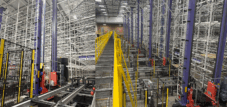
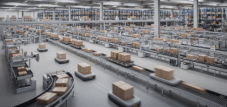
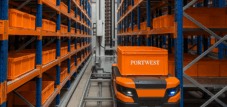
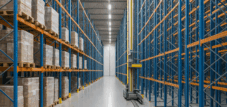
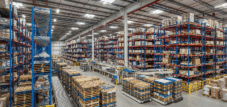
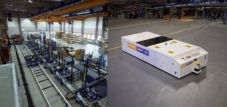
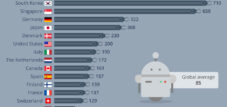
The Robot S (SOTR-S) sorting robot from DAIFUKU and the transformation of the European logistics landscape – Image: Xpert.Digital
Staff shortages are paralyzing logistics: How this Japanese robot is set to change everything
A $15 billion market explodes: This robot is reshuffling the cards in e-commerce
The European logistics industry is under immense pressure. The unstoppable rise of e-commerce, ever-increasing customer expectations for delivery speed, and a structural labor shortage, particularly noticeable in key markets like Germany, are creating an environment where automation is evolving from an option to a strategic necessity. In this highly dynamic scenario, the launch of the Sorting Transfer Robot S (SOTR-S) from Japanese market leader Daifuku marks a crucial turning point. This development is more than just a product launch; it is symptomatic of the profound transformation of an entire industry, whose market volume for warehouse automation in Europe is projected to grow from US$5.46 billion in 2024 to a projected US$15.35 billion by 2030. The SOTR-S exemplifies a new generation of logistics solutions that, with impressive speeds of up to 10,000 sorting operations per hour, revolutionary space efficiency, and modular scalability, delivers answers to the industry's most pressing challenges. The following analysis shows how Daifuku's technology not only optimizes individual warehouse processes, but fundamentally redefines the competitive dynamics in the European logistics landscape and why investing in such systems determines the future viability of companies.
Related to this:

When automation becomes a strategic necessity
Daifuku's launch of the Sorting Transfer Robot S in the UK and European markets marks far more than just another product launch in the intralogistics industry. It represents a turning point in the fundamental reshaping of logistics value chains, driven by the relentless pressure of e-commerce, structural labor shortages, and intensified competitive dynamics. The economic significance of this development can only be understood within the context of a European warehouse automation market projected to grow from US$5.46 billion in 2024 to US$15.35 billion by 2030, representing an average annual growth rate of 20.1 percent.
The structural transformation of the European logistics industry
The European logistics automation landscape is undergoing a period of accelerated change, characterized by several interconnected megatrends. The e-commerce boom has radically altered expectations regarding delivery speed and accuracy. Germany, as the largest European market, already recorded €8.7 billion in revenue from warehouse automation in 2023, representing 35 percent of the total European market share. With an implementation rate of 72 percent, German logistics companies significantly outperformed the European average of 54 percent, underscoring the strategic importance of automation as a competitive advantage.
The UK e-commerce market, valued at US$234.37 billion in 2024, is projected to grow at an annual rate of 7.9 percent and is expected to reach US$501.32 billion by 2034. This explosive expansion is putting enormous pressure on fulfillment infrastructure. More than 30.7 percent of all UK retail sales will be generated online by 2025, meaning that nearly a third of all transactions will need to pass through highly efficient sorting systems.
The European courier, express, and parcel (CEP) market, which reached a volume of US$94.62 billion in 2024 and is projected to grow to US$118.50 billion by 2033, faces the challenge of managing exponentially increasing parcel volumes while profit margins shrink. The average annual growth rate of 2.41 percent in the CEP sector masks the true intensity of competition, as volumes are growing significantly faster than revenues, indicating substantial price pressure.
Structural labor shortages are further exacerbating these trends. In 2024, Germany recorded a difficulty rate of 82 percent for filling vacancies, among the highest in Europe. The transport and warehousing sector is particularly hard hit, with the COVID-19 pandemic further aggravating the situation through disruptions in training and certification processes. This shortage is not only driving up labor costs but also making automation a vital necessity for companies that want to maintain their operational capability.
Daifuku's strategic market position and competitive dynamics
Daifuku has established itself as a global leader in automated material handling, with sales of 737.32 billion yen in 2024, representing a 20.58 percent increase year-over-year. The company holds a global market share of over 14 percent in logistics automation, alongside Dematic and Honeywell International. In Singapore, Daifuku achieved a remarkable 30 percent market share, demonstrating the company's ability to build dominant positions in highly competitive markets.
The financial performance of the first half of 2025 underscores the strength of Daifuku's business model. With revenues of 326.4 billion yen, an increase of 7.9 percent, and operating profit of 51.1 billion yen, representing a growth of 34 percent, the company demonstrates impressive profitability. The operating margin rose to 15.7 percent, an increase of 3.1 percentage points, indicating successful efficiency improvements and cost optimizations.
The competitive landscape in the automation industry is characterized by intense rivalry between globally operating corporations. Besides Daifuku, companies like Dematic, SSI Schaefer, Körber, and Swisslog compete for market share in a rapidly growing market. Differentiation is primarily achieved through technological innovation, system integration expertise, and the ability to offer scalable, modular solutions that can adapt to changing business requirements.
Daifuku's strategy rests on several pillars. The $35 million investment to double its US production capacity in 2024 aims to establish local manufacturing for local markets, thereby shortening delivery times and reducing supply chain risks. The company's long-term vision of achieving one trillion yen in revenue by 2030 requires continued investment in research and development, as well as strategic infrastructure investments.
Daifuku's Japanese heritage gives it specific competitive advantages. The Japanese manufacturing philosophy, based on Kaizen, continuous improvement, and zero-defect approaches, is deeply ingrained in the company culture. The Toyota Production System, with its just-in-time manufacturing and lean principles, has shaped the global manufacturing industry and is reflected in Daifuku's operational processes. This philosophy enables the company to deliver systems of exceptional reliability and quality, which is a crucial competitive advantage in an industry where downtime is extremely costly.
Technological architecture and economic implications of the SOTR-S
The Sorting Transfer Robot S represents a significant technological innovation in the field of automated sorting systems. With a speed of up to 180 meters per minute and a capacity of 10,000 sorting operations per hour, the system positions itself in the high-performance segment of the market. Its two-stage structure ensures a smooth flow of traffic and prevents bottlenecks, which often lead to throughput problems in conventional systems.
Space efficiency is a crucial economic factor. The SOTR-S requires less than half the floor space of conventional sorting systems, made possible by its narrow aisle structure achieved through tilting trays. In a market environment where warehouse property costs in London reach up to €323 per square meter per year, this reduction in space represents a substantial cost advantage. In Germany, leasing costs range from €6 to €10 per square foot, while in the UK they range from £9 to £15 per square foot, with prime locations in the southeast of England reaching over £20.
The system's modularity and scalability are critical design features that determine its long-term economic value. The ability to add vehicles and slides without major system disruptions allows businesses to gradually expand their capacity as their business grows. This incremental scalability significantly reduces capital risk, as investments can be staggered rather than requiring large upfront expenditures.
The tilt-tray technology underlying the SOTR-S has established itself as one of the most reliable sorting solutions for heterogeneous product mixes. Tilt-tray sorters consist of trays mounted on moving carriages that tilt at the target point, allowing products to slide by gravity onto their designated chute. This technology can handle irregularly shaped products and a wide range of package sizes and weights, from small polybags to packages weighing up to 34 kilograms.
Integrating a barcode reader that automatically scans labels while operators simply place products onto the vehicle optimizes ergonomics and reduces the cognitive load on staff. This simplification of operator interaction is crucial for maintaining high productivity levels over extended shifts and helps reduce fatigue-related errors.
The charging stations enable rapid recharging of the vehicles, maximizing operating time. The ability to maintain operation almost 24 hours a day stands in stark contrast to systems tied to manual labor, which are limited by shift times, breaks, and human fatigue.
Economic return on investment considerations and investment rationality
The economic justification for investing in high-performance sorting systems like the SOTR-S is based on several value-added dimensions. In modern warehouses, labor costs typically represent 50 to 70 percent of total operating costs. Automation can reduce these costs by 20 to 30 percent while simultaneously increasing throughput capacity two to five times.
A mid-sized e-commerce company investing $500,000 in a fulfillment automation system can expect annual benefits of $350,000, consisting of $200,000 in labor cost savings, $50,000 from error reduction, and $150,000 from increased capacity, less $50,000 in operating costs. This results in a payback period of approximately 1.43 years and an annual return on investment of 70 percent.
The typical payback period for warehouse automation is between two and three years, with most systems having a lifespan of more than a decade. According to McKinsey, companies that have implemented advanced automation technologies typically achieve a payback period of 18 to 36 months. This represents an attractive investment, especially considering that the systems generate value well beyond the payback period.
Robotic automation can reduce picking errors by up to 70 percent and increase inventory accuracy to over 99 percent. Manual data entry has an error rate of up to 4 percent, meaning that four errors, such as incorrect item numbers or quantities, can occur in 100 orders. The costs of these errors quickly add up through returns, reorganization logistics, customer compensation, and reputational damage.
Amazon has reduced labor costs per unit by 20 percent through comprehensive warehouse automation. This cost advantage increases with high volumes, allowing the company to maintain low prices while protecting profit margins. The strategic importance of this cost reduction cannot be overstated, as it gives Amazon a sustainable competitive advantage in a market characterized by intense price competition.
Beyond direct cost savings, automation generates significant indirect benefits. Reduced employee turnover, lower injury rates, and improved customer satisfaction all contribute to long-term value creation. In a labor market where warehouse workers are increasingly difficult to recruit and retain, automation reduces reliance on scarce human resources and allows remaining employees to focus on higher-value tasks.
Calculating the total cost of ownership (TCO) must consider both acquisition and operating costs over the entire life cycle. While the initial investment can be substantial, the long-term operating costs of automated systems are typically lower than those of manual alternatives. Energy-efficient motors, low-friction components, and intelligent energy management significantly reduce power consumption.
Market segmentation and application domains
The market for automated sorting systems exhibits clear segmentation by application, technology, and industry. The global market for automated sorting systems was valued at US$4.215 billion in 2024 and is projected to reach US$5.737 billion by 2031. North America held the largest market share in 2024, accounting for over 40 percent of the market at US$1.686 billion, while Europe had the second-largest share at 30 percent and US$1.265 billion.
The e-commerce sector is the dominant driver for sorting system implementations. The need to sort heterogeneous product mixes quickly and accurately makes high-performance systems indispensable. German e-commerce packaging expenditure reached US$3.99 billion in 2025, with expected average annual growth of 14.03 percent until 2034, underscoring the intensity of parcel processing.
The retail sector uses sorting systems for omnichannel fulfillment, where inventory must be managed simultaneously for physical stores and online orders. This complexity requires flexible sorting solutions that can quickly switch between different operating modes. The Otto Group operates a €260 million fulfillment hub in Poland that processes 110 million parcels annually and serves both channels.
The CEP (courier, express, and parcel) sector uses sorting systems to consolidate packages by delivery area. FedEx has implemented AI-powered sorting robots in its sorting facilities in southern China and Singapore, capable of sorting up to 1,000 packages per hour and serving up to 100 destinations simultaneously. This capacity is crucial for managing peak demand during busy seasons such as Chinese Singles' Day or Christmas.
Returns logistics represents a growing field of application. With return rates of 20 to 30 percent in e-commerce, the efficient processing of returned goods requires specialized sorting capabilities.
Automated systems can quickly identify returned items, verify their condition, update inventory levels in real time, and direct the items to the appropriate storage location for resale or disposal.
Expert partner in warehouse planning and construction

Automation as a competitive advantage: Strategies for logistics companies
Strategic implications and competitive dynamics
The implementation of advanced automation technology such as the SOTR-S has far-reaching strategic implications for companies and the competitive structure of the logistics industry. Automation increasingly functions as a differentiation strategy, enabling companies to stand out in a highly competitive market.
Companies that successfully implement automation can offer service levels unattainable for competitors with manual processes. Same-day and next-day delivery, a decisive factor for over 74 percent of online shoppers in the US when choosing a retailer, requires highly efficient sorting systems. The ability to process and ship orders within hours of receipt becomes a critical competitive advantage.
Automation contributes to supply chain resilience by enabling companies to respond quickly to disruptions. Automated systems can monitor operational data in real time, identify potential problems before they escalate, and initiate alternative processes. This agility is crucial in an era of heightened supply chain volatility.
Studies by Deloitte show that companies that have adopted advanced automation technologies are 3.5 times more likely to outperform their competitors in terms of supply chain resilience, demonstrating faster recovery times and better overall performance during disruptions. This resilience translates directly into financial performance, as supply chain disruptions are avoided or minimized.
The scalability of automated systems allows companies to manage growth without having to invest proportionally in additional labor. As business volume increases, additional robots or sorting modules can be added to expand capacity without requiring extensive retraining or new hires. This flexibility is particularly valuable in industries with seasonal fluctuations in demand.
Automation is fundamentally changing the cost structure of logistics companies. While traditional warehouses have high variable costs due to labor, automation shifts the cost structure towards higher fixed costs and lower variable costs. This shift creates economies of scale, where average costs decrease with increasing volume, giving large players a structural advantage.
Related to this:
Implementation hurdles and adoption barriers
Despite the compelling economic advantages, companies face significant challenges when implementing warehouse automation. The high initial investment costs represent a major barrier for many businesses, especially small and medium-sized enterprises (SMEs). Automated systems often require investments in the millions, necessitating careful capital allocation decisions and long-term strategic planning.
Integrating with existing legacy systems is a common technical challenge. According to Gartner, 54 percent of warehouse managers cite system incompatibility as the primary reason for delayed automation adoption. Many warehouses operate with outdated warehouse management systems that don't integrate seamlessly with modern automation solutions. API-based solutions and cloud-based platforms can help bridge this gap, but they require additional investment and technical expertise.
A lack of expertise in robotics and automation can hinder the adoption process. Successful implementation and operation of automated systems require a skilled workforce that understands the intricacies of the technology. Companies must invest in comprehensive training programs for existing employees and hire individuals with the necessary skills, which can be challenging in a tight labor market.
The resilience of the workforce to technological change presents another significant hurdle. Employees may perceive automation as a threat to their jobs, leading to resistance and suboptimal adoption. Change management strategies that include transparent communication, retraining for higher-value roles, and demonstrating the benefits of automation are crucial for overcoming this resistance.
The reliability and maintenance of automated systems are critical considerations. Technical malfunctions or failures can lead to downtime and impact productivity. Robust maintenance protocols, predictive maintenance strategies, and investments in high-quality, durable equipment are essential to mitigate these challenges and maintain the efficiency of automated processes.
The scalability of automation systems requires careful planning. As business operations grow or change, automated solutions should be flexible enough to adapt to varying requirements. Selecting modular and easily expandable automation technologies allows for the seamless integration of additional robotic systems or customizations to accommodate evolving business needs.
Industry consolidation and market concentration
The warehouse automation industry is showing signs of consolidation, as larger players strengthen their market positions through acquisitions and strategic partnerships. Daifuku, Dematic, SSI Schaefer, Honeywell, and a handful of other dominant players control a significant share of the global market. This concentration reflects the importance of economies of scale in research and development, global service capability, and systems integration expertise.
The development and maintenance of advanced automation technology requires significant investment in research and development. Daifuku plans to invest 80 billion yen in research and development and capacity expansion by 2030. This scale of investment is difficult for smaller players to replicate, giving larger companies a structural advantage.
A global presence is increasingly important for serving multinational clients who require consistent solutions across multiple locations. Daifuku operates in 26 countries and can provide consistent service and support across geographical boundaries. This global reach enables the company to transfer best practices, leverage economies of scale in procurement, and diversify risks across different markets.
Market consolidation has an impact on customers. On the one hand, they benefit from the technological expertise and financial stability of large providers. On the other hand, reduced competition and vendor lock-in can lead to less favorable terms. Companies must carefully weigh these trade-offs when selecting automation partners.
AMRs 2.0 and the warehouse of the future: When AI and IoT work hand in hand
The future of warehouse automation is shaped by several technological trends. Artificial intelligence and machine learning are increasingly being integrated into automation systems to enable predictive analytics, adaptive control, and autonomous decision-making. AI-powered systems can analyze historical data, predict demand patterns, and optimize operational parameters in real time.
The integration of Internet of Things (IoT) technology enables comprehensive sensor networks that collect real-time data on every aspect of warehouse operations. This data can be used to monitor machine performance, predict maintenance needs, and continuously optimize processes. Predictive maintenance based on IoT data can reduce unplanned downtime and extend equipment lifespan.
Autonomous mobile robots are evolving from simple, path-guided systems to highly intelligent agents capable of dynamic navigation, collaboration, and complex task execution. The next generation of AMRs will be able to adapt to changing environments, avoid obstacles, and interact safely with humans in shared workspaces.
Blockchain technology could improve transparency and security in supply chains by creating tamper-proof records of transactions and product movements. This could be particularly valuable for traceability, anti-counterfeiting, and regulatory compliance.
The trend toward modularity and flexibility will continue. Future automation systems will likely rely even more heavily on plug-and-play architectures that enable rapid reconfiguration and expansion. This flexibility will allow companies to make their automation investments incrementally and adapt systems as business needs evolve.
Sustainability is becoming an increasingly important design criterion. Energy-efficient drives, renewable energy integration, and circular economy principles are being embedded in the next generation of automation systems. Companies will consider not only cost efficiency but also environmental impact when making automation decisions.
The role of automation in the overall economic architecture
Daifuku's introduction of the Sorting Transfer Robot S is more than a product launch; it is a symptom of fundamental structural transformations in the global economy. The automation of logistics processes represents the continuation of a centuries-old trend of technological substitution of labor, stretching from the Industrial Revolution through assembly line production to today's robotics.
This development raises profound economic questions. Automation shifts the factor proportions in production by substituting capital for labor. This substitution is economically rational if capital costs decrease relative to labor costs or if technological progress increases the productivity of capital. In Europe, both rising labor costs and rapidly decreasing costs for robotics and automation technology are driving this substitution.
The macroeconomic effects are complex. On the one hand, automation increases the overall productivity of the economy, which can lead to higher output, lower prices, and a higher standard of living. On the other hand, the displacement of workers from routine tasks can lead to job losses and increased income inequality if affected employees are unable to successfully transition to higher-value roles.
Historical evidence suggests that technological change creates more jobs than it destroys in the long run, but the adjustment processes can be painful and lengthy. The challenge for businesses and societies is to manage these transitions by investing in retraining, providing social safety nets, and ensuring that the benefits of technological progress are widely shared.
The geopolitical dimensions of automation should not be overlooked. The ability to develop and implement advanced automation technology is increasingly becoming a factor in national competitiveness. Countries like Germany and Japan, which are leaders in automation, secure strategic advantages in globalized value chains. Dependence on foreign technology providers can create risks regarding technology transfer, data security, and industrial sovereignty.
The automation of logistics also impacts urban geography and real estate markets. Demand for large, highly automated fulfillment centers near metropolitan areas is driving up prices for logistics properties. This can lead to displacement effects, where warehouses push other economic activities out of urban fringe areas.
How the Sorting Transfer Robot S makes companies permanently more competitive
Daifuku's introduction of the Sorting Transfer Robot S to the European market is a microcosm of larger economic forces transforming industries globally. Technological innovation enables dramatic efficiency gains, cost reductions, and service improvements that fundamentally alter consumer expectations and competitive dynamics.
For companies, automation is increasingly no longer an option, but a necessity for survival in intensely competitive markets. The economic logic is compelling: labor shortages, rising wages, exploding e-commerce volumes, and relentless pressure on delivery times create an environment in which manual processes are simply not competitive. Companies that successfully invest in and implement automation will build competitive advantages that will be difficult for laggards to overcome.
For workers, this transformation presents both challenges and opportunities. As routine, repetitive tasks are increasingly automated, new roles emerge in system monitoring, maintenance, programming, and process optimization. The ability to adapt, acquire new skills, and transition to higher-value roles is becoming increasingly crucial for economic success.
Automation presents complex policy challenges for society as a whole. Ensuring that the benefits of technological progress are widely shared, supporting affected workers during the transition, and maintaining social cohesion amidst rapid economic change require thoughtful policy interventions.
The Sorting Transfer Robot S is therefore far more than just a piece of equipment. It is a symbol of the technological revolution that is fundamentally reshaping economic structures, labor market dynamics, and social organizations. Understanding these profound transformations is crucial for all stakeholders who want to navigate the economy of the future successfully.

Xpert.Plus Warehouse Optimization - High-bay warehouses and pallet warehouses: Consulting and planning
We are here for you - Consulting - Planning - Implementation - Project Management
☑️ Our business language is English or German
☑️ NEW: Correspondence in your native language!

Konrad Wolfenstein
I and my team are happy to be available to you as your personal advisor.
You can contact me by filling out the contact form here wolfenstein@xpert.digital:or simply call me at +49 7348 4088 965. My email address is
I'm looking forward to our joint project.