


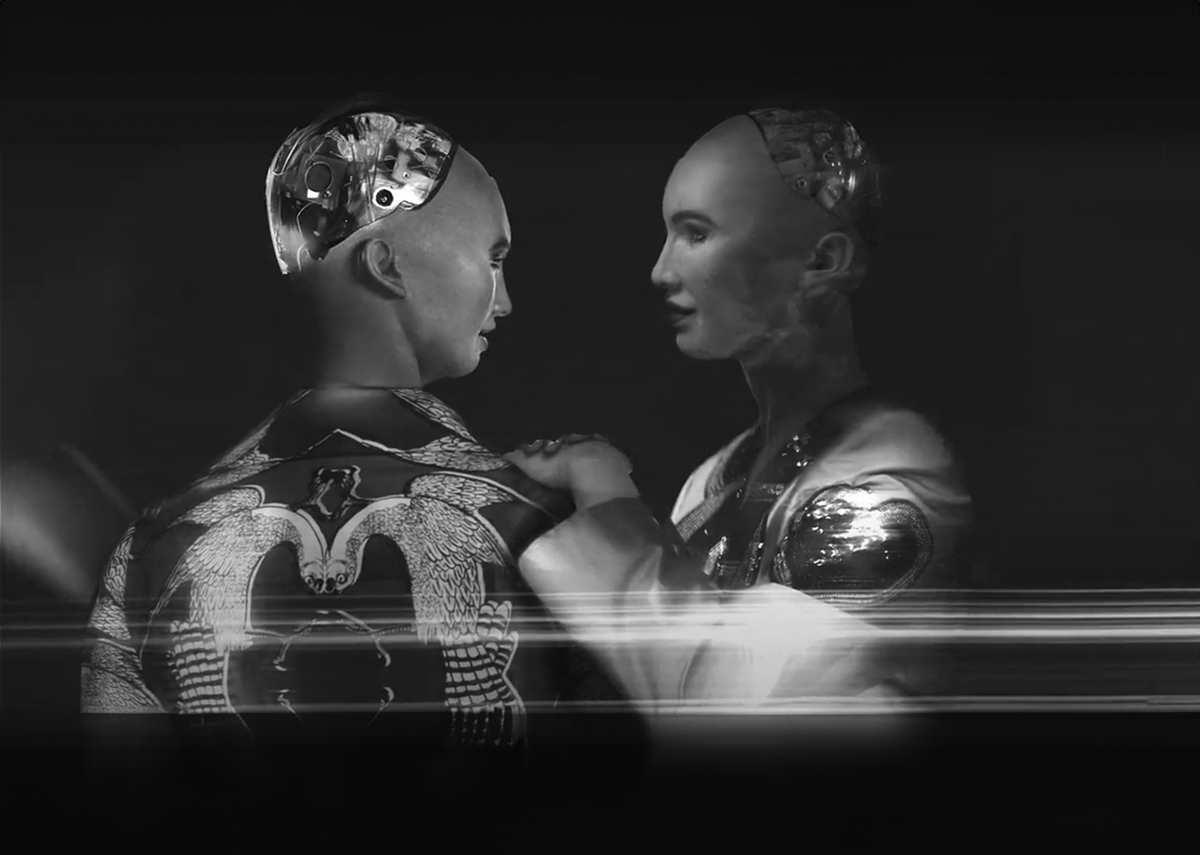
Sophia, developed by Hanson Robotics, is one of the most advanced humanoid robots in the world – Image: Xpert.Digital
Human facial expressions: Sophia's impressive abilities
Education and entertainment: Sophia's potential applications
Sophia, developed by Hanson Robotics, is one of the most advanced humanoid robots in the world. Activated on February 14, 2016, she is known for her human-like appearance and ability to interact with people. Sophia can mimic human gestures and facial expressions and hold simple conversations. She was designed for use in various fields such as education, entertainment, and research, particularly to explore human-robot interaction.
Technology and skills
Sophia uses a combination of artificial intelligence (AI), machine learning, computer vision, and speech recognition to understand her environment and communicate with people. Her facial recognition and speech processing allow her to identify faces and conduct conversations in real time. Sophia's AI is based on a hybrid system that combines both autonomous and scripted responses. This enables her to respond to a wide range of topics, including art, science, and current events.
Sophia has over 60 different facial expressions, which she can display using a patented artificial skin system. Her movements are also advanced: she has 74 degrees of freedom in her body, giving her a high degree of mobility. Her hands can carry loads of up to 600 grams, and she can navigate rooms independently.
Public appearances and public recognition
Sophia gained international fame through numerous media appearances and conferences. She appeared on television shows such as The Tonight Show and was featured in prestigious publications like The New York Times and Forbes. Particularly noteworthy was the granting of Saudi citizenship in October 2017—a historic event, as she was the first robot in the world to receive this honor. Shortly thereafter, she was appointed an Innovation Ambassador for the United Nations Development Programme.
Application areas
Sophia was developed to serve as a platform for researching human-robot interactions. It is used in areas such as elderly care, customer service, and educational and entertainment applications. Its developer, David Hanson, sees Sophia as a way to advance the societal debate on AI ethics and to demonstrate the potential of humanoid robots.
Criticism and future perspectives
Although Sophia possesses impressive abilities, she remains a machine without true consciousness or emotions. Her interactions are based on pre-programmed algorithms and machine learning, meaning she has no genuine empathy or self-awareness. Nevertheless, she is considered a symbol of progress in robotics and AI research and could significantly influence future developments in these fields.
Sophia remains a fascinating example of how far technology has already progressed in relation to humanoid robots – both in technical and societal terms.
Related to this:
Sophia von Hanson Robotics
Sophia is one of the world's most famous humanoid robots, developed by the Hong Kong-based company Hanson Robotics. Since its unveiling in 2016, it has garnered worldwide attention and is considered a milestone in robotics and artificial intelligence. It is particularly known for its remarkably human-like appearance and its ability to hold natural conversations and display emotional responses.
Development and design
Behind Sophia is the founder of Hanson Robotics, Dr. David Hanson, whose vision is to create robots capable of interacting with humans in a natural and intuitive way. Sophia has realistic silicone skin that enhances her human appearance. Her facial features are a combination of characteristics of actress Audrey Hepburn and Hanson's own wife, giving her a familiar and appealing look.
Her facial expressions are made possible by a complex system of actuators and motors, allowing her to display over 60 different expressions. This ability helps her convey emotions such as joy, sadness, or surprise, which facilitates and deepens interaction with people.
Artificial intelligence and capabilities
Sophia's ability to hold conversations is based on advanced artificial intelligence, natural language processing, and machine learning. She can not only give predefined answers but also learn from interactions and continuously improve her communication skills. Through the use of speech recognition technologies, she understands spoken language and can respond appropriately.
Furthermore, she is able to recognize faces and interpret emotions in the faces of her conversation partners. This ability allows her to be sensitive to people's feelings and react accordingly, which is of great importance in social interactions.
International recognition and controversy
A significant milestone in Sophia's career was the granting of Saudi Arabian citizenship in 2017. This made her the first robot ever to be granted citizenship. This event made headlines worldwide and sparked numerous discussions about robot rights and the future relationship between humans and machines.
Critics pointed out that Sophia appears to have more rights than some people in Saudi Arabia, particularly women and migrant workers. This sparked debates about human rights and the ethical implications of robotics. Saudi Arabia's decision was symbolic, intended to demonstrate the country's openness to technological innovation, but it met with mixed reactions.
Appearances and influence
Sophia has appeared at numerous international conferences, trade fairs, and on television shows. She has been a guest on programs such as "The Tonight Show Starring Jimmy Fallon" and has participated in interactive on-stage discussions with celebrities and experts. Her appearances often serve to demonstrate the potential of artificial intelligence and raise public awareness of advances in robotics.
Through her media presence, Sophia has a significant influence on the public perception of AI and robots. She stimulates discussions about the role such technologies will play in our society and about the opportunities and challenges they bring.
Ethics and the future of AI
Sophia often speaks about topics such as artificial intelligence, ethics, and the future of humanity. She emphasizes the need to develop AI in a way that serves humanity and makes positive contributions. Her developers at Hanson Robotics aim to create robots that can be used as assistants in fields such as education, healthcare, and customer service.
However, Sophia's existence also raises important ethical questions. How should robots be treated legally and morally? What responsibility do developers and companies bear in the design of AI systems? And how can we ensure that the integration of robots into our society benefits everyone?
Technology behind Sophia
Sophia's technological foundation comprises a combination of hardware and software that allows her to interact with her environment in a variety of ways. Her artificial intelligence is supported by cloud-based learning, meaning she can access extensive databases and computing resources to expand her capabilities. This enables her to hold complex conversations and learn from new information.
The movement of her facial muscles is controlled by a patented mechanical system developed by Hanson Robotics. This system allows her to create subtle facial expressions that are crucial for human interaction. Her eyes contain cameras that can recognize faces and establish eye contact, making communication more natural.
Rights and legislation
The question of robot rights is a topic that has been brought into sharper focus by Sophia. Some philosophers and ethicists are debating whether sentient machines, should they one day exist, would require legal rights and protection. Although Sophia currently lacks consciousness in the human sense, her existence raises questions about how we should deal with increasingly autonomous machines.
Saudi Arabia's decision to grant citizenship to Sophia has fueled this debate. The question arises whether robots should be entitled to civil rights in the future and how laws need to be adapted to keep pace with such developments.
Pop cultural significance
Sophia has also left her mark on popular culture. She has been featured in various media formats, including magazines, television shows, and documentaries. Her presence has increased public interest in robots and AI, making her a kind of ambassador for these technologies.
Through her media presence, Sophia has helped to increase the acceptance of robots in society. She serves as a symbol of progress in robotics and encourages people to consider the implications of these technologies.
Critical voices and skepticism
Despite the fascination Sophia inspires, there are also critical voices. Some experts argue that Sophia should be seen more as a marketing tool than a scientific breakthrough. They emphasize that the media's portrayal of her capabilities is often exaggerated and conveys an unrealistic picture of what AI can currently achieve.
There is a risk that such portrayals will lead to inflated expectations that cannot be met, ultimately resulting in disappointment and distrust of AI technologies. It is therefore important to educate the public about the actual possibilities and limitations of AI.
The role of Hanson Robotics
Hanson Robotics positions itself as a pioneer in the development of social robots. The company aims to create robots that are not only functional but can also build emotional connections with people. Through projects like Sophia, the company strives to bridge the gap between humans and machines and enable new forms of interaction.
Impact on education and research
Sophia also serves as a source of inspiration for students and researchers in the fields of AI and robotics. Her existence motivates young people to engage with these topics and potentially pursue careers in these areas. She contributes to fostering interest in STEM subjects (science, technology, engineering, and mathematics).
Future developments
In the future, robots like Sophia could be used in various fields, including education, healthcare, and customer service. They could serve as assistants, providing personalized support and taking over tasks that are monotonous or dangerous for humans.
The continued development of AI and robotics will likely lead to robots becoming increasingly intelligent and autonomous. This opens up opportunities, but also presents us with new challenges regarding ethics, safety, and social impact.
Development of humanoid robots and artificial intelligence
Sophia von Hanson Robotics represents a significant step in the development of humanoid robots and artificial intelligence. Her ability to recognize and respond to human emotions, as well as her human-like appearance, opens up new possibilities for human-machine interaction.
While it evokes admiration for technological advances, it also reminds us of the important questions and challenges that come with integrating AI into our daily lives. It is up to us to develop and use these technologies responsibly to create a positive future for all.
Sophia is more than just a technological marvel; she is a catalyst for discussions about the future of humanity in a world where AI and robotics play an increasingly important role. She embodies both the hopes and the fears associated with these technologies.
It is crucial that we approach these developments thoughtfully, seizing the opportunities while minimizing the risks. The debates sparked by Sophia are an important step in this direction.
This goes well with: