Solid-state batteries for electric vehicles ready for use as early as 2027? – Image: Xpert.Digital
Next-generation electric vehicles: Toyota's plans for solid-state batteries
Toyota's revolutionary battery technologies for the future of battery electric vehicles (BEVs)
Toyota recently unveiled impressive new battery technologies for future battery electric vehicles (BEVs), including the innovative solid-state battery with extended range and fast charging.
Toyota's commitment to sustainable mobility
We are thrilled by Toyota's commitment to sustainable mobility and the optimization of all aspects of the next generation of BEVs to achieve maximum battery utilization and efficiency. The primary goal is to achieve a range of 1,000 km, thereby addressing concerns about the range of electric vehicles. Toyota is investing in a comprehensive strategy that includes research, development, and the expansion of production capacity for batteries and hydrogen components. The company's vision is to create a carbon-free society by 2050 and reduce emissions throughout the entire life cycle of its vehicles.
Solid-state batteries – A promising technology
These novel solid-state batteries, which utilize solid electrolytes, offer higher energy density, improved safety, longer lifespan, and shorter charging times compared to conventional batteries. While challenges remain in scaling production and reducing costs, these batteries are considered a promising technology for improving battery performance and safety in various applications, including electric vehicles. The automotive industry, together with battery manufacturers and research institutions, is committed to overcoming these challenges and further advancing battery technology.
Electric vehicles as a sustainable alternative
The increased use of renewable energies and advances in battery technology are contributing to the growing importance of electric vehicles as a sustainable alternative to conventional combustion engines. The efforts of Prime Planet Energy & Solutions, a joint venture between Toyota and Panasonic, to accelerate the development of high-performance batteries for electric vehicles represent another step towards a greener future. This company is working to provide advanced battery solutions for the entire automotive industry.
Challenges and solutions
While solid-state batteries hold great promise, several challenges remain. Scaling up production and the associated cost reductions are crucial for the widespread adoption of solid-state batteries in electric vehicles. Toyota and other automakers are working closely with research institutions and suppliers to address these challenges. New technologies and advanced manufacturing processes are being developed to make the mass production of solid-state batteries economically viable.
The advantages of solid-state batteries
Solid-state batteries offer several advantages over conventional lithium-ion batteries. The elimination of liquid electrolytes significantly increases safety by minimizing the risk of leaks and fires. Their higher energy density allows for longer driving distances on a single charge, considerably reducing range anxiety. Furthermore, the extended battery lifespan results in less frequent replacement cycles and lowers the vehicle's overall operating costs.
The role of solid-state batteries in the energy transition
The energy transition is a key issue in combating climate change and promoting sustainable energy sources. Electric vehicles play a crucial role in this process, as they enable the use of renewable energies in the transport sector. Solid-state batteries offer the potential to further improve the performance and range of electric vehicles, thereby accelerating the acceptance and spread of electromobility.
A glimpse into the future of electromobility
With the introduction of solid-state batteries and other innovative technologies, the future of electric mobility is becoming increasingly promising. Battery performance will continue to improve, charging times will decrease, and the range of electric vehicles will increase every year. Toyota and other automakers are committed to revolutionizing electric mobility and creating a sustainable future for transportation.
The role of research and development
Advances in battery technology would not be possible without extensive research and development. Toyota invests considerable resources in researching new materials, production processes, and technologies to continuously improve the performance of solid-state batteries. Collaboration with universities and research institutions enables the company to remain at the forefront of technology and drive the development of solid-state batteries.
How solid-state batteries could revolutionize everyday life
The introduction of solid-state batteries in electric vehicles would have far-reaching implications for people's daily lives. Greater range would enable longer journeys without stops, improving the travel experience for drivers. Furthermore, solid-state batteries could be used in other areas, such as home energy storage and the electronics industry, to meet the demand for durable and safe energy storage solutions.
The importance of battery technology for electromobility
Battery technology is a crucial factor for the success of electromobility. With the further development of solid-state batteries and other technologies, electromobility is becoming increasingly attractive and competitive. Reducing dependence on fossil fuels and promoting sustainable mobility are important goals that can be achieved through the use of advanced battery technologies.
progress
Toyota's progress in developing groundbreaking battery technologies for electric vehicles is impressive. The introduction of next-generation solid-state batteries promises improved performance, safety, and range for electric mobility.
Frequently Asked Questions (FAQs)
1. What are solid-state batteries?
Solid-state batteries are a new generation of batteries that use solid electrolytes instead of liquid electrolytes.
2. What advantages do solid-state batteries offer?
Solid-state batteries offer higher energy density, improved safety, longer lifespan and shorter charging times compared to conventional batteries.
3. When does Toyota plan to introduce solid-state batteries in BEVs?
Toyota plans to launch its first BEVs with solid-state batteries starting in 2027-28.
4. What is Toyota's main goal regarding electromobility?
Toyota's main goal is to achieve a range of 1,000 km and to sell 3.5 million vehicles with solid-state batteries by 2030.
5. What role does research and development play in the development of solid-state batteries?
Research and development play a crucial role in the continuous improvement of the performance of solid-state batteries and other battery technologies.
Toyota unveils breakthrough in solid-state batteries: Greater range and faster charging times for electric vehicles possible from 2027

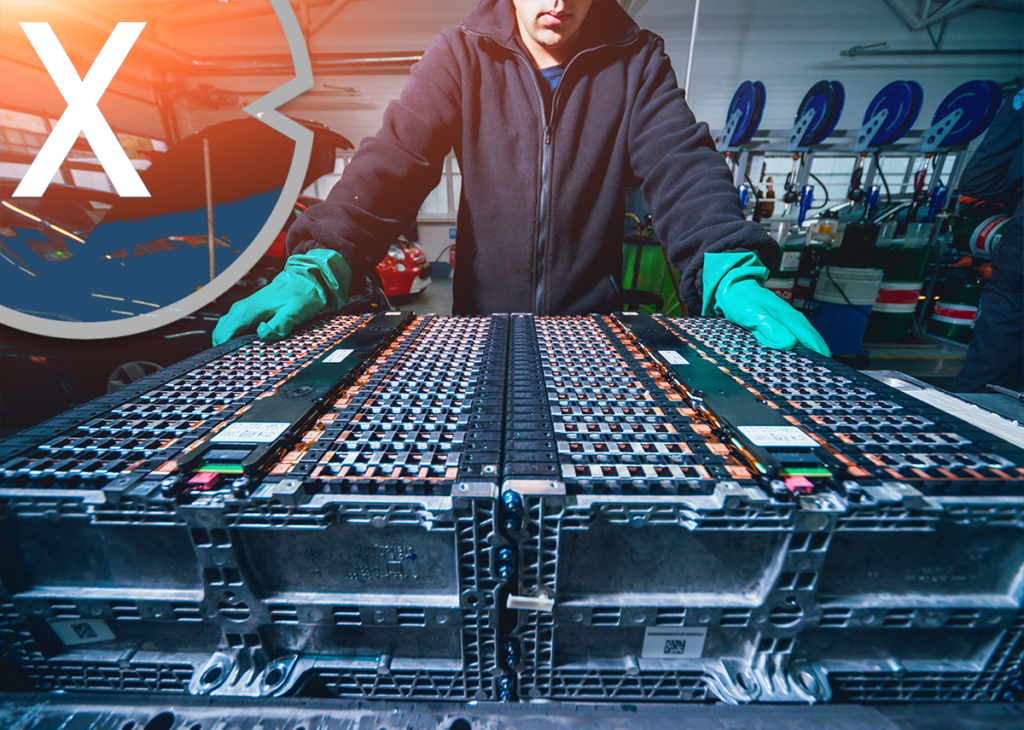
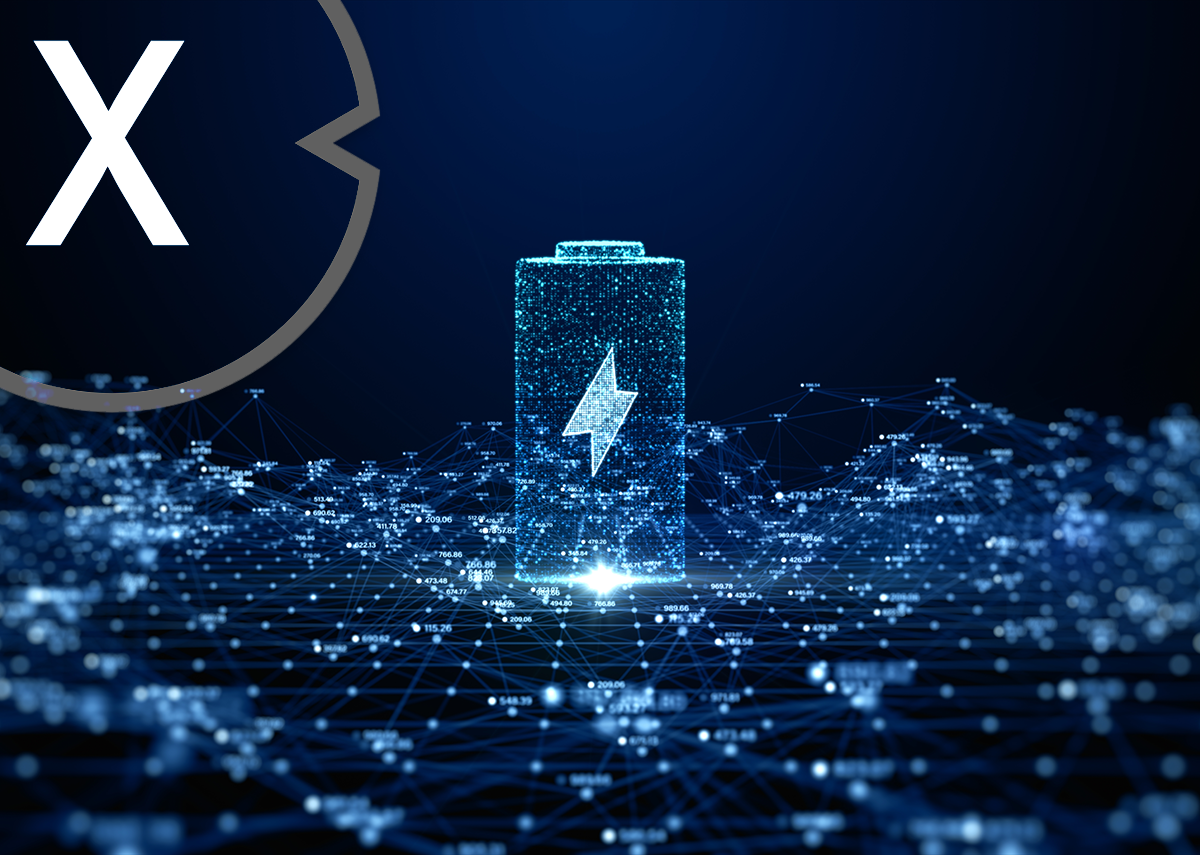
Symbolic image of solid-state batteries: The future of battery technology with higher performance and improved safety – Image: Xpert.Digital / Roman Zaiets|Shutterstock.com
Toyota originally planned to introduce solid-state batteries in hybrid electric vehicles (HEVs) in 2021. However, these plans have been revised, and the company now aims to commercialize the technology in 2027-2028. The development of the high-performance battery is being carried out in collaboration with Prime Planet Energy & Solutions, while the popularization version and the solid-state battery are a joint project with Toyota Industries Corporation. By pooling expertise from across the Toyota Group, the company intends to accelerate the commercialization of solid-state battery technology.
More information here:
The Xpert.Solar solar carport planner
Solar parking spaces are a promising way to generate renewable energy while simultaneously optimizing the limited space available in cities and urban areas. However, there are indeed some challenges that can hinder the implementation of such parking spaces.
One of the biggest hurdles is the high cost and planning effort associated with installing solar panels in parking lots. Not only must the cost of the solar panels themselves be considered, but also the cost of the infrastructure required to connect them to the power grid. Furthermore, the space required for the installation of the solar panels must be precisely planned and coordinated to ensure effective use of the available area.
Another obstacle is bureaucratic hurdles and permitting procedures, which can complicate the installation of solar panels in parking lots. Depending on the region or country, different regulations and rules may apply, further complicating the approval and implementation process.
Despite these challenges, there is high demand for solar parking spaces, as they represent an effective way to promote renewable energy while simultaneously optimizing space utilization in urban areas. With careful planning and collaboration between the stakeholders, the obstacles can be overcome to facilitate the implementation of such parking spaces.
➡️ We specialize in providing consulting and planning support for such solar carport projects and in advancing their implementation.
➡️ Our solar carport planner simplifies the process.
➡️ We are here for you for the next steps, thus minimizing costs and effort for you.

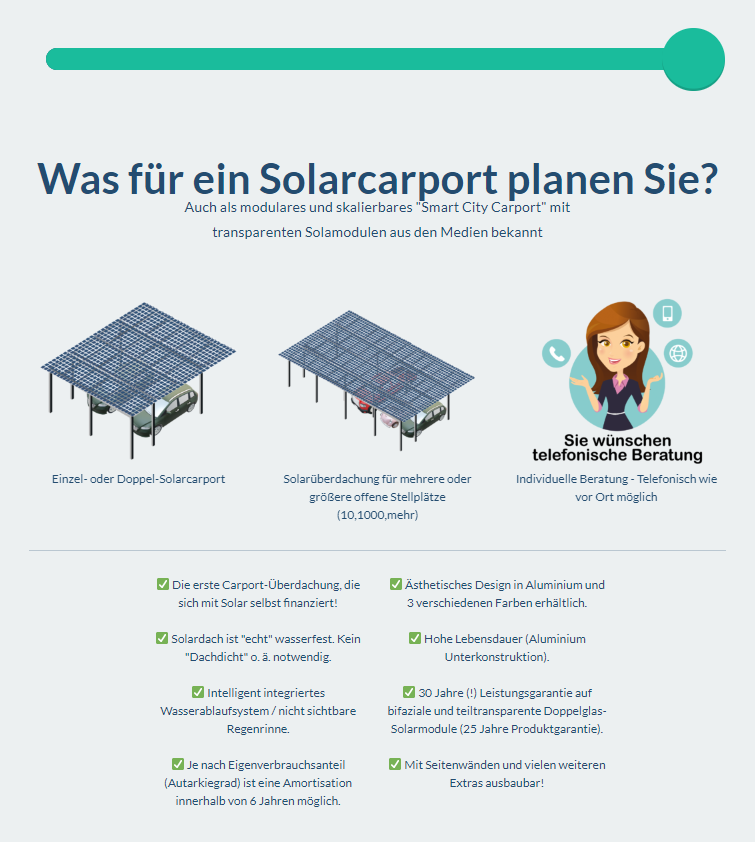
Xpert.Solar solar carport planner
More information here:
AC/DC or DC-side only planning and installation for third parties - our offer


Solar canopy: Solar-covered parking lot – Image: Wiederspan.Solar
More information here:
Our preferred city solar carport or solar carport module
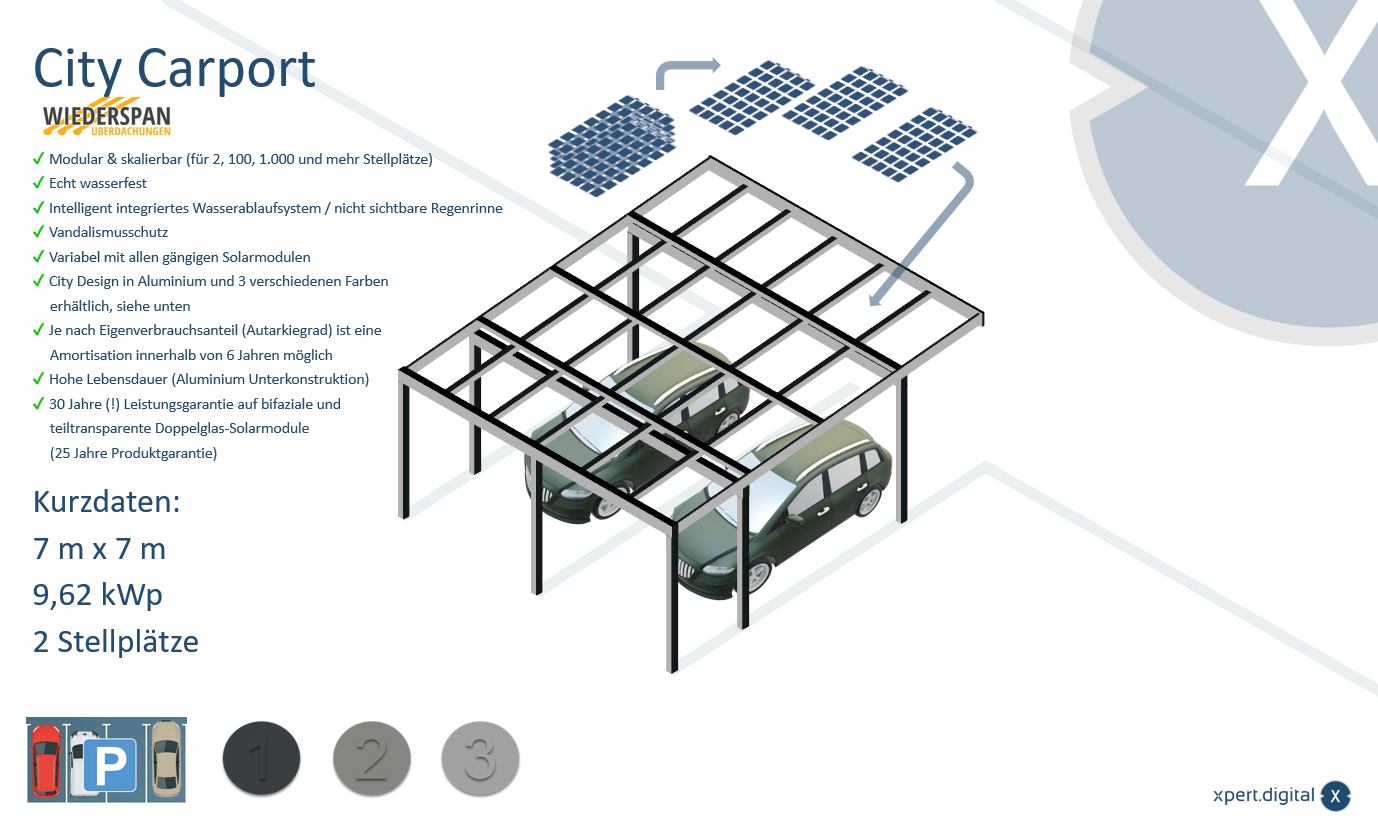
The City Solar Carport – with enhanced impact and vandalism protection – Image: Xpert.Digital
Advantages at a glance
- Support & Made in Germany
- Modular & scalable (for 2, 100, 1,000 and more parking spaces)
- Truly waterproof
- Integrated water drainage / concealed rain gutter
- Vandalism protection, optionally with integrated impact protection
- Compatible with all common solar modules
- City Design available in aluminium and 3 different colours
- Depending on the level of self-consumption (degree of self-sufficiency), amortization is possible within 6 years
- Long service life (aluminum substructure)
- 30-year (!) performance guarantee on bifacial and semi-transparent double-glass solar modules (25-year product guarantee)
- Reduction of urban heat islands
- Building-integrated photovoltaics
- Ideally suited for transparent and translucent double-glass solar modules with overhead mounting approval!
Is there a difference between solid-state batteries, solid-state accumulators, and solid-state rechargeable batteries?
The terms "solid-state batteries," "solid-state accumulators," and "solid-state rechargeable batteries" are often used interchangeably and refer to the same concept of batteries where solid materials are used as electrolytes instead of liquid electrolytes. Generally, there is no clear distinction between these terms.
This type of battery technology, which uses solids as electrolytes, has the potential to offer some advantages over conventional liquid electrolytes, such as higher energy density, improved safety, and a longer battery lifespan.
However, slight variations in the use of these terms may occur in certain disciplines, research environments, or technology industries. They may also sometimes be used to highlight specific nuances or characteristics. Generally, though, they all refer to the same concept of solid electrolyte batteries.
Nevertheless, there are subtle but important differences between "solid-state batteries," "solid-state accumulators," and "solid-state rechargeable batteries," even though they generally describe similar technologies. Let me explain the differences:
1. Solid-state batteries
The term "solid-state batteries" is a general term for batteries that use solid electrolytes instead of a liquid electrolyte solution. In conventional lithium-ion batteries, the electrolyte consists of a liquid solution that transports lithium ions between the anodes and cathodes. In solid-state batteries, on the other hand, solids are used as electrolyte materials, which can enable higher energy density, improved safety, and better long-term stability.
2. Solid-state batteries
The term "solid-state batteries" is often used synonymously with "solid-state batteries," as both refer to the use of solid electrolytes instead of liquid electrolytes. Solid-state batteries are a type of solid-state battery in which all components, including the electrolyte, are solid.
3. Solid-state batteries
The term "solid-state batteries" is less common and is sometimes used synonymously with "solid-state accumulators." The difference lies in the fact that "accumulators" is more frequently used in connection with mobile devices such as smartphones and laptops, while "batteries" is more often used in connection with stationary energy storage systems or vehicle batteries. However, in terms of technology and concept, "solid-state batteries" generally refer to batteries with solid electrolytes.
Various sources
These various terms originate from different sources, including scientific literature, research papers, patents, technical publications, and industry. The use of these terms can change over time, and sometimes they are used differently regionally. It is important to note that solid-state battery technology and similar solid-state batteries or accumulators is an active field of research, and new developments and innovations can lead to changes in terminology.
In general, the terms are used synonymously to describe batteries that use solid materials as electrolytes instead of liquid electrolytes. There is no clear distinction between the terms, and they are often used interchangeably.
These terms refer to batteries that use solids as electrolyte materials, offering potential advantages such as higher energy density, improved safety, and a longer battery lifespan. This technology is currently under research and development, and various approaches and materials are being investigated.
As mentioned previously, slight variations in the use of these terms may occur in specific fields or technological environments, but generally they refer to the same technological concept: solid electrolyte batteries. It is important to pay attention to the context in which these terms are used to understand their precise meaning.
Battery electric vehicles (BEVs): Progress and potential
BEVs on the rise: Electrifying the roads for a cleaner future
Battery electric vehicles (BEVs) are vehicles that are powered exclusively or primarily by an electric motor and draw their energy from a battery. They are an environmentally friendly alternative to conventional vehicles with combustion engines, as they do not produce direct emissions of carbon dioxide (CO2) and other pollutants when in operation.
The main components of a battery electric vehicle (BEV) are
1. Battery
The battery is the main energy storage device of the electric vehicle. It consists of lithium-ion or other advanced battery cells and supplies the electrical energy that powers the electric motor.
2. Electric motor
The electric motor is the drive unit of the electric vehicle and converts the electrical energy from the battery into mechanical energy that drives the wheels of the vehicle.
3. Power Electronics
The power electronics are an important component that converts the electrical energy from the battery so that it can be efficiently transferred to the electric motor.
4. Charger
The charger is responsible for charging the battery. It converts the alternating current (AC) from the wall socket into direct current (DC), which is used to charge the battery.
5. On-board computers and control units
These components monitor and control various systems of the electric vehicle to ensure optimal performance and efficiency.
Battery electric vehicles
A battery electric vehicle (BEV) driver can charge the vehicle by plugging it into a charging station or a standard electrical outlet. The range of electric vehicles varies depending on the model and battery capacity, and advances in battery technology are leading to ever greater ranges.
Battery electric vehicles have gained popularity in recent years, offering an environmentally friendly alternative to traditional combustion engine vehicles and contributing to the reduction of greenhouse gas emissions. Electric vehicle technology is constantly evolving, and many automakers are investing in the development of new models with improved performance and range.
Battery Electric Vehicle
BEV stands for "Battery Electric Vehicle." It is a vehicle that is powered exclusively or primarily by an electric motor and draws its energy from a battery. A BEV is not powered by an internal combustion engine and therefore emits no exhaust fumes and produces no direct CO2 emissions while driving.
The battery in a battery electric vehicle (BEV) is the main energy storage unit, storing electrical energy and using it to power the electric motor. The vehicle can be charged by connecting it to a charging station or a standard electrical outlet.
Battery electric vehicles (BEVs) are an environmentally friendly alternative to conventional combustion engine vehicles, as they help reduce greenhouse gas emissions and improve air quality in urban areas. Battery electric vehicle technology has advanced significantly in recent years, and more and more automakers are offering BEV models with greater range and advanced technology.



- Planning photovoltaics on warehouses, commercial buildings and industrial buildings
- Industrial plant: Planning a photovoltaic open-field system or open-area system
- Planning solar power systems with photovoltaic solutions for freight forwarding companies and contract logistics
- B2B Solar Systems and Photovoltaic Solutions & Consulting
From simple solar carports to large-scale systems: Xpert.Solar offers individual solar carport consultation

Konrad Wolfenstein
I would be happy to serve as your personal advisor.
You can contact me by filling out the contact form below or simply call me on +49 7348 4088 965 .
I'm looking forward to our joint project.
Write to me


Xpert.Digital – Konrad Wolfenstein
Xpert.Digital is a hub for industry focusing on digitalization, mechanical engineering, logistics/intralogistics and photovoltaics.
With our 360° Business Development solution, we support renowned companies from new business to after-sales.
Market intelligence, smarketing, marketing automation, content development, PR, mail campaigns, personalized social media and lead nurturing are part of our digital tools.
You can find more information at: www.xpert.digital – www.xpert.solar – www.xpert.plus
Keep in touch