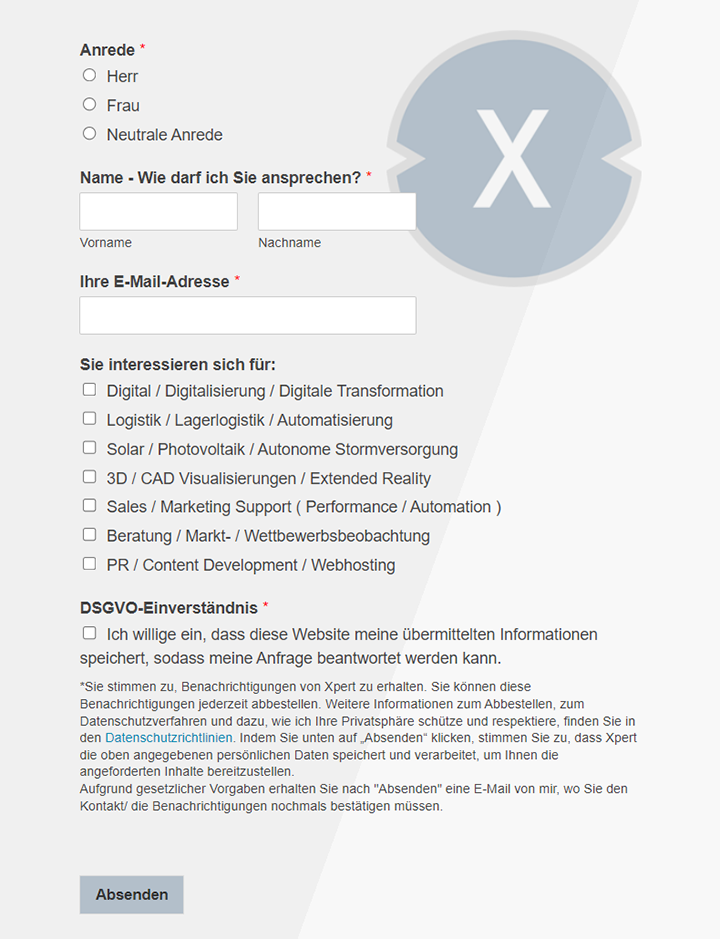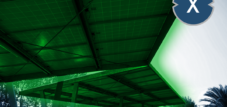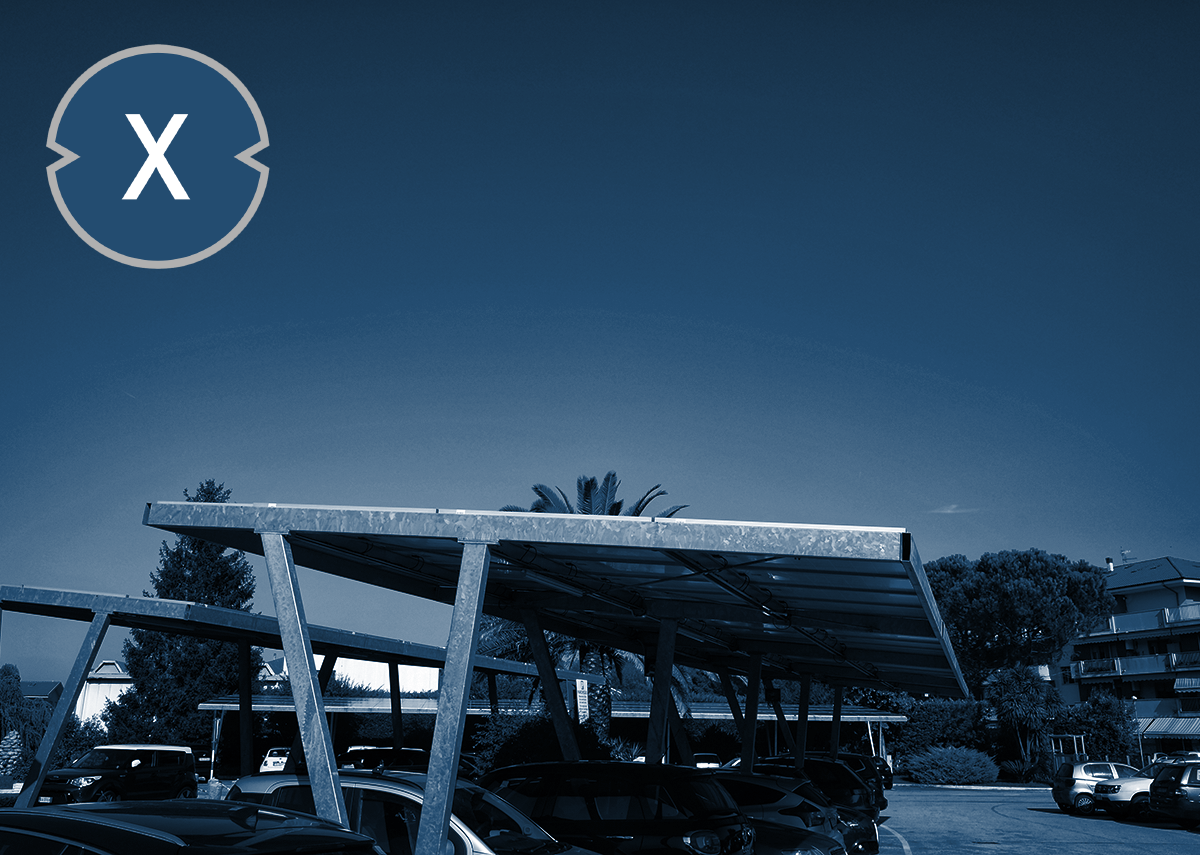
Solar carports generate electricity and protect parking spaces – Image: Xpert.Digital / robypangy|Shutterstock.com
In addition to parking, already sealed surfaces gain two new functionalities: protection from the elements and electricity generation
Climate protection is not only changing building regulations; it will also completely transform our current parking, refueling, and driving habits in the coming years. With your own solar system on the roof, whether on a building or warehouse, or even as a solar parking lot canopy, you can become independent of the electricity grid. The future belongs to autonomous power generation
Solar carports protect your parking areas from the elements. Thanks to the optimized mounting system, these PV carports provide secure shelters that simultaneously generate electricity. Both private car owners and parking lot operators such as supermarkets or municipalities benefit from the advantages of a solar carport. The electricity generated by the modules means the PV system pays for itself in a short time. As an added bonus, they enhance the visual appeal of your parking area.
📣 Parking lot solar solutions for industry, retail and municipalities
Everything from a single source, specifically designed for solar solutions for large parking areas. Refinance or offset your future costs with your own electricity generation.
🎯 For solar installers, plumbers, electricians and roofers
Consultation and planning including a non-binding cost estimate. We connect you with strong partners in photovoltaics.
👨🏻 👩🏻 👴🏻 👵🏻 For private households
We have a regional presence throughout the German-speaking world. We have reliable partners who will advise you and implement your wishes.
With over 1,000 articles published, we cannot present all topics here. Therefore, you will find a small selection of our work here, and we would be delighted if we have sparked your interest in learning more about us:
Our Photovoltaics Library (PDF)

Photovoltaic Library (PDF) – Image: Xpert.Digital / Benvenuto Cellini|Shutterstock.com
Large PDF library: Market monitoring and market intelligence on the topic of photovoltaics.
Data is reviewed and its relevance assessed at regular intervals. This usually yields a number of interesting pieces of information and documentation, which we summarize in a PDF presentation: our own data analyses and marketing intelligence, as well as external market observations.
More information here:
What percentage of new car registrations in Germany are electric cars?
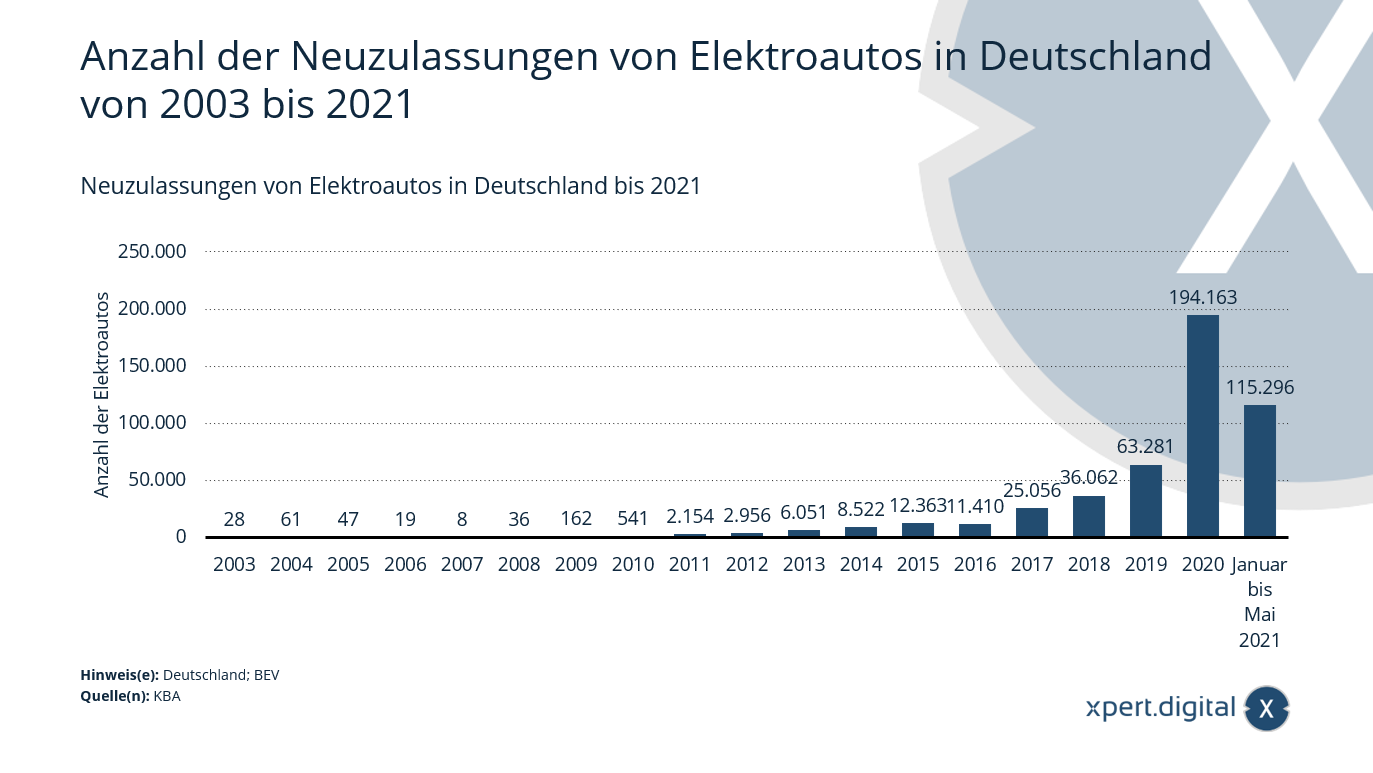
New registrations of electric cars – Image: Xpert.Digital
A record number of new electric car registrations were recorded in Germany in 2020 – with approximately 194,200 purely electric passenger cars registered, the highest number ever recorded. This represents a threefold increase compared to the previous year. The year 2021 also began with a significant increase compared to the same period of the previous year.
New registrations of battery electric vehicles (BEVs)
The statistics reflect new registrations of purely battery-powered electric cars. The term "electromobility" often encompasses various electric and partially electric drive systems. Battery electric vehicles are powered exclusively by an electric motor, which draws the necessary electrical energy from a traction battery. Plug-in hybrid vehicles, which have both an electric motor and a combustion engine and can only operate partially on electric power, are also generally included under the umbrella term "electromobility.".
Charging infrastructure is a basic requirement for the mobility transition
The number of publicly accessible charging stations is a key factor in the decision for or against an electric car. In 2020 alone, over 3,000 new charging points were added, bringing the total number of charging stations available to drivers to over 16,800 in December. Bavaria was the German state with the most charging stations in 2020.
How many electric cars are there worldwide?
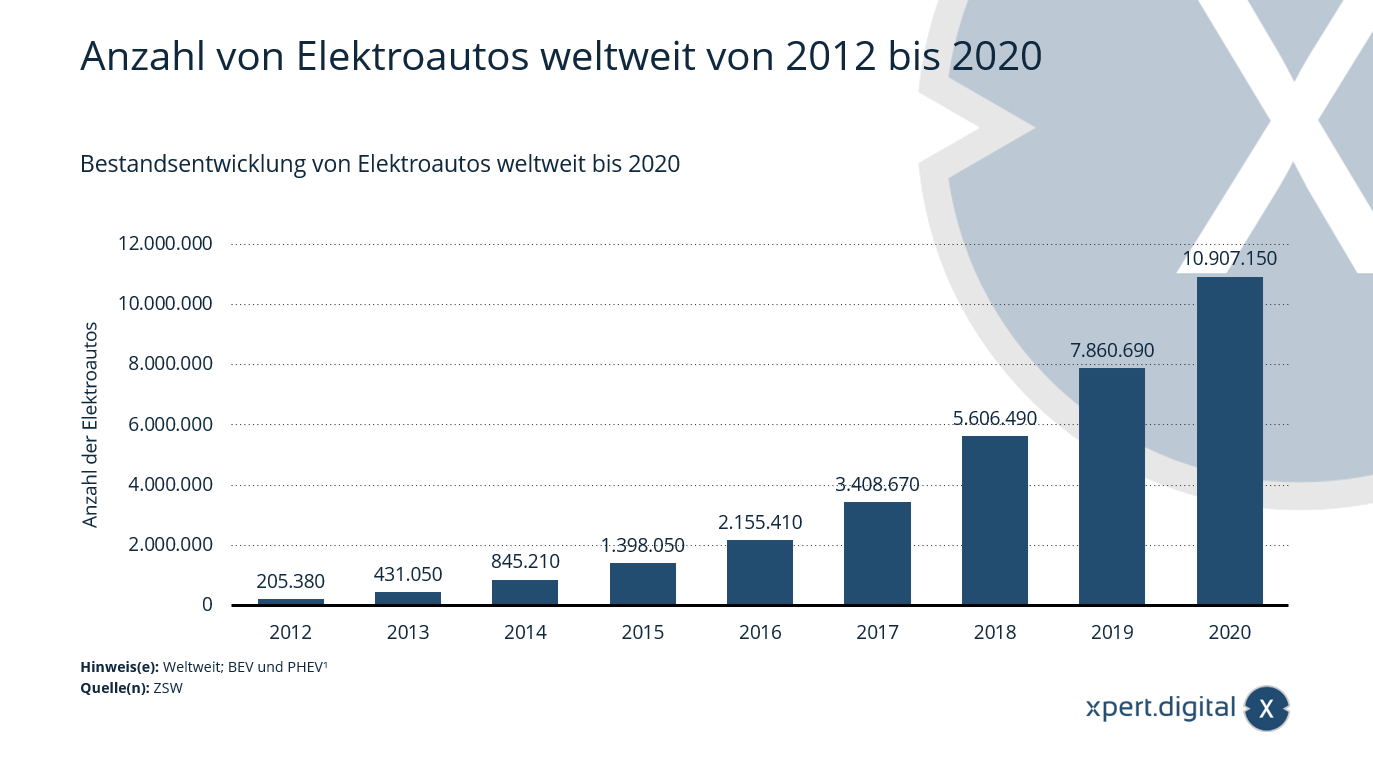
Number of electric cars worldwide – Image: Xpert.Digital. A new record has been set for the global number of electric cars – in 2020, around 10.9 million electric vehicles were registered worldwide, over three million more than the previous year. The number has increased more than fiftyfold since 2012. Given increasing air pollution and dependence on fossil fuels, alternative drive systems such as electromobility are playing an increasingly important role in motorized individual transport.
What is the price trend using the example of a fully installed solar power system?
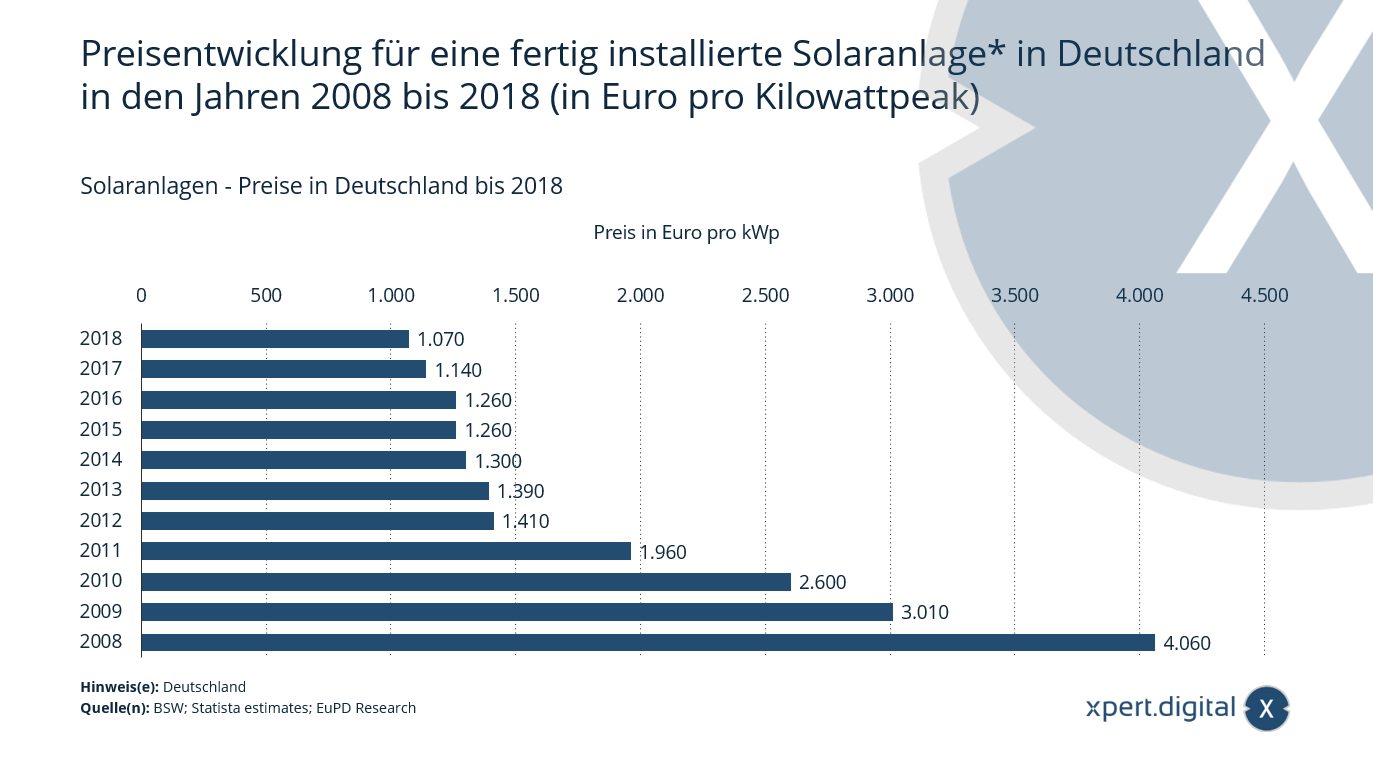
Solar panels – prices in Germany – Image: Xpert.Digital
The statistic shows the price development for a fully installed solar power system in Germany from 2008 to 2018. In 2018, a fully installed rooftop solar power system with a capacity of ten to 100 kilowatt peak cost 1,070 euros per kilowatt peak in Germany in the fourth quarter of the year.
*Net system price for a rooftop system from 10 to 100 kWp. The values refer to the fourth quarter of the year.
What is the share of solar energy in gross electricity generation in Germany?

Solar energy use through solar power systems – Image: Xpert.Digital / Kuznetcov_Konstantin|Shutterstock.com
According to current data from the Working Group on Energy Balances, around seven percent of Germany's gross electricity generation in 2018 came from photovoltaic systems. This marked the first increase in the share of photovoltaic energy in the electricity mix after several years of stagnation, as the graphic illustrates. Low system prices and high demand for more environmentally friendly energy sources fueled growth in the solar energy market last year.
More information here:
Record share of renewable energies of 55.8 percent
Net electricity generation in the first half of 2020: On July 1st, the Fraunhofer Institute for Solar Energy Systems ISE presented data on net public electricity generation for the first half of 2020, derived from the Energy-Charts data platform. With a share of 55.8 percent of net electricity generation for public use – that is, the electricity mix that comes out of the socket – renewable energies set a new record. In February, their share was even higher at 61.8 percent. Solar and wind power plants together fed 102.9 terawatt-hours (TWh) into the public grid, compared to 92.3 TWh in the first half of 2019. In contrast, electricity production from coal declined sharply: the share of lignite fell to 13.7 percent, and hard coal to just 6 percent. Wind energy, with a share of 30.6 percent, was once again the strongest energy source.
More information here:
Was the Earth greener 20 years ago or not?


The Earth is much greener than it was 20 years ago – @envato | PaulSchlemmer
The Earth is much greener than it was 20 years ago. While this sounds like cause for celebration, it should be viewed with caution. The areas of leafy greenery added to the Earth's surface since 2000 and cataloged by NASA's MODIS satellite have appeared as a result of reforestation and agricultural activities.
Particularly in China and India, human activity has led to increased vegetation cover. China increased its green area by 17.8 percent between 2000 and 2017, while India's increase was 11.1 percent. The EU, one of the eleven countries with the largest total leaf area, ranked third. Scientists analyzing data for a study published in the journal Nature Sustainability found that in China's case, 42 percent of the additional green space came from new forests and 32 percent from arable land. The country has recently invested billions in reforestation programs. India, on the other hand, had to account for 82 percent of its leaf area growth in agriculture. In Brazil, for example, the increase in green agricultural land was still almost entirely offset by the disappearance of forests and savanna vegetation.
Overall, the area of leaf litter on Earth increased by more than 4 percent over the 18 years studied, with two-thirds of this increase attributable to agricultural activities. The use of genetically modified plants, multiple growth cycles, intensive irrigation and fertilization, and the mechanization of agriculture have made farming more visible in satellite images, particularly in developing countries.
More information here:
How many people work in the renewable energy sector worldwide?
People – Renewable Energies – Image: Xpert.Digital / VAKS-Stock Agency|Shutterstock.com
According to a recent report published by the International Renewable Energy Agency, nearly 11 million people worldwide work in the renewable energy sector. Around 3.5 million of these employees work for companies involved in photovoltaics, the conversion of solar power into electricity.
The solar industry holds the strongest position in the statistics, employing another 800,000 people in solar energy that is directly converted into heat or cooling, and 34,000 more in concentrated solar power (CSP), an industry that builds large-scale solar power projects using mirrors and lenses to concentrate solar energy from large areas onto smaller ones. An example of this powerful technology is the PS10 solar power plant near Seville, Spain.
Since the first analysis in 2013, the number of people employed in the sector has increased from 5.7 million to around 11 million in 2018. The country with the most jobs is China, with just over 4 million people employed in its strong photovoltaic and wind power industries. Brazil employs 1.1 million people, mainly in the biofuels sector. Around 1.2 million people in the EU work in this sector, with solid biomass and wind power being equally important.
More information here:
Which form of energy supply is best suited for municipalities and communities?

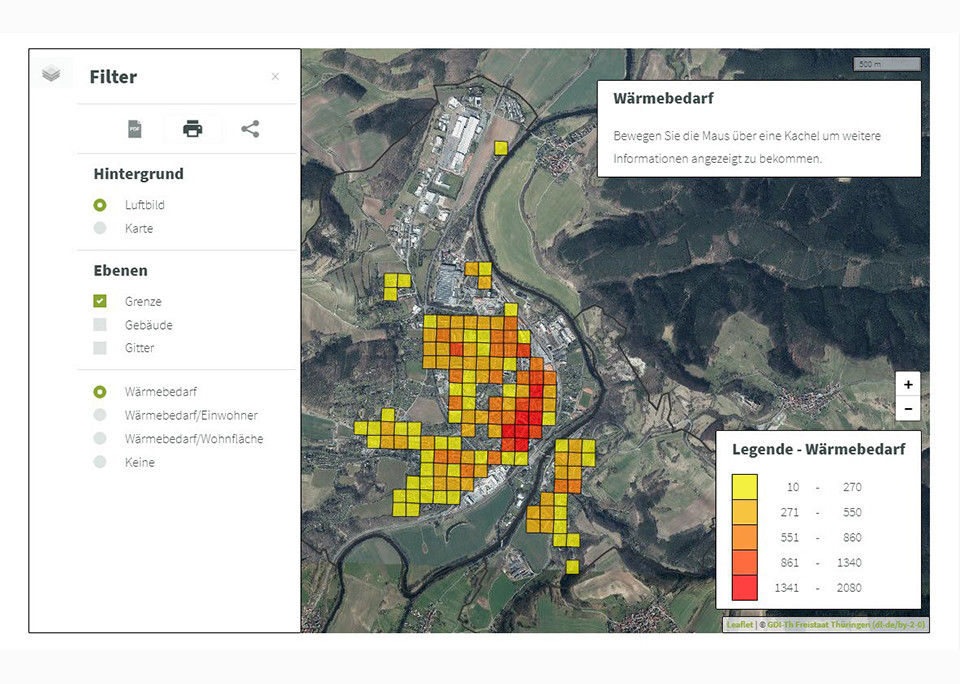
© Fraunhofer IOSB-AST/Martin Käßler
Visualized heating demand of the municipality of Neumark (486 inhabitants) on a 100 x 100 m grid. Dark colors indicate high heating demand. The results were estimated based on building structures.
The energy transition is upon us. Representatives of small communities, however, are often unsure what this transition might look like for them. Solar energy, photovoltaics, or geothermal energy? What makes sense, and to what extent can these technologies contribute to the community's energy supply? What about potential subsidies?
Software tool analyzes needs and possibilities
This is where a tool from the Applied Systems Technology AST division of the Fraunhofer Institute for Optronics, System Technologies and Image Processing IOSB comes into play, developed by researchers in the "Energy Technology and Economic Modeling modTRAIL" project. "Our software allows mayors of smaller municipalities to learn about the technical possibilities in the area of the energy transition and the corresponding funding opportunities – tailored to their specific municipality," says Liane Rublack, a scientist at Fraunhofer IOBS-AST. "Heat and electricity do not have to be generated entirely from renewable sources; rather, the tool relies on an energy mix of conventional and renewable generation facilities."
More information here:
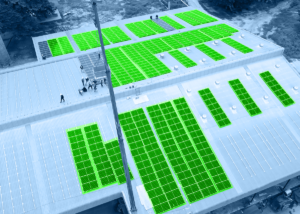
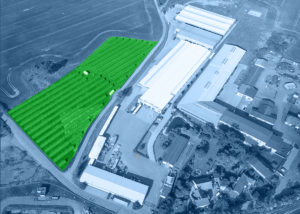
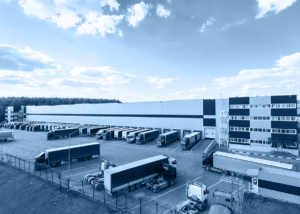
- Planning photovoltaics on warehouses, commercial buildings and industrial buildings
- Industrial plant: Planning a photovoltaic open-field system or open-area system
- Planning solar power systems with photovoltaic solutions for freight forwarding companies and contract logistics
- B2B Solar Systems and Photovoltaic Solutions & Consulting
Solar system solutions: Xpert.Solar for planning and consulting in the area of solar carports, rooftop solar systems and photovoltaic systems in general for Duisburg, Bochum, Wuppertal and Bonn

Konrad Wolfenstein
I would be happy to serve as your personal advisor.
You can contact me by filling out the contact form below or simply call me on +49 7348 4088 965 .
I'm looking forward to our joint project.
Write to me


Xpert.Digital – Konrad Wolfenstein
Xpert.Digital is a hub for industry focusing on digitalization, mechanical engineering, logistics/intralogistics and photovoltaics.
With our 360° Business Development solution, we support renowned companies from new business to after-sales.
Market intelligence, smarketing, marketing automation, content development, PR, mail campaigns, personalized social media and lead nurturing are part of our digital tools.
You can find more information at: www.xpert.digital – www.xpert.solar – www.xpert.plus
Keep in touch