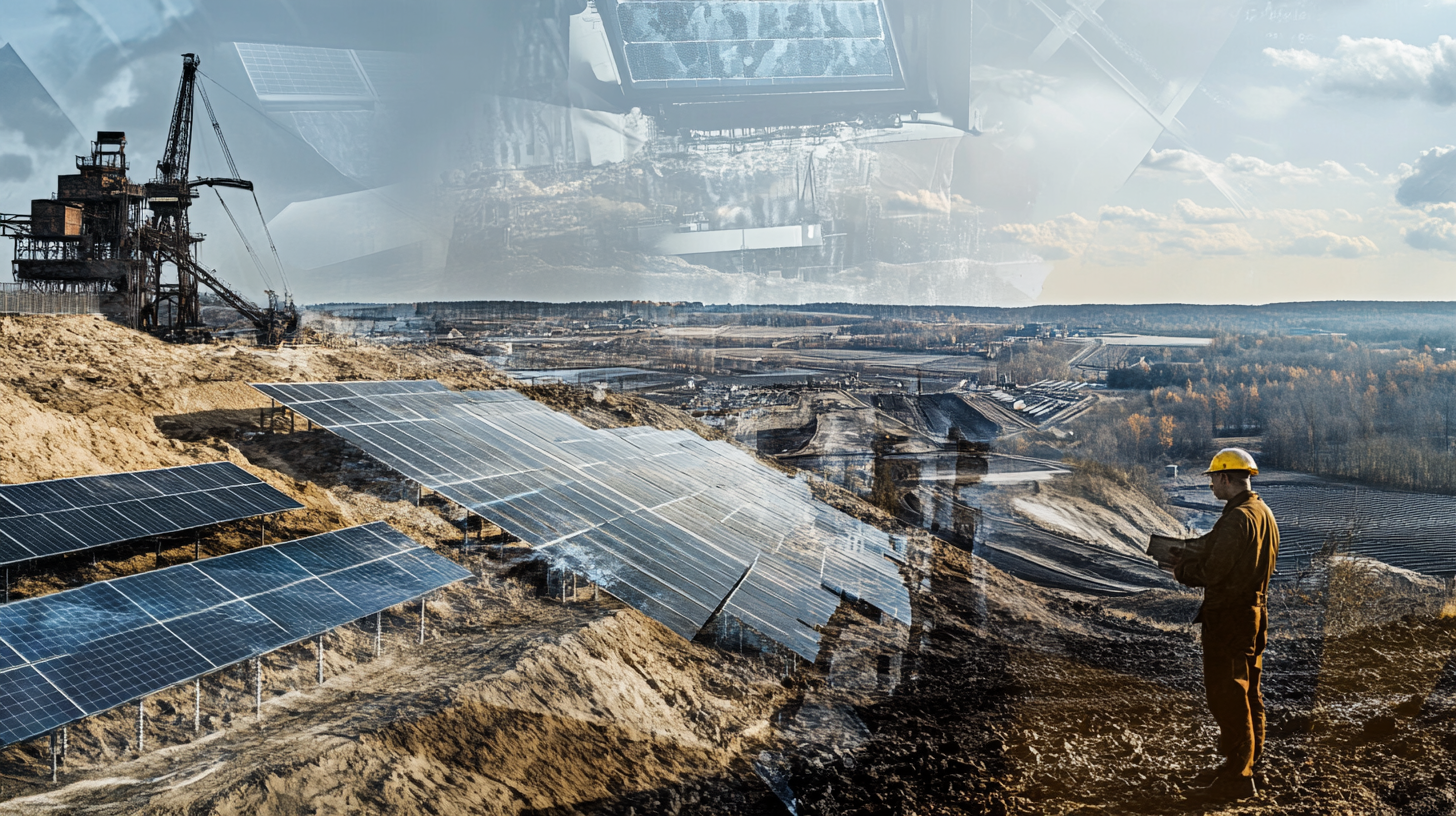
Solar park transformation of former lignite mining areas in Saxony: Pödelwitz and Witznitz – Germany's largest solar park – Image: Xpert.Digital
From open-pit mining to solar transformation: The change in Saxony
Photovoltaics instead of coal: A look at Saxony's energy landscape
The Witznitz Energy Park and the solar power plants in Pödelwitz represent a significant transformation in Saxony's energy landscape. Photovoltaic systems are increasingly being built on former open-cast mining sites, enabling a sustainable energy supply and simultaneously contributing to the economic restructuring of the region. The Witznitz Energy Park has established itself as Germany's largest solar park, while Mibrag, with its projects near Pödelwitz, is making a significant contribution to local power generation and the regional energy transition.
Related to this:

Witznitz Energy Park: Germany's largest solar park
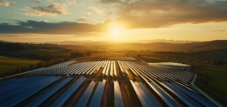
The Witznitz Energy Park was officially commissioned in July 2024 and marks a milestone in Germany's energy transition. With an installed capacity of 605 megawatts and a planned expansion to 650 megawatts, it is the largest solar park in Germany. The impressive facility covers an area of approximately 500 hectares, roughly equivalent to 700 football fields, and was built on the site of a former open-cast lignite mine.
Construction of the energy park began on June 8, 2022, and approximately 1.1 million solar modules were installed within two years. The plant went into operation in April 2024 and was officially opened in July 2024. At the opening ceremony, Saxony's Minister-President Michael Kretschmer emphasized the significance of the project: "This largest solar park in Germany is located in the heart of the Central German mining region. We see that renewables have a future and are delighted about this major investment here in Central Germany."
Financing and profitability
A remarkable aspect of the Witznitz Energy Park is its innovative financing model. The entire facility was built without any government subsidies, financed by the largest sustainability investment to date by the Signal Iduna Group and its financial subsidiary, Hansainvest Real Assets. Martin Berger, CFO of the Signal Iduna Group, emphasized the significance of the investment as a flagship project for the energy transition. This decision underscores the insurance group's responsibility for a sustainable future and simultaneously provides a crucial boost to the economic development of the region.
Instead of relying on government subsidies, the energy produced is sold directly to Shell for a fixed amount over a period of 15 years, which in turn supplies the electricity to Microsoft data centers. This direct purchase agreement ensures the long-term profitability of the project.
Power supply and ecological aspects
With its enormous capacity, the Witznitz energy park can theoretically cover the average annual energy needs of approximately 200,000 four-person households. This will save more than 250,000 tons of CO₂ emissions per year. In addition to the installed solar panels, 1.2 square kilometers of ecological compensation area were also created.
The electricity is fed directly into the high-voltage grid, which already existed in the region due to former lignite mining. However, after commissioning, there were complaints about a humming noise emanating from the substation. The Borna district office received approximately 70 such complaints, and although no guideline values were exceeded, further measurements are to be carried out and noise abatement measures implemented if necessary.
Mibrag solar parks: Energy transition in the Vereinigtes Schleenhain open-cast mine
In parallel with the large-scale project in Witznitz, the Central German Brown Coal Company (Mibrag) has implemented its own solar park projects on former open-cast mining areas. The Peres II solar park near Pödelwitz was officially commissioned in September 2023 and represents an important step in the company's transformation.
Technical specifications and investment
Mibrag invested around €25 million in the Peres II solar park. 66,000 solar modules were installed on a total area of 55 hectares, capable of generating 37 megawatts peak power. The energy produced is theoretically equivalent to the consumption of approximately 15,000 households.
Armin Eichholz, Chairman of the Mibrag Management Board, emphasized at the commissioning: "At peak times we can generate 37 megawatts peak and use the green electricity to operate our open-cast mining facilities." The solar park was built on a recultivated area of the Vereinigtes Schleenhain open-cast mine and primarily serves to supply the mining company with its own electricity.
Expansion of solar capacities
In December 2024, Mibrag commissioned its third photovoltaic plant, Peres West I. This plant, with a peak capacity of 43 megawatts, was also built on a reclaimed area of the Vereinigtes Schleenhain open-cast mine and represented an investment of €24 million. With this addition, Mibrag more than doubled its solar capacity, reaching a total peak output of approximately 80 megawatts.
Dr. Armin Eichholz explained: “In this way, we are directly strengthening our own electricity supply and creating a high-performance basis to be able to produce green hydrogen in the future as an energy and industrial service provider at the Profen site.” The annual electricity production of Peres West I is estimated at around 41,000 megawatt hours, which is theoretically enough to supply around 16,000 households with renewable energy.
Ecological measures
Extensive ecological compensation measures were also implemented during the construction of the Peres II solar park. Large-scale mapping of flora and fauna in 2021 was part of the technical project planning. Based on this, 45 partially interconnected individual habitats were created to protect sand lizards and insects, and hedges were planted as compensation areas for breeding birds.
Related to this:

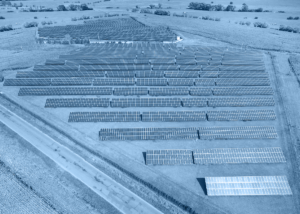
Transformation of the Central German mining region
The solar parks in Witznitz and near Pödelwitz are part of a larger transformation of the Central German mining region. Dominique Guillou, Managing Director of EPNE (EP New Energies), which also includes Mibrag, describes the commissioning of the Peres II solar park as "another significant step towards transforming the Central German mining region into a modern energy and industrial location based on renewable energies and hydrogen production".
The conversion of former open-cast mining areas for solar energy generation represents a sensible repurposing of the land, offering both ecological and economic advantages. The Witznitz Energy Park will supply one-third of the output of the nearby coal-fired power plant in the future, thus making a significant contribution to the structural transformation of the former lignite mining region.
Transformation in the Ruhr region: Pödelwitz fights for its future
Despite the positive developments, the transformation of the region also presents challenges. In Pödelwitz, where a solar farm has also been built, long-time and new residents are struggling with the fact that Mibrag, the owner of many houses, is allowing them to fall into increasing disrepair. Although the association "Pödelwitz has a Future" recently managed to purchase a house from the company, revitalizing the village is proving difficult.
Lusatia plans: Up to 14 gigawatts for renewable energies
The solar parks in Witznitz and near Pödelwitz mark a significant step forward for the energy transition in Saxony. A spokesperson for the Saxon Ministry of Energy emphasized the size of the Witznitz energy park and explained that it makes a significant contribution to Saxony's energy balance. To illustrate this, he stated that the total installed photovoltaic capacity in Saxony in 2023 amounted to approximately 650 MWp.
EPNE, to which Mibrag belongs, has identified a potential of 1 gigawatt for renewable energies with Mibrag alone, of which 250 megawatts are already under development. The plans for Lusatia are even larger, with figures of 7 to 14 gigawatts being discussed.
How former lignite mining regions of Germany contribute to the energy transition
The solar parks in Witznitz and near Pödelwitz exemplify how former lignite mining areas can be used for renewable energy production. The Witznitz Energy Park, Germany's largest solar park, and the Mibrag projects near Pödelwitz are making a significant contribution to the transformation of Saxony's energy landscape and supporting structural change in the affected regions. These projects not only promote a sustainable energy supply but also support economic development in the areas impacted by the coal phase-out.
This transformation is an important contribution to Germany's energy transition and demonstrates how former industrial sites can be used effectively for renewable energy generation. The combination of ecological compensation measures and renewable energy production also creates added value for the environment and climate.
Related to this:
Your partner for business development in the fields of photovoltaics and construction
From industrial rooftop PV to solar parks and larger solar parking lots
☑️ Our business language is English or German
☑️ NEW: Correspondence in your native language!

Konrad Wolfenstein
I and my team are happy to be available to you as your personal advisor.
You can contact me by filling out the contact form here wolfenstein@xpert.digital:or simply call me at +49 7348 4088 965. My email address is
I'm looking forward to our joint project.