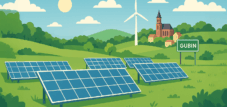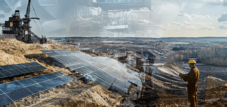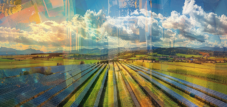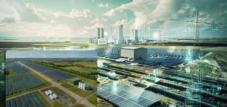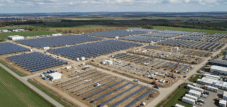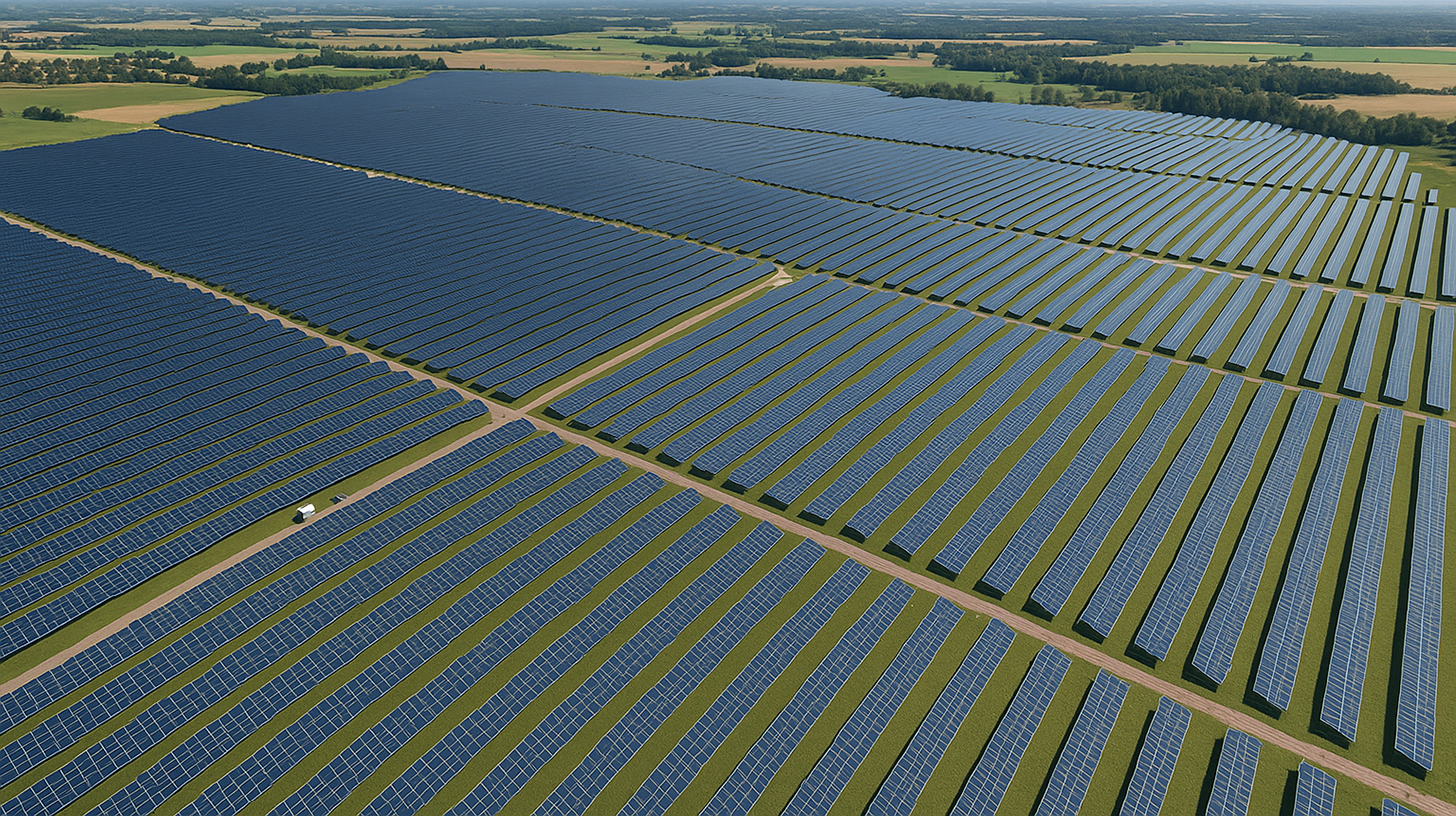
Park Słoneczny | Largest solar park in Poland/Lower Silesia with 303 MW on over 260 hectares northeast of Wrocław – Creative image: Xpert.Digital
Larger than 360 football fields: Is this the beginning of Poland's new solar record for 117,000 households?
### From Coal Country to Solar Champion: This Mega-Project is Changing Poland's Energy Future ### German Solar Giant for Poland: This Power Plant Supplies an Entire Major City ### Poland's Solar Revolution: A New 303-Megawatt Project Breaks All Standards ### Energy Miracle on the Oder: Why Germany is Now Looking Closely to Poland ### Supplying 117,000 Households: This Solar Project in Lower Silesia is Making History ###
This could become Poland's largest PV farm – a record project is being built in Lower Silesia
In Lower Silesia, an extraordinary energy project is taking shape that has the potential to fundamentally transform the solar energy sector in Poland. The Dresden-based VSB Group secured the contract in July 2025 for a photovoltaic park with an installed capacity of 303 megawatts peak, making this project one of the largest solar projects in the country.
The project, planned for an impressive area of over 260 hectares northeast of Wrocław, marks a significant milestone for Poland's energy transition. Once fully operational, the plant will generate enough clean electricity to theoretically power approximately 117,000 households. Construction is scheduled to begin in October 2025, with grid connection planned for the second quarter of 2027.
A market experiencing rapid growth
Poland has developed into one of the most dynamic photovoltaic markets in Europe in recent years. At the end of 2024, the country surpassed the impressive mark of 21 gigawatts of installed photovoltaic capacity, having already reached the 20-gigawatt threshold in October 2024. This rapid development underscores the enormous potential of the Polish solar market, which is now among the most important in the European Union.
Particularly noteworthy is the fact that renewable energies reached a share of 44.1 percent of Poland's electricity mix for the first time in June 2025, thus overtaking traditional coal-fired power generation at 43.7 percent. This historic turning point illustrates the speed of the energy transformation in Poland and the central role of photovoltaics in this process.
Forecasts for future development are extremely optimistic. Analysts expect that installed photovoltaic capacity could reach between 22 and 27 gigawatts by 2025, representing annual growth of over 20 percent. By 2030, photovoltaic capacity is projected to rise to 35.5 gigawatts, which would account for approximately 68.9 percent of Poland's total planned renewable energy capacity.
Lower Silesia as a center of solar energy
The Lower Silesia region has become a focal point for Polish photovoltaic development. In addition to the VSB project, numerous other solar parks are being built here, fundamentally changing the region's energy profile. SachsenEnergie AG, for example, has acquired three solar parks in the region with a total capacity of 23.1 megawatts peak, including the Jawor plant with 12.0 MWp, Jelenia Góra 1 with 6.7 MWp, and the Jelenia Góra 2 expansion with 4.4 MWp.
International corporations are also taking advantage of the favorable conditions in the region. PepsiCo has commissioned a 3.5 MWp photovoltaic plant near Wrocław, which covers 24 percent of the total energy needs of PepsiCo's most modern plant in the European Union. These examples demonstrate how companies from various sectors are turning to solar energy to reduce their energy costs and achieve sustainability goals.
Financing models and funding structures
The VSB project benefits from government funding through a Contract for Difference (CfD) agreement, which guarantees long-term price stability. These CfD agreements are a proven instrument for mitigating risk in large-scale renewable energy projects and provide investors with the necessary planning certainty. The mechanism stipulates that projects are initially subsidized for up to 25 years, with a guaranteed, inflation-indexed feed-in tariff for the electricity generated during the first 100,000 full-load operating hours.
The Polish energy regulator URE regularly conducts auctions in which project developers compete for government subsidies. These auctions have proven to be an effective means of keeping costs down for consumers while simultaneously promoting the expansion of renewable energy. The new system has replaced the previous certificate model and, through mandatory direct marketing based on the differential pricing system, offers a strong link to electricity price developments.
Technological developments and innovations
The Polish photovoltaic market is characterized by high technological diversity. Projects range from small rooftop installations for prosumers to large-scale ground-mounted systems in the megawatt range. A particular trend is the integration of energy storage solutions, with approximately 10 percent of planned projects including battery storage. For large-scale solar projects, about a quarter plan to build storage facilities with a total capacity of 1.7 gigawatts.
The VSB Group plans to develop its Lower Silesia project into one of Europe's largest hybrid energy projects in the medium term, combining photovoltaics, battery storage, and wind energy. This hybrid approach maximizes energy generation efficiency and contributes to grid stability.
New: Patent from the USA – install solar parks up to 30% cheaper and 40% faster and easier – with explanatory videos!

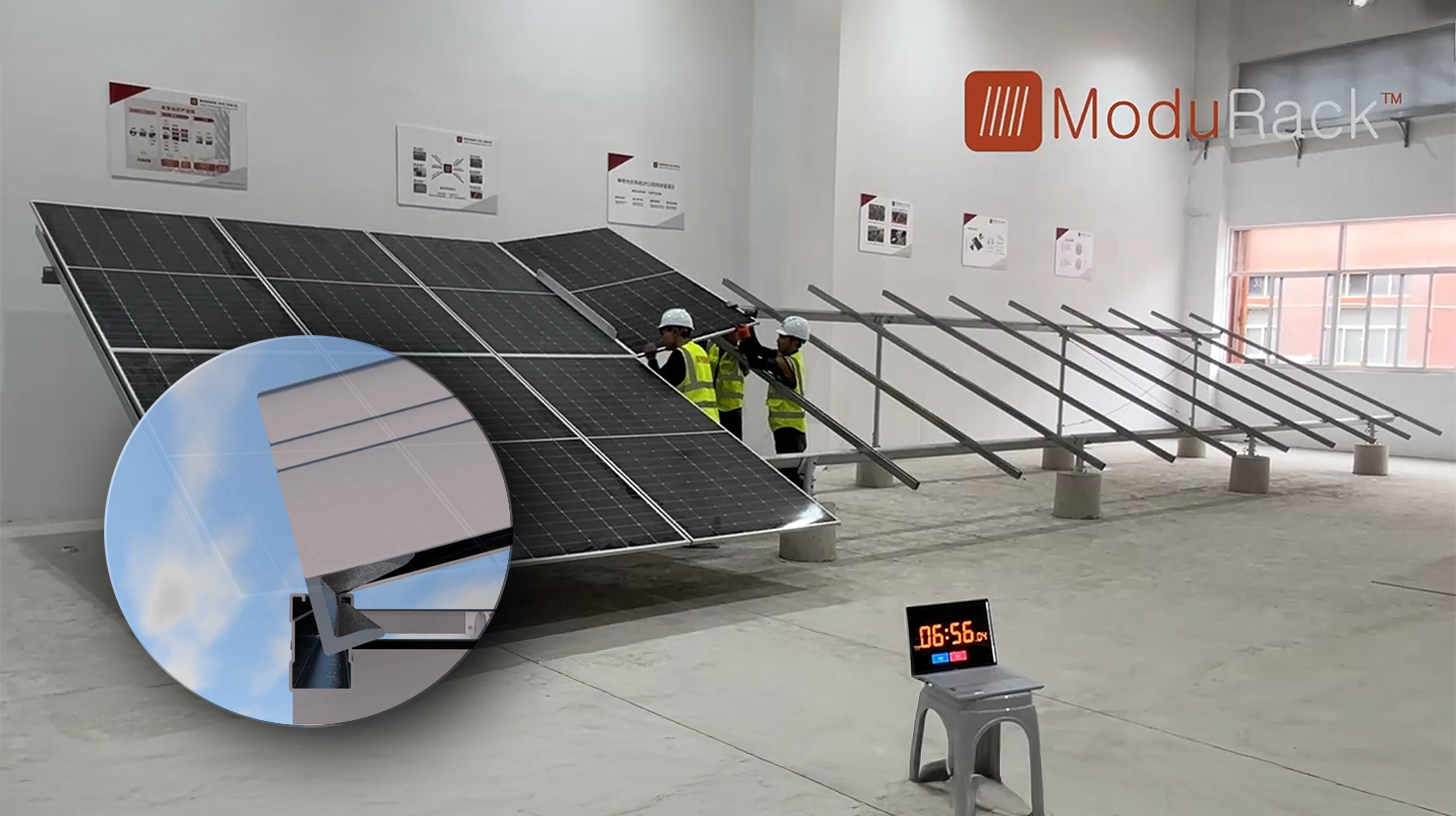
New: Patent from the USA – Install solar parks up to 30% cheaper and 40% faster and easier – with explanatory videos! - Image: Xpert.Digital
The core of this technological advancement is the deliberate departure from conventional clamp mounting, which has been the standard for decades. The new, more time- and cost-effective mounting system addresses this with a fundamentally different, more intelligent concept. Instead of clamping the modules at specific points, they are inserted into a continuous, specially shaped support rail and held securely in place. This design ensures that all forces – whether static loads from snow or dynamic loads from wind – are distributed evenly across the entire length of the module frame.
More information here:
Hybrid parks and storage: This is how Poland could become the solar capital
Current market leaders and competitive situation
The Polish photovoltaic market is characterized by various national and international players. The country's largest solar park to date is Zwartowo, operated by Goldbeck Solar, with an installed capacity of 204 megawatts in the first phase and a planned capacity of 290 megawatts upon completion. This project is considered the largest solar power plant in Central and Eastern Europe and is estimated to supply around 153,000 households with green electricity.
RWE has also established a strong presence in the Polish market and already operates solar power plants with a total capacity of 54 megawatts and wind farms with 541 megawatts of installed capacity. At the most recent Polish renewable energy auction, RWE was also awarded contracts for 31 additional solar projects with a total capacity of 84 megawatts.
Other significant players include companies such as Qair Polska, R.Power, and Lightsource Renewable Energy Poland, which have been identified as investors in 1,496 projects with a total capacity of over 3.3 gigawatts. This diversity of market participants ensures healthy competition and drives innovation.
Challenges and market barriers
Despite the positive developments, the Polish photovoltaic industry faces several challenges. One of the biggest hurdles is the increasing difficulty in connecting new plants to the electricity grid. Due to grid overloads, more and more applicants are being denied grid connection for renewable energy plants, making projects with already granted connection conditions particularly valuable.
The COVID-19 pandemic and the war in Ukraine have led to significant disruptions in supply chains and caused asset prices to rise dramatically. In addition, investment funds are experiencing substantial difficulties in financing further investments, which is delaying project implementation.
Another aspect is the change in the support system for small-scale prosumer installations. The discontinuation of applications under the preference-based support system and its replacement with market-oriented net billing has tightened the framework conditions for smaller installations.
Economic importance and jobs
The expansion of photovoltaics in Poland has significant economic implications. The Polish photovoltaic market could reach a value of up to 80 billion zlotys within a decade, benefiting traders, installers, banks, and end users. Annual market revenue already exceeds 5 billion zlotys, with an expected increase of 25 percent per year.
Large-scale projects like the VSB project in Lower Silesia not only create jobs during the construction phase, but also long-term prospects in the maintenance and operation of the plants. PepsiCo's investment of over one billion zlotys near Wrocław has created several hundred new jobs and demonstrates how industrial companies can gain strategic advantages through their own solar power plants.
International cooperation and EU policy
The development of the Polish photovoltaic market is significantly influenced by the EU solar strategy. As part of the REPowerEU plan, an ambitious solar energy strategy was adopted, aiming to increase installed photovoltaic capacity to more than 320 gigawatts by 2025 and to almost 600 gigawatts by 2030 across the EU.
New EU regulations make the installation of photovoltaic systems on building roofs mandatory. In Poland, these regulations will be implemented gradually: from 2026 for new commercial and public buildings and from 2029 for new residential buildings. This regulation will significantly increase the number of installations and contribute to the further popularization of solar energy.
German companies play a particularly important role in the Polish market. SUNfarming, with an existing portfolio of 11 megawatts, has become one of the largest solar investors in Poland, while BayWa r.e. already realized what was then Poland's largest subsidy-free solar park with 64.6 MWp in 2020.
4,000 projects, 12.3 GW approved — Poland's photovoltaics are exploding
The outlook for the Polish photovoltaic industry is exceptionally positive. With over 4,000 solar projects in various stages of development and a planned total capacity of more than 19 gigawatts, Poland boasts one of the largest project pipelines in Europe. Nearly 1,500 projects with a cumulative capacity of over 12.3 gigawatts have already received building permits and could be considered in upcoming tenders.
The VSB project in Lower Silesia could indeed become Poland's largest photovoltaic park, ushering in a new era of large-scale solar energy use. The planned expansion into a hybrid energy project with battery storage and potentially wind power demonstrates the industry's innovative strength and the potential for integrated energy solutions.
Poland already holds a leading position in the European Union in the growth of photovoltaic capacity and ranks fourth in terms of photovoltaic power output growth. This position will be further solidified with projects like the VSB solar park in Lower Silesia, making Poland one of the most important solar markets in Europe.
The combination of favorable climatic conditions, supportive political frameworks, falling technology costs, and growing environmental awareness creates ideal conditions for the continued dynamic development of the Polish photovoltaic industry. The project in Lower Silesia exemplifies this positive development and could become a symbol of Poland's successful energy transition.
Look, this little detail saves up to 40% installation time and reduces costs by up to 30%. It comes from the USA and is patented.

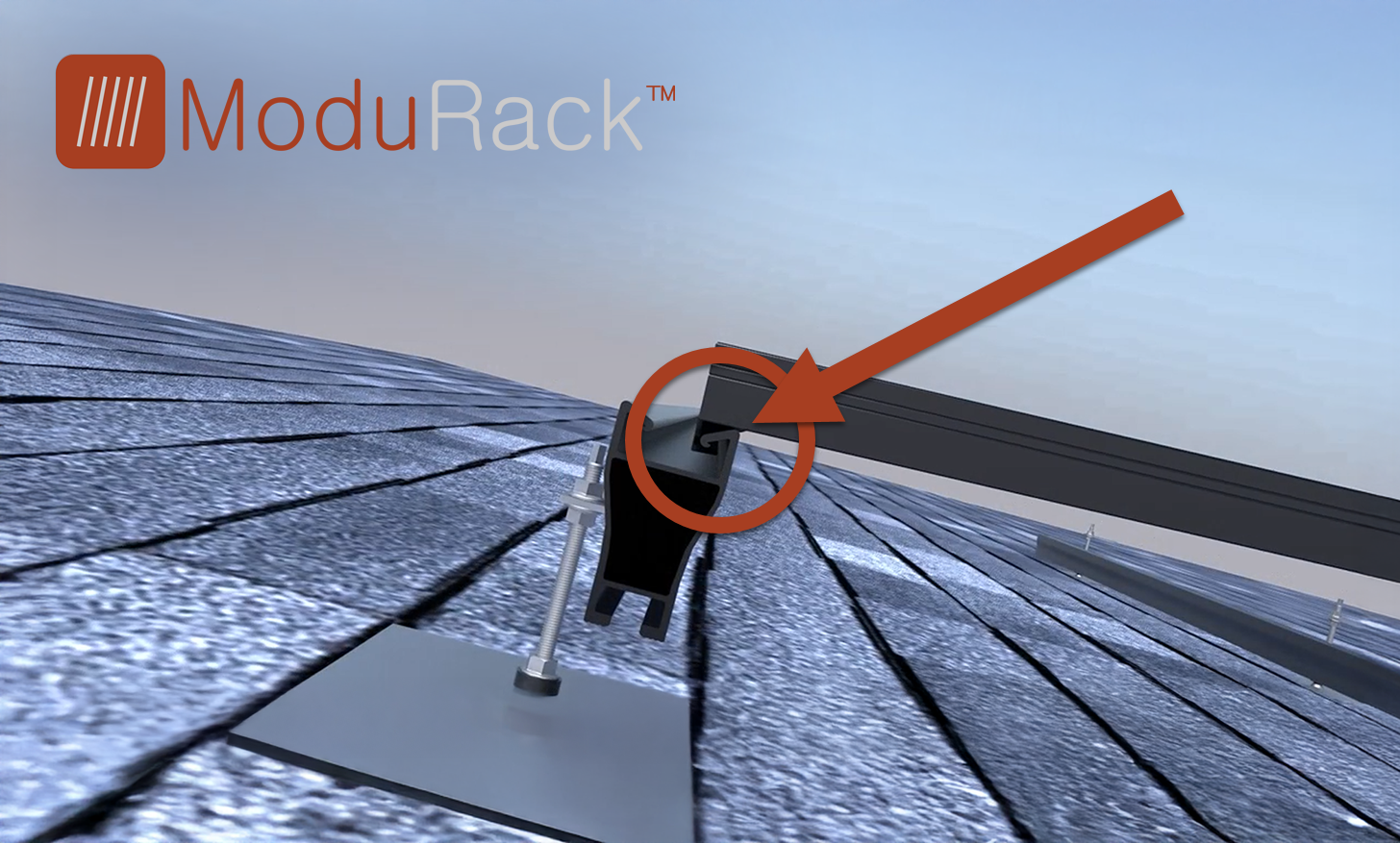
NEW: Ready-to-install solar systems! This patented innovation significantly accelerates your solar construction project
The core of ModuRack 's innovation lies in the departure from conventional clamp fastening. Instead of clamps, the modules are inserted and held in place by a continuous support rail.
More information here:
Your partner for business development in the fields of photovoltaics and construction
From industrial rooftop PV to solar parks and larger solar parking lots
☑️ Our business language is English or German
☑️ NEW: Correspondence in your native language!

Konrad Wolfenstein
I and my team are happy to be available to you as your personal advisor.
You can contact me by filling out the contact form here wolfenstein@xpert.digital:or simply call me at +49 7348 4088 965. My email address is
I'm looking forward to our joint project.