

Published on: February 22, 2025 / Updated on: February 22, 2025 – Author: Konrad Wolfenstein
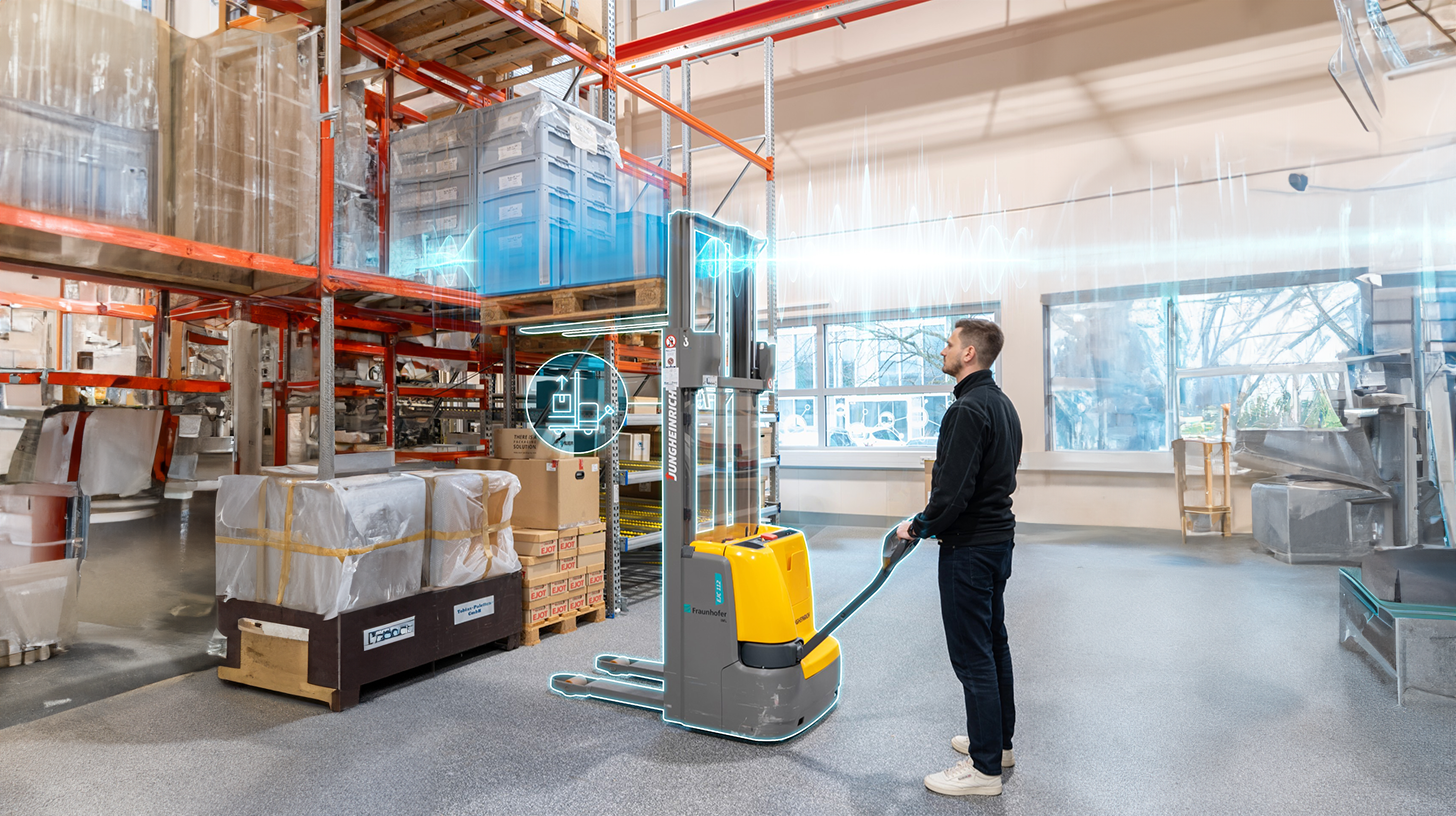
Smart equipment: Real-time data from pallets with Pal2Rec – use of artificial intelligence for data analysis of sensor data – Original image: Fraunhofer IML / Creative image: Xpert.Digital
Real-time tracking: Pallets become digital information sources
Smart Pallets: The Transformation of Intralogistics through Real-Time Data and Intelligent Technology
In the complex world of logistics, where efficiency and transparency are crucial for success and competitiveness, pallets play a central, albeit often underestimated, role. These unassuming load carriers are the backbone of global goods flows, moving countless items daily through warehouses, production facilities, and distribution centers. But their potential extends far beyond mere transport. The Fraunhofer Institute for Material Flow and Logistics IML has explored these hidden possibilities and, within the framework of the research project "Pal2Rec"—short for "Pallet to Recognition"—conducted a feasibility study that fundamentally changes the traditional understanding of pallets. The goal was ambitious: to prove that pallets can do more than just carry loads. They should "think" along and provide valuable information about their logistical journey, the process steps they undergo, and their movements in real time. The initial results of this research impressively confirm this vision and point to an impending revolution in intralogistics.
Challenges of the logistics industry
We live in a time where the logistics industry is under enormous pressure to operate ever more efficiently, sustainably, and economically. Optimizing processes, reducing costs, and minimizing environmental impact have become key challenges. However, a major problem for many companies is the lack of transparency in their own logistics operations. Often, there is a lack of transparency regarding the actual movement of goods, resource utilization, and the efficiency of individual process steps. This lack of information inevitably leads to inefficient processes, unnecessary costs, and missed optimization opportunities. This is where Pal2Rec comes in, to shed light on this opacity.
Intelligent sensors for pallets
The project's innovative approach lies in equipping pallets with intelligent sensors. These sensors, which can be discreetly and robustly integrated into the pallets, capture a multitude of data points crucial for understanding the logistics process. Real-time movements, precise detection of shocks and vibrations, tilt and inclination angles – all this information is recorded seamlessly and placed within a comprehensive logistical context. Imagine each pallet becoming a "talking" object, documenting its own journey through the logistics chain and providing valuable insights into the efficiency and quality of the processes.
Suitable for:
Artificial intelligence for data analysis
The sheer volume of data generated by these smart pallets would be worthless without intelligent analysis. This is where artificial intelligence (AI) comes in. The researchers at Pal2Rec used the collected sensor data to train an AI capable of recognizing complex movement patterns and assigning them to the corresponding activities in everyday logistics. Whether it's loading a pallet with goods, storing it in a high-bay warehouse, transporting it with a forklift, or picking items – the AI learns to identify and interpret the characteristic movement profiles of each activity. The result is a kind of "activity profile" for each individual pallet, providing detailed information about its tasks, the process steps it has undergone, and its movements.
Advantages of the data obtained
Julian Brandt, project manager of Pal2Rec and research associate at Fraunhofer IML, emphasizes the enormous added value of this data: "The data provides valuable insights that help companies to specifically identify weaknesses and fully exploit optimization potential." But the advantages extend far beyond pure process optimization. One particularly promising application is predictive maintenance. By continuously monitoring pallet movements and analyzing vibrations and loads, potential damage can be detected early, before it even occurs. For example, if a pallet is repeatedly subjected to strong impacts or shows signs of material fatigue, this can be detected in time to take the pallet out of service and avoid costly failures or even accidents. This predictive maintenance not only contributes to increased safety but also significantly reduces the costs of repairs and replacements.
Selection of the appropriate sensor technology
Another important aspect of the Pal2Rec project was the careful selection of suitable sensor technology. As part of the feasibility study, the researchers intensively investigated which sensors were best suited for this demanding application. A surprising and encouraging result was that even cost-effective sensor models can meet the requirements in many cases. This is a crucial factor for the widespread acceptance and implementation of the technology in industry. Companies can thus not only benefit from the numerous advantages of smart pallets, but also do so within an economically viable framework. Investing in smart pallets therefore promises a rapid return on investment through increased efficiency, cost reductions, and improved process quality.
Partnership and support
The Pal2Rec project is an impressive example of successful collaboration between research and academia. It was carried out as a joint project with the renowned Chair of Materials Handling and Warehousing (FLW) at TU Dortmund University. The project received financial support of approximately €180,000 from the Federal Ministry for Digital and Economic Affairs (BMDV) as part of the mFUND innovation initiative. This funding underscores the project's importance for the further development of the logistics industry and the promotion of digital innovation in Germany. The project's results to date are not only considered a complete success but also serve as a strong incentive for the project partners to seek follow-up funding and to further develop and implement this promising technology.
Closing event
For anyone interested in the future of logistics and the potential of smart pallets, February 25, 2025, offers an excellent opportunity. On this day, the official closing event of the Pal2Rec research project will take place. Those interested from industry, academia, and practice are cordially invited to attend the presentation of the project results, both in person and online, and to discuss them directly with industry experts. This event provides a unique platform to learn firsthand about the latest developments in the field of smart pallets and to establish valuable contacts.
More about it here:
Detailed insights into the Pal2Rec project: objectives, technology and benefits
The Pal2Rec (Pallet to Recognition) research project is more than just a feasibility study – it is an innovative initiative with the potential to fundamentally change logistics. At the heart of the project is the vision of making pallets in logistics smarter and transforming them from passive load carriers into active sources of information.
Goal and concept: Autonomous activity recognition for intelligent logistics processes
The central goal of Pal2Rec is to investigate how (Euro) pallets can be integrated autonomously and proactively into logistics processes through sensor-based activity detection. The project pursues the approach of precisely capturing and intelligently interpreting pallet movement data using sensors, without relying on additional, costly, and complex accompanying information such as camera images. The idea is that the pallet itself becomes the "informant," communicating its status, position, and the processes it has undergone in real time.
Technology and implementation: Sensor equipment, AI-supported data analysis and activity profiles
To achieve this ambitious goal, Pal2Rec relies on a combination of state-of-the-art sensors and artificial intelligence. The technological implementation essentially comprises the following steps:
Sensor equipment on the pallets
In the first step, conventional pallets – especially Euro pallets, which represent the industry standard – are equipped with intelligent sensors. These sensors are capable of measuring a variety of physical quantities that provide information about the pallet's movement and condition. These typically include accelerometers, gyroscopes, position sensors, and, if necessary, sensors for detecting temperature, humidity, or vibrations. The sensors are integrated into the pallet in such a way that they are robust enough to withstand the harsh conditions of everyday logistics and do not impair the pallet's functionality. The sensors can be powered, for example, by small batteries or by energy harvesting technologies that extract energy from the pallet's movement or vibration.
AI application for data interpretation
The data captured by the sensors is continuously collected and transmitted to a central evaluation unit. This is where artificial intelligence comes into play. The raw sensor data is initially not very informative. Only through intelligent processing and analysis using AI does it become valuable information. The AI is trained to recognize complex movement patterns and assign them to specific logistical activities. This training is carried out using large amounts of sensor data collected in real-world logistics environments. Through machine learning, the AI learns to distinguish the characteristic movement profiles of various activities such as loading, unloading, storage, retrieval, forklift transport, order picking, and so on.
Creation of activity profiles
The result of AI-supported data analysis is the creation of a detailed "activity profile" for each individual pallet. This profile precisely documents which logistical processes the pallet has undergone, when and where these processes took place, and how long they lasted. The activity profile thus contains valuable information about the entire "life story" of the pallet within the logistics chain. This information can be used for a wide range of applications, from process optimization and inventory management to quality assurance.
Advantages and applications: Process optimization, predictive maintenance and cost efficiency
The implementation of intelligent pallets based on Pal2Rec technology offers companies a multitude of advantages and opens up new fields of application in logistics:
Process optimization and efficiency improvement
Detailed tracking and analysis of pallet movements provides companies with transparent insights into their logistics processes. Weaknesses, bottlenecks, and inefficiencies become visible and can be addressed proactively. For example, unnecessary waiting times, empty runs, or cumbersome transport routes can be identified and optimized. The real-time data from smart pallets enables dynamic process adjustments and a more flexible response to unforeseen events. This leads to a significant increase in efficiency, reduced lead times, and optimized material flow.
Predictive maintenance and reduction of downtime
As previously mentioned, continuous monitoring of pallet movements and analysis of loads and vibrations enables the early detection of potential damage. Predictive maintenance allows companies to remove pallets from circulation in a timely manner before failures, damage to goods, or even accidents occur. This not only reduces the costs of repairs and replacements but also minimizes downtime and production interruptions. Predictive maintenance thus contributes to higher pallet availability and an overall more stable and reliable logistics system.
Improved inventory management and warehousing
The smart pallets provide precise information about their location and contents. This enables improved inventory management and warehousing. Companies have a clear overview of their goods' whereabouts at all times and can optimize their stock levels. Searching for specific pallets or items in the warehouse is significantly simplified and accelerated. Inventory counts can also be made more efficient through the automatic recording of pallet movements and locations.
Quality assurance and damage prevention
By detecting impacts, vibrations, and extreme temperatures, smart pallets can also contribute to quality assurance and damage prevention. When transporting sensitive goods, the sensor data can reveal whether the goods were handled improperly during transport and may have been damaged. This enables early damage detection and the initiation of appropriate measures to minimize damage.
Cost efficiency and profitability
Although implementing smart pallets initially requires investment in sensors and IT infrastructure, it promises high cost-efficiency and profitability in the long run. The savings achieved through process optimization, predictive maintenance, improved inventory management, and damage prevention typically far outweigh the initial investment costs. Furthermore, the Pal2Rec feasibility study demonstrated that even cost-effective sensor models can meet the requirements, making the technology attractive for small and medium-sized enterprises (SMEs) as well.
Sensor-based activity detection in detail: data acquisition, AI analysis and activity profiles
The sensor-based activity detection system for pallets, developed within the Pal2Rec project, relies on a sophisticated interplay of sensors, data transmission, artificial intelligence, and data analysis. The individual steps of this process are explained in more detail below:
Comprehensive sensor suite for detailed motion data
The first step is to equip the pallets with a variety of sensors capable of capturing detailed movement data. Various sensor types are used, each measuring specific aspects of pallet movement:
Accelerometers
They detect accelerations in three spatial directions and provide information about the dynamics of the movement, such as starting, braking or accelerating the pallet.
Gyroscopes
They measure rotation rates around three axes and thus record rotary movements and rotations of the pallet, for example when cornering or turning with a forklift.
Position sensors (tilt sensors)
They determine the orientation of the pallet in space and detect tilt and inclination angles, for example when lifting or setting down the pallet.
Optional: Environmental sensors
Depending on the application, additional sensors can be used to record temperature, humidity, vibrations or light intensity in order to document other relevant environmental conditions.
Continuous data collection for complete information
The sensors continuously collect data on the pallet's activities and movements. The measurement data is captured and stored at short intervals to ensure seamless information capture throughout the entire logistics process. Data transmission from the sensors to the central evaluation unit can be wireless via radio technologies such as Bluetooth, WLAN, or Narrowband IoT (NB-IoT). NB-IoT is particularly suitable for applications in large warehouses or outdoors due to its long range and energy efficiency.
AI-supported analysis for pattern recognition and activity assignment
The collected sensor data is used to train an artificial intelligence (AI). This AI is designed to recognize complex movement patterns and assign them to specific logistical activities. The AI is trained using machine learning, particularly deep learning methods. Large amounts of sensor data are presented to the AI, annotated with the corresponding logistical activities (e.g., "loading," "storage," "forklift operation"). The AI learns to identify and generalize the characteristic movement profiles of each activity. After training, the AI is able to analyze even unknown movement patterns and recognize the underlying logistical activity with high accuracy.
Creation of activity profiles for comprehensive process information
Based on the evaluated data and the identified activities, a detailed activity profile of the pallet is created. This profile contains information about various logistical processes the pallet has undergone, such as:
Loading and unloading
Detection of charging and discharging processes, including timestamp and duration.
Storage and retrieval
Identification of storage and retrieval processes in the warehouse, including storage location (if supplemented by additional localization technologies).
Transport with forklift
Detection of forklift journeys, including distance traveled, speed and driving behavior.
order picking
Identification of picking operations, including picked items (if combined with additional identification technologies).
Waiting and standstill
Recording of waiting times and downtimes in various process steps.
Interpretation and analysis for process optimization
The identified patterns and activities are used to interpret and analyze logistics processes. The activity profiles provide companies with valuable insights into their logistics operations, enabling them to identify weaknesses and recognize optimization potential. For example, companies can analyze which process steps are particularly time-consuming, where unnecessary waiting times occur, or where material flows are inefficient. Based on these findings, targeted measures for process optimization can be initiated.
Proof of concept for autonomous and transparent logistics
The Pal2Rec project aims to demonstrate that logistical processes can be interpreted and reproduced using additional sensor data, without relying on external information such as camera images or manual data entry. The autonomous activity detection of the smart pallets significantly increases transparency in the logistics chain. Companies gain comprehensive, real-time insights into their goods movements and can optimize their processes based on this data.
Smart pallets as the key to the logistics of the future
This innovative technology transforms pallets from simple load carriers into intelligent information sources within the logistics chain. Smart pallets are more than just a trend – they are a key to the logistics of the future. They enable improved transparency, efficiency, and sustainability in logistics processes and help to meet the challenges of modern logistics. The Pal2Rec project by Fraunhofer IML and TU Dortmund has laid an important foundation for the widespread implementation of this promising technology and impressively demonstrates the potential of smart pallets to revolutionize intralogistics. The future of logistics is smart – and pallets play a crucial role in it.
Suitable for:
Your global marketing and business development partner
☑️ Our business language is English or German
☑️ NEW: Correspondence in your national language!

Konrad Wolfenstein
I would be happy to serve you and my team as a personal advisor.
You can contact me by filling out the contact form or simply call me on +49 7348 4088 965 (Munich) . My email address is: wolfenstein ∂ xpert.digital
I'm looking forward to our joint project.