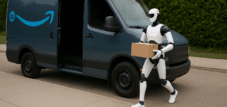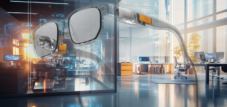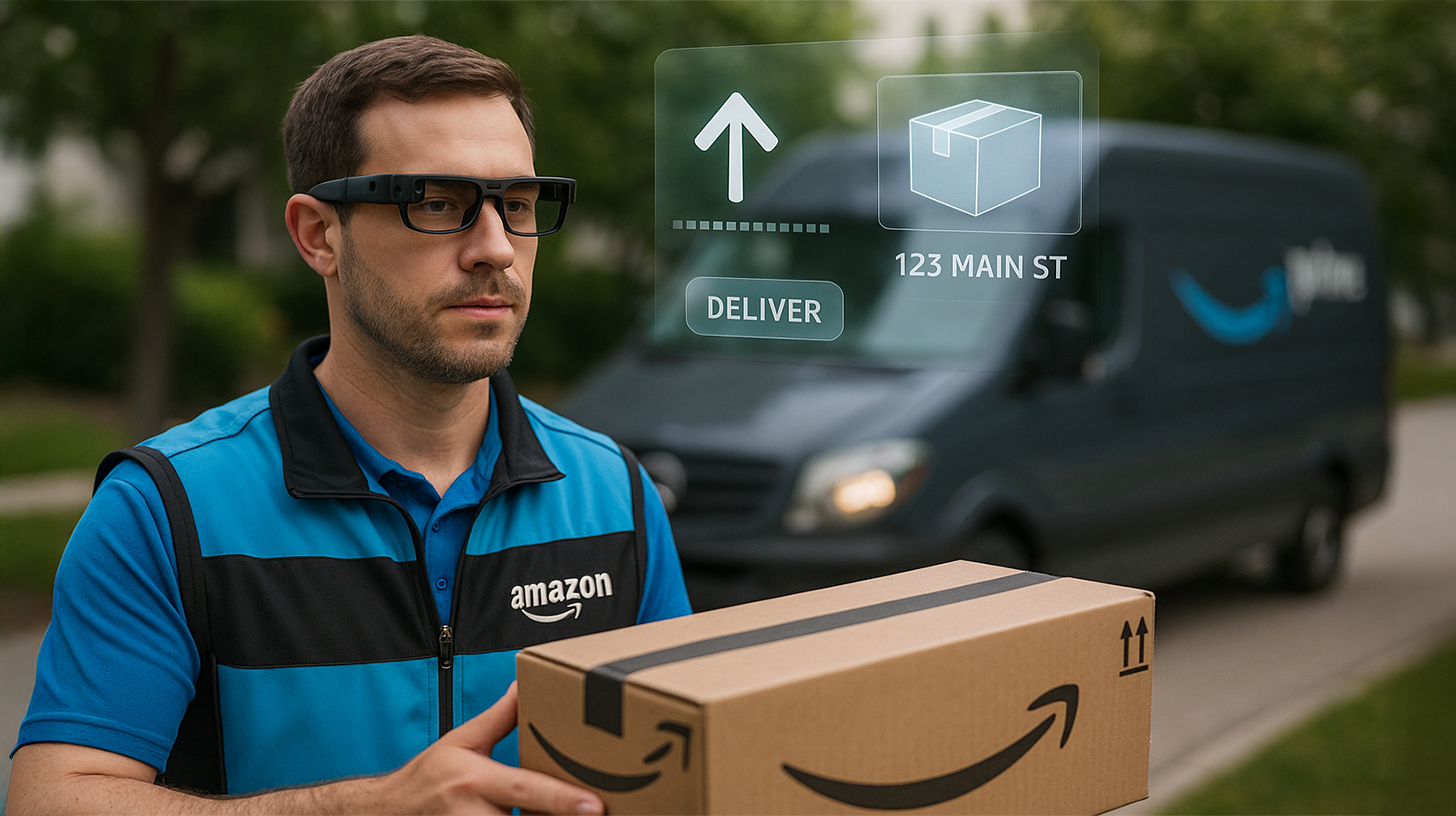
Amazon's smart delivery glasses: Using augmented reality to streamline last-mile delivery – Creative image: Xpert.Digital
When milliseconds become millions: The relentless battle for delivery efficiency
High-tech on the last mile: The economic calculation behind Amazon's delivery glasses
The idea of a future where delivery drivers navigate using augmented reality glasses may initially seem futuristic. But Amazon's development of smart delivery glasses for its delivery partners reveals a fundamental economic truth of modern logistics: In a business model based on economies of scale, even minimal efficiency gains become decisive competitive advantages when repeated millions of times. The smart delivery glasses, which Amazon has been testing since October 2024, are more than just a technological gadget. They represent a strategic attempt to optimize the most costly and complex phase of the entire supply chain: the last mile to the customer's doorstep.
The economic logic behind this innovation becomes clear when considering the structure of delivery costs. The last mile accounts for between 41 and 53 percent of total delivery costs, even though it often represents only a fraction of the distance traveled. In the third quarter of 2023, Amazon's shipping costs totaled $23.5 billion, an 8 percent increase year over year. With a daily package volume of over 13 million shipments, every second saved per delivery translates into substantial cost savings. If the smart glasses can reduce delivery time per package by just an average of ten seconds, this adds up to significant savings in labor, fuel, and vehicle wear and tear when dealing with millions of daily deliveries.
The technical functionality of the glasses demonstrates how Amazon is attempting to eliminate inefficiencies in the micro-process of deliveries. Once the driver reaches a safe parking position, the system activates automatically and displays relevant delivery information directly in their field of vision. The glasses can scan packages and verify whether they are the correct one for the address being served. This eliminates the time-consuming process of drivers constantly switching between their smartphone, the package, and their surroundings. After exiting the vehicle, the delivery driver receives turn-by-turn navigation to the exact drop-off location, supported by Amazon's geospatial technology. In complex apartment buildings, the system is designed to guide the driver safely to their destination and warn them of potential hazards.
The hardware architecture reflects the practical requirements of everyday delivery work. The glasses are connected via a cable to a controller housed in the driver's delivery vest. This controller contains the controls and a replaceable battery designed to ensure all-day use. A dedicated emergency button allows direct contact with emergency services. The lenses are photochromic, thus also functioning as sunglasses. Prescription lenses can also be used, increasing acceptance among those who wear glasses. These thoughtful details demonstrate that Amazon has not developed the technology as an isolated product, but rather as an integral part of the workflow.
Related to this:

The algorithm as boss: How data glasses are redefining work control
Behind this seemingly harmless navigation aid lies a far-reaching transformation of work organization. The smart glasses are part of a broader technological ecosystem that Amazon uses to optimize and monitor its delivery processes. The glasses continuously collect data on every aspect of the delivery process: timestamps for each stop, movement patterns, dwell times at different locations, scans, and potential delays. This information is fed in real time into Amazon's algorithms, which calculate performance indicators and identify areas for improvement.
This form of data-driven work organization raises fundamental questions about the distribution of power in modern working relationships. Amazon operates its delivery network through the Delivery Service Partner Program, in which independent entrepreneurs operate their own delivery fleets. Over 3,000 such partners worldwide employ a total of approximately 150,000 drivers. Since 2018, Amazon has invested a total of $16.7 billion in this program, including $1.9 billion in 2024 alone. The entry costs for partners are around $10,000, with the requirement to demonstrate available assets of $30,000. This structure allows Amazon to massively scale its delivery capacity without incurring the legal and financial obligations of a direct employer.
The introduction of smart glasses, however, strengthens Amazon's de facto control over the work process. While the DSP partners are formally the employers, Amazon uses the technology to dictate the parameters of work execution: optimal routes, delivery sequences, time windows, and performance metrics. Drivers report that Amazon's algorithms continuously evaluate their performance, and that failure to meet targets can result in consequences. A Reddit thread by Amazon DSP drivers confirms that the system automatically assigns more stops and packages if drivers complete their routes quickly. Amazon Logistics' artificial intelligence determines how many stops per hour a driver can manage based on speed in specific areas. For example, if a driver reaches a limit of 180 stops, the system gradually increases the package volume. If the driver cannot meet the quota, the system reduces stops and volume again.
This algorithmic control creates a gray area in the legal classification of employment relationships. While Amazon argues that DSP drivers are independent contractors, the company uses technology to exercise a form of control similar to traditional employer-employee relationships. This issue gained urgency in 2024 when thousands of Amazon delivery drivers went on strike, prompting the Teamsters union to demand formal recognition and collective bargaining. The drivers argue that Amazon controls their daily routines, package quotas, and performance monitoring—functions typically exercised by an employer. This gray area is a central point of contention in the debate surrounding workers' rights in the platform economy.
From data point to money: The hard-hitting ROI calculation behind AR glasses
The economic justification for investing in AR glasses lies in the mathematics of economies of scale. With an estimated investment volume encompassing development, hardware, and implementation, Amazon must demonstrate that the technology delivers substantial efficiency gains. Industry analyses show that companies using wearable technology in logistics experience an average productivity increase of 8.5 percent, a 7.2 percent reduction in operational errors, and 30 percent fewer workplace accidents. In warehouse solutions using asset-tracking wearables have reduced inventory losses by up to 27 percent.
The implementation of augmented reality in manufacturing provides concrete benchmarks for potential savings. One aerospace manufacturer reported a 34 percent increase in assembly speed and zero nonconformities for complex parts after implementing AR solutions. A commercial vehicle manufacturer halved its wire harness assembly cycle time and reduced rework by 80 percent using AR-supported projection. Latecoere, a leading manufacturer of aerospace structures, reduced inspection times by up to 30 percent with AR-supported methods. Safran, a global aerospace supplier, achieved four times greater efficiency in incoming inspections and reduced the cost of non-quality paint masking by a factor of seven using AR technology.
Applied to delivery logistics, even conservative estimates translate into substantial savings. If the glasses reduce the average delivery time per package by just five to ten seconds, this adds up to thousands of saved work hours per day, given millions of deliveries. With an average hourly wage of approximately $19.43 for delivery drivers, as reported by the Bureau of Labor Statistics (though actual costs vary significantly by region), the resulting wage savings are substantial. Added to this are reduced fuel costs through optimized routes and less vehicle wear and tear from more efficient delivery routes.
The return on investment becomes even more favorable when indirect savings are factored in. Automated warehouse systems typically achieve a payback period of six to 18 months. Training time for new employees drops from two to four weeks with traditional systems to one to two days with automated solutions. This not only reduces training costs but also enables faster scaling during peak periods. Improved ergonomics through hands-free operation could also lower injury rates, reducing insurance costs and downtime. Warehouse workers suffer injuries at a rate of 5.5 per 100 employees, more than double the industry average of 2.7. Musculoskeletal disorders are the leading cause of injuries, often resulting from repetitive, forceful, and awkward movements without sufficient recovery time.
Progress with side effects: Work pressure and health risks in the gig economy
The introduction of smart glasses is taking place within a broader context of fundamental changes in work organization. The gig economy, which includes Amazon's DSP model, has blurred the traditional lines between employees and the self-employed. Projections indicate that gig workers will comprise nearly 50 percent of the US workforce by 2025. This development is driven by technological advancements, changing worker expectations, and economic uncertainties. For companies, the model offers cost advantages of up to 30 percent, as many expenses and liabilities are shifted to the workers, who are classified as contractors.
The downside of this flexibility is evident in increasingly harsh working conditions and precarious incomes. Many Amazon delivery drivers report workdays that regularly exceed ten to eleven hours, especially during peak season. While Amazon emphasizes that overtime is paid and the workweek must not exceed 60 hours, these peak workloads lead to significant stress. A US Senate report led by Bernie Sanders documented that Amazon pushes its warehouse workers to a pace that results in increased injury rates, despite the company's awareness of these dangers. The 18-month investigation corroborated allegations made by workers and labor rights groups for years. The report criticized Amazon for rejecting changes that could have slowed the pace of work and improved safety, citing concerns about profitability.
Injury rates in Amazon warehouses are alarming. Between 2016 and 2021, reported injuries and illnesses in warehouses nearly doubled, from 42,500 to 80,500 cases—an 89 percent increase, far exceeding the 14 percent growth rate of the warehouses themselves during that period. In New York State, the injury rate among warehouse workers rose 30 percent from 2022 to 2023, reaching 11.5 per 100 full-time employees. This equates to more than one injury for every nine warehouse workers each year, compared to one for every eleven the previous year. Injuries are also becoming more severe: In 2023, over 90 percent of injuries required sick days or a job change, compared to only 60 percent in 2017.
The introduction of smart glasses could paradoxically both solve and exacerbate these problems. On the one hand, the technology promises improved ergonomics through hands-free operation and warnings of hazards in the driver's field of vision. The glasses could warn drivers of obstacles, poor lighting conditions, or animals, thus reducing the risk of accidents. On the other hand, there is a risk that the time gained through increased efficiency will lead to even higher performance expectations. If the system detects that drivers are working faster with the glasses, the algorithms could automatically assign more stops and packages, further increasing work intensity.
From delivery service to lifestyle product: Amazon's dual strategy in the AR competition
Amazon's foray into AR glasses for delivery drivers isn't happening in a vacuum; it's part of intense competition for dominance in the wearables market. Meta currently dominates the consumer smart glasses market with a 73 percent market share in the first half of 2025. Ray-Ban Meta smart glasses saw year-over-year growth of over 200 percent in the second quarter of 2025. Since the launch of the second generation in October 2023, over two million units have been sold. The global smart glasses market grew by 110 percent year-over-year in the first half of 2025, driven by strong demand for Ray-Ban Meta smart glasses and the entry of new players such as Xiaomi, TCL-RayNeo, and several smaller brands.
The market for wearables in logistics demonstrates impressive growth potential. The global market size for wearables in logistics reached US$3.8 billion in 2024 and is projected to grow at a robust CAGR of 18.2 percent from 2025 to 2033, with the total market value forecast to reach US$18.7 billion by 2033. The broader global wearable technology market was valued at US$78.4 billion in 2024 and is expected to grow from US$86.78 billion in 2025 to US$191.58 billion by 2032. These figures highlight the enormous commercial potential offered by both consumer and enterprise applications of wearable technology.
Amazon is pursuing a dual strategy: Smart Delivery Glasses for professional applications are being developed in parallel with consumer AR glasses, codenamed Jayhawk, which are expected to launch in late 2026 or early 2027. These consumer glasses will overlay digital information onto the physical world, allowing users to see and interact with both their physical and virtual environments. The glasses are expected to be equipped with speakers, a microphone, and a camera, and will feature a full-color display integrated into a single lens. This strategy positions Amazon as a competitor to Meta, Google, and Apple in the burgeoning AR glasses market.
The development of the delivery glasses is based on Amazon's Echo Frames, which allow users to listen to audio and use voice commands via Alexa, Amazon's virtual assistant. Internally codenamed Amelia, the delivery glasses will feature a small display on a lens and potentially be able to take photos of delivered packages as proof of delivery for customers. This technology transfer from the consumer to the enterprise sector demonstrates Amazon's ability to leverage synergies between different business units and amortize development costs across multiple product lines.
🎯🎯🎯 Benefit from Xpert.Digital's extensive, five-fold expertise in one comprehensive service package | BD, R&D, XR, PR & Digital Visibility Optimization

Benefit from Xpert.Digital's extensive, five-fold expertise in a comprehensive service package | R&D, XR, PR & Digital Visibility Optimization - Image: Xpert.Digital
Xpert.Digital possesses in-depth knowledge across various industries. This allows us to develop tailored strategies precisely aligned with the requirements and challenges of your specific market segment. By continuously analyzing market trends and monitoring industry developments, we can act proactively and offer innovative solutions. The combination of experience and expertise generates added value and provides our clients with a decisive competitive advantage.
More information here:
Visionary Systems – The Power of Data: Amazon, Delivery and Market Strategy
The seeing system: How AI and computer vision are driving logistics
Smart glasses are just the visible tip of a complex technological iceberg. The real innovation lies in the computer vision algorithms and artificial intelligence that process the collected visual data and transform it into actionable information. Computer vision in logistics uses artificial intelligence and deep learning to automate manual processes across the entire supply chain, reducing costs and accelerating operations. The global computer vision market is projected to grow to over US$175.72 billion worldwide by 2032, driven by widespread adoption by leading companies such as Amazon, DHL, and UPS.
Amazon already uses computer vision in various areas of its logistics infrastructure. Researchers at Amazon trained machine learning models to detect product defects by comparing images of products to their expected state. Cameras scan every item that passes through the warehouse, and the model analyzes the scans to identify defects. Computer vision is also used in Amazon's robotic systems such as Sparrow, Robin, and Cardinal. Sparrow can identify, pick up, and handle individual products in the warehouse. Robin and Cardinal, on the other hand, are used to handle packages after they have been packed. These innovations have enabled Amazon employees to process over 13 million packages per day.
The application of computer vision in the delivery glasses extends these capabilities to the last mile. The glasses use AI-powered sensor capabilities and computer vision, along with cameras, to create a heads-up display that includes everything from navigation details and hazards to delivery tasks. When drivers are safely parked at a delivery location, the glasses activate automatically, and the delivery partner receives their delivery information directly in their field of vision, from locating the correct packages in the vehicle to the corresponding addresses. The display then provides turn-by-turn walking navigation to the delivery address, using Amazon's geospatial technology to guide drivers to the exact delivery location without them having to check their smartphones.
Future versions of the glasses will offer real-time defect detection, enabling drivers to be notified if they have accidentally left a package at a customer's door that doesn't match the house or apartment number on the package. The system will also detect pets in the yard and automatically adapt to hazards such as low light. These planned enhancements demonstrate Amazon's long-term vision of a comprehensive, AI-powered delivery infrastructure that continuously learns from data and improves.
Related to this:

The transparent driver, the transparent front door: data protection as collateral damage
The continuous data collection by smart glasses raises fundamental questions about data privacy, both for drivers and recipients. The glasses potentially capture sensitive information about living conditions, daily routines, security features, and other private details. The planned photo function for delivery documentation could capture images of entrances, gardens, and possibly even people. This data flows into Amazon's extensive databases, where it can be linked with other information and used for various purposes.
Wearable technology, in general, is associated with significant privacy concerns. Each wearable device continuously collects thousands of data points per user per day. Over time, the cumulative volume of data becomes enormous, and much of it is collected and processed without users having explicit understanding or control. Previous research has highlighted risks stemming from inadequate data protection, opaque data-sharing practices with third parties, and regulatory gaps that leave users vulnerable to data breaches. Informed consent, a cornerstone of ethical data collection, is often undermined by lengthy and complex privacy policies, which in one study averaged 6,113 words and would require approximately 26 minutes of reading time. Unsurprisingly, up to 97 percent of users accept these agreements without fully understanding their terms.
Information asymmetry exacerbates these challenges. Companies that operate or develop wearable devices have far greater insight into the data lifecycle and the logic of the algorithms. Users, on the other hand, navigate vague and lengthy privacy policies with little understanding of how their information is handled. In this context, personal and personal health information increasingly holds economic value, not only to support health-related services and personalized wellness initiatives, but also to generate data-driven insights. These insights can, in some cases, inform insurance assessments or corporate wellness programs, raising further concerns about the scope and purpose of data use beyond the individual's awareness.
For Amazon delivery drivers, an additional dimension of surveillance is being added. The glasses enable seamless documentation of the work process at a level of granularity that would be impossible with traditional methods. Amazon can track how long a driver spends at each stop, the routes they take, where they pause, how fast they move, and even where they look. This data can be compiled into comprehensive performance profiles that serve as the basis for evaluations, compensation, and employment decisions. Drivers will have virtually no way to escape this surveillance, as the use of the technology will be practically mandatory once it is rolled out nationwide.
The global parcel deluge: How e-commerce growth is forcing technological leaps
Investing in smart glasses must be understood within the context of the explosive growth dynamics of e-commerce. The global e-commerce market is projected to reach a value of US$10.19 trillion by 2025, with a compound annual growth rate (CAGR) of 15.8 percent, and is expected to reach US$21.22 trillion by 2030. Over a third of the global population shops online, highlighting the increasing adaptability and accessibility of online shopping. China holds the largest e-commerce market worldwide, valued at US$3.19 trillion. Amazon dominates the US e-commerce market with a 37.6 percent share and remains the most visited e-commerce website, averaging 2.48 billion monthly visits.
Mobile commerce is growing particularly dynamically. The mobile commerce market is projected to reach a value of $1.54 trillion by 2025 and grow to $2.12 trillion by 2030. More than 50 percent of online shoppers use mobile devices to make purchases. These trends demonstrate that people are increasingly spending their online time on mobile devices. In response, e-commerce companies are offering more options for shoppers to make purchases directly from their smartphones. Approximately 34 percent of shoppers make online purchases at least once a week. This rate rises to 82 percent when considering shoppers who shop online monthly.
This explosive growth is putting enormous pressure on delivery infrastructure. According to McKinsey, despite globally declining mail volumes, parcel volumes will increase at an annual growth rate of six to nine percent between now and 2028. B2B e-commerce deliveries are also increasing, according to the International Trade Administration, driven by industries such as advanced manufacturing, energy, healthcare, and professional business services. As expectations for parcel delivery rise, both B2C and B2B organizations will increasingly seek innovative strategies for the last leg of the fulfillment journey.
The convergence of these trends is creating a massive market for logistics innovations. The industry is urgently seeking solutions to keep pace with rising demand while simultaneously controlling costs and maintaining service quality. In this context, investments in technologies such as smart glasses are no longer optional but a competitive necessity. Companies that succeed in making their delivery processes substantially more efficient will gain a decisive advantage in a market where speed and reliability are increasingly becoming differentiators.
Between relief and surveillance: Two scenarios for the future of work
Amazon's introduction of smart glasses is just one step in a broader transformation of logistics work. The future of delivery will likely be characterized by an intensive merging of human labor with AI-powered systems. The question is not whether automation is coming, but how the benefits and burdens of this transformation will be distributed. The optimistic vision is a future where technology eliminates the most dangerous and monotonous aspects of work, while people can focus on more complex, fulfilling tasks. Wearable technology could reduce injury rates by warning workers of hazards and promoting ergonomic work practices. The improved efficiency could enable higher wages and better working conditions.
The pessimistic vision, however, envisions a future of intensified surveillance and relentless work, where every second is measured and optimized, with people essentially reduced to mere appendages of algorithmic control systems. Efficiency gains through technology flow exclusively to shareholders, while workers face stagnant wages, precarious employment, and increasing work intensity. The legal gray area of gig economy classification deprives workers of traditional protective rights, while simultaneously allowing technology to exert de facto employer control.
The likely reality will lie somewhere between these extremes, shaped by legal frameworks, union organization, and societal norms. Experiences with Amazon's Smart Delivery Glasses in the coming years will provide important insights into how this balance will play out. Initial feedback from test drivers is mixed. Kaleb M., a delivery partner working for Maddox Logistics Corporation in Omaha, Nebraska, who tested the technology, explained: "I felt safer the whole time because the glasses have the information right in my field of vision. Instead of having to look down at a phone, you can look forward and over the display. You're always focused on what's in front of you.".
However, such positive reports must be weighed against broader concerns about working conditions at Amazon. The turnover rate in Amazon warehouses typically exceeds 100 percent annually, likely due to demanding working conditions. Warehouse work, in general, carries higher risks than the average job, especially since the pandemic boosted e-commerce demand and made manual order fulfillment even more difficult. The challenges of recruiting and retaining talent have long plagued the warehousing industry. In this context, automation could be seen as a response to labor shortages rather than a threat to jobs.
Seizing the entire supply chain: Amazon's strategy for logistics dominance
From a strategic perspective, Amazon's smart delivery glasses represent its attempt to defend and expand its dominance in e-commerce through vertical integration and technological innovation. Building its own delivery capabilities, complemented by its DSP program, reduces Amazon's reliance on external courier services like UPS and FedEx. Integrating advanced technology into every step of the supply chain, from automated warehouses to AI-powered route optimization and now AR glasses for last-mile delivery, creates efficiency gains that are difficult for competitors to replicate.
This technological dominance also has defensive dimensions. Walmart has intensified its e-commerce initiatives and lowered prices, increasing competitive pressure on Amazon. Walmart has also introduced new incentives for independent delivery drivers to fulfill online orders during the shopping season. In this context, Amazon must continuously innovate to maintain its market position. The ability to deliver packages faster, more reliably, and more cost-effectively than competitors is becoming the decisive competitive advantage.
The development of these delivery glasses also positions Amazon for future business opportunities. The experience gained and technologies developed in the enterprise sector can be transferred to consumer products. The planned Jayhawk consumer AR glasses could become a new product segment, complementing Amazon's hardware portfolio, which already includes Echo devices, Kindle, Fire tablets, and Ring security systems. Successful consumer AR glasses would provide Amazon with a platform to integrate its shopping experience even more seamlessly into customers' everyday lives, similar to how Amazon's Alexa voice assistant enables shopping through voice commands.
In the long term, Amazon's investment in AR technology could lead to a broader ecosystem where Amazon services are integrated across various touchpoints. Imagine a future where consumers wear AR glasses that guide them through stores, display product information, compare prices, and provide instant access to Amazon reviews, while Amazon delivery drivers use the same technologies to deliver packages more efficiently. This vision of a comprehensive, AI-powered infrastructure for commerce and logistics would give Amazon an unprecedented position in the global economy.
The realization of this vision, however, depends on numerous factors, some of which are beyond Amazon's control. Regulatory intervention could limit Amazon's market power. Antitrust authorities in the US and Europe are already investigating Amazon's business practices. Changes in labor law could challenge the DSP model and force Amazon to classify drivers as employees, fundamentally altering its cost structure. Data privacy laws could restrict the collection and use of data by the glasses. Unionization could strengthen workers' bargaining power and lead to higher wages and better working conditions. Technological advancements at competitors could erode Amazon's lead.
In this uncertain future, smart delivery glasses represent both a bet on technological progress and an attempt to define the terms of future competition. Whether this bet pays off will become clear in the coming years. What is already clear is that the way goods get from warehouses to doorsteps is undergoing a fundamental transformation. Amazon is determined to lead this transformation, and the smart delivery glasses are a visible symbol of this ambition. The economic, social, and legal implications of this development will shape the world of work and the economy for years to come.

Xpert.Plus Warehouse Optimization - High-bay warehouses and pallet warehouses: Consulting and planning
We are here for you - Consulting - Planning - Implementation - Project Management
☑️ SME support in strategy, consulting, planning and implementation
☑️ Creation or realignment of the digital strategy and digitization
☑️ Expansion and optimization of international sales processes
☑️ Global & Digital B2B trading platforms
☑️ Pioneer Business Development

Konrad Wolfenstein
I would be happy to serve as your personal advisor.
You can contact me by filling out the contact form below or simply call me on +49 7348 4088 965 .
I'm looking forward to our joint project.
Write to me



Xpert.Digital - Konrad Wolfenstein
Xpert.Digital is a hub for industry focusing on digitalization, mechanical engineering, logistics/intralogistics and photovoltaics.
With our 360° Business Development solution, we support renowned companies from new business to after-sales.
Market intelligence, smarketing, marketing automation, content development, PR, mail campaigns, personalized social media and lead nurturing are part of our digital tools.
You can find more information at: www.xpert.digital - www.xpert.solar - www.xpert.plus
Keep in touch