

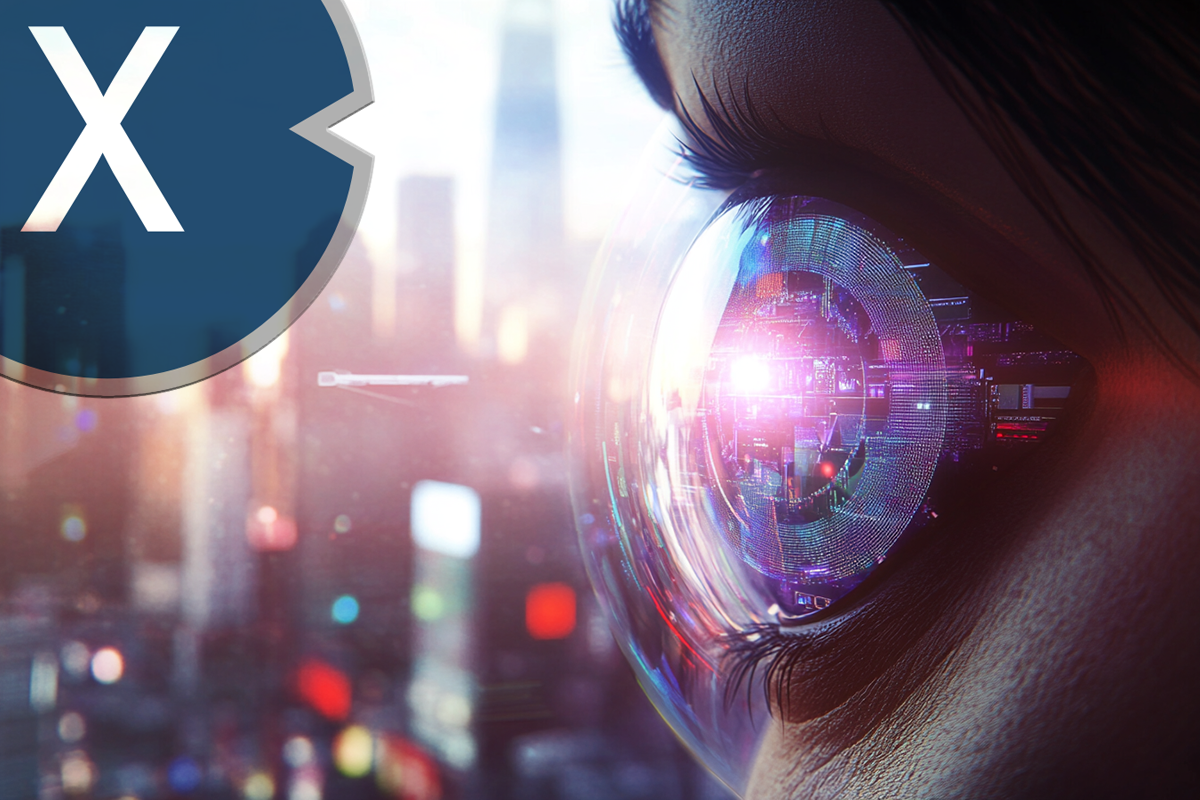
Smart Contact Lenses (SCL): The future of intelligent contact lenses – Augmented Reality (AR) and Extended Computing (XC) – Image: Xpert.Digital
Visions of the future: Intelligent contact lenses and their incredible possibilities
From AR to healthcare: The diverse applications of smart contact lenses
Smart contact lenses are an emerging technology with the potential to go far beyond traditional vision correction. These innovative lenses combine advanced electronics and sensors with the functionality of conventional contact lenses, opening up a multitude of new applications. From augmented reality (AR) and medical monitoring to athletic performance optimization, the possibilities seem almost limitless. Companies like Mojo Vision and Xpanceo are at the forefront of this development and are working intensively to bring this technology to market.
Functionalities and applications of smart contact lenses
Augmented Reality (AR) and Virtual Reality (VR)
One of the most promising applications of smart contact lenses lies in the field of augmented reality (AR). By integrating AR technologies, these lenses can project virtual information directly into the wearer's field of vision. The Mojo Lens, for example, uses a micro-LED display with an extremely high pixel density of 14,000 pixels per inch (ppi) to display crystal-clear images. These images appear as if projected directly onto the retina, allowing the user to view digital content such as videos, graphics, or text without the need for additional devices like glasses or headsets.
This technology could find applications in many areas of daily life. In a professional context, for example, smart contact lenses could be used to display information in real time – such as during surgical procedures or complex technical work. They could also enable a new way of learning in education, where pupils and students see interactive content directly in front of their eyes.
Medical monitoring
Another significant application of smart contact lenses is health monitoring. These lenses are capable of measuring and monitoring important physiological data. Of particular note is the monitoring of blood glucose levels in people with diabetes. The lenses can measure the glucose concentration in tear fluid and warn the wearer if the values fall outside the normal range. This offers a non-invasive alternative to conventional methods of blood glucose measurement and could significantly simplify the daily lives of diabetics.
Smart contact lenses also offer promising possibilities for people with glaucoma. They can monitor intraocular pressure, which is crucial for the early detection and treatment of this disease. By continuously collecting data and wirelessly transmitting it to a connected device, these lenses enable close monitoring of the eye's health without requiring any active intervention from the patient.
Vision improvement for people with visual impairments
Besides monitoring health data, smart contact lenses also offer solutions for people with visual impairments. Some models are designed to electronically enhance vision. They boost image contrast, sharpen edges, or enlarge text—all in real time. These features could be particularly beneficial for people with age-related macular degeneration (AMD) or other degenerative eye diseases.
The possibility of improving eyesight through technology could help many people maintain their independence in everyday life. It's conceivable that smart contact lenses could one day replace conventional vision aids such as glasses or magnifying glasses.
Sports and performance optimization
Smart contact lenses also offer exciting possibilities in the field of sports. Athletes could use this technology to access important training data in real time – such as their heart rate, running speed, or calorie consumption. This information could be displayed directly in their field of vision, without the athlete needing an additional device like a smartwatch or smartphone.
Furthermore, smart lenses could help improve concentration during training or competition. By minimizing visual distractions or providing targeted cues, they could help athletes optimize their performance and achieve their goals faster.
Technological challenges on the road to market maturity
Despite the impressive progress in the development of smart contact lenses, manufacturers still face some significant challenges.
Energy supply
One of the biggest hurdles lies in powering these sophisticated devices. Because the lenses constantly process and display data, they require a reliable power source. Some prototypes use miniaturized batteries, but these must be small enough to be integrated into the lens while still providing enough power to sustain operation for extended periods.
Innovative approaches to solving this problem include harnessing energy from eye movements or even sunlight. However, such technologies are still in an early stage of development and need further improvement before they can be used in marketable products.
Miniaturization and comfort
Another challenge is the miniaturization of electronic components. Smart contact lenses must not only contain all the necessary sensors and displays, but also be comfortable enough to be worn for extended periods. This requires flexible materials and extremely small components.
While some companies like InWith Technologies use flexible microelectronics, other manufacturers like Mojo Vision rely on harder scleral lenses – larger lenses that sit on the white part of the eye (the sclera). These offer more space for electronic components, but may be less comfortable than traditional soft contact lenses.
Hygiene and safety
Since smart contact lenses are worn directly on the eye, hygiene is of paramount importance. There is an increased risk of infection or irritation due to protein or fat deposits on the lens surfaces. Manufacturers must therefore ensure that their products are safe and pose no health risks.
Another important aspect is the security of data transmission. Since many smart contact lenses are intended to communicate wirelessly with other devices – whether to display AR content or to transmit medical data – comprehensive security measures must be taken to ensure the protection of sensitive information.
When will smart contact lenses be available?
It will take several years before this technology is ready for market. Companies like Mojo Vision and Xpanceo are working intensively to perfect their prototypes and are planning clinical trials and market launches within the next few years. The first marketable products are expected to be available by 2026.
In the long term, this technology could fundamentally change the lives of many people – both in the medical field and in everyday life. Smart contact lenses could not only improve the lives of people with visual impairments, but also create new opportunities for AR applications – be it in work, sports, or simply for entertainment.
It remains to be seen what technological breakthroughs will be achieved in the coming years and what new applications will emerge. However, one thing is already clear: smart contact lenses have the potential to fundamentally change the way we see – both literally and figuratively.
Related to this: