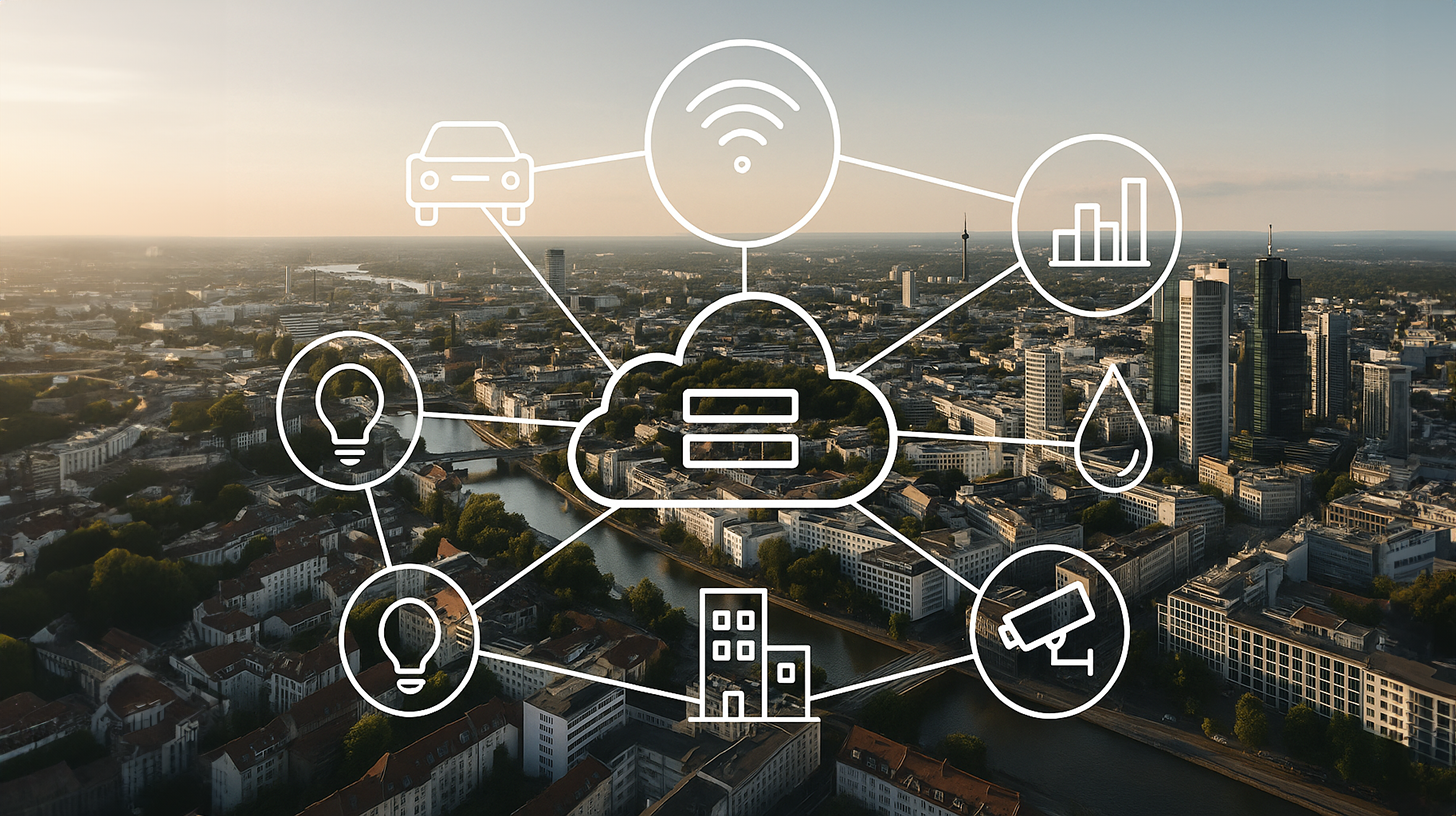
Smart City and urbanOS by dataMatters: Germany's first municipal operating system reaches 25 connected cities – Image: Xpert.Digital
How urbanOS connects German cities smarter
The first municipal operating system: urbanOS sets standards
Cologne-based startup dataMatters has achieved a significant milestone in the German smart city landscape with urbanOS. Following the launch of the world's first municipal operating system in May 2025, more than 25 German cities are already connected to the innovative platform via sensor networks. The system is based on a multi-layered approach combining sensors, a municipal data space, and artificial intelligence, providing municipalities with, for the first time, a real-time overview of urban processes and even generating future forecasts. This rapid adoption demonstrates the strong interest of German municipalities in data-driven solutions for urban challenges, although many projects are still in the early testing phase, and therefore not all participating cities wish to be named.
Related to this:


Technical architecture and functionality of urbanOS
Multi-stage system design
The urbanOS system is based on a sophisticated multi-layered model that connects five key components: sensors, a municipal data space, artificial intelligence, data-driven decision-making, and optimized services for citizens and administration. Dr. Daniel Trauth, founder and CEO of dataMatters GmbH, describes the operating principle as a continuous data cycle: “A wide range of sensors captures what is happening in the city. This information is transferred to a municipal data space and processed there using AI.”.
The collected data is then visualized in a central urbanCockpit, providing decision-makers with, for the first time, a real-time overview of actual events in their city. The system functions similarly to an aircraft cockpit, where a pilot receives all the relevant information for controlling their aircraft. The technical infrastructure supports various connectivity standards such as LoRaWAN, NB-IoT, and cellular networks to ensure seamless integration of different sensor technologies.
AI-supported forecasting and decision-making
A key feature of urbanOS lies in its predictive capabilities powered by artificial intelligence. The AI not only analyzes current data but also generates detailed forecasts of future urban developments. These forecasts are also displayed in the urbanCockpit, providing municipalities with an unprecedented data foundation for urban decision-making. Dr. Trauth illustrates the practical application with a concrete example: "Cameras in buses and trains can precisely record how many seats are occupied." This information makes it possible to optimize transport capacity in real time and predict future demand.
The system already supports all common AI models and IT systems, allowing existing municipal infrastructures to be seamlessly integrated with the operating system. This compatibility significantly simplifies integration and reduces the technical hurdles for interested municipalities. The AI component works continuously in the background, learning from incoming data streams to constantly improve the accuracy of its predictions.
App store concept for municipal services
Similar to modern smartphone operating systems, urbanOS features an integrated app store, making the system particularly flexible and scalable. Municipal utilities and private companies can offer their services in this urbanOS app store, allowing service providers to access them for a fee. This structure creates a digital ecosystem where various providers can offer their specialized solutions for urban challenges.
Current distribution and participating cities
Rapid expansion since market launch
The response to urbanOS has far exceeded the developers' expectations. Since its official launch in early May 2025, more than 25 German cities have already been connected to the system via sensor networks. Dr. Daniel Trauth is delighted with the demand: "The demand is enormous, even though many projects are still in the early testing phase." This rapid adoption indicates a strong need among German municipalities for innovative smart city solutions.
The cities mentioned by name include significant municipalities of varying sizes: Aachen, Auweiler, Bad Honnef, Coesfeld, Dormagen, Dülmen, Essen, Euskirchen, Frechen, Grevenbroich, Heiligenstedt, Hürth, Krefeld, Leverkusen, Lüdinghausen, Mönchengladbach, Munich, Nuremberg, Siegen, Singen, Solingen, St. Augustin, Weinheim, Widdersdorf, and Willich. This geographical distribution demonstrates that urbanOS is relevant for both large cities like Munich and Essen and smaller municipalities.
Scalability from small towns to large cities
The urbanOS "digital civic center" is designed to be highly scalable and covers the requirements of various administrative levels – from small municipalities and medium-sized towns to megacities. This flexibility makes the system equally attractive for cities, districts, and counties. The platform can be adapted to the specific needs and resources of each municipality without requiring fundamental system changes.
Already established implementations demonstrate the system's practical applicability. The urbanOS website lists Dormagen, Hürth, Dülmen, Senden, Lüdinghausen, and Nordkirchen as active users. These cities serve as reference projects and demonstrate various application scenarios of the system in real-world municipal environments.
Application areas and practical implementation
Optimization of waste management
A prominent application example of urbanOS can be found in the field of intelligent waste management. The system has already been successfully implemented in the city of Hürth, where smart trash cans have been equipped with sensors. These sensors continuously monitor the fill level of the containers and transmit the data to the central platform. The AI-supported analysis enables optimized route planning for garbage trucks, leading to demonstrable CO₂ savings and increased efficiency in urban waste disposal.
The practical implementation exemplifies how urbanOS can optimize complex urban processes. Instead of working according to fixed schedules, waste disposal companies can now operate on a demand-driven basis and only empty containers when they are actually full. This not only reduces the environmental impact of unnecessary trips but also significantly lowers operating costs for municipalities.
Traffic control and public safety
The system is suitable for optimizing a wide variety of urban infrastructures, from traffic management and energy supply to public safety. By integrating traffic sensors, traffic light timings can be adjusted in real time to reflect actual traffic volume. Energy management modules enable intelligent control of urban lighting and other energy-intensive infrastructure.
In the area of public safety, various sensors can provide data on noise levels, air quality, or pedestrian flows. This information helps authorities to identify potential problems early and take preventative measures. Furthermore, AI's predictive capabilities make it possible to identify trends and patterns relevant for long-term urban planning.
Economic aspects and pilot programs
Cost efficiency and financing models
A key advantage of urbanOS lies in its cost efficiency, which is particularly important in times of tight municipal budgets. The system promises not only improved services for citizens but also reduced administrative costs and optimized resource utilization. Data-driven optimization of urban processes can lead to significant savings, as resources are deployed more effectively and waste is avoided.
The company offers various package solutions, ranging from a free starter package to comprehensive district-level solutions. A nine-month pilot program is available for interested municipalities, allowing them to test the system risk-free. During this trial period, cities receive limited access to the functionalities and can evaluate the system's benefits in practice.
Community Edition and entry options
For initial testing and smaller applications, dataMatters offers a Community Edition that provides immediate access to a LoRaWAN nameserver and 5,000 free credits. This low-barrier entry point allows municipalities to gain initial experience with the platform without a credit card or long-term commitments. Sensors can be connected and data received immediately via roaming gateways, enabling rapid implementation.
The tiered pricing structure makes urbanOS accessible even to smaller municipalities with limited IT budgets. At the same time, larger cities can benefit from more comprehensive packages that offer expanded functionalities and higher data volumes. This flexibility contributes to the system's broad acceptance among municipalities of varying sizes.
Related to this:

Future prospects and further development
Nationwide scaling and market potential
The successful implementation in 25 cities already demonstrates the considerable market potential of urbanOS in Germany. The system addresses key challenges facing German municipalities, such as demographic change, climate protection, digitalization, and cost optimization. With the ongoing digitalization of public administration and increasing demands for sustainable urban development, the demand for such integrated smart city solutions is likely to continue to grow.
The fact that many other municipalities have expressed interest but do not yet wish to be publicly named suggests even greater potential. Dr. Trauth sees urbanOS as a "digital civic center for smart cities," which is already being piloted in several cities. This vision of a comprehensive digital ecosystem for municipal services could revolutionize the way cities manage their infrastructure and provide citizen services.
Technological development and integration
The continuous development of AI components and the integration of new sensor technologies will make urbanOS even more powerful. The platform is designed to grow with new technological developments and support various IoT standards. This ensures future-proofing for investing municipalities and allows them to benefit from technological advancements without having to replace the entire system.
Data-driven cities: urbanOS as the key to the modern city
The development of urbanOS by dataMatters marks a significant milestone in the German smart city landscape. With 25 cities already connected and rapidly growing demand, the system has established itself as a viable solution for municipal digitalization challenges. The combination of sensor technology, AI-supported data analysis, and predictive capabilities offers municipalities, for the first time, the opportunity to act in a data-driven and proactive manner.
The multi-tiered architectural concept, with its app store approach, creates a flexible ecosystem that is scalable for both small communities and large cities. Successful implementations in areas such as smart waste management demonstrate tangible benefits in the form of cost savings and environmental protection. The availability of various pilot programs and entry points significantly lowers the barrier to entry for interested municipalities.
For the future of smart city development in Germany, urbanOS could play a catalytic role by demonstrating how integrated technological solutions can address municipal challenges. Its continuous expansion and ongoing interest from other cities suggest that the system will make a lasting contribution to the modernization of German local government.
Related to this:
Your global marketing and business development partner
☑️ Our business language is English or German
☑️ NEW: Correspondence in your native language!

Konrad Wolfenstein
I and my team are happy to be available to you as your personal advisor.
You can contact me by filling out the contact form here wolfenstein@xpert.digital:or simply call me at +49 7348 4088 965. My email address is
I'm looking forward to our joint project.