

Published on: January 12, 2025 / Updated on: January 12, 2025 – Author: Konrad Wolfenstein
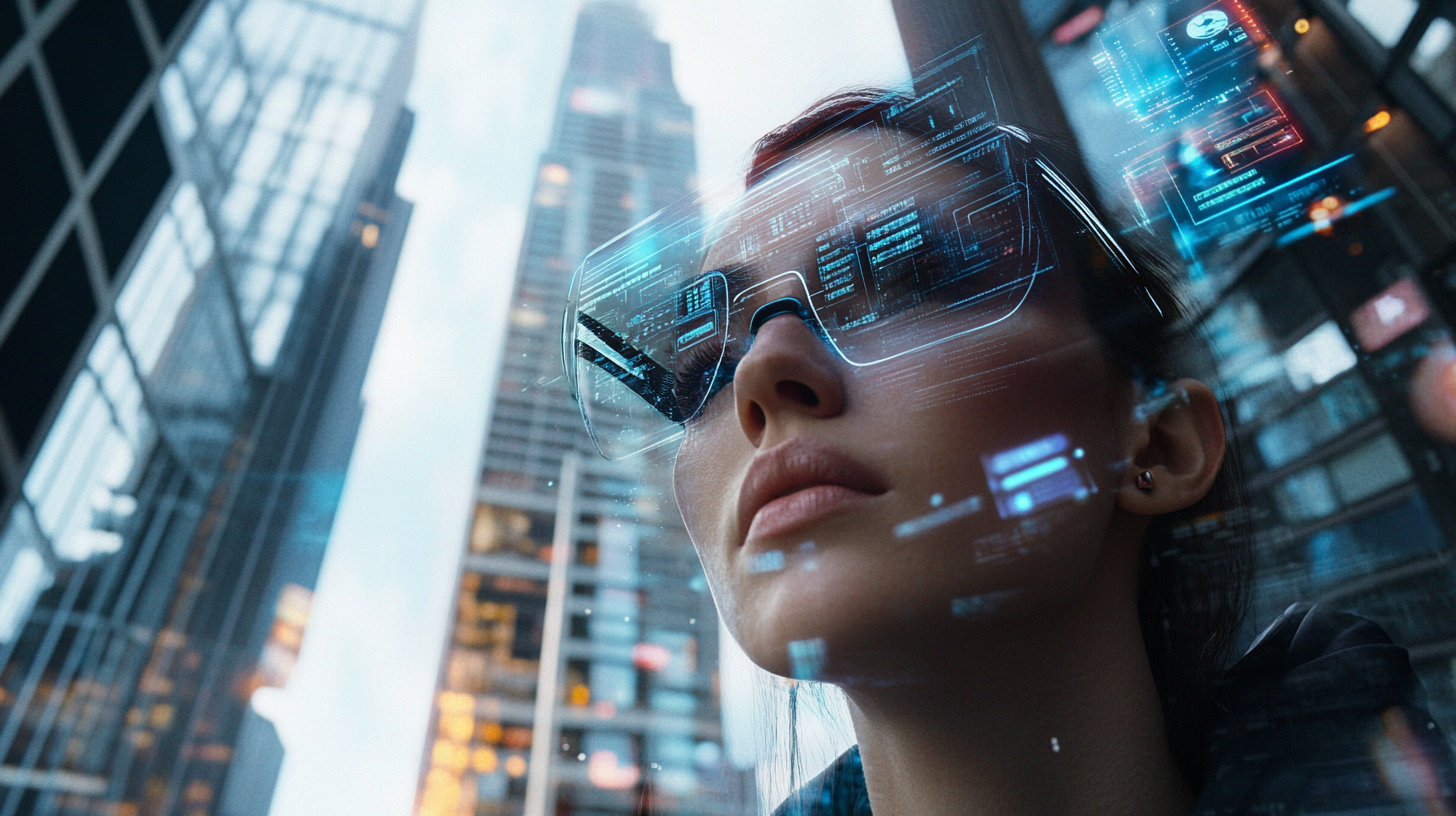
Looking to the future: How smart glasses are evolving – From a simple vision aid gadget to AR/MR smart glasses – Image: Xpert.Digital
Limits and opportunities: Smart glasses on the path to AR/MR - More than just a gadget
Smart glasses – More than just a vision aid
Smart glasses have become one of the most exciting trends in wearable technology in recent years. They go far beyond simply providing vision or sun protection, offering a new level of comfort and possibilities through networked functions, sensors, and intuitive controls. Their use is no longer limited to tech enthusiasts or industrial professionals – smart glasses can also help us access information more quickly and discreetly in everyday life, keep our hands free for important tasks, and improve our organizational skills.
But for all the enthusiasm, we shouldn't forget that smart glasses require a complex interplay of various technologies: from powerful processors and high-resolution displays to robust data protection mechanisms. They are often associated with augmented reality (AR) or mixed reality (MR) systems, but their functionality is often simpler. Nevertheless, the question remains: how long will this last? With each new generation of devices, the lines between "simply smart" and "immersively enhanced" become increasingly blurred.
Furthermore, aspects such as battery life, wearing comfort, and social acceptance should not be underestimated. After all, what good are glasses with great features if you don't like wearing them in everyday life or if those around you are bothered by the constant camera surveillance? In this introduction, we want to provide an initial overview of the potential and challenges of smart glasses. The following text delves deeper into the technical fundamentals, application possibilities, and the development towards more immersive technologies such as AR and MR.
Related to this:
Smart glasses are already useful companions in many areas. As technology advances, their capabilities are expanding to include AR or even MR functions. Crucially, manufacturers will need to balance functionality, design, data privacy, and everyday usability. The development of smart glasses is likely to remain exciting in the coming years – and fundamentally change our understanding of what glasses can do.
What are smart glasses?
Smart glasses are glasses that go beyond their classic function of vision correction or sunglasses. They have integrated technical components such as processors, sensors, and wireless modules to display notifications, data, or other digital information directly in the user's field of vision. This allows wearers to access information without having to pick up a smartphone or other device.
What key features make glasses "intelligent"?
- Connectivity: Wireless connection (Bluetooth or WLAN) to smartphones or other devices.
- Discreet information display: A small display that projects information into the field of vision or is attached to a spectacle lens.
- Hands-free function: Integrated microphones and speakers allow you to make phone calls or listen to music without having to pick up your smartphone.
- Sensors: Motion sensors (accelerometer, gyroscope, magnetometer) and often also cameras or ambient light sensors.
- Basic computing power: A dedicated processor and memory for processing notifications and sensor data.
- Voice control: For intuitive operation and interaction, often in conjunction with voice assistants.
What role does connectivity play?
Connectivity is at the heart of smart glasses. Via Bluetooth or Wi-Fi, they can connect to external devices and receive messages, calls, or notifications. This makes it possible to see information directly in the field of vision or to answer phone calls without having to pick up the smartphone.
How is information displayed in smart glasses?
Most models have a small display that either projects information into the field of vision or is embedded as an additional element in the lens. These displays are often minimalist to minimize energy consumption and avoid distracting the wearer. Typical information includes the time, notifications, navigation instructions, or weather data.
Why is a hands-free function in smart glasses so practical?
Integrated microphones and speakers allow you to make phone calls, listen to voice messages, or listen to music without having to take out your smartphone. This is particularly useful in situations where you want or need to have your hands free, for example, while cycling, doing DIY projects, or cooking.
What sensors are used in smart glasses?
- Motion sensors: accelerometer, gyroscope and magnetometer to detect the position and movements of the glasses.
- Ambient light sensors: Regulate the brightness or contrast of the display depending on the amount of light.
- Cameras: Enable taking photos and videos from a first-person perspective or are used for object recognition.
- Additional sensors: Depending on the model, heart rate sensors or other biometric sensors may be integrated.
What computing power is packed into smart glasses?
Most smart glasses have their own energy-efficient processor and small amount of memory to handle basic tasks. They process incoming notifications, run simple apps, and analyze sensor data. For more complex tasks (e.g., data analysis), they usually rely on the connected smartphone or the cloud to extend the glasses' battery life.
Why is voice control important?
Voice control enables hands-free and intuitive operation. Users can, for example, make calls or start certain functions without relying on buttons or touchpads. If voice recognition is reliable, this increases convenience and improves everyday usability.
What distinguishes smart glasses from augmented reality (AR) and mixed reality (MR) glasses?
- Smart glasses: These display information in the field of vision without significantly altering the real environment. For example, they show text messages, navigation instructions, or weather data.
- AR glasses: They augment reality by projecting digital content contextually into the real environment. The virtual content is firmly anchored in the user's field of vision and adapts to their perspective.
- MR glasses: These offer additional interactive elements, allowing users to interact with virtual objects in the real world. These objects appear tangible and react to movements or gestures.
Related to this:
Why are AR and MR glasses particularly resource-intensive?
AR and MR glasses must capture the environment in real time and precisely place digital objects in the real world. This requires high computing power, advanced sensors (e.g., depth sensors), and complex algorithms. As a result, they also consume more energy, necessitating specialized hardware and more powerful batteries.
Related to this:
To what extent are smart glasses the "precursors" of AR glasses?
Today's smart glasses are often less powerful than AR glasses and are mostly limited to simple display or hands-free functions. However, with advancing technology (more powerful processors, improved sensors, more efficient displays), smart glasses are increasingly approaching the capabilities of AR systems by integrating expanded information into the field of vision or enabling object recognition.
What are the most important application areas for smart glasses?
- Everyday use: Quick access to notifications, appointments, or messages.
- Navigation: Directions displayed directly in the field of vision, helpful for pedestrians, cyclists or public transport users.
- Communication: Hands-free calling, video conferencing, taking and sharing photos/videos.
- Health and fitness: Recording steps, heart rate, or support for visual impairments.
- Industry and trade: Display of instructions, checklists or drawings for more efficient work.
- Education and training: Interactive learning content or simulations.
- Entertainment and gaming: Basic game and video functions (extended with AR/MR glasses).
What challenges and concerns exist regarding smart glasses?
- Data protection and privacy: Cameras and sensors could collect data or make recordings unnoticed.
- Social acceptance: Not everyone finds it pleasant when someone else is wearing a camera on their head or is constantly online.
- Battery life: The glasses must have enough energy to last through everyday use.
- Ease of use and user-friendliness: The controls must be intuitive and not distracting.
- Cost: High-quality hardware is usually expensive, which can hinder its widespread use.
What does the future of smart glasses look like?
The technology is still in its infancy, but the potential is enormous. Future models are expected to be lighter, more powerful, and less obtrusive. Improved display and sensor technologies will allow for the integration of more AR functions, creating new applications – from everyday navigation aids to immersive AR experiences. It is crucial to offer genuine added value without compromising data protection, privacy, and social norms.
Related to this: