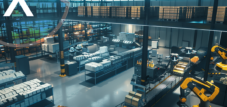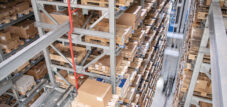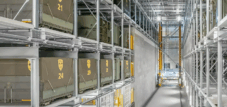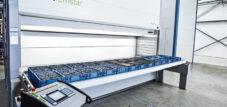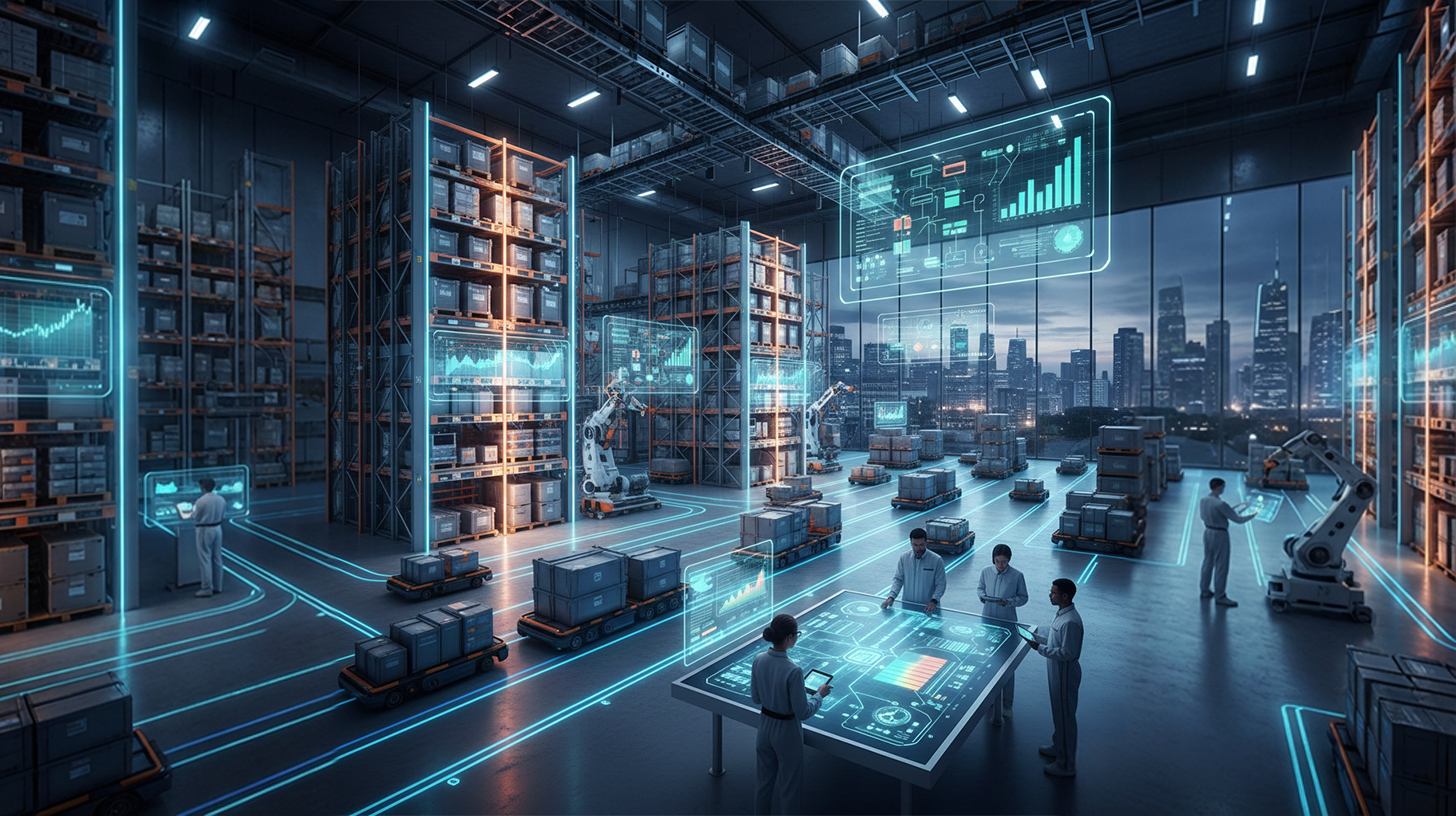
Strategic analysis of automated intralogistics – Image: Xpert.Digital
ROI in 12 months? How quickly does modern warehouse automation really pay for itself?
45% lower energy costs: The underestimated lever in intralogistics
The global logistics landscape is currently undergoing one of the most profound transformations in its history. Driven by a chronic shortage of skilled workers, exploding demands for delivery speeds, and the imperative of decarbonization, automation is no longer an optional extra, but a sheer necessity for economic survival. Germany is establishing itself as a technological leader with a production volume of around €27 billion, but the market is not standing still: New players and technologies are redefining what efficiency in warehousing means.
This article offers an in-depth strategic analysis of modern automated intralogistics. We examine the technological shift from classic, aisle-bound storage and retrieval machines to highly flexible shuttle systems and analyze which technology is most advantageous for which scenario. We go beyond mere mechanics: Learn how innovative materials such as CFRP (carbon fiber reinforced polymer) and intelligent energy management using supercapacitors can drastically reduce operating costs.
Furthermore, we take a look at the "software revolution": from "warehouse healing" through AI algorithms to cross-manufacturer standardization via VDA 5050. Whether you are facing an investment decision, need to calculate the ROI of a system, or are looking for a strategy against technological obsolescence – this analysis provides the crucial facts and key figures for setting the course for the next decade of logistics.
Strategic analysis of automated intralogistics
The global logistics landscape is undergoing a profound transformation, driven by the need for increased efficiency, a massive shortage of skilled workers, and rapid developments in information technology. In Germany, one of the world's leading locations for intralogistics technology, the sector recorded a production volume of approximately €27 billion in 2023, representing a significant increase of 9 percent compared to the previous year. This development underscores the central role that automated systems such as stacker cranes and modern conveyor technology now play in the competitiveness of companies. Despite global economic uncertainties, industry associations forecast further, albeit more moderate, growth of around 2 percent for 2024, with production volume expected to rise to approximately €27.7 billion. Global trade in this sector reached a volume of €123.5 billion in 2024, highlighting the global dimension of the automation wave. The USA and France are emerging as the most important trading partners for German cutting-edge technology, while the market in Asian countries, especially China, is characterized by a massive modernization of the industrial base.
The development of bearing kinematics between tradition and disruption
The classic automation of warehouses is primarily defined by the storage and retrieval machine (SRM). Such a machine functions as a rail-guided vehicle that moves units like pallets, containers, or bins fully automatically in high-bay warehouses. These systems are mechanical marvels, reaching heights of up to 45 meters and precisely handling loads of up to 3,000 kilograms. Their technical superiority over manual processes is evident in travel speeds of up to 240 meters per minute and vertical lifting speeds of up to 90 meters per minute. A key advantage of these aisle-based systems lies in their ability to maximize vertical space utilization, which can reduce a warehouse's footprint by up to 60 percent compared to conventional forklift solutions.
In recent years, however, technological diversification has taken place. While storage and retrieval machines (SRMs) impress with their high individual machine efficiency and enormous height, shuttle systems have established themselves as a highly dynamic alternative. In shuttle solutions, lifting and travel movements are decoupled. While an SRM serves an entire aisle as a single system, numerous vehicles can operate simultaneously on different levels in shuttle warehouses. This architecture not only increases overall throughput but also offers significantly higher system redundancy. If a single shuttle fails, operations can usually continue, whereas a defect in an SRM would block the entire warehouse aisle.
| System feature | Unit-loading storage and retrieval machine | Shuttle system (pallets/containers) |
|---|---|---|
| Maximum building height | Up to 45 m | Typically up to 25 m |
| Maximum load capacity | Up to 3,000 kg | 50 kg (containers) to 1,500 kg (pallets) |
| Horizontal velocity | Up to 4 m/s | Up to 5 m/s |
| Land utilization rate | Very high (narrow aisle) | Extremely high (channel bearing) |
| Scalability | Low (permanent installation) | High (due to additional vehicles) |
| Energy efficiency | Medium (high dead mass) | Very high (low weight) |
The economic decision for one of the two systems depends largely on the product structure and the required dynamics. Storage and retrieval machines are ideal for heavy loads and warehouse environments with a moderate number of SKUs (Stock Keeping Units), where vertical capacity is paramount. Shuttle systems, on the other hand, are perfectly suited for e-commerce and the pharmaceutical industry, where high picking rates and flexible adaptation to seasonal peaks are essential. A four-way shuttle can not only move lengthwise and crosswise within the racking, but also change levels using integrated lifts, enabling fully automated access to the entire storage cube without human intervention.
The physics of efficiency through innovative materials engineering
The mechanical performance of storage and retrieval machines is limited by the physical laws of inertia and vibration. A tall mast tends to oscillate during acceleration and deceleration, leading to waiting times before the load handling device can safely enter the rack. To minimize these dead times, leading manufacturers rely on two strategies: active oscillation damping and radical lightweight construction. Oscillation damping can be implemented either via additional drives at the mast tip or through intelligent software algorithms that optimize the travel trajectory to suppress vibrations as soon as they occur. This not only increases throughput but also protects the mechanical components and extends the service life of the system.
In parallel, the use of composite materials such as carbon fiber reinforced plastic (CFRP) is revolutionizing the design of mast structures. CFRP profiles offer exceptional stiffness with minimal weight, enabling weight reductions of up to 40 percent compared to conventional steel or aluminum structures. Since the energy required for acceleration scales linearly with mass, this weight saving leads to significantly higher energy efficiency. Furthermore, the reduced mass allows the use of smaller drive motors, which in turn lowers the acquisition costs for the electrical infrastructure. The corrosion resistance of CFRP components also makes them ideal for use in demanding environments such as the food industry or chemical storage facilities, where moisture and aggressive media would attack conventional materials.
Manufacturing processes for these high-performance components have advanced significantly. Processes such as tow preg winding and prepreg pressing allow for the production of complex geometric structures with predictable mechanical properties. This technological maturity is a prerequisite for lightweight solutions to be used economically not only in aerospace but also in industrial automation. The combination of high strength and thermal stability ensures precise positioning of load-bearing elements, even under extreme temperature fluctuations, such as those found in deep-freeze warehouses.
Intelligent energy management as an economic lever
In a modern logistics center, a significant portion of operating costs is attributable to the electricity consumption of automated systems. This is where the concept of direct energy recycling comes in. By using a shared DC link, storage and retrieval machines can directly utilize the energy released when the drive unit brakes or the hoist lowers for other motor loads. For example, when the hoist lowers a pallet, the motor becomes a generator and feeds energy into the DC link, which can then be used by the drive unit for acceleration.
If internal demand is insufficient, the excess energy can either be fed back into the local power grid or buffered in intermediate storage devices. Supercapacitors, also known as double-layer capacitors, have proven particularly effective in this regard. These storage devices can absorb and release very high power levels in a very short time, making them ideal for the typical load profiles of storage and retrieval machines, which are characterized by constant acceleration and deceleration.
| Energy efficiency measure | Technical mechanism | Economic effect |
|---|---|---|
| Common Intermediate Circle | Exchange between lifting and chassis | Reduction of total electricity demand by approximately 10-15% |
| Grid feedback | Feeding regenerative energy into the grid | Energy cost savings of up to 30% |
| Supercapacitors | Buffering of load peaks in the device | Reduction of connected load by up to 60% |
| Lightweight components | Reduction of the masses to be moved | Lower wear costs and smaller drives |
| Optimized driving profiles | Software-based adjustment of acceleration | Reduction of mechanical stress by approximately 5% |
Reducing grid connection capacity is an often underestimated economic factor. Many energy suppliers calculate their tariffs based on annual peak demand. By using supercapacitors, these peak loads can be reduced to one-fifth, which significantly lowers the monthly fixed costs for grid connection. In practice, case studies show that combining these measures can achieve energy savings of over 45 percent, meaning the investment in high-quality drive technology pays for itself in a very short time.
Algorithmic optimization through data-driven intelligence
While mechanical hardware forms the foundation, software now determines the actual productivity of a warehouse. The introduction of artificial intelligence and machine learning enables a new level of process optimization that goes far beyond static rules. A key concept is so-called warehouse healing. Here, an algorithm continuously analyzes the flow of goods and order patterns to dynamically optimize the storage locations of items. Items with high turnover or those often ordered together are automatically relocated to route-optimized positions near the picking point.
Simulations demonstrate that such a healing model can reduce picking distances by 20 to 25 percent. In a real-world pilot project, even with less-than-perfect implementation, a reduction in distances of nearly 19 percent was achieved. Since travel time often accounts for more than half of the total picking time, a 20 percent reduction in distances leads to a direct increase in overall picking efficiency of approximately 11 percent. This is particularly critical in markets with high cost pressures and a shortage of skilled workers, as the same volume of orders can be processed with significantly less personnel or in less time.
Another promising area is the use of digital twins. A digital twin is a virtual representation of the physical logistics facility, fed by real-time data from IoT sensors and the warehouse management system. This model allows operators to simulate various scenarios, such as the impact of a changed warehousing strategy or managing seasonal order peaks, without disrupting ongoing operations. According to current market analyses, digital twins can reduce the time to market for new processes by up to 50 percent and increase operational efficiency by up to 10 percent.
Expert partner in warehouse planning and construction

Technology trap in the warehouse: How to protect your multi-million dollar investment from obsolescence
Standardization as the foundation for modular ecosystems
The increasing complexity of intralogistics demands the seamless integration of diverse systems, from stationary conveyor technology and stacker cranes to mobile robots. For a long time, the industry was characterized by proprietary interfaces, resulting in high integration costs and a strong dependence on individual manufacturers. The introduction of the VDA 5050 interface marks a turning point. Originally developed for communication between automated guided vehicles (AGVs) and a central control system, it now provides the foundation for cross-manufacturer orchestration of mobile units in the warehouse.
VDA 5050 utilizes established web standards such as MQTT and JSON to exchange order data and status messages in real time. The economic benefit for companies lies in its flexibility: they can mix vehicles from different manufacturers within a single fleet and coordinate them via a central control system. This enables gradual automation and protects investments, as new technologies can be more easily integrated into existing structures. However, VDA 5050 is not a panacea; it primarily covers communication, while safety aspects and specific process logic still require individual project planning.
Standardization also extends to the mechanical level. Modular conveyor systems make it possible to implement complex routings in three-dimensional space using standardized components. These systems can be used across industries and can be flexibly adapted to changes in the production process. The use of standardized workpiece carriers and modular belt conveyors significantly reduces planning time and spare parts costs, thus lowering the plant's life cycle costs.
Industry-specific requirements and specialized solutions
Automated storage systems today must meet extremely diverse requirements, depending on the industry in which they are used. In the pharmaceutical and food production industries, hygiene and cleanroom compatibility are paramount. Here, stacker cranes and conveyor systems are used that feature smooth, easy-to-clean surfaces and where product-contacting parts are made of stainless steel or anodized aluminum. Special lubricants and sealing systems prevent contamination of the stored goods.
Another extreme application is refrigerated logistics. Systems for deep-freeze environments must function reliably at temperatures as low as minus 30 or even minus 40 degrees Celsius. The choice of materials and electronic components is crucial here, as conventional steels become brittle and condensation can damage the electronics. Automated systems offer a significant advantage because, unlike humans, they don't require breaks to warm up, and cold loss can be minimized through smaller airlock openings.
| Industry | Specific requirement | Technological solution |
|---|---|---|
| Pharmaceuticals / Food | Hygiene, cleanroom | Stainless steel components, ionization devices |
| Refrigerated logistics | Extreme cold (-30°C) | Special steels, heated sensors |
| E-commerce | High dynamics, small units | Mini-load systems, shuttle technology |
| Automotive | Heavy loads, just-in-time | Unit-load RBGs, pallet shuttles |
| Chemistry | Explosion protection, corrosion | CFRP components, ATEX certification |
In the automotive industry, the focus is on handling heavy loads and seamless integration into just-in-time production. Robust storage and retrieval systems (SRS) dominate here, capable of moving pallets weighing several tons with high precision. Linking these systems to the company's warehouse management system (WMS) and enterprise resource planning (ERP) system is essential for a smooth material flow that prevents production downtime.
Economic analysis and strategic investment planning
The decision to automate is primarily a financial one. The acquisition costs for automated storage systems are substantial: While simple vertical lift modules are available starting at around $95,000, fully integrated mini-load systems with over 80,000 storage locations can cost more than $3 million. For large, multinational distribution centers, investments in state-of-the-art robotic cube systems can even exceed $50 million.
However, focusing solely on capital expenditures (Capex) is insufficient. A professional analysis must consider life cycle costs (LCC) and return on investment (ROI). In many cases, automated systems pay for themselves within 12 to 36 months. The drivers for this rapid payback are manifold. Besides the savings in personnel costs, which are continuously rising in many industrialized countries, the drastic reduction in errors plays a crucial role. Every picking error incurs costs through correction efforts, returns handling, and damage to the customer's image.
Another critical point is space productivity. In urban areas, storage space is expensive and scarce. An automated high-bay warehouse makes optimal use of the available height and can multiply the storage capacity on the same footprint. The cost per cubic meter of stored goods decreases with increasing system size, as the expensive moving components can be distributed across more static storage locations.
| System type | Estimated startup costs | Typical ROI period |
|---|---|---|
| Vertical Lift Modules (VLM) | $95.000+ | 6 – 18 months |
| Mini-load AS/RS | $750.000+ | 18 – 36 months |
| Multi-shuttle systems | $1.000.000+ | 24 – 48 months |
| Robotic Cube Storage | $1.500.000+ | 24 – 36 months |
| Unit-load RBG | $1.000.000+ | 24 – 48 months |
Despite the clear advantages, small and medium-sized enterprises (SMEs) in particular often hesitate due to high initial barriers to entry. This is where new business models like Robotics-as-a-Service (RaaS) are gaining importance. Instead of purchasing the hardware, companies pay for the service provided, for example, per pick or per month. This shifts costs from the balance sheet (Capex) to the operating income statement (Opex) and significantly reduces financial risk.
Sustainability and decarbonization as a regulatory necessity
Environmental sustainability has evolved from a matter of image to a hard economic requirement. The Greenhouse Gas Protocol categorizes emissions into three scopes: Scope 1 covers direct emissions within the company, Scope 2 covers emissions from purchased energy, and Scope 3 covers indirect emissions in the supply chain. Automated systems make a significant contribution to reducing Scope 2 emissions due to their superior energy efficiency compared to manually operated forklifts.
Leading companies are setting ambitious targets to achieve climate neutrality in Scopes 1 and 2 by 2030 or 2040. Intralogistics plays a key role in this. Using lithium-ion technology instead of lead-acid batteries can reduce energy consumption in daily operations by around 20 percent. Automation itself, through leaner and more reliable processes, leads to average energy savings of approximately 17 percent compared to manual processes.
Creating a corporate carbon footprint (CCF) is becoming increasingly mandatory for many companies, whether due to legal requirements or pressure from customers in the supply chain. A CO2 balance is not merely a documentation tool, but serves as the basis for a strategic management tool to identify potential savings. Investments in energy-efficient storage and retrieval systems and conveyor technologies not only improve the environmental footprint, but also enhance a company's attractiveness as an employer in a society that increasingly values sustainable practices.
Risk management and dealing with technological obsolescence
In a world of ever-accelerating technological advancements, obsolescence management is becoming a crucial task. A distinction is made between physical obsolescence, caused by wear and tear, and technological obsolescence, where a system is rendered obsolete by newer, more efficient solutions. This poses a particular challenge in intralogistics, where systems are often designed for a lifespan of 15 to 25 years.
Outdated systems pose significant risks: They are more vulnerable to cyberattacks because security updates are often no longer available for older software. Furthermore, inefficiencies and frequent outages lead to increased operating costs and jeopardize delivery capability. Compliance risks can arise when outdated technology no longer meets current security or environmental standards.
Strategy against obsolescence
| measure | Goal |
|---|---|
| Lifecycle Management Monitoring of EoL (End-of-Life) Data |
Early planning of replacement investments |
| Regular audits assess the technical state of the IT. |
Identification of critical vulnerabilities |
| Modernization plan (retrofit): Gradual upgrade of control systems |
Extending the service life of existing mechanisms |
| Cloud computing: outsourcing of computing power and updates |
Reduction of internal IT complexity |
| Close supplier relationships; early notification of product discontinuations |
Ensuring the supply of spare parts |
Effective obsolescence management includes the regular assessment of the installed base and the planning of retrofit measures. Often, it is more economically viable to retain the mechanical structure of a storage and retrieval machine and simply upgrade the drives, sensors, and controls. This reduces downtime compared to a complete new build and saves considerable investment capital, while restoring the system to the performance and safety of a new machine.
Setting the strategic course for the next decade
The analysis of current developments in storage and retrieval technology makes it clear that automation is no longer an optional extra, but rather the backbone of every modern value chain. The fusion of highly efficient mechanics, advanced materials science, and artificial intelligence creates systems whose performance and environmental footprint far surpass what was conceivable just a few years ago.
Companies today face the challenge of not only investing in hardware but also pursuing a holistic digital strategy. Choosing the right system—whether aisle-based storage and retrieval machines or flexible shuttles—must be based on in-depth data analysis and take into account long-term trends such as e-commerce growth and decarbonization. Economic success will increasingly depend on the ability to transform data into knowledge and use this knowledge for continuous, algorithmic self-optimization of the warehouse.
The technological transformation of intralogistics is an ongoing process. Standards like VDA 5050 and innovations such as the use of supercapacitors and CFRP lightweight construction are just the beginning. The future belongs to modular, interoperable, and learning systems capable of flexibly adapting to an increasingly volatile world. Those who set the right course today and invest in intelligent, sustainable automation will secure the necessary agility and efficiency to succeed in the global competition of the next decade.

Xpert.Plus Warehouse Optimization - High-bay warehouses and pallet warehouses: Consulting and planning
Your global marketing and business development partner
☑️ Our business language is English or German
☑️ NEW: Correspondence in your native language!

Konrad Wolfenstein
I and my team are happy to be available to you as your personal advisor.
You can contact me by filling out the contact form here wolfenstein@xpert.digital:or simply call me at +49 7348 4088 965. My email address is
I'm looking forward to our joint project.
☑️ SME support in strategy, consulting, planning and implementation
☑️ Creation or realignment of the digital strategy and digitization
☑️ Expansion and optimization of international sales processes
☑️ Global & Digital B2B trading platforms
☑️ Pioneer Business Development / Marketing / PR / Trade Fairs
Our global industry and economic expertise in business development, sales and marketing


Our global industry and economic expertise in business development, sales and marketing - Image: Xpert.Digital
Industry focus areas: B2B, digitalization (from AI to XR), mechanical engineering, logistics, renewable energies and industry
More information here:
A thematic hub offering insights and expertise:
- Knowledge platform covering global and regional economies, innovation and industry-specific trends
- A collection of analyses, insights, and background information from our key areas of focus
- A place for expertise and information on current developments in business and technology
- A hub for companies seeking information on markets, digitalization, and industry innovations