Current status of Samsung's "Haean" smart glasses: Goodbye smartphone? AR glasses with AI and gesture control! – Creative image: Xpert.Digital
Gesture control and more: With 'Project Haean', Samsung is redefining the standards for AR glasses
Augmented Reality 2025: Samsung's answer with "Project Haean"
Samsung is working intensively on its first augmented reality glasses, codenamed "Haean," which are slated for release in 2025. Development is already well advanced, with the company currently finalizing the features and specifications. Unlike simpler smart glasses such as Meta's Ray-Ban models, Haean will feature an integrated display that can project information directly into the user's field of vision. With advanced sensors for gesture control, AI integration, and a focus on wearing comfort, Samsung aims to create a practical AR solution suitable for both consumer and industrial applications.
Related to this:


Technical specifications and design
Hardware and performance
The Haean smart glasses are expected to be equipped with powerful hardware. At its core will likely be a Snapdragon processor – either the Snapdragon XR2 Plus Gen 2, which is also rumored to be used in Samsung's XR headset "Project Moohan," or a dedicated Snapdragon AR1 chipset. These processors offer sufficient performance for demanding AR applications while remaining energy efficient.
Power is supplied by a battery with a capacity of approximately 155 milliampere-hours, although this specification has not yet been officially confirmed. Energy efficiency will be a crucial factor in enabling all-day use.
To capture the environment and enable interaction, the glasses will be equipped with multiple cameras and sensors. Reports indicate that a high-quality 12-megapixel camera with a Sony IMX681 sensor will be integrated. These sensors will not only allow for capturing images and videos but are also crucial for gesture control and AR functionality.
Innovative display concept
A key differentiator from previous smart glasses like the Ray-Ban Meta Smart Glasses is the integrated display. Samsung plans to equip the Haean glasses with the ability to project information or images directly onto the lens or into the eye. This would transform them from mere "audio and camera" glasses into a true augmented reality device.
The exact display technology has not yet been revealed, but the ability to project digital content into the wearer's field of vision would open up a wide range of new applications – from navigation and information display to immersive AR experiences.
Design and comfort
Samsung is placing particular emphasis on comfort and ergonomic design in the development of its Haean glasses. The company states that it is investing "a great deal of time in a design tailored to the human body." The goal is to create glasses that are light enough to be worn all day and that can adapt to different face shapes.
The glasses are said to weigh between 50 and 150 grams, depending on the source, which would be remarkably light for a device of this complexity. For comparison, normal glasses often weigh between 20 and 50 grams, while most AR headsets are significantly heavier.
For audio, Samsung uses small speakers integrated into the glasses frame that direct the sound directly to the wearer's ear. This solution enables a discreet audio experience without the need for additional headphones.
Functions and areas of application
AI integration and voice control
The Haean glasses will be tightly integrated with artificial intelligence. They are expected to be equipped with Samsung's Galaxy AI and possibly also integrate Google's Gemini AI. This AI integration could turn the glasses into a personal assistant, supporting the user in everyday life.
AI-powered features could include real-time translations, where foreign language texts are translated directly in the user's field of vision. Visual navigation, where directions are overlaid as AR elements onto the real-world environment, is also mentioned as a possible feature.
Innovative operating concepts
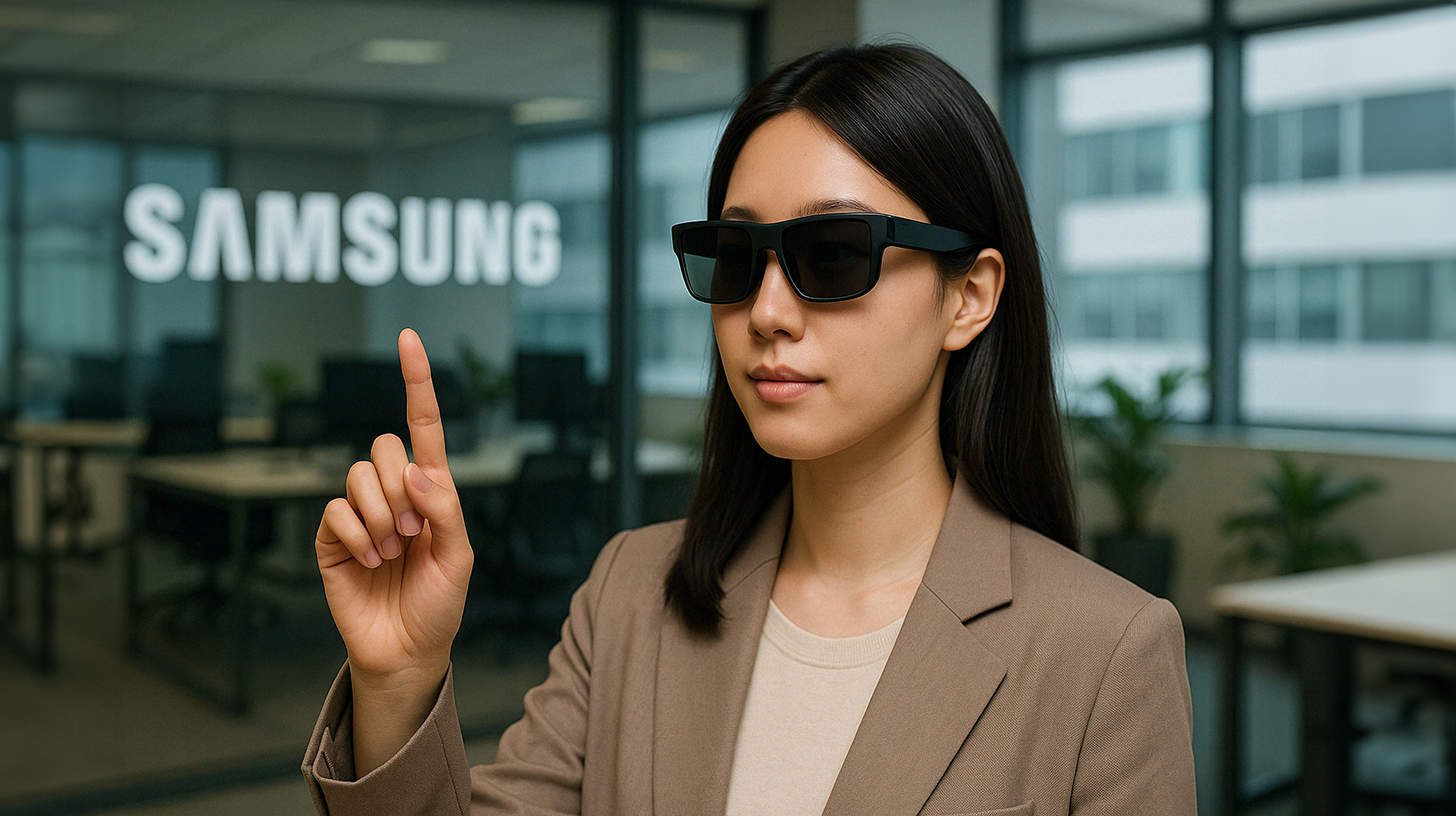
A revolutionary feature of the Haean glasses is their planned control system without physical buttons or remote controls. Instead, interaction will be via gestures recognized by integrated cameras and sensors. This touchless control could make the device more intuitive and natural to use than conventional wearables.
The glasses are also intended to offer practical everyday functions, such as the ability to process payments via QR code. This would make contactless payment even easier, as the user would only need to look at the QR code without having to take out a smartphone.
Industrial and professional applications
In addition to the consumer market, Samsung is also targeting industrial applications with its Haean glasses. The glasses are specifically designed for use in various sectors such as manufacturing, logistics, and healthcare to increase efficiency and productivity.
In manufacturing, for example, workers could have assembly instructions displayed directly in their field of vision, while keeping both hands free. In healthcare, doctors could access important patient data during examinations or operations without having to look away.
Market positioning and competition
Samsung's XR strategy
The Haean glasses are part of Samsung's broader strategy in the field of Extended Reality (XR). Alongside the AR glasses, the company is also developing a more comprehensive XR headset codenamed "Project Moohan." While Moohan is intended to compete with Apple Vision Pro and offer a complete mixed reality experience, Haean is aimed at everyday use.
According to recent reports, both devices could be launched as early as 2025. This two-pronged strategy allows Samsung to serve different segments of the growing XR market – from intense immersive experiences with the headset to everyday AR applications with the glasses.
Strategic partnerships
Samsung is working closely with Google and Qualcomm on the development of the Haean glasses. This partnership was announced back in December 2024, initially focusing on Project Moohan, which is slated to be the first device to launch with the Android XR platform.
Google contributes its expertise in software and AI, while Qualcomm provides the powerful and energy-efficient processors. Samsung combines this with its hardware experience and design know-how. This collaboration could set a standard for future AR devices.
Positioning against competitors
With its Haean glasses, Samsung is positioning itself in direct competition with established players in the AR market. While Meta has so far relied on a simpler concept without a display for its Ray-Ban Smart Glasses, Samsung is going a step further by integrating an AR display.
Apple has launched the Vision Pro, a high-quality but also expensive mixed-reality headset. Samsung seems to be pursuing a complementary approach with its Haean glasses – more practical for everyday use, lighter, and presumably also more affordable than full-fledged XR headsets.
Related to this:

Samsung Haean: The new generation of AR glasses is imminent
Market launch timeline
The development of the Haean glasses is already well advanced. Samsung is in the final stages of defining the features and specifications. Industry experts expect the AR glasses to be officially unveiled later this year, with a possible market launch at the end of 2025.
It's likely that Samsung will unveil the glasses at a larger event, possibly alongside the Project Moohan XR headset. Reports indicate that the headset is slated to enter mass production in April for a release in the third quarter of 2025, suggesting a similar timeframe for the Haean glasses.
Potential in the growing AR market
With the Haean glasses, Samsung could take a significant step in the development of everyday AR technologies. The market for augmented reality is growing steadily, and wearable AR devices that can be discreetly worn in everyday life could represent a breakthrough for this technology.
The combination of technological innovation, strategic partnerships, and Samsung's market reach gives the company a good chance of establishing itself in this emerging segment. In particular, the balance between advanced technology and everyday usability could be the key to success.
Project Haean: Samsung's key role in the future market of XR technologies
Samsung's Project Haean represents an ambitious foray into the augmented reality glasses market. With a focus on innovative display technology, advanced sensors for gesture control, and AI integration, the company aims to create AR glasses that are both technologically impressive and practical for everyday use.
The planned market launch in 2025 suggests a mature product with the potential to fundamentally change how we interact with digital information. Whether for consumers looking to improve their everyday activities or for companies seeking efficiency gains, the Haean glasses could represent a significant milestone in the development of wearable AR technologies.
With the support of its partnerships with Google and Qualcomm, as well as the experience gained from developing the Project Moohan headset, Samsung is well-positioned to take a leading role in the growing XR market. The coming months will reveal what the final product will look like and whether it can live up to the high expectations.
Related to this:
Your global marketing and business development partner
☑️ Our business language is English or German
☑️ NEW: Correspondence in your native language!

Konrad Wolfenstein
I and my team are happy to be available to you as your personal advisor.
You can contact me by filling out the contact form here wolfenstein@xpert.digital:or simply call me at +49 7348 4088 965. My email address is
I'm looking forward to our joint project.