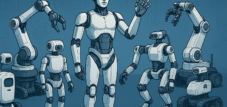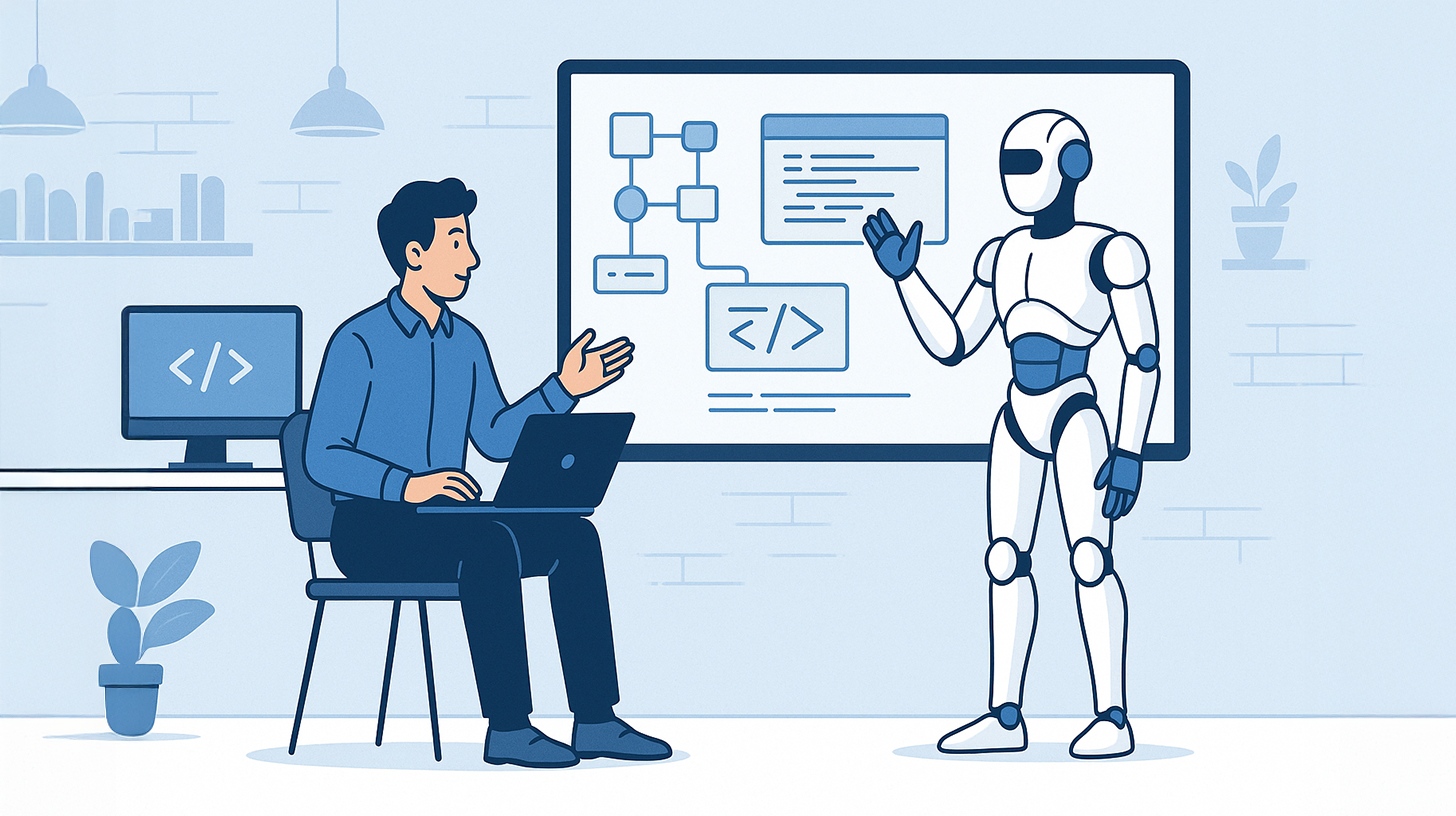
Wandelbots robotics start-up and its no-code approach “Nova” – From magic pen to “Windows for robots” – Image: Xpert.Digital
The future of automation: When robots are as easy to control as smartphones
Wandelbots: The turning point in robot technology made in Germany
Wandelbots, based in Dresden, is considered one of Germany's most prominent and well-funded robotics startups. Founded in 2017 by a team of researchers from TU Dresden, the company embarked on a clear mission: to democratize the complex and expensive programming of industrial robots. The original idea that brought Wandelbots international recognition was as simple as it was ingenious: instead of writing code, skilled workers could simply demonstrate movements to robots using an intuitive stylus, the TracePen. This no-code approach promised to make automation accessible to medium-sized businesses and combat the shortage of skilled workers.
Despite having prestigious clients like Volkswagen and BMW, and after investments exceeding $123 million from heavyweights such as Insight Partners, Microsoft, and Siemens, Wandelbots underwent a radical strategic shift in 2023. The company ceased its hardware production and has since focused entirely on its software platform, "Nova." This platform is designed to function as a vendor-independent operating system—essentially a "Windows for robots"—providing a unified environment for the simulation, control, and AI-powered optimization of robots from various brands. This pivot, which also involved reducing the workforce by approximately 30%, marks a bold attempt to establish a scalable, global software business model and position itself as a key player in the fragmented robotics market.
Related to this:


Why is Wandelbots exciting for the German-speaking world and beyond?
Wandelbots is considered one of the best-known German robotics startups because the company has developed a no-code approach that allows non-experts to operate industrial robots without traditional programming skills. The Dresden-based company promises not only cost reductions in manufacturing but also addresses the labor shortage in many industries.
Who founded Wandelbots?
Who are the people behind the founding?
Wandelbots was founded in 2017 by Christian Piechnick, Maria Piechnick, Georg Püschel, Sebastian Werner, Jan Falkenberg, Giang Nguyen, and Christoph Biering. All co-founders previously worked at the Technical University of Dresden, primarily at the Chair of Software Technology.
What roles do founders play today?
Christian Piechnick leads the company as Chief Executive Officer, while Maria Piechnick and Georg Püschel perform strategic tasks in product and technology matters.
How did the core idea for Wandelbots come about?
What problem did the team originally want to solve?
The founders observed that around 75% of the total cost of an industrial robot is attributable to programming or reconfiguration. Their goal was therefore to radically simplify the process so that even medium-sized companies could efficiently automate small batch sizes.
What initial approaches did the start-up pursue?
The first demonstrators were a sensor jacket and later the TracePen, a stylus that allowed users to easily demonstrate robot paths. This hardware was accompanied by agnostic software that translated the movements into controllable robot programs.
What exactly is the TracePen?
How does the TracePen work?
The TracePen is a wireless pen equipped with inertial sensors, light sensors, and interchangeable tool tips. Two external tracking cubes transmit infrared signals to precisely determine the pen's position in space. The motion data is transmitted via an industrial PC to the Wandelbots software, which uses it to generate a robot path in real time.
What advantages does this offer the user?
According to Wandelbots, programming times can be reduced by up to 70 times, as only a demonstration is required instead of lines of code. Furthermore, the generated programs can be transferred between different robot manufacturers because the software is vendor-independent.
How has the product portfolio changed?
Is the TracePen still the main product?
No. In 2023, Wandelbots decided to exclude all hardware products from its core business and focus entirely on software. In 2024, the company introduced the "Nova" platform as a robot-independent operating system designed to empower developers to write their own automation applications.
What role does the original hardware play now?
The TracePen will continue to be supported in some existing projects, but is no longer part of the long-term strategy. The experience gained with the pen has been incorporated into digital workflows, which Nova now replicates virtually.
What software solutions does Wandelbots currently offer?
What exactly is Wandelbots Nova?
Nova is a robotics-agnostic operating system that connects to hardware from ABB, KUKA, FANUC, Yaskawa, and other manufacturers. It combines path planning, cycle time optimization, digital twins, and AI-based services in a unified environment.
Who is Nova aimed at?
The platform is designed to appeal to system integrators, medium-sized businesses, and large corporations alike. Thanks to no-code and low-code approaches, production planners can model, simulate, and commission robot cells without in-depth robotics expertise.
What is the financing story?
Public funding rounds for Wandelbots
Wandelbots has completed several significant funding rounds in recent years. The company launched in 2018 with a Seed/Series A round, in which Paua Ventures and EQT Ventures invested €6 million. Two further funding rounds followed in 2020: first, a Series B round of $30 million, led by 83North, Microsoft M12, and Siemens Next47. An expanded Series B round raised an additional €26 million from the same investors. In 2022, Wandelbots reached another milestone with its Series C round, in which Insight Partners, 83North, and Microsoft provided $84 million. By the end of 2024, the company had raised an impressive total of $123 million in venture capital, underscoring the continued confidence of investors in the company.
How much capital has Wandelbots raised in total?
According to several sources, by the end of 2024 the company had raised €109 million or $123 million in venture capital.
What does Wandelbots use the money for?
The funds will be used for accelerated product development, the establishment of go-to-market teams in North America and Asia, and the opening of the software platform to external developers.
Has Wandelbots experienced staff reductions?
Is it true that there were mass layoffs?
At the end of 2023, Wandelbots eliminated approximately 30% of its workforce; 27% left through a voluntary redundancy program, and the remaining 11 open positions were not filled. This move was part of a strategy to move away from hardware and build a purely software-based organization.
How was the transition managed?
According to its own statements, management offered severance packages, coaching and placement services to support dismissed employees.
🎯🎯🎯 Benefit from Xpert.Digital's extensive, five-fold expertise in one comprehensive service package | BD, R&D, XR, PR & Digital Visibility Optimization

Benefit from Xpert.Digital's extensive, five-fold expertise in a comprehensive service package | R&D, XR, PR & Digital Visibility Optimization - Image: Xpert.Digital
Xpert.Digital possesses in-depth knowledge across various industries. This allows us to develop tailored strategies precisely aligned with the requirements and challenges of your specific market segment. By continuously analyzing market trends and monitoring industry developments, we can act proactively and offer innovative solutions. The combination of experience and expertise generates added value and provides our clients with a decisive competitive advantage.
More information here:
Smart automation: Efficiency and sustainability in the food industry
Which customers use Wandelbots?
Which well-known companies work with Wandelbots?
Early pilot and series production customers included Volkswagen, BMW, and Infineon, who already used the TracePen for welding path and gripper programming. Later, users such as Fraunhofer, Schaeffler, Rotop, Vitesco, and Bayer joined, testing the platform in various applications.
Are there examples outside the automotive industry?
Yes. A Danish systems integrator installed robots in large bakeries using Wandelbots software to decorate cake surfaces, drastically reducing manual time.
How does Wandelbots differentiate itself from established robotics companies?
What distinguishes Wandelbots from traditional robot manufacturers?
While traditional providers like KUKA or ABB rely heavily on proprietary controllers, Wandelbots positions itself as a manufacturer-independent software layer that unites different robot brands via a common interface.
How does Wandelbots compare to other German robotics startups?
The German robotics scene recently experienced bankruptcies at Franka Emika and Gestalt Robotics, highlighting the risks of hardware-heavy business models. Wandelbots is attempting to counter this trend with a software focus and an ecosystem approach.
What key technical concepts does Wandelbots use?
What does "no-code" mean in the context of industrial robots?
No-code refers to tools that make complex functions accessible through graphical or gesture-based interfaces. In Wandelbots, demonstrations via TracePen or virtual models in Nova replace traditional programming languages like RAPID or KRL.
What role does artificial intelligence play?
AI helps to filter out processing fluctuations and tremors in human demonstrations, smooth paths, and optimize processing speeds. Later, AI was also used for anomaly detection and self-adapting process control.
Which markets does Wandelbots address?
Where does Wandelbots see the greatest growth potential?
Managing Director Piechnick sees the greatest opportunities in the medium-sized mechanical and plant engineering sector, where flexible batch sizes are required and skilled workers are in short supply. Furthermore, the company is targeting North America and East Asia, where a high density of robots coincides with a growing demand for software.
Which specific industries are being addressed?
In addition to automotive and electronics manufacturing, Wandelbots addresses logistics, component manufacturing, food processing, life science laboratories and even wood and metalworking.
How does Wandelbots make money?
What will the business model look like after the pivot?
Wandelbots sells Nova as a subscription license, supplemented by add-on modules for simulation, real-time AI services, and open APIs that third-party developers can monetize. Custom integration projects are deliberately minimized to establish a scalable SaaS model.
Are there any hardware sales?
Only in niche projects now. The majority of revenue is expected to come from software licenses, training, and a future marketplace for robot apps.
What impact did the change in strategy have on investors?
How did the investors react to the pivot?
According to interviews, management had to intensively convince its investors of the software focus, but was able to keep all major investors such as Insight Partners, Microsoft and 83North on board, as proven by the Series C funding round.
Which arguments were particularly convincing?
A hardware-free platform promises higher margins, faster iterations and global economies of scale, similar to a "Windows for robots", as Piechnick put it.
How big is the team today?
How many employees does Wandelbots currently have?
According to the company, after the job cuts, Wandelbots now employs around 100 to 110 people from 17 countries; previously, the number was around 140.
Which locations does the company operate?
The headquarters are located in Dresden, with an additional office in the 1871 technology hub in Chicago for the US market.
What partnerships exist?
Does Wandelbots cooperate with robotics manufacturers?
Yes. The company lists ABB, KUKA, FANUC, Yaskawa, and Universal Robots as supported brands. It also has a strategic partnership with Yaskawa Motoman for welding applications.
Are there any technology partnerships?
Microsoft provides cloud and AI infrastructure, NVIDIA supports simulations via Omniverse, and 3M contributes tools for grinding and joining processes.
What prizes and awards has Wandelbots received?
Was the company awarded a prize?
Wandelbots was a Battlefield finalist at TechCrunch Disrupt 2017. Furthermore, the TracePen has received several industry awards for innovation, including at the Automatica 2020 trade fair.
What challenges does Wandelbots see?
Despite the successes, what risks remain?
The industrial robotics market is fragmented, dominated by ten major manufacturers, and requires deep integration into existing production IT systems. Furthermore, economic fluctuations can dampen investment, as demonstrated by the bankruptcies of competitors.
How does the company intend to address these risks?
Through openness of the platform, strong focus on software and long-term community engagement, Wandelbots aims to create a network effect that increases switching barriers for customers.
What does the outlook look like until 2030?
What roadmap has Wandelbots communicated?
The company plans to expand Nova by 2027 to include app stores, AI-powered process autotuning modules, and standardized interfaces to MES systems. By 2030, Wandelbots aims to be a leading operating system for collaborative robotics, present in all major factories.
What key performance indicators (KPIs) should support this?
According to its business plan, Wandelbots expects annual growth rates of over 40% in software revenue and a user base of several tens of thousands of active robots by the end of the decade.
Summary of key points
What are the key findings about changebots?
- Wandelbots was founded in Dresden in 2017 to democratize robotics through no-code approaches.
- The company has raised $123 million in venture capital to date, led by Insight Partners and 83North.
- Following initial hardware products such as the TracePen, 2023 saw a pivot to a purely software platform called Nova.
- Nova connects robots from different manufacturers, offers simulation and AI optimization, and is aimed at medium-sized businesses and large industries.
- Despite a wave of layoffs of around 30%, management is optimistic about a scalable SaaS business model.
- Customers such as BMW, VW, Schaeffler and Fraunhofer are validating the concept in real manufacturing environments.
We are here for you - Consulting - Planning - Implementation - Project Management
☑️ SME support in strategy, consulting, planning and implementation
☑️ Creation or realignment of the digital strategy and digitization
☑️ Expansion and optimization of international sales processes
☑️ Global & Digital B2B trading platforms
☑️ Pioneer Business Development

Konrad Wolfenstein
I would be happy to serve as your personal advisor.
You can contact me by filling out the contact form below or simply call me on +49 7348 4088 965 .
I'm looking forward to our joint project.
Write to me


Xpert.Digital - Konrad Wolfenstein
Xpert.Digital is a hub for industry focusing on digitalization, mechanical engineering, logistics/intralogistics and photovoltaics.
With our 360° Business Development solution, we support renowned companies from new business to after-sales.
Market intelligence, smarketing, marketing automation, content development, PR, mail campaigns, personalized social media and lead nurturing are part of our digital tools.
You can find more information at: www.xpert.digital - www.xpert.solar - www.xpert.plus
Keep in touch