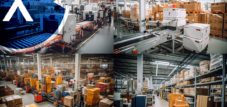
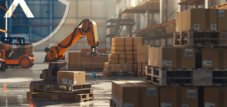
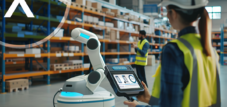
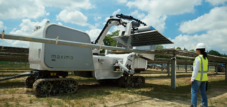
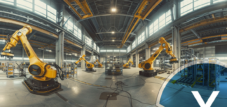
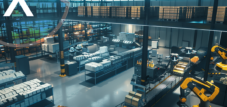
Skilled worker shortage in food logistics: Robots in the central warehouse of a supermarket chain – Creative image: Xpert.Digital
🤖🏭 First German supermarket chain uses robot warehouse: Fully automated robots in use
🤖🚚 Technological change due to skills shortage: Supermarket chain relies on robots in logistics
The German supermarket chain Kaufland has taken a significant step towards the future by becoming the first company of its kind in Germany to introduce robots in one of its central warehouses. As reported by Bild, this is a state-of-the-art, fully automated warehouse in Geisenfeld near Ingolstadt, which has been operational since the end of 2023. There, robots now take over tasks previously performed by humans, primarily those formerly carried out by forklifts. This introduction of robots marks not only a technological innovation but also a cultural shift in the logistics sector.
🌟 Automation in warehousing
Kaufland's new facility utilizes various technologies. Unmanned, remotely controlled vehicles transport goods such as juices, canned goods, and wine through the warehouse. These automated guided vehicles (AGVs) are precise and efficient, following programmed routes to deliver products quickly and safely to their designated storage locations. These systems are capable of moving thousands of products. Initially, the project involved approximately 7,000 different items, but Kaufland aims to increase this number to 8,500.
In addition to transport robots, robotic arms and conveyor belts are also used to ensure that products are efficiently sorted and packaged. These technologies enable a smooth and rapid processing of the entire warehouse operation. Automation is intended not only to accelerate workflows but also to reduce the error rate, as machines, unlike humans, are less susceptible to fatigue or lapses in concentration.
👩💻 New jobs instead of job cuts
Despite increasing automation, Kaufland emphasizes that this development is not intended to eliminate jobs. On the contrary, the use of robots is meant to create more attractive jobs and simultaneously alleviate the existing shortage of skilled workers. The new facility employs around 200 people working in shifts. However, their tasks have changed significantly due to automation. While physically demanding and monotonous tasks were previously the focus, today's jobs are more diverse and challenging.
Employees are now increasingly taking on tasks related to monitoring and controlling machines, maintaining and repairing robots, and optimizing logistics processes. These activities require new qualifications and technical expertise, which will allow employees to benefit from automation in the long term. "We see automation as an opportunity to give our employees new, more challenging tasks," says a Kaufland spokesperson.
⚙️ Challenges and limitations
As with any pilot project, the automation of Kaufland's central warehouse also presents some challenges and limitations. One of the biggest hurdles is that not all types of goods are suitable for fully automated storage and processing. Products with sensitive packaging, such as fresh food, meat, or frozen items, are still handled in traditional warehouses. Here, human intervention remains essential, as machines do not yet offer the necessary care and flexibility when handling such products.
Furthermore, the entire project is currently designed as a pilot, meaning that Kaufland is aware of potential setbacks and that the system will require continuous optimization. While the technology is advanced, unforeseen problems can always arise in practice – be it due to technical defects, unexpected workloads, or software errors. Such challenges, however, are part of any innovation process, and Kaufland is committed to improving the systems through continuous testing and adjustments.
📈 Trend towards automation in retail
Automation in retail is not a phenomenon limited to Kaufland or Germany. Internationally, large retail chains are increasingly relying on robots and automated systems to optimize their warehouse processes. A prominent example is Walmart in the USA, which has been heavily investing in automation for several years to increase efficiency in its logistics centers. This development demonstrates a clear trend: the retail sector is moving towards automation to meet the growing demands of e-commerce, which requires fast and error-free logistics.
The efficiency gains achieved through the use of robots are enormous. Robots can work around the clock, they don't need breaks, and they are less prone to errors. This allows companies to save costs while simultaneously increasing customer satisfaction, as products are delivered faster and more reliably. In the long run, the competitive advantage for those companies that invest in automation early on will be substantial.
📉 Impact on the labor market
Despite the advantages of automation, the question remains how this trend will affect the labor market in the long term. The fear that robots could replace human workers and thus lead to massive job losses is not unfounded. However, studies show that the effects of automation must be considered in a nuanced way. While some simple and repetitive tasks are indeed being replaced by machines, new jobs requiring higher qualifications are simultaneously being created.
Kaufland is consciously pursuing a strategy of retraining and further education for its employees to facilitate their transition to an automated working world. This strategy could serve as a model, demonstrating that automation and job security need not be mutually exclusive. On the contrary, technological advancements offer the opportunity to improve working conditions and open up new career prospects.
Another important aspect in this context is the increasing digitalization of the workplace. The ability to work with computer systems and operate technical devices will become ever more crucial in the future. Companies that offer their employees opportunities for further training in these areas will secure a long-term competitive advantage. At the same time, it will be essential for employees to develop their digital skills in order to succeed in an automated work environment.
🔮 Future prospects
The introduction of robots and automated systems in Kaufland's warehouse is just the beginning of a development that will gain further importance in the coming years. Experts anticipate that the level of automation will increase significantly in many sectors, particularly in retail and logistics. Technological advancements are enabling machines to take on increasingly complex tasks, leading to even more efficient supply chains.
Kaufland has taken an important step in this direction with its pilot project in Geisenfeld. However, it remains to be seen how automation will perform in practice and what challenges still need to be overcome. One thing is certain, though: automation will fundamentally change the world of work – not only in retail, but in almost all sectors. Those who recognize this development early on and adapt accordingly will benefit in the long run.
🔍 Challenges of the skills shortage and increasing customer demands
Automation in Kaufland's warehouse is a pioneering project demonstrating how the retail sector is responding to the challenges of skilled labor shortages and rising customer demands. The use of robots and modern technologies not only increases efficiency but also creates new, attractive jobs. At the same time, automation is a process that requires continuous optimization to ensure long-term success. Kaufland is relying on a combination of technological advancements and employee training – an approach that could serve as a model for the entire industry.
📣 Similar topics
- 🤖 Warehouse automation: The future starts now!
- 🚚 Efficiency through technology: Robots in use
- 🏗️ State-of-the-art warehouse: Robots take over
- 🤝 New jobs through automation
- 📈 Increasing efficiency in retail through robots
- 💡 Innovation in warehousing: Automated systems
- 💼 The world of work is changing: Robots are creating new perspectives
- 🧩 Challenges of warehouse automation
- 🔧 Employee qualification in the age of robots
- 🌐 International Trends in Warehouse Automation
#️⃣ Hashtags: #Automation #Logistics #Innovation #Workplace #Technology

Expert partner in warehouse planning and construction

We are here for you - Consulting - Planning - Implementation - Project Management
☑️ Smart City & Factory: Industry expert for energy-efficient 5G buildings and halls, as well as consulting and installation of solar systems
☑️ Xpert.Plus - Logistics consulting and logistics optimization
☑️ Industry expert, here with his own Xpert.Digital industry hub with over 2,500 specialist articles

Konrad Wolfenstein
I would be happy to serve as your personal advisor.
You can contact me by filling out the contact form below or simply call me on +49 7348 4088 965 .
I'm looking forward to our joint project.
Write to me



Xpert.Digital - Konrad Wolfenstein
Xpert.Digital is a hub for industry focusing on digitalization, mechanical engineering, logistics/intralogistics and photovoltaics.
With our 360° Business Development solution, we support renowned companies from new business to after-sales.
Market intelligence, smarketing, marketing automation, content development, PR, mail campaigns, personalized social media and lead nurturing are part of our digital tools.
You can find more information at: www.xpert.digital - www.xpert.solar - www.xpert.plus
Keep in touch