Robotics and automation in France: France's robot future between ambitions and reality – Image: Xpert.Digital
Robotics in Europe: How France is catching up – or falling behind – compared to Germany
French robotics research is soaring – but industry is struggling with lags
France, a country with a rich tradition in science and technology, aspires to a leading position in robotics and automation. Its internationally recognized robotics research demonstrates the country's potential, yet industrial implementation lags behind expectations. This article examines the challenges facing France, analyzes its progress and shortcomings in automation, and draws comparisons with other European countries such as Germany.
Related to this:
Challenges of robotics in France
Societal skepticism and acceptance
A key challenge is the negative public perception of robots. Many French people see robots as a threat to jobs and fear increasing dependence on technology. This mistrust can hinder the acceptance and implementation of robotics, particularly in traditional industries. To counteract this, targeted public awareness campaigns and educational initiatives are needed to highlight the benefits of robotics for the economy and society.
Education and skills shortage
Strengthening robotics expertise and training qualified professionals are crucial for the industry's continued development. Despite existing initiatives, such as integrating robotics into curricula and competitions like the "Coupe de France de Robotique," there is a lack of sufficient programs that can sustainably inspire young people and professionals to pursue robotics. Additional educational opportunities and specialized degree programs could help to overcome this shortage.
Protection of the national robotics ecosystem
France faces the challenge of protecting its robotics industry from foreign competition without neglecting international cooperation. This requires a balanced strategy that ensures access to global markets while simultaneously fostering local innovation. Through targeted support programs and protective mechanisms, France could strengthen its domestic industry.
Development of innovative applications
The development of new applications that offer added value both economically and socially is another key aspect. France must increase its support for research and development (R&D) to generate innovative robotics technologies. This includes supporting start-ups and fostering collaboration between companies, universities, and research institutions.
Advances in automation
France has made significant progress in automation in recent years. The market for industrial process automation is projected to reach US$2.54 billion by 2030, with an average annual growth rate of 6.5%. Particularly noteworthy are the developments in automated road transport, where vehicles up to Level 4 autonomy are approved. These technologies could position France as a leader in the future of mobility.
Automated vehicles
Automated vehicles are being used in France at various stages:
- Partially automated vehicles: These systems require a takeover request from the driver in the event of specific hazards or technical problems.
- Highly automated vehicles: They can react to hazards independently, without requiring manual intervention.
- Fully automated vehicles: These vehicles operate autonomously and are equipped with remote control capabilities to provide an additional level of safety.
Robotics investments
Between 2014 and 2019, investments in robotics in France increased by an average of 20% per year. This growth is primarily driven by advances in collaborative robots and polyarticular systems specifically tailored to the needs of industry and services.
Comparison with other European countries
In a European comparison, France lags behind countries like Germany in automation. One key indicator is robot density, the number of industrial robots per 10,000 workers. France achieves a density of 194, while Germany has 429. Nevertheless, France ranks second in the EU in the automotive sector with 940 robots per 10,000 workers.
The differences can be attributed to various factors:
- Industrial structure: Germany has a stronger industrial base with a high rate of automation.
- Social acceptance: Robots are perceived more positively in Germany, which facilitates their integration.
- Government strategies: Initiatives such as Germany's "Industry 4.0" focus on automation earlier and more intensively.
Furthermore, Brexit could lead to car manufacturers relocating their production facilities to more automation-friendly countries such as France.
Key players in robotics in France
France has numerous important companies and research institutes in the field of robotics:
- Companies: International giants such as ABB, FANUC and YASKAWA, as well as French start-ups like Azur Drones and MainBot, shape the industry.
- Research institutes: Institutions such as the “Institute of Movement Sciences” in Marseille and the “Institut des Systèmes Intelligents et de Robotique” (ISIR) in Paris are driving basic research forward.
Government funding programs
The government has launched various programs to support the development of robotics:
- Robolution Plan (2013): The goal is to promote R&D and the establishment of a national network of robotics centers.
- France AI (2018): This initiative focuses on artificial intelligence and includes training programs to prepare the workforce for automation.
- France 2030: A budget of 54 billion euros is intended to promote innovations in robotics and AI.
Despite these programs, there is criticism of their implementation, particularly regarding the high level of bureaucracy and lack of flexibility for companies.
Key application areas of robotics
The main areas of application for robotics in France include:
- Automotive industry: The most important customer for robots.
- Metal and mechanical engineering: A growing field for collaborative robotics.
- Food and pharmaceutical industries: Robots are used here for packaging and quality control.
Furthermore, drones and service robots are becoming increasingly important. They are used in agriculture, surveillance, and logistics.
Related to this:
Strengths and weaknesses of France
Strengthen
- Research landscape: France has a strong scientific base with internationally recognized institutions.
- Innovative strength: The growing number of start-ups demonstrates the industry's potential.
- Automated mobility: France has pioneered automated vehicles.
Weaken
- Negative image: Skepticism among the population remains an obstacle.
- Low robot density: Compared to other countries, there is a lack of comprehensive automation.
- Skills shortage: The demand for qualified workers exceeds the supply.
Future of robotics in France
The French robotics market is expected to continue growing in the coming years. Forecasts predict that around 7,000 new robots will be installed annually starting in 2024. France has the potential to take a leading role in areas such as collaborative robotics and service robotics. This will require targeted support for innovation, strengthening of research, and improved public acceptance.
France faces complex challenges, but also great opportunities. The combination of strong research, government support, and innovative companies provides a solid foundation for the further development of robotics. However, to achieve a leading position, France must strengthen public acceptance, promote education, and intensify collaboration between science, industry, and politics. With a strategic approach, France could become a global leader in robotics.
Our recommendation: 🌍 Limitless reach 🔗 Connected 🌐 Multilingual 💪 Sales power: 💡 Authentic with strategy 🚀 Innovation meets 🧠 Intuition


From local to global: SMEs conquer the world market with a clever strategy - Image: Xpert.Digital
In an era where a company's digital presence determines its success, the challenge lies in creating an authentic, personalized, and far-reaching presence. Xpert.Digital offers an innovative solution that positions itself as the intersection of an industry hub, a blog, and a brand ambassador. It combines the advantages of communication and sales channels in a single platform and enables publication in 18 different languages. Cooperation with partner portals and the ability to publish articles on Google News and a press distribution list with approximately 8,000 journalists and readers maximize the reach and visibility of the content. This represents a crucial factor in external sales and marketing (SMarketing).
More information here:
Between science and business: How France wants to catch up with Germany in automation - background analysis
Robotics in France: Challenges and opportunities on the path to technological sovereignty
France boasts a long and distinguished tradition in science and technology and is now determined to assume a leading role in robotics and automation. French robotics research enjoys an excellent international reputation, reflected in numerous high-profile publications and innovative projects. However, a closer look reveals that the industrial implementation and widespread acceptance of robotics still lag behind expectations compared to other European nations, particularly Germany. This article examines the diverse challenges facing robotics in France, analyzes the current state of automation in various economic sectors, and draws a detailed comparison with other leading European countries, especially Germany. It considers not only technological aspects but also the social, economic, and political framework.
The multifaceted challenges of robotics in France
France's path to becoming a leading robotics nation is fraught with a number of complex challenges. A key problem, deeply rooted in French society, is the often negative public perception of robots. Many French people primarily associate robots with potential job losses and an increasing, possibly uncontrollable, dependence on technology. This profound skepticism, manifested in surveys and public debates, can significantly hinder the acceptance and, consequently, the successful implementation of robotics in various areas of life and work. This negative attitude is often fueled by historical fears of the loss of human labor through automation, fears that were already expressed in the 19th century during the Industrial Revolution. The media's portrayal of robots, often dominated by science fiction scenarios and the image of the "job killer," also contributes to this skepticism.
To sustainably advance robotics in France, it is essential to promote robotics expertise at all levels and intensify the training of highly qualified professionals in this promising field. This requires the early integration of robotics topics into school and university curricula, as well as targeted support for practical training and professional development programs. Initiatives such as the "Coupe de France de robotique," a national robotics competition for young people, play a crucial role in sparking interest in robotics among the next generation and playfully fostering the development of essential technical and programming skills. Such competitions provide a platform where young talents can demonstrate their creativity and technical know-how while simultaneously developing an enthusiasm for the diverse possibilities of robotics.
Another key objective is the strategic protection and strengthening of the national robotics ecosystem. In a globalized world, France must protect its domestic robotics industry from increasing competitive pressure from abroad while simultaneously cultivating and expanding constructive collaboration with international partners. This requires a coordinated industrial policy that supports both established companies and innovative startups and creates an attractive environment for research, development, and production in France.
Furthermore, it is crucial that France actively promotes the development of innovative robotics applications that create tangible added value for society and the national economy. This includes the targeted promotion of interdisciplinary research and development at the interfaces of robotics, artificial intelligence, sensor technology, and materials science, as well as providing unbureaucratic support to startups and established companies that develop new and future-oriented robot technologies and bring them to market. The focus should not only be on industrial applications, but also on sectors such as healthcare, agriculture, logistics, and public safety.
To spark young people's interest in the fascinating field of robotics and promote the necessary training in this area, numerous initiatives are being implemented in France at the national and regional levels. A notable example is the "Globeducate France Robotics Challenge," organized in France by the international education group Globeducate. This competition aims to promote STEAM (Science, Technology, Engineering, Arts, and Mathematics) learning in a playful way, giving students the opportunity to apply and deepen their acquired knowledge of robotics and programming. Within this challenge, students work with LEGO® Education SPIKE™ Prime resources to construct, program, and optimize their own robots for various tasks. Initiatives like these help to break down barriers and cultivate the next generation of robotics experts.
The state of automation in France: A nuanced picture
France has made remarkable progress in automation in recent years, although the pace could still be accelerated compared to other countries. The French market for industrial process automation was valued at a substantial $1.57 billion in 2023. Experts predict significant growth for this sector, reaching $2.54 billion by 2030, which equates to an average annual growth rate of approximately 6.5%. The French market for factory automation and industrial control systems is also showing dynamic development and is expected to experience an annual growth rate of over 8.47% during the forecast period from 2021 to 2026. These figures underscore the growing interest in and increasing willingness to invest in automation technologies within French industry.
Of particular note are the significant advances in automated road transport, a field in which France plays a pioneering role in Europe. Since September 2022, automated vehicles up to Level 4 autonomy (i.e., vehicles that can operate without a driver on board) have been permitted for passenger transport on public roads. However, it is important to emphasize that fully automated vehicles may currently only be operated within a clearly defined and officially approved automated road transport system, which must meet a number of stringent safety precautions and operational requirements. Internationally recognized levels of vehicle automation are used, ranging from partial automation to full autonomy
Partially automated vehicles: These vehicles are capable of performing certain driving tasks independently, but require the constant attention and readiness to intervene of a human driver who must take control if necessary, for example to react to unexpected traffic situations or technical malfunctions.
Highly automated vehicles: In contrast, highly automated vehicles can independently react to most traffic situations and technical failures within their defined operational design domain (ODD) without requiring immediate driver intervention while driving. However, the driver must still be able to take over the vehicle if necessary.
Fully automated vehicles: These vehicles represent the highest level of automation. They are capable of handling all driving tasks within their operating range completely autonomously and can react to complex traffic situations and unexpected events without human intervention. Fully automated vehicles are typically used in automated road traffic systems that have remote control or monitoring capabilities to allow for intervention from a distance if necessary.
Between 2014 and 2019, investments in robotics in France saw an impressive average increase of approximately 20% per year. This significant rise is primarily attributable to the rapid development and increasing prevalence of polyarticular robots (industrial robots with multiple articulated arms) and collaborative robots (cobots). Cobots, specifically designed to work alongside humans, are opening up entirely new possibilities for automating production processes and are increasingly being used in small and medium-sized enterprises.
Comparison with other European countries: Germany as a benchmark
However, a direct comparison with other leading European industrial nations, particularly Germany, reveals that France still lags behind in the widespread implementation of automation technologies. An important and internationally recognized indicator of an economy's level of automation is the so-called robot density, which indicates the number of installed industrial robots per 10,000 employees in the manufacturing sector.

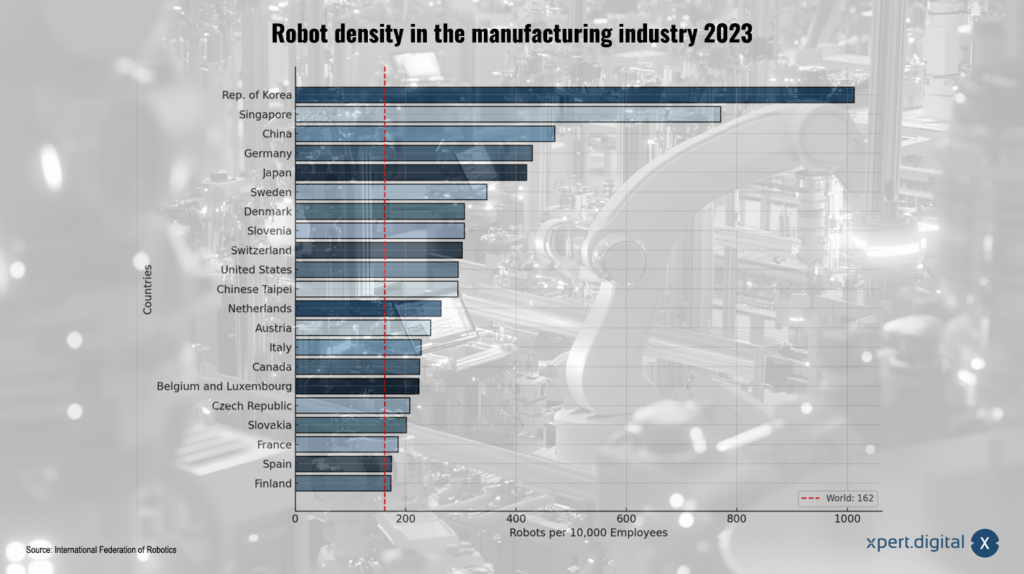
Robot density in the manufacturing industry in 2023 – Image: Xpert.Digital
The robot density in the manufacturing industry paints a clear picture of the increasing automation worldwide. The number of installed robots per 10,000 employees is not only an indicator of a country's technological progress, but also of its ability to leverage innovation to increase efficiency and competitiveness in manufacturing.
More information here:
We are here for you - Consulting - Planning - Implementation - Project Management
☑️ SME support in strategy, consulting, planning and implementation
☑️ Creation or realignment of the digital strategy and digitization
☑️ Expansion and optimization of international sales processes
☑️ Global & Digital B2B trading platforms
☑️ Pioneer Business Development

Konrad Wolfenstein
I would be happy to serve as your personal advisor.
You can contact me by filling out the contact form below or simply call me on +49 7348 4088 965 .
I'm looking forward to our joint project.
Write to me


Xpert.Digital - Konrad Wolfenstein
Xpert.Digital is a hub for industry focusing on digitalization, mechanical engineering, logistics/intralogistics and photovoltaics.
With our 360° Business Development solution, we support renowned companies from new business to after-sales.
Market intelligence, smarketing, marketing automation, content development, PR, mail campaigns, personalized social media and lead nurturing are part of our digital tools.
You can find more information at: www.xpert.digital - www.xpert.solar - www.xpert.plus
Keep in touch