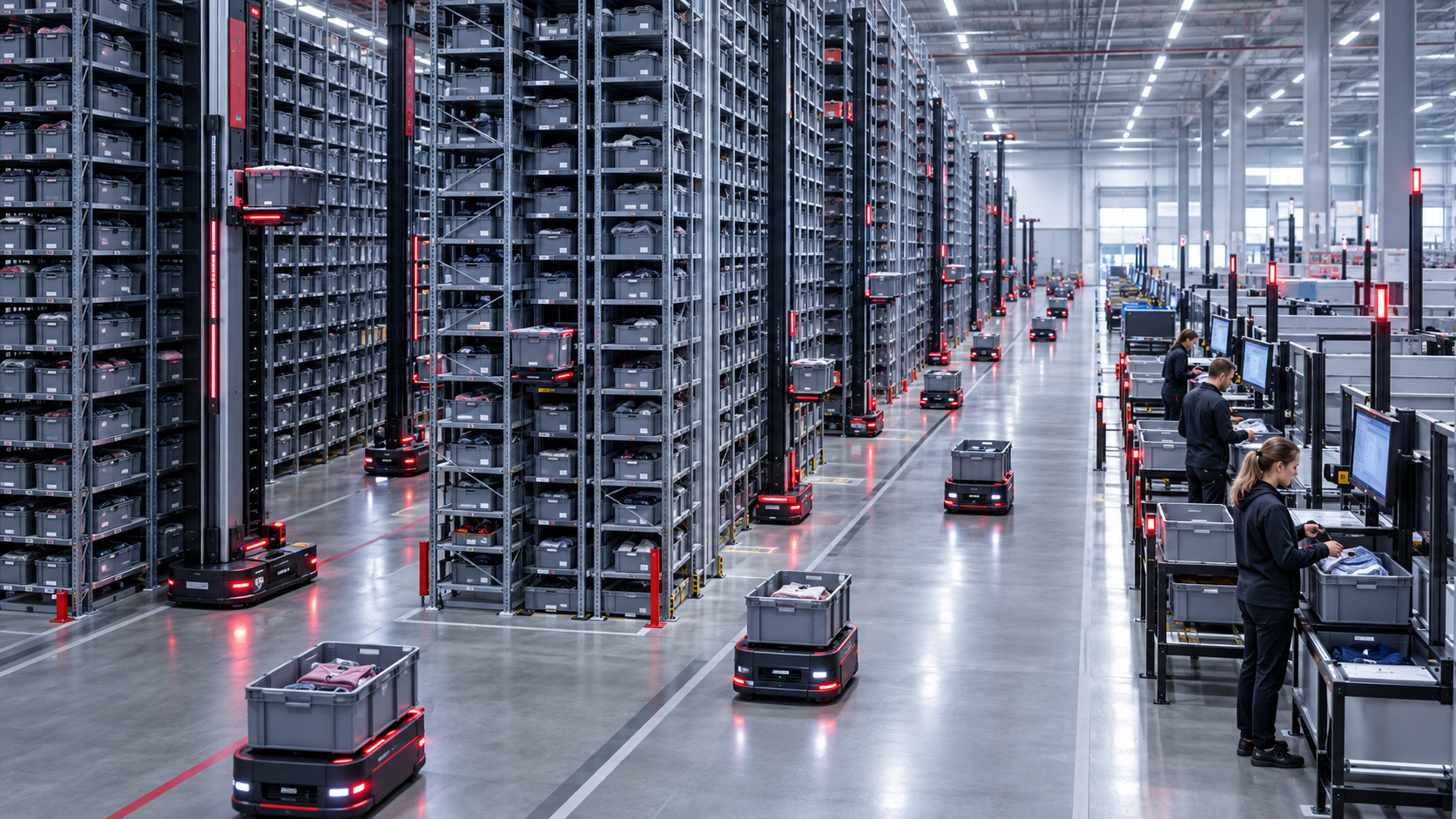
From fashion retailer to logistics platform: LPP is building a state-of-the-art robotic warehouse in Poland – with more than 1,500 robots for online retail – creative image on the topic, with AI: Xpert.Digital
1,500 robots, 1.2 million storage spaces: LPP is implementing a new logistics model in Tczew – a mega-warehouse is intended to bring fashion to customers faster
Sinsay, marketplace and e-commerce: This is the role LPP's new robotics center plays
24,000 containers per hour: LPP plans one of the largest automated warehouses in Europe
With a new e-commerce logistics center in Tczew, Poland, the fashion group LPP aims to achieve far more than just additional storage capacity. More than 1,500 autonomous robots, 1.2 million storage locations, and a planned throughput of over 24,000 containers per hour are intended to support online growth, the expansion of the Sinsay brand, and the development of its own marketplace. The project, scheduled to begin operations in the second quarter of 2027, illustrates how logistics in the fashion industry is changing: it is increasingly becoming a strategic foundation for digital growth – and no longer merely a supporting function.
The center will initially cover approximately 60,000 square meters and can later be expanded to around 100,000 square meters. The 30,000-square-meter automated zone will accommodate more than eight million garments and accessories. The facility is designed to process over 400,000 items daily. At its core is the goods-to-person principle: robots deliver the required containers of goods to employees, eliminating the need for them to walk long distances through aisles.
The economic significance extends beyond potential savings in labor and space. LPP is investing in an infrastructure designed to handle additional orders, a larger product range, and seasonal order peaks. This could become particularly important if Sinsay continues to grow and opens its marketplace to external retailers. In that case, logistics will not only have to ship more of its own fashion items, but also manage a broader product range, different delivery models, and additional returns.
The project's profitability cannot yet be precisely calculated: the investment volume for automation has not been disclosed. However, it is clear that success does not depend solely on the number of robots. Crucial factors include utilization, fleet management, the integration of returns and marketplace merchandise, and software reliability. Tczew thus becomes a test case for whether a fashion retailer can transform its logistics into a scalable digital production platform.
LPP automates Tczew: When fashion retail becomes a robot economy
1,500 robots against the cost trap of e-commerce
With its new e-commerce logistics center in Tczew, the Polish fashion group LPP is not undertaking a typical capacity expansion. Rather, the company is building an industrial platform designed to simultaneously secure further online growth, the expansion of its Sinsay brand, and the development of its own marketplace. More than 1,500 autonomous warehouse robots, 1.2 million storage locations, and a planned throughput of over 24,000 containers per hour make the project one of the largest European applications to date for highly scaled goods-to-person automation. However, the sheer size of the facility is not the only crucial factor. What is particularly interesting from an economic perspective is that LPP is transforming its logistics from a supporting function into a strategic production system for digital commerce.
The Tczew site is scheduled to begin operations in the second quarter of 2027. The entire center is planned to cover approximately 60,000 square meters and can be expanded to around 100,000 square meters in the future. The robotic zone will initially comprise 30,000 square meters. The warehouse is designed to hold more than eight million garments and accessories and process over 400,000 items daily. This creates not just additional space, but a compact, modularly expandable infrastructure whose performance is determined more by software, robot density, container movements, and process synchronization than by the number of employees or the length of walking distances.
The investment volume for the specific automation measures was not disclosed. This information gap limits a traditional return on investment calculation, as neither acquisition costs nor integration expenses, depreciation periods, maintenance costs, and financing terms are known. Nevertheless, the economic logic can be clearly assessed: LPP is not primarily investing in Tczew to reduce personnel costs in the short term. The company is acquiring predictable capacity, higher sales per square meter, faster scalability, and greater resilience to peak demand. Especially in the margin-sensitive fashion retail sector, this combination can be more valuable than simply reducing labor costs.
From warehouse to growth machine
The investment is directly linked to LPP's expansion strategy. In 2025, the group achieved a turnover of more than 23 billion złoty, increasing its revenue by 21 percent in constant currencies. The online channel grew by 19 percent and already accounted for 28 percent of total sales. At the same time, the group invested approximately 3.2 billion złoty, of which more than 1.3 billion złoty was invested in logistics and automation. Tczew should therefore not be seen as an isolated technology project, but rather as part of a capital-intensive growth architecture that integrates sales, IT, the branch network, and the flow of goods.
The role of the more affordably positioned brand Sinsay is particularly relevant. LPP intends to significantly expand its store network while simultaneously increasing online availability. The strategic plan envisions a group structure with approximately 7,500 stores by 2027, of which around 6,000 are to be Sinsay. A medium-term revenue target of up to ten billion zlotys has been set for e-commerce. Even if these targets are adjusted over time, the operational consequence remains the same: a significantly larger number of stores, markets, online customers, and products generates exponentially more logistical interfaces.
Branch expansion does not automatically reduce the need for e-commerce logistics. In the omnichannel model, stores can act as pickup points, return locations, contact points, and local demand generators. The denser the network becomes, the more frequently customers switch between app, website, and brick-and-mortar stores. This results in more small orders, more cross-channel inventory inquiries, and higher demands on product availability. The warehouse then has to not only ship packages but also intelligently distribute inventory across brands, countries, and sales channels.
Tczew is thus becoming a kind of industrial operating system for growth. The facility is designed not only to handle demand as it arises, but also to maintain capacity before the planned expansion takes full effect. This upfront investment carries a risk of underutilization, but is strategically sound. A retail group can only credibly scale new markets and marketplace product ranges if its logistics infrastructure doesn't reach its limits during every seasonal peak.
The mathematics behind the system
The published performance data demonstrates the project's strong focus on high-density storage. 1.2 million storage locations on an automated area of 30,000 square meters equates to 40 storage locations per square meter of floor space in the robotics zone. This figure doesn't reflect the overall building efficiency, as traffic routes, workstations, technical areas, safety zones, and different levels must be taken into account. However, it clearly illustrates the economic value of the hall's vertical utilization and double-deep storage.
In the so-called double-deep principle, containers are stored at twice the depth. This increases storage density, but also the complexity of access. A container in the rear position is not easily accessible if another container is in front of it. The quality of the system therefore depends not only on the mechanics of the robots, but also on the software that positions inventory, minimizes relocations, and predicts access sequences. A poorly controlled, high-density warehouse can generate unnecessary movements and bottlenecks; a well-controlled system transforms space into productive capacity.
The planned throughput of over 24,000 containers per hour theoretically corresponds to at least 400 container movements per minute. Distributed across more than 1,500 robots, this results in an average of approximately 16 container movements per robot per hour. This ratio should not be misinterpreted as the actual individual performance, because the fleet handles different routes, charge levels, waiting times, and tasks. However, it illustrates that the bottleneck does not lie solely in the speed of a single robot. The crucial factor is the ability to orchestrate a very large fleet as a cohesive traffic system.
This is precisely where the technological leap lies. In smaller installations, the operator can often mitigate individual disruptions locally. In a fleet of more than 1,500 units, routes, intersections, priorities, and workstations constantly interact. Performance therefore arises from the interplay of warehouse management, warehouse control, fleet management, inventory logic, and the physical picking locations. The software must not only find the shortest route, but the best route for the entire system.
For LPP, throughput is more economically important than a high number of robots. If containers are moved quickly but then wait at picking stations, packaging lines are overloaded, or orders are prioritized incorrectly, no corresponding customer benefit is generated. The system must therefore be viewed as an end-to-end process: from goods receipt through storage and replenishment to picking, packing, sorting, dispatch, and returns processing. Otherwise, a highly automated subprocess can merely shift the bottleneck to another point.
Goods reach people
The HaiPick Climb system follows the goods-to-person principle. Employees no longer walk through long aisles to collect items. Instead, autonomous robots bring the required containers to ergonomically designed workstations. The devices move through the aisles, climb the shelving structures, and retrieve containers from different heights. This concentrates human activity from unproductive tasks to controlled picking, inspection, and packaging processes.
Economically, this model primarily reduces the variability of manual labor. In a conventional warehouse, performance depends heavily on walking distance, experience, physical strain, shift composition, and layout knowledge. In goods-to-person, a significant portion of these differences is standardized technically. New employees can be trained more quickly because they don't need to be familiar with the entire warehouse. At the same time, the physical strain from long distances and repetitive reaching at awkward heights is reduced.
This doesn't mean that humans disappear from the process. Despite standardized containers, clothing and accessories are by no means completely homogeneous products. Fabrics can shift, packaging can be damaged, items need to be inspected, and special cases need to be resolved. In addition, there's maintenance, troubleshooting, quality assurance, inventory control, and process management. Automation therefore shifts work from transport and searching to monitoring, exception handling, and technical support.
This shift has a mixed impact on employment. Less simple transport work is likely to be required per unit processed. At the same time, a growing order volume could stabilize or even increase absolute employment. Therefore, a polarization of tasks is more likely than a simple replacement of workers: less manual transport work, more standardized station work, and a growing demand for mechatronics engineers, automation technicians, data analysts, and shift supervisors with systems expertise.
From a company perspective, this increases the dependence on qualified key personnel. A manual warehouse can operate more slowly in the event of staff shortages; a highly automated center can suffer disproportionately high performance losses in the event of a central software, network, or control system problem. Personnel is not only reduced but also restructured. The personnel strategy must therefore include training, technical readiness, spare parts management, and clearly defined escalation procedures.
Tczew as a strategic node
Tczew's location is a crucial factor in the project's economic calculations. Situated south of the greater Gdańsk area, it is close to LPP's existing distribution center in Pruszcz Gdański. Efficient north-south connections are provided via National Road 22 and the A1 motorway. Furthermore, the region is near the seaports of Gdańsk and Gdynia, which are of vital importance for global trade and the supply of Central and Eastern Europe.
This location combines procurement and sales logic. A fashion retailer that sources a large portion of its goods via international supply chains benefits from short connections between the port, distribution center, and e-commerce fulfillment. At the same time, the A1 motorway enables rapid access to central Poland, the Czech Republic, and other markets in Central and Southeastern Europe. Tczew is therefore not located in the geographical center of Europe, but within a functional corridor for LPP between Baltic Sea access, the Polish home market, and growing regional expansion.
Proximity to existing group locations creates additional synergies. Management personnel, technical expertise, transport contracts, and inventory processes do not need to be completely rebuilt. Goods can be coordinated between distribution and fulfillment functions. Even in the event of disruptions or seasonal shifts, geographical proximity facilitates more flexible load distribution, provided IT systems and inventory management are appropriately integrated.
At the same time, the location is not without risks. Northern Poland is not an inexhaustible labor market, and large logistics companies compete for shift workers, technicians, and drivers. Rising wages and demographic challenges are weakening the previous advantage of comparatively inexpensive labor. This is precisely what makes automation plausible: Tczew still combines competitive location costs with the ability to mitigate labor shortages through technology.
The planned expandability from 60,000 to 100,000 square meters is also a compelling argument for the location. Logistics properties are often designed for anticipated peak demand, which is not initially fully utilized. Modular expansion reduces the risk of financing unproductive space too early. At the same time, it preserves LPP's option of creating additional capacity at the existing hub should growth accelerate, rather than building a new location with new interfaces.
The marketplace changes everything
The launch of the Sinsay marketplace significantly increases the strategic importance of the center. LPP is thus opening its digital platform to external retailers and expanding its product range beyond its own brands. The company aims to offer more than 100,000 products by 2027; at the same time, LPP Logistics will handle a portion of the marketplace orders. This represents a gradual shift for the group from a vertically integrated fashion retailer to a platform operator with logistics services.
A marketplace changes the economics of the flow of goods. For its own products, LPP largely controls product development, procurement, inventory, and pricing. For third-party vendors, the product range, data diversity, and number of possible delivery models increase. Some retailers handle shipping themselves, while others utilize the platform's fulfillment services. For the warehouse, this potentially means more items with lower turnover rates, more heterogeneous packaging, and more complex service agreements.
The high storage density in Tczew is particularly well-suited for this long-tail product range. A broad assortment requires numerous storage locations, even though individual items are ordered only rarely. In a manual warehouse, a growing number of slow-moving items would result in longer travel distances and higher search costs. With the robotic storage system, software can position rarely requested goods deeper or in less convenient locations, while dynamically moving frequently ordered items closer to productive access points.
Furthermore, the business model can be expanded with less capital. Owning your own product range ties up liquidity in inventory and carries the risk of write-offs. A marketplace can increase sales and customer traffic without LPP having to own every item itself. This is not entirely risk-free: The platform must monitor quality, delivery reliability, returns, and customer expectations. The more LPP takes over the fulfillment of external retailers, the greater the revenue potential and operational responsibility become simultaneously.
Tczew could therefore become a building block of a regional platform strategy. LPP has brand recognition, apps, customer programs, physical stores, and logistics. This combination is an advantage over purely online platforms because stores can be used as pick-up and return points. Compared to traditional retailers, LPP also possesses a more industrialized digital infrastructure. The competition is thus shifting from the question of who offers the most attractive fashion to the question of who most efficiently combines assortment, data, physical proximity, and fulfillment.
Capital intensity at a strategic price
Without a published investment volume, the amortization period cannot be reliably determined. However, in a project of this scale, the robots themselves are likely to be just the only significant factor. Other costs include shelving systems, containers, conveyor technology, picking stations, packaging automation, fire protection, power supply, charging infrastructure, network, servers, software licenses, system integration, testing, and training. Start-up losses during the ramp-up phase are also economically significant.
The relevant benchmark is therefore not the purchase price of robotics versus the wages of an unchanged workforce. What needs to be compared are two business models: a predominantly manual warehouse with lower initial investment, higher space and personnel requirements, and limited peak performance, versus an automated system with high capital outlay, lower variable costs per additional unit, and greater technical complexity. With rapidly increasing volume, the advantage usually shifts in favor of automation because fixed costs are spread across more orders.
LPP's existing scale speaks in its favor. The group's e-commerce warehouses processed around 60 million orders in 2025. At the same time, the fleet of autonomous units in its centers in Poland and Romania grew from 555 to more than 3,500 robots within a single year. The company is therefore not starting from scratch. It already possesses operational experience, process data, and organizational knowledge, which should make the implementation risk in Tczew lower than for a first-time large-scale project.
Nevertheless, the new plant is not simply a copy of existing systems. The architecture and the number of jointly controlled units reach a different dimension. Economies of scale can, beyond a certain point, turn into disadvantages in complexity. The denser and more tightly coupled the system is, the more important simulations, load tests, digital twins, and phased ramp-ups become. A single additional percentage point of technical availability can have a significant economic impact when processing 24,000 containers per hour.
Capital costs deserve special attention. Robotics ties up capital for years, while the fashion industry and consumer spending remain dependent on economic cycles. If demand falls, robots cannot simply be moved to another industry or property. The modular nature of mobile systems reduces this rigidity compared to permanently installed conveyor technology, but it doesn't eliminate it. Shelving, software, and building technology remain tailored to the specific operating concept.
The investment is therefore particularly compelling if LPP can utilize the facility across multiple brands, countries, its own merchandise, marketplace assortments, and returns. The broader the utilization, the lower the risk of one-sided dependence on the growth of a single channel. This is precisely where the project's strategic strength lies: Tczew is not only designed for additional fashion orders, but for a more comprehensive retail ecosystem.
Your intralogistics experts

Consulting, planning and implementation of complete solutions for high-bay warehouses and automated storage systems - Image: Xpert.Digital
More information here:
Innovative e-commerce logistics centers are changing the fashion industry
Productivity beyond labor costs
The most obvious benefit of automation lies in increased labor productivity. Fewer walking distances mean more items processed per working hour. However, the greater economic impact arises from several interconnected factors. Shorter lead times allow for later order deadlines, faster handover to parcel services, and potentially shorter delivery times. Lower error rates reduce reshipments, customer service calls, and unnecessary return shipments.
Space productivity is also crucial. Commercial space incurs not only rent and depreciation costs, but also heating, cooling, lighting, insurance, and maintenance expenses. When double-deep and vertical storage accommodates more goods in the same volume, the space required per storage location decreases. This advantage increases as prime logistics locations become more expensive or harder to find.
In addition, there's the issue of inventory productivity. An automated system generates more precise transaction data and can monitor inventory more closely. If LPP thereby reduces safety stock, detects shortages more quickly, or distributes items more effectively between markets, less capital is tied up in unproductive goods. This is particularly relevant in the fashion industry because collections age and discounts rapidly reduce margins.
Another source of profitability is managing peak periods. Black Friday, Christmas sales, seasonal changes, and marketing campaigns generate sudden spikes in volume. Manual warehouses have to temporarily recruit and train many employees to cope. A fleet of robots can operate longer and more consistently, provided charging and maintenance concepts are sound. Additional shifts still require staff, but the ratio between order growth and additional personnel becomes more favorable.
Profitability ultimately depends on the cost per item delivered correctly and on time. A plant can exhibit high technical utilization and still be economically disappointing if errors, maintenance, energy consumption, or returns increase. Conversely, a plant deliberately operating below maximum capacity can be beneficial if spare capacity serves as insurance against peak demand and growth. Productivity, therefore, should not be confused with permanent full utilization.
Fashion returns as a stress test
Online fashion retail has a structural peculiarity: returns are not an exception, but a second stream of goods. Size discrepancies, fit issues, material feel, multiple orders, and purchases for selection lead to significantly higher return rates than in many other categories. Every return must be accepted, identified, inspected, possibly processed, repackaged, restocked, or written off. This means that a seemingly completed order can generate additional logistics costs.
For Tczew, the crucial factor will be whether automation not only speeds up the shipping of new goods but also the return of saleable items. A returned garment loses value with each passing day, especially during seasonal trends. Rapid inspection and restocking increase the likelihood of reselling the item at the regular price. Slow processes, on the other hand, lead to higher inventory levels, discounts, and write-offs.
The container system can flexibly handle returns when item identification, quality classification, and inventory release are digitally linked. However, some of the more difficult steps remain manual: odors, stains, signs of use, missing labels, or damaged packaging cannot always be reliably standardized. Artificial intelligence and image processing can provide support, but cost-effectiveness depends on the item value, the cost of errors, and process speed.
The marketplace exacerbates this challenge. External retailers can have different return policies, quality standards, and packaging. LPP must decide which returns are processed centrally in Tczew, which are returned to the retailer, and which can be offered for sale again immediately. Without clear data standards, the high physical performance of the robots risks being wasted on administrative exceptions.
That's precisely why the system shouldn't be judged solely on delivery figures. Key performance indicators include the time from returns acceptance to re-release for sale, the percentage of automatically identified items, the resale rate at the original price, and the cost per processed return. These metrics reveal whether Tczew truly supports modern circular logistics or merely accelerates the forward flow.
Software becomes an operational risk
With increasing automation, the critical part of operations is migrating to the digital realm. The warehouse management system decides where inventory is located and which orders are prioritized. Fleet management coordinates robot movements. Control software connects workstations, conveyor technology, and packaging. Interfaces link the operation to online shops, marketplace partners, payment processing systems, and transport providers.
This interconnectedness creates efficiency, but also systemic risks. A cyberattack, faulty update, or failure of key network components can disrupt physical processes. With more than 1,500 robots, the number of networked endpoints increases significantly. Identity management, network segmentation, encrypted communication, logging, and tested recovery procedures are therefore not secondary IT issues, but prerequisites for reliable delivery.
Particular attention must be paid to the dependence on the technology provider. Proprietary control systems can generate high switching costs. If expansions, spare parts, or software updates are only available from one provider, the negotiating power shifts over the plant's lifetime. LPP should therefore contractually and technically secure data access, interface rights, response times, spare parts availability, and the transferability of operational information.
European regulations are also raising the bar. The new EU Machinery Directive will become mandatory on January 20, 2027. It covers autonomous mobile machinery and, among other things, tightens expectations regarding safety, documentation, and the protection of safety-relevant control systems against tampering. Since the commissioning of Tczew falls roughly within the same timeframe, the plant must be designed to comply with the new legal framework from the outset. Subsequent adjustments would be costly and could delay the ramp-up.
For ongoing operations, LPP needs a robust emergency mode. Complete manual backup processes are hardly realistic at this scale. However, segmented plant areas, redundant servers, local control capabilities, backup robots, and prioritized order classes are all possible. The key question is not whether disruptions will occur, but whether they will remain localized or bring the entire fulfillment process to a standstill.
Europe's automation wave reaches Eastern Europe
This project represents a major structural transformation. Central and Eastern Europe was long attractive due to lower labor costs, available land, and its proximity to Western European markets. While this advantage persists to some extent, it is becoming less absolute. Wages are rising, labor is becoming scarcer, and the demands for delivery speed are increasing. As a result, companies can no longer secure their competitiveness solely through cheaper labor.
In this environment, Poland is evolving from a low-cost logistics hub to a technology-intensive fulfillment center. Strong domestic demand, highways, Baltic Sea ports, and its location between Western and Eastern Europe continue to provide advantages. Automation further enhances these advantages, as high volumes can be processed with less reliance on local personnel. The country is thus competing not only on cost but also on scalability and process expertise.
The market for European warehouse automation is growing accordingly. Mobile robotics, in particular, is gaining importance because it is more modular than traditional, fixed-installation systems. Operators can expand fleets gradually and adapt layouts. However, Tczew also points out that mobile robotics, even at very high scales, is by no means simple or infinitely flexible. The more closely shelves, containers, and software are coordinated, the more likely a long-term system commitment becomes.
For other retailers, LPP is setting a new benchmark. A mid-sized competitor doesn't need to deploy 1,500 robots. However, they will be competing in the future with delivery speed, inventory availability, and cost structures that are dominated by large automated networks. This could further polarize the industry: Large retailers are investing in their own platforms, while smaller providers are dependent on specialized fulfillment service providers or marketplaces.
Hai Robotics has secured a significant reference project in Europe with the Tczew project. If the system operates reliably, this will strengthen the credibility of rack-climbing robotics compared to established automated small parts warehouses, shuttle systems, and other mobile solutions. Conversely, any ramp-up problems would be noticed far beyond LPP. The project therefore serves as a technological demonstration for the entire intralogistics industry.
What determines success
The first success factor is a controlled ramp-up. Nominal maximum capacity is less important in the initial phase than stable processes. New systems require real order data to optimize warehouse strategies, routes, and station utilization. Too rapid a shift in volume can multiply errors and simultaneously complicate root cause analysis. Therefore, a phased rollout by brand, product group, or region is advisable.
The second factor is the quality of the master data. Robotics can only work as precisely as the product dimensions, weights, inventory locations, and order information. In the fashion industry, variations in size, color, and season complicate data maintenance. External marketplace sellers further increase this heterogeneity. Incorrect measurements or identification data can negatively impact container utilization, picking processes, and shipping costs.
The third factor is the balance of the subprocesses. 24,000 container movements per hour only generate value if there are enough orders and downstream stations can process the goods. Packaging, labeling, sorting, and handover to parcel services must therefore be appropriately sized. The number and ergonomics of the workstations also determine whether robotic output is actually converted into orders ready for shipment.
The fourth factor is technical availability. In continuous operation, even short interruptions add up to significant capacity losses. Predictive maintenance, standardized modules, spare parts inventories, and trained teams are just as economically important as the initial purchase of the robots. Performance agreements with the supplier should cover not only response times but also recovery times and measurable system availability.
The fifth factor is organizational acceptance. Employees must understand how to work safely with the robots, report malfunctions, and address quality issues. If targets are set too aggressively, ergonomic benefits can be lost due to high cycle time and monitoring pressure. Good automation not only increases speed but also creates a more stable and safer workplace.
The sixth factor is the ability to continuously optimize. An automated warehouse isn't finished after commissioning. Product range, demand, shipping options, and marketplace rules change. LPP therefore needs a permanent team to analyze data, adjust slotting rules, simulate bottlenecks, and test new processes. The long-term advantage comes less from owning the hardware than from the ability to operate it better than the competition.
A bet on industrial trade
Tczew is a bet that the future of European fashion retail will be driven by industrial logistics. LPP is investing capital to avoid having to finance growth proportionally with space and personnel. The combination of high warehouse density, goods-to-person order picking, more than 1,500 robots, and a throughput of over 24,000 containers per hour creates the conditions for handling large online volumes with more predictable unit costs.
The investment is by no means a sure thing. Unknown project costs, technological dependencies, cyber risks, the complexity of a huge fleet, and the volatility of the fashion industry limit any premature success stories. Even a high-performance system can yield poor returns if demand targets are missed, returns are not managed, or marketplace processes are inadequately integrated. Automation doesn't automatically eliminate operational problems; it can only expedite poorly designed processes.
The overall outlook remains positive. LPP has rapidly growing sales channels, significant order volumes, existing robotics expertise, and a clear strategic use for additional capacity. The facility will not only serve today's online retail but also Sinsay's expansion, international markets, a broader product range, and the development of a marketplace. Therefore, the conditions for high and diverse utilization are better than for a purely speculative logistics project.
For the industry, the real message isn't that every warehouse must be fully robotized in the future. The crucial point is that large e-commerce networks will hardly be able to achieve the same combination of speed, product range, space efficiency, and scalability without deeply integrated automation. Manual processes will remain important, but they will increasingly be used where perception, decision-making, and flexibility are paramount. Standardizable routes and container movements, on the other hand, will be automated.
If Tczew achieves its planned throughput consistently, integrates returns and marketplace goods, and operates at full economic capacity, it will create far more than just a modern warehouse. The site will become a European benchmark for how a retailer can transform its supply chain into a digital production platform. The competitive advantage would lie not in individual robots, but in the ability to connect thousands of machines, millions of storage locations, human labor, and market data into a manageable overall system.
Media links for the LPP logistics project in Tczew
As of October 27, 2026
Recommended CRM section
Relevant media and project links
The project was initially announced in April 2026 as a new, highly automated e-commerce location with 60,000 square meters and an expansion option to 100,000 square meters. In October, the robotics specifications were further detailed: more than 1,500 HaiPick Climb robots, 1.2 million storage locations, 30,000 square meters of automated zone, and more than 24,000 containers per hour.
Primary sources and official project announcements
– Official Polish primary source for the automation decision; includes project scope, key performance indicators, operational details, management statements, and strategic rationale. Priority: very high.
– English version of the official automation announcement; ideal for international sales materials. Priority: very high.
– Original project announcement from April detailing the site, location logic, 60,000 square meters, expansion to 100,000 square meters, more than eight million items, and a daily throughput of over 400,000 items. Priority: very high.
– English version of the construction and location announcement; suitable for English-speaking stakeholders. Priority: very high.
– Official news hub of the future operator; useful for ongoing project monitoring. Priority: high.
– Capital market document confirming the start of construction and its integration into the logistics and online growth strategy. Priority: high.
– Technical vendor analysis of fleet orchestration, throughput, routing, and system architecture for more than 1,500 robots. Priority: very high for technical sales qualification.
– Manufacturer's website for the large-scale project and its scaling; useful for technical and reference context. Priority: high.
news agencies and financial media
– – Concise international press release on the contract signing; high credibility and good for brief external confirmation. Priority: very high.
– – Accessible Reuters version with key performance indicators and the planned launch period. Priority: high.
– – Polish Economic Agency with project figures and a management statement from Sebastian Sołtys. Priority: very high.
– – English agency version; useful for international decision-makers. Priority: high.
– – Financial and stock market publication with information on automation and the existing LPP robot fleet. Priority: high.
– – Press release on the initial investment and construction decision. Priority: medium to high.
– – ISBnews-based financial market coverage of the contract and automation decision. Priority: medium.
– – Business news item with project scope and contextualization of the existing LPP logistics network. Priority: supplementary.
Logistics, intralogistics and automation
– One of the most comprehensive technical reports; combines robotics, throughput, storage density, scalability, and operational objectives. Priority: very high.
– Earlier project phase including location, building area, capacity, and planned automation. Priority: high.
– Logistics-related classification of the Hai Robotics installation and LPP's operational goals. Priority: high.
– IT and technology publication with a concise overview of robotics, area, storage locations, and throughput. Priority: high.
– Industry perspective on the automation of the LPP center. Priority: medium.
– Summary of the cooperation and its significance for online sales and marketplace development. Priority: medium.
– English-language robotics analysis with project metrics, technical classification, and embedded official video footage. Priority: high for technical stakeholders.
Real estate, location and construction
– Real estate and warehouse perspective on the automation decision and site growth. Priority: high.
– Project announcement from the perspective of construction, real estate, and site development. Priority: medium.
– English real estate announcement regarding the planned site opening. Priority: medium to high.
– Detailed regional economic report including location, area, capacity, automation, and statements from the LPP Logistics board. Priority: high.
– Regional report including environmental procedures, area, and employment context. Priority: high for site and regional sales perspectives.
– Economic site article on capacity, employment, automation, and international growth. Priority: medium.
Trade and e-commerce
– – Broad strategic context regarding e-commerce, robotics, AI, and the planned center. Priority: high.
– – Trade and retail perspective on the project. Priority: medium.
Regional and local media
– Local report on the location and potential employment effects. Priority: high for regional stakeholder monitoring.
– Early local reporting with information on land and planning. Priority: medium.
– Local report with location, traffic, capacity, and automation data. Priority: medium.
– Regional perspective on land, area growth, and site development. Priority: medium.
– Local context on potential expansion areas and complementary logistics facilities around LPP. Priority: high for regional follow-up opportunities.
Video and social media
– Direct management interview regarding LPP's robotics strategy, experience with Hai Robotics, and the upcoming center with more than 1,000 robots. Priority: very high.
– Reference video of the previous LPP-Hai project in Romania; relevant for the expected implementation logic in Tczew, but not a Tczew site video. Priority: high as a reference.
– Interview regarding the previous joint automation project and its ramp-up. Priority: high as a reference.
– Helpful for identifying and classifying the decision-makers and subject matter experts involved; relates to the existing collaboration. Priority: high.
– Social media summary with key performance indicators and reference to the Sinsay marketplace. Priority: supplementary.
Prioritization for Sales
Definitely store this in the CRM
1. The official LPP announcement regarding automation, as it is the most reliable source for project scope, objectives, and designated executives.
2. The official LPP announcement regarding the initial site investment, as it documents the land, building, capacity, and timeline.
3. The Hai Robotics Tech Blog, as it describes technical bottlenecks and the system architecture, thus providing concrete starting points for discussion.
4. Trans.info on automation, as the article concisely summarizes the operational objectives and key performance indicators.
5. Reuters or PAP as independent external confirmation of the contract and investment decision.
6. The management interview with Sebastian Sołtys, as it reveals priorities, implementation experience, and attitude toward collaboration.
7. TV Tetka or regional local media, if the offer concerns construction, personnel, infrastructure, or regional services.
Only to be added as a supplement
Short news items that largely reiterate the same press release should be treated as additional media coverage and not as an independent source of information. These include, in particular, Do Rzeczy, Investing.com, RetailWork, SCF News, and Urbanity.
Your global marketing and business development partner
☑️ Our business language is English or German
☑️ NEW: Correspondence in your native language!

Konrad Wolfenstein
I and my team are happy to be available to you as your personal advisor.
You can contact me by filling out the contact form here wolfenstein@xpert.digital:or simply call me at +49 7348 4088 965. My email address is
I'm looking forward to our joint project.