Real-time transcription and translation technologies: An Xpert study of mobile apps, video platforms and smart glasses – Image: Xpert.Digital
AI translators in a comprehensive comparison: What apps, video tools and glasses can really do
### The Future of Real-Time Translation: Which Technology Will Prevail? ### Smart Glasses, Apps & Video Tools Put to the Test: The New Translation Reality ### From DeepL to Meta Glasses: How to Choose the Best Translator for Every Situation ### Global Communication Without Borders: The Truth About Real-Time Translators ### Google Translate, Zoom, or Smart Glasses: Which Real-Time Translator Is Truly the Best? ### Smart Glasses Promise the Future of Translation – But One Problem Makes Them Almost Useless ### The Perfect Translator Doesn't Exist: Why You Need the Right Tool for Every Situation ###
Revolution in conversation: How AI is breaking down our language barriers
The vision of a world without language barriers, once the stuff of science fiction, is becoming a tangible reality thanks to artificial intelligence. From smartphone apps that help us when traveling, to live subtitles in Zoom meetings, to futuristic smart glasses – real-time translation technology is fundamentally changing our private and professional communication. The variety of available solutions is impressive, but it poses a crucial question for users and companies: Which technology is best for which purpose?
Are mobile apps like Google Translate or DeepL the undisputed champions for spontaneous conversations? Do video conferencing platforms offer the most reliable and secure solution for professional use? And are smart glasses like those from Meta and Ray-Ban already more than just an expensive gimmick for tech enthusiasts?
This comprehensive overview analyzes the three central pillars of modern translation technology: mobile applications, services integrated into video conferencing platforms, and the emerging category of smart glasses. We not only examine the technological foundations, from automated speech recognition (ASR) to large language models (LLMs), but also evaluate market leaders based on critical criteria such as accuracy, latency, ease of use, and cost. The analysis reveals a fragmented yet fascinating market where there is no one-size-fits-all solution. Instead, the choice of the right tool depends heavily on the context—from a spontaneous conversation on vacation to a business-critical meeting. Learn about the strengths and weaknesses of each technology and which strategy is right for your needs.
Never speechless again? Global meetings & business trips: These translation tools are indispensable
This article provides a comprehensive analysis of the real-time transcription and translation technology market. The study segments the market into three main categories—mobile applications, video conferencing platforms, and smart glasses—and assesses their technological maturity, functionality, and strategic suitability for various use cases. The analysis reveals a fragmented market in which each category has reached a different stage of development and exhibits specific strengths and weaknesses.
The key findings of the analysis are:
- Mobile applications represent the most mature and widely used solution. They offer a low barrier to entry for personal and occasional business use. Leading providers such as Google Translate, Microsoft Translator, and DeepL offer a wide range of features, including conversational modes and offline capabilities. However, their practical applicability in real-world conversational situations is often limited by a cumbersome user interface and difficulties in capturing natural, overlapping dialogue, making them awkward intermediaries. DeepL is identified as the quality leader for text-based translations, while Microsoft Translator offers the most robust features for group conversations.
- Video conferencing platforms have established themselves as the most reliable and scalable solutions for structured, professional communication. The market shows a clear division: On the one hand, AI-powered live captions are becoming a standard feature for accessibility and improved comprehension in providers such as Microsoft Teams, Google Meet, and Zoom. On the other hand, human-led live interpreting, as prominently offered by Zoom, is positioning itself as a premium service for business-critical events where the highest accuracy is essential. These solutions are deeply integrated into the enterprise ecosystem but are not suitable for mobile or spontaneous use cases.
- Smart glasses represent the technological cutting edge and promise a truly hands-free and seamless communication experience. However, this category is the least mature and is critically limited by significant hardware constraints. Insufficient battery life when actively using translation functions—often less than an hour—and the heavy reliance on a paired smartphone prevent widespread adoption. Products like the Ray-Ban Meta smart glasses are currently best considered for early adopters or niche applications, rather than mature enterprise tools.
- Based on these findings, a hybrid adoption strategy is recommended. For immediate, widespread needs, organizations should leverage the advanced features of their existing video conferencing platforms and provide best-in-class mobile apps for employees on the go. Smart glasses should be placed on a strategic watchlist. Pilot programs can be considered for specific, hands-free use cases once significant improvements in battery technology and on-device processing are achieved. The choice of the right solution depends critically on the specific communication context; a one-size-fits-all solution does not exist in the current market.
Related to this:


The technology behind real-time communication
To fully understand the capabilities and limitations of real-time transcription and translation solutions available on the market, a fundamental understanding of the underlying technologies is essential. These technologies form a processing chain where the quality of each link significantly impacts the overall system performance.
The core components: From detection to generation
The process of converting spoken language into another language in real time consists of several technological steps. Each of these steps has seen significant improvements in recent years due to advances in artificial intelligence (AI).
Automatic Speech Recognition (ASR)
The first and most fundamental step is converting the spoken audio signal into written text. The accuracy of ASR systems is the foundation of the entire process. Errors that occur at this stage—such as incorrectly recognized words or faulty punctuation—propagate through the entire pipeline and are often amplified in the subsequent translation. Modern ASR systems use deep neural networks (deep learning) to learn from massive amounts of data. This enables them to distinguish between different speakers (speaker-independent recognition), filter out background noise, and adapt to different accents. The quality of the ASR is therefore a crucial factor in the final quality of the translation.
Neural Machine Translation (NMT)
After the spoken words are transcribed, the actual translation takes place. The modern era of machine translation is dominated by NMT technology. Unlike older, statistical methods that broke sentences down into phrases and translated them individually, NMT models analyze the entire sentence at once. This allows them to grasp the context, grammatical structures, and semantic nuances, resulting in significantly smoother and more natural translations. Services like Google Translate and Microsoft Translator rely on sophisticated NMT models trained on billions of text pairs to achieve high translation quality across a wide range of languages.
The Rise of Large Language Models (LLMs)
The latest paradigm shift in AI translation is the integration of LLMs, such as those used in Google's Gemini model. While NMT systems are highly specialized models for the translation task, LLMs are multimodal, generative AI systems with a far broader contextual understanding. They can not only translate but also adapt the tone, style, and formality of a statement to the target context. The integration of Gemini into Google Translate is a clear signal of this market trend and promises a new level of translation quality that goes beyond mere word-for-word rendering and strives for deeper semantic equivalence.
This technological development has far-reaching strategic implications. Originally, established vendors like Google and Microsoft built their competitive advantage on proprietary, massive datasets for training their NMT models, creating a high barrier to entry. However, the increasing availability and power of widely accessible LLMs is democratizing the core technology. As a result, competitive advantage is shifting away from pure translation algorithm quality toward other factors. These include seamless integration into existing workflows (e.g., Microsoft Teams or smart glasses), a superior user interface that enables a natural conversational flow, and robust guarantees for data privacy and security. Smaller, more agile vendors can now leverage powerful LLMs to compete on user experience, while the tech giants must leverage their established ecosystems to maintain their market leadership. This accelerates innovation at the application level and places a greater emphasis on practical usability.
Key performance metrics for evaluation
In order to objectively compare the different solutions, several performance metrics must be considered that go beyond mere word accuracy.
Accuracy & Nuance
This metric assesses how well a system conveys not only the literal meaning but also idiomatic expressions, cultural allusions, and the subtle context of a sentence. While accuracy is often high for common language pairs and general topics, it decreases significantly for complex technical texts, rare languages, or creative language. The ability to accurately capture nuances is a crucial quality characteristic that distinguishes professional solutions from simple ones.
latency
Latency refers to the time delay between the end of a spoken utterance and the output of the translation. For a natural, flowing dialogue, the lowest possible latency is crucial. High latency disrupts the flow of conversation and makes interaction unnatural and cumbersome. Factors such as processing speed (cloud-based vs. on-device), sentence complexity, and internet connection quality significantly influence latency.
Contextual understanding
This describes AI's ability to grasp the broader conversational context in order to correctly interpret ambiguous words. A word like "bank" can mean a seat or a financial institution, depending on the context. Without an understanding of the topic, a system can easily produce mistranslations. These limited contextual understanding capabilities are one of the main causes of significant translation errors, especially in longer and more complex dialogues.
Related to this:

Category analysis: Mobile translation applications
Mobile applications are the most established and accessible form of real-time translation technology. They have evolved from simple dictionaries to sophisticated AI-powered tools offering a variety of translation modes. This category is dominated by a few large technology companies, complemented by specialized niche providers.
Market Leaders: A Detailed Analysis
The leading providers in the field of mobile translation apps offer comprehensive solutions tailored to different user needs, from everyday travel requirements to business communication.
Google Translate
Due to its brand recognition, broad language support of over 133 languages, and deep integration into the Android operating system, Google Translate is the undisputed market leader.
Functionality: The core feature for live conversations is the "Conversation Mode," designed for two-way dialogue and offering automatic speech recognition to identify which of the two participants is speaking. In addition, the app offers a wide range of extra features, including camera translation for signs and menus, an offline mode for over 50 languages, and the "Tap to Translate" function, which enables translations directly within other apps.
Performance: Despite its impressive range of features, user feedback on performance in conversation mode is mixed. While the app is praised for simple queries, users report noticeable latency ("it just spins a wheel forever"), inaccuracies in more complex dialogues, and especially problems when conversation partners interrupt each other. The quality of offline translations is considered lower than that of the online version, as context is less accurately captured.
Microsoft Translator
Microsoft Translator positions itself as a strong competitor, particularly in business and educational contexts, and offers unique features for group communication.
Functionality: The standout feature is the multi-device conversation function. This allows up to 100 participants to join a conversation using a unique code, with each participant receiving the transcript and translation in their own language on their device. For two-person conversations, the app offers a convenient split-screen mode on a single device as well as robust offline capabilities.
Performance: The translation quality is generally considered high, especially for formal and technical language, making the app attractive for professional use. However, some recent user reviews indicate technical issues where the conversational feature no longer works as expected and all translations are displayed only in English. This could be due to software bugs or a change in the feature's prioritization.
DeepL
DeepL has established itself as a benchmark for quality in machine translations and is widely praised for its ability to produce grammatically correct and natural-sounding texts that often surpass Google's results.
Functionality: The mobile app offers core features such as text, speech-to-text, and camera translation. A special offering called "DeepL Voice for Conversations" is designed for real-time dialogues but is primarily aimed at enterprise customers and requires contacting sales. This suggests that a seamless conversational feature is not included by default in the free app.
Performance & Pricing: While the translation quality is undeniably high, the free version has certain limitations, such as character count. The "DeepL Pro" version, aimed at businesses, offers enhanced data security and higher usage limits, but is a paid service. The lack of an easily accessible, free conversation mode comparable to those offered by competitors is a potential drawback for casual users.
Specialized providers: The conversation specialists
Besides the large all-rounders, there are apps that focus specifically on language translation.
SayHi: After being acquired by Amazon, this app, advertised as a "pocket-sized interpreter," became free and ad-free. It is specifically designed for conversations and supports approximately 50 languages via a simple "tap-to-talk" interface, aiming for ease of use.
iTranslate (Voice/Converse): This app family places a strong emphasis on voice translation. iTranslate Voice supports over 40 languages and offers useful features such as a phrasebook and the ability to export conversation transcripts. However, its business model is perceived as aggressive, as users are strongly pressured into a paid annual subscription.
Comparative functional analysis
Analysis of market leaders reveals a "usability-accuracy-scalability trilemma": Currently, no single app seems to excel in all three areas simultaneously. Users are forced to choose a solution that prioritizes one or two of these aspects at the expense of the third. DeepL is consistently regarded as a leader in accuracy, delivering natural and nuanced translations. However, its advanced conversational features are part of a premium offering for businesses, limiting accessibility. Google Translate and SayHi, on the other hand, optimize usability for spontaneous two-person conversations through automatic recognition or a simple tap-to-talk interface. This simplicity, however, comes at the expense of accuracy, as users report errors, particularly when handling the natural back-and-forth of human speech. Finally, Microsoft Translator prioritizes scalability through its unique multi-device conversational feature, which supports up to 100 people. This is a powerful tool for groups, but the setup process (sharing code) is more involved than a simple two-person chat, and the accuracy, while good, is generally ranked below that of DeepL. A user must therefore make a strategic choice: DeepL for critical accuracy, where some friction is acceptable; Google/SayHi for casual convenience, where errors are tolerable; and Microsoft for scalable group communication, where the setup is manageable.
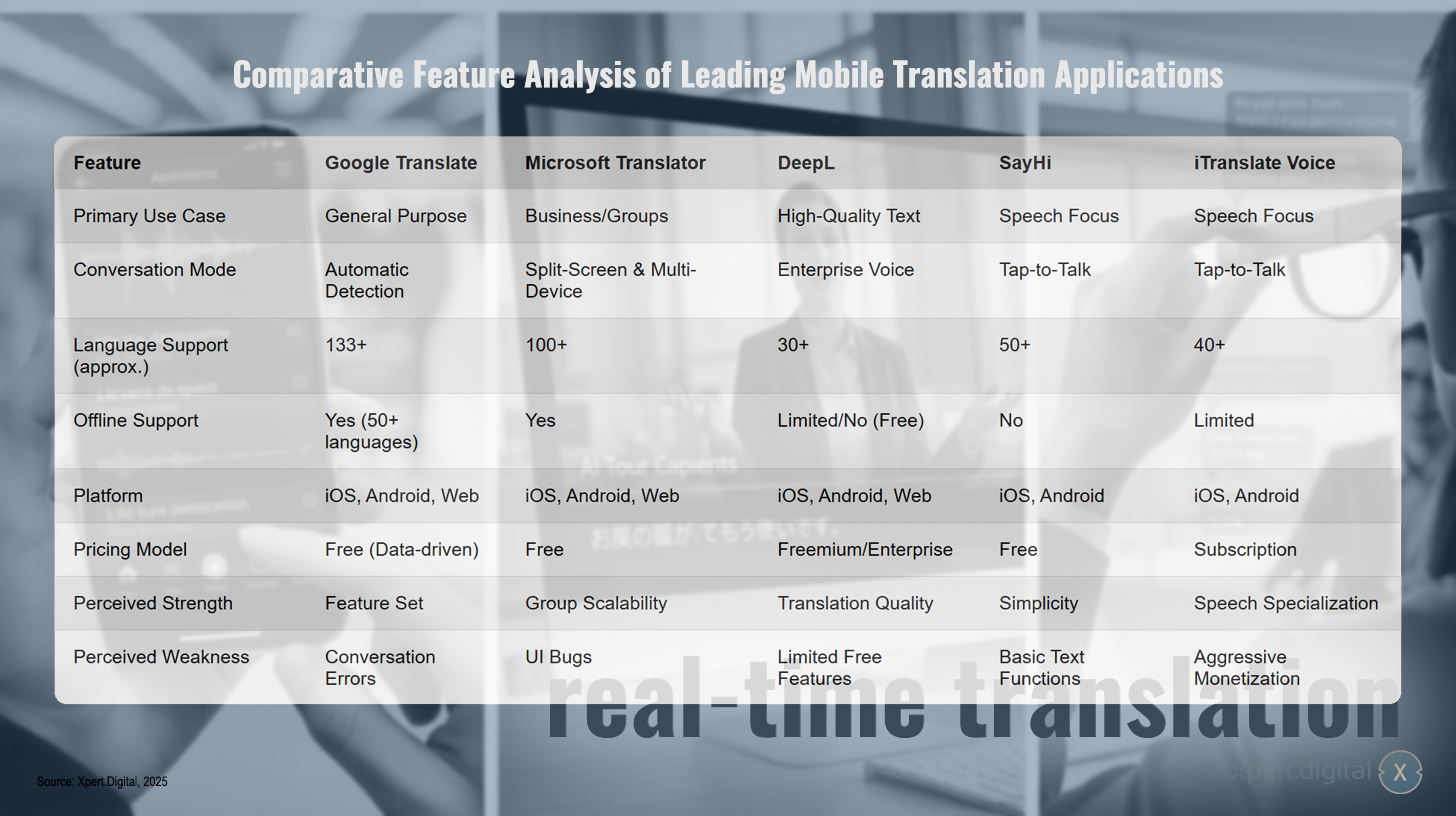
Comparative functional analysis of the market leaders in mobile translation applications – Image: Xpert.Digital
A comparative functional analysis of the leading mobile translation applications reveals a diverse landscape with varying focuses and strengths. Google Translate positions itself as an all-purpose solution with a comprehensive feature set and automatic speech recognition, while Microsoft Translator concentrates on business and group applications. DeepL stands for high-quality text translations, while SayHi and iTranslate Voice excel in their voice capabilities.
Language support varies considerably, ranging from 30 to 133 languages, with offline availability differing depending on the provider. All services are available on common platforms such as iOS and Android, with web access. Pricing models range from free to freemium and subscription options.
Each application has its perceived strengths and weaknesses: Google Translate impresses with its range of functions, Microsoft with its group scalability, DeepL with its translation quality, SayHi with its simplicity, and iTranslate Voice with its specialization in language. Challenges include conversation errors, UI bugs, or limited free features.
Business models and pricing structures
Pricing strategies in the mobile translator app market reflect the different target groups and value propositions.
- Free (ad- or data-driven): Google Translate and SayHi (after its acquisition by Amazon) fall into this category. Monetization is indirect, using user-generated data to improve AI models and other services. For companies handling sensitive information, this model poses a potential data privacy risk.
- Freemium/Subscription: DeepL and iTranslate follow this model. They offer a free basic version with functional or usage-based limitations to encourage users to upgrade to paid plans. These premium plans offer expanded features, higher usage limits, and, crucially for businesses, improved data security guarantees, such as assurances that texts are deleted after translation.
This distinction highlights a critical trade-off for business users: Free services offer broad accessibility but can pose data privacy risks, while premium services offer enterprise-grade security at a corresponding price.
Our recommendation: 🌍 Limitless reach 🔗 Connected 🌐 Multilingual 💪 Sales power: 💡 Authentic with strategy 🚀 Innovation meets 🧠 Intuition


From local to global: SMEs conquer the world market with a clever strategy - Image: Xpert.Digital
In an era where a company's digital presence determines its success, the challenge lies in creating an authentic, personalized, and far-reaching presence. Xpert.Digital offers an innovative solution that positions itself as the intersection of an industry hub, a blog, and a brand ambassador. It combines the advantages of communication and sales channels in a single platform and enables publication in 18 different languages. Cooperation with partner portals and the ability to publish articles on Google News and a press distribution list with approximately 8,000 journalists and readers maximize the reach and visibility of the content. This represents a crucial factor in external sales and marketing (SMarketing).
More information here:
Overcoming language barriers: Revolutionary translation technologies for global teams
Category analysis: Video conferencing platforms
The integration of translation and interpreting services into video conferencing platforms has fundamentally changed the way global teams collaborate. These tools have become an integral part of modern business communication. However, it is crucial to distinguish between the two main approaches offered by these platforms: AI-powered automatic translation and professional human interpreting.
Related to this:

Differentiation between translation and interpreting
The solutions available on the market can be divided into two clearly separate categories, which have different use cases, quality levels and cost structures.
AI-powered live subtitles (translation)
This feature uses machine translation technology to generate real-time translated subtitles for spoken audio. Its main purpose is to improve accessibility and comprehension in multilingual meetings.
- Microsoft Teams offers "Live Translated Subtitles" as part of its Teams Premium subscription, utilizing its proprietary Microsoft Translator technology. The platform supports a wide range of spoken languages and can translate them into a select number of subtitle languages. Furthermore, Teams is developing an "Interpreter" feature that uses AI for direct speech-to-speech translation and even attempts to simulate the speaker's voice.
- Google Meet: Provides "Translated captions" in certain Google Workspace editions (e.g., Business Plus, Enterprise Standard). This feature leverages Google's powerful translation engine and is increasingly enhanced by the multimodal capabilities of Gemini AI for direct language translation.
- Zoom offers "Translated Subtitles" as a paid add-on for licensed accounts. The meeting host can specify in advance which language pairs should be available for translation during the meeting, which requires some administrative preparation.
Live interpreting provided by humans
This feature is a professional service that allows a human interpreter to participate in a call and transmit their translation on a separate audio channel. Participants can then choose whether to hear the original audio or the interpreter's channel.
- Zoom: Is the clear market leader in this segment and offers a dedicated "interpreting" function. The host can assign participants as interpreters for specific language channels (e.g., English to German) in advance. This function is designed for formal, highly critical occasions such as international conferences, diplomatic meetings, or legal negotiations, where the highest precision and the capture of nuances are essential.
- Skype: With Skype Translator, an early pioneer in speech-to-speech translation powered by Microsoft Translator, the platform supports several major languages for voice calls. However, through its integration into the broader Microsoft Teams ecosystem, Skype has lost significance as a standalone competitor in the enterprise sector.
The evolution of the videoconferencing market doesn't point to a single, unified translation solution. Instead, a two-tiered market structure is solidifying, mirroring the traditional translation industry: "Machine translation" for everyday use and "professional human interpreting" for high-value, critical tasks. Platforms like Teams and Meet are integrating AI-powered translated captions as a scalable, cost-effective solution to address the growing need for multilingual support in day-to-day business operations. This is the "good enough" solution for the majority of use cases where perfect nuance isn't critical. At the same time, these platforms recognize the limitations and potential liability risks associated with relying solely on AI in highly critical communication situations. Zoom's robust, human-centric interpreting feature specifically targets this high-end market. Rather than attempting to replace human interpreters with AI, Zoom provides them with a digital platform, acknowledging that professional judgment remains indispensable in critical scenarios. The market is therefore not evolving towards a single AI solution, but rather a clear stratification. AI subtitles are becoming a standard feature included in enterprise licenses, while platforms that enable professional human interpreting are conquering the premium segment with high margins.
Platform-specific skills and requirements
The use of these advanced communication functions is subject to specific commercial and technical requirements, which are crucial for strategic evaluation.
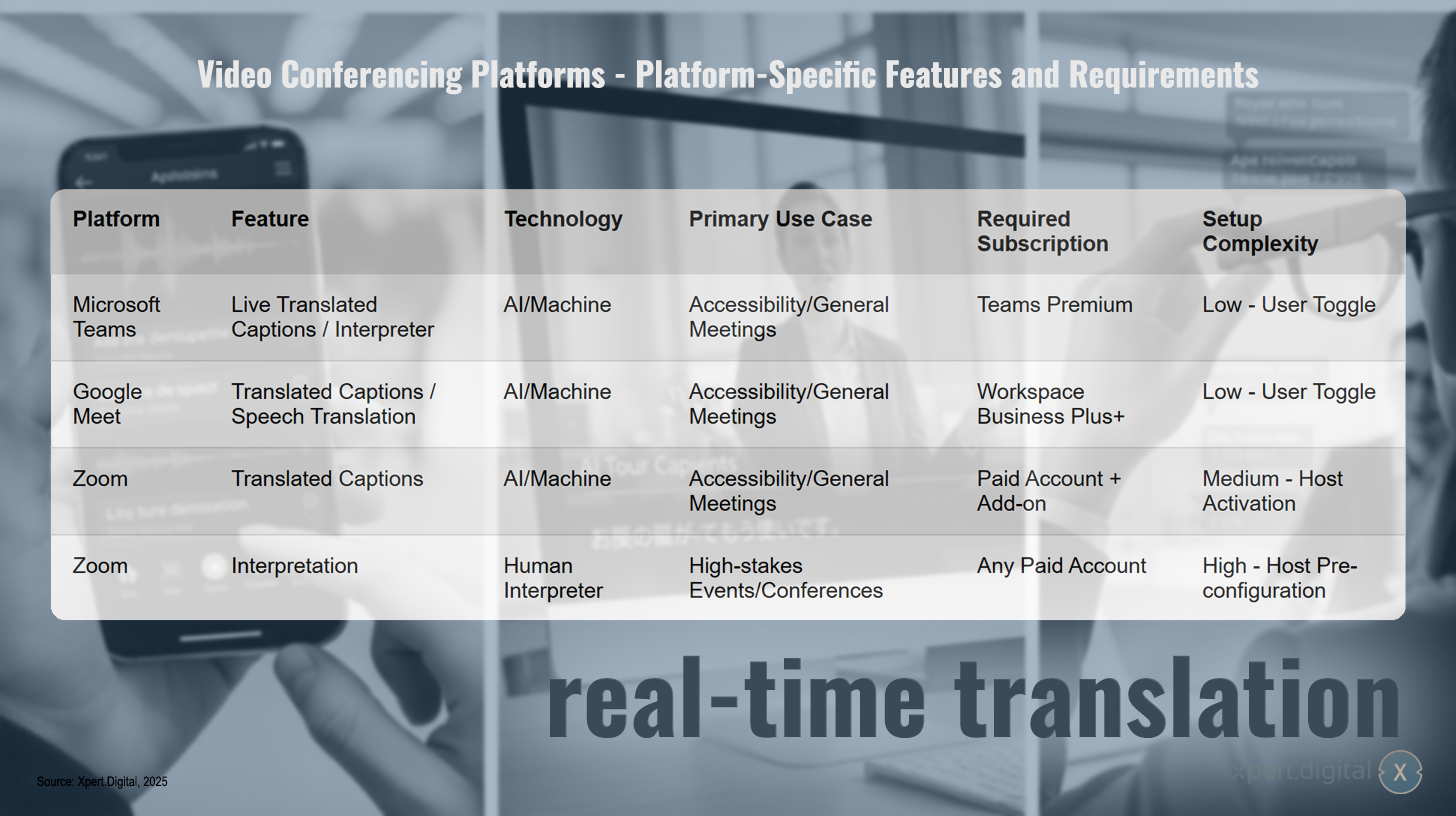
Video conferencing platforms – platform-specific capabilities and requirements – Image: Xpert.Digital
In today's digital communication landscape, video conferencing platforms play a crucial role in overcoming language barriers. Various providers, such as Microsoft Teams, Google Meet, and Zoom, have developed innovative solutions for translation and interpreting services.
Microsoft Teams and Google Meet both offer AI-powered live translation features that primarily improve accessibility and general meetings. These services require a premium subscription and can be easily switched between by users.
Zoom differentiates itself through two distinct approaches: Firstly, the platform offers AI-generated translated subtitles, which also aim for accessibility and general meetings. For highly critical events and conferences, Zoom additionally relies on human interpreters, which requires more complex setup and pre-configuration by the host.
The technologies vary between machine translation (AI) and human interpreting, with the choice depending on the type of event and requirements.
Licensing and costs
A key finding of the analysis is that these advanced features are almost without exception tied to premium enterprise licenses or special add-ons. Zoom's translated subtitles, for example, require a paid account plus an add-on, while Google Meet's features require specific Workspace editions. This clearly positions real-time translation as a value-added service rather than a standard feature.
Setup and administration
The process for activating these features differs significantly. AI-powered captions are often a simple user-level setting that can be enabled during a meeting. In contrast, Zoom's interpreter feature requires careful planning and pre-configuration by the host, including inviting and assigning interpreters before the meeting, resulting in a considerably more complex workflow.
Suitability for use cases
The choice between AI subtitles and human interpretation depends directly on the nature and criticality of the communication.
- AI subtitles: These are ideal for internal team meetings, training sessions, and webinars to improve accessibility for non-native speakers or people with hearing impairments. They enhance understanding but, due to potential inaccuracies, are not reliable enough for legally binding negotiations or sensitive customer conversations.
- Human interpreting (Zoom): This is the gold standard for board meetings, international sales negotiations, court proceedings, and large public events. In these scenarios, where nuance, cultural context, and 100% accuracy are non-negotiable, human expertise remains irreplaceable.
Category Analysis: Smart Glasses
Smart glasses represent the newest and most promising category in the field of real-time translation. They promise a revolutionary user experience, enabling hands-free communication seamlessly integrated into natural interaction. However, the market is still in an early stage of development and characterized by significant technological hurdles that currently prevent widespread adoption.
Related to this:

Premium consumer devices
Leading technology companies are positioning smart glasses as stylish lifestyle accessories, with the translation function serving as one of several AI-powered capabilities.
Ray-Ban Meta Smart Glasses
This collaboration between Meta and EssilorLuxottica aims to establish smart glasses in the mainstream.
Functionality: The translation is delivered exclusively as audio output via open-ear speakers integrated into the temples of the glasses. The wearer hears the translation of what the other person is saying. The other person can then view a text transcript of the wearer's response on their smartphone using the Meta View app. The function is powered by Meta AI and must be activated via voice command ("Hey Meta, start live translation").
Performance: Language support is currently very limited, initially including only English, Spanish, Italian, and French. Language packs can be downloaded for offline use, which is advantageous for travel. However, the crucial limitation is battery life. While the glasses offer a general usage time of up to four hours with mixed use, actively using computationally intensive features such as live translation or video streaming can completely drain the battery in 30 to 60 minutes.
Solos AirGo 3
This product focuses on integrating AI assistants and practical everyday functions into a glasses-like form factor.
Functionality: The glasses feature a "SolosTranslate" function for real-time speech translation. Additionally, ChatGPT is integrated to enable a conversational AI experience. Similar to the Meta glasses, the output is audio-based.
Performance: Reviews are mixed. While the concept is praised, the execution is criticized. The controls are described as unintuitive, the sound quality as poor (especially with AI features enabled), and some features require an additional subscription. Battery life is stated as 7-10 hours for music playback, but is likely to be significantly less with intensive AI use.
XREAL Air Series (Air 2, Air 2 Pro)
The XREAL glasses differ fundamentally from the audio-based models, as they are true augmented reality (AR) devices with a visual display.
Functionality: The glasses themselves have no integrated processing or translation capabilities. They function solely as a portable screen for a connected device, such as a smartphone or the XREAL Beam Pro unit. The translation is performed by a third-party app on the host device (e.g., "Glasses interpreter for XREAL" or Google's "Live Transcribe"), whose text output is then projected into the wearer's field of vision.
Performance: This approach enables a "real-world subtitles" experience. However, performance is entirely dependent on the processing power of the connected smartphone and the quality of the specific app. The user experience can be choppy and requires a constant wired connection to the host device, limiting mobility.
Related to this:

The budget and niche market
Besides the well-known brands, there is a growing market for cost-effective and specialized smart glasses.
- Low-cost alternatives: Platforms like AliExpress and Amazon Marketplace offer a wide variety of "AI smart glasses" priced between €30 and €100. These devices often promise an impressive range of features (support for over 100 languages, AI, camera), but typically rely on generic, unreliable companion apps. Their quality, durability, and especially data security are highly questionable. Some vendors explicitly state that features like offline translation become chargeable after a free initial trial period.
- Emerging Innovators: Brilliant Labs Frame/Halo: This project takes a different approach, targeting developers and "hackers" with an open-source platform. The glasses connect to various AI services (OpenAI, Whisper) and project information onto a monocular display. While not a mass-market product, it signals a trend toward more customizable and developer-friendly hardware. Priced at approximately $349, it falls into the premium segment, and access to its core AI features requires the purchase of credits.
Critical limitations and user experience
Despite its technological potential, the entire category of smart glasses struggles with fundamental challenges that severely limit its practical applicability.
- The battery barrier: This is the biggest and most crucial obstacle. Active use of AI, camera, and real-time translation consumes a huge amount of energy and often drains the battery in less than an hour. This makes the glasses unusable for longer conversations or all-day use.
- The smartphone tether: Most smart glasses are not standalone devices. They are peripherals that outsource processing power, connectivity, and app functionality to a paired smartphone. This dependency undermines the promise of a truly "hands-free" experience.
- Social acceptance and form factor: Although the design is becoming increasingly discreet (e.g. Ray-Ban Meta), wearing recognizable technology on the face is still stigmatized in many social and professional contexts.
Analysis of the smart glasses market reveals that what's currently being sold isn't a standalone translation solution, but rather a new interface for smartphone-based AI. The translation function serves as a "killer app" demonstration for this new interface, but the underlying hardware isn't yet capable of supporting it as a primary, standalone application. The core processing and AI models reside not on the glasses themselves, but on the connected smartphone and its cloud services. The hardware, particularly battery technology, lags years behind the software. Therefore, the further development of translation functionality in smart glasses depends entirely on breakthroughs in two separate areas: miniaturized, energy-efficient processors and significantly higher battery energy density. Until these challenges are overcome, translation will remain a novelty for short, specific interactions and not a robust communication tool.
Smart Glasses Comparison: A Comprehensive Overview of Current Technologies
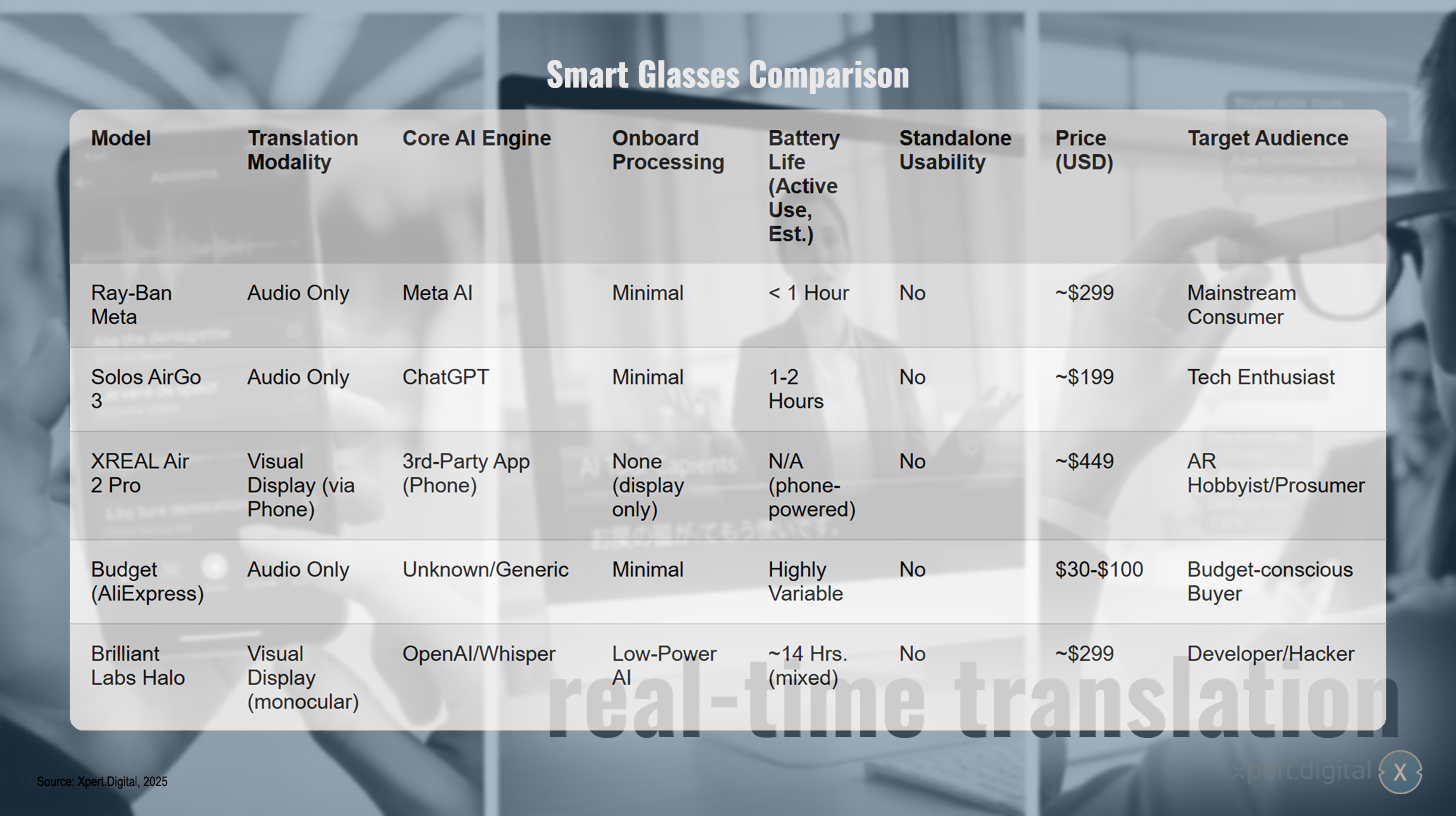
Smart Glasses Comparison: A comprehensive overview of current technologies – Image: Xpert.Digital
The smart glasses market is developing rapidly, offering various models for different user groups. The Ray-Ban Meta is aimed at mainstream consumers and costs around $299, but only offers audio functions with minimal onboard processing and a battery life of less than an hour.
For tech enthusiasts, there's the Solos AirGo 3, which uses ChatGPT and offers a slightly longer battery life of 1-2 hours. It's priced at around $199. AR hobbyists and prosumers might be interested in the XREAL Air 2 Pro, which provides a visual display over the phone and costs approximately $449.
Price-conscious buyers can find models with basic features on platforms like AliExpress, priced between $30 and $100. One particularly interesting model is the Brilliant Labs Halo, aimed at developers and hackers. It features a monocular display, utilizes OpenAI/Whisper technology, and offers a remarkable battery life of approximately 14 hours.
Despite the variety, all models have in common that they are not yet fully usable independently and mostly represent a supplement to smartphones.
Our recommendation: 🌍 Limitless reach 🔗 Connected 🌐 Multilingual 💪 Sales power: 💡 Authentic with strategy 🚀 Innovation meets 🧠 Intuition
From local to global: SMEs conquer the world market with a clever strategy - Image: Xpert.Digital
In an era where a company's digital presence determines its success, the challenge lies in creating an authentic, personalized, and far-reaching presence. Xpert.Digital offers an innovative solution that positions itself as the intersection of an industry hub, a blog, and a brand ambassador. It combines the advantages of communication and sales channels in a single platform and enables publication in 18 different languages. Cooperation with partner portals and the ability to publish articles on Google News and a press distribution list with approximately 8,000 journalists and readers maximize the reach and visibility of the content. This represents a crucial factor in external sales and marketing (SMarketing).
More information here:
Multimodal AI speech technology: The future of global communication without borders – When technology truly understands languages
Strategic comparison and market synthesis
Following the detailed analysis of the three individual technology categories, this chapter summarizes the results into a comprehensive market overview. The aim is to provide direct, actionable comparisons that support strategic decisions.
Cross-category skills matrix
The following matrix visualizes the strengths and weaknesses of each technology category with regard to key operational requirements. It highlights the inherent trade-offs that must be made when choosing a solution.
The matrix clearly shows that the market is not converging on a single, superior solution. Instead, specialization is taking place, with each category occupying its own niche defined by the context of communication (e.g., structured vs. spontaneous, individual vs. group, mobile vs. stationary). A tool that works brilliantly in one scenario (e.g., Zoom for a formal webinar) is completely unsuitable for another (e.g., directions in a foreign country). Technological and form-factor-based limitations, such as battery life for glasses or cumbersome user interfaces for phones, are not easily overcome and force product development to focus on optimizing for specific contexts. It follows that a company's translation strategy should not be about selecting a single "winning product." Rather, it should aim to provide employees with a toolkit and train them on which tool is best suited to which context. The "perfect translator" is therefore not a single device, but an ecosystem of tools.
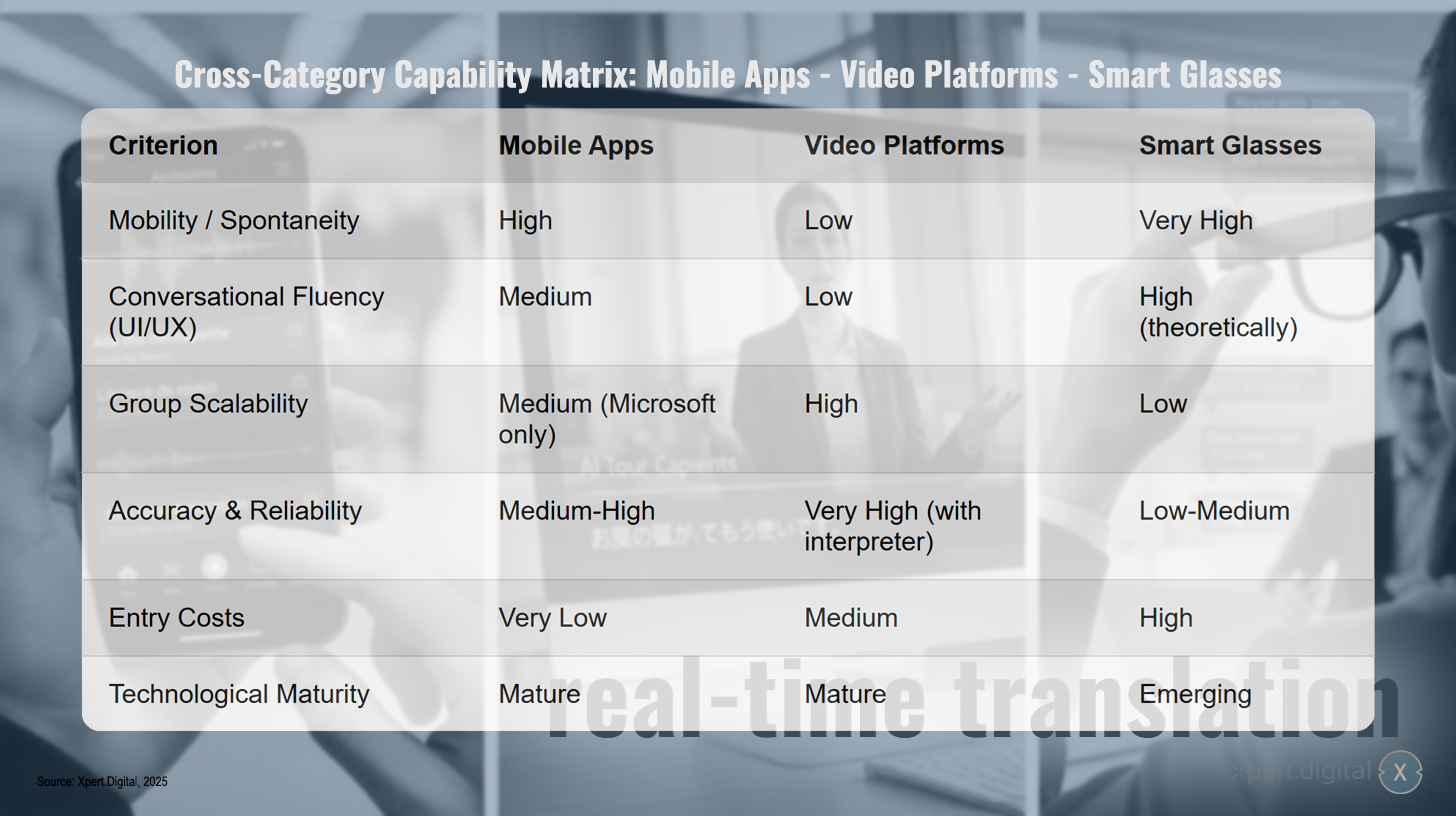
Cross-category capability matrix: Mobile apps – Video platforms – Smart glasses – Image: Xpert.Digital
The cross-category capability matrix compares mobile apps, video platforms, and smart glasses across various performance criteria. Smart glasses score highest in mobility and spontaneity, while video platforms score lowest. Conversational fluency is theoretically best with smart glasses, whereas video platforms show weaknesses in this area. Group scalability is strongest with video platforms, while smart glasses exhibit limitations. Video platforms excel in accuracy and reliability, particularly with interpreter support. Entry costs vary significantly: mobile apps are very inexpensive, while smart glasses require the highest investment. Technologically, mobile apps and video platforms are already mature, while smart glasses are still considered an emerging technology.
The right tool for the task: A scenario-based analysis
To illustrate the practical implications of the matrix above, three typical user scenarios are analyzed below and corresponding solution recommendations are derived.
Scenario 1: The international business traveler
An employee is traveling to a client abroad and needs a tool for spontaneous, informal conversations, such as directions to the hotel, ordering in a restaurant, or a short conversation with a taxi driver.
Recommendation: The most practical and reliable solution is a combination of leading mobile apps. Google Translate is indispensable due to its comprehensive language support and useful camera translation feature for menus and signs. For simple, voice-based dialogues, SayHi can be a good complement thanks to its straightforward tap-to-talk interface. Crucially, for this scenario, it's essential to download the relevant language packs beforehand to ensure offline functionality and avoid roaming charges.
Scenario 2: The global remote team
A multinational company is conducting a formal quarterly business presentation with key stakeholders from Germany, Japan, and the USA. The accuracy of the communication is business-critical.
Recommendation: For the main presentation, Zoom with its human interpreting feature is the only appropriate choice. Only a professional interpreter can guarantee the accuracy and nuance required for such an event. For subsequent, less formal internal debriefing sessions, using Microsoft Teams or Google Meet with AI-powered translated subtitles would be a cost-effective and sufficient solution to promote general understanding.
Scenario 3: The field service technician
A technician is performing a complex repair on a machine on site and must work hands-free. At the same time, he must communicate with local staff who speak a different language to receive instructions or report the status.
Recommendation: This is the ideal theoretical use case for smart glasses, as they enable hands-free operation. However, due to current, significant limitations in battery life, widespread deployment is not advisable. A pilot program with a device like the Ray-Ban Meta could be initiated to test feasibility for very short interactions. A more reliable, albeit less elegant, current solution would be the use of a rugged tablet with the Microsoft Translator app in split-screen mode, placed on a nearby surface.
Cross-cutting challenges and market barriers
Beyond the specific limitations of each category, there are systemic challenges that affect the entire industry and will define the next stage of development in real-time translation technology.
The nuance barrier: dialects, jargon, and culture
Even the most advanced AI models reach their limits when confronted with non-standard language. The training data for these models is predominantly based on standardized, often formal texts. This results in highly unreliable translations of regional dialects, colloquial slang, and idiomatic expressions. A literal translation can lead to bizarre or even offensive results, as the cultural context is lost.
A similar problem arises with industry-specific jargon. Terms from medicine, law, or engineering often have highly specific meanings that are not captured by general translation models. While some professional platforms offer the ability to create custom glossaries to ensure the correct translation of technical terms, this is not the case with most consumer-oriented tools. This "nuance barrier" significantly limits the usefulness of real-time translators in many professional contexts.
Data privacy in the age of AI conversation
Data security is one of the biggest obstacles to the widespread adoption of translation technologies in the corporate environment. When an employee conducts a potentially confidential business conversation via a translation service, the crucial question is: What happens to this data?
- Consumer-oriented services (Google, Meta): The privacy policies of these providers often state that the data entered may be collected and used to improve the services. For sensitive business information, customer data, or internal strategy discussions, this poses an unacceptable security risk. Using such services for confidential content represents a significant threat to data security.
- Business-oriented services (Microsoft, DeepL Pro): In contrast, these services often offer stronger data privacy guarantees in their paid plans. These include "no-trace" policies that ensure conversation data is not stored after translation or used to train AI models. This security guarantee is a key selling point for their business and enterprise plans.
Data protection is therefore a crucial, non-technical differentiating factor that separates free consumer tools from paid business solutions. For any professional use, the choice must fall on a service that offers explicit guarantees of data confidentiality.
AI-powered speech technology: The key to global networking – The future without language barriers
The market for real-time translation technology is undergoing rapid development, driven by advances in artificial intelligence and hardware miniaturization. The following trends will shape the landscape in the coming years and necessitate proactive strategic planning.
Emerging Trends
- On-Device AI: A crucial trend is the shift of AI processing from the cloud to the end device itself. This will bring several advantages: a significant reduction in latency, as data no longer needs to be sent to and from a server; robust offline capabilities for all functions, not just text; and a drastic improvement in data privacy, as sensitive conversation data no longer needs to leave the user's device.
- Multimodal AI Integration: The future of translation is not limited to language alone. As developments at Google Gemini and the potential of AR glasses demonstrate, future AI systems will be able to "see" what the user sees and "hear" what they hear. This multimodal understanding of the full context of a situation will lead to far more accurate and relevant translations, as AI can incorporate visual cues and the environment into its analysis.
- Seamless ecosystems: The major technology companies (Google, Microsoft, Meta, Apple) will increasingly compete to create integrated ecosystems where translation capabilities are ubiquitous and seamlessly available across all of a user's devices – from smartphones and laptops to smart glasses and cars. The competitive advantage will lie with the provider that can offer the smoothest and most context-aware experience across its entire product portfolio.
Recommendations for the technology strategist
Based on market analysis and future trends, a three-stage strategic approach is recommended to leverage the opportunities of real-time translation technology while minimizing risks.
Short term (0-12 months): Invest and deploy
In the immediate future, the focus should be on maximizing the value of existing, mature technologies.
- Conduct a review of your company's current licenses for video conferencing platforms. Determine whether premium translation features (such as live captions in Teams or Meet) can be cost-effectively activated or expanded to improve internal global collaboration.
- Develop a "best practices" guide for employees. Recommend specific mobile apps for different scenarios (e.g., Microsoft Translator for group travel, DeepL for reviewing critical document translations) and train employees on the limitations of these tools and the critical importance of data privacy when using free services.
Medium-term (12-36 months): Pilot and evaluate
This phase is about gaining experience with emerging technologies in a controlled environment in order to be prepared for the future.
- Identify one or two specific, high-value use cases within the company that would benefit from hands-free operation (e.g., in warehouse logistics, remote maintenance, or training).
- Launch a small, clearly defined pilot project with a leading smart glasses product (e.g., the next generation of Ray-Ban Meta). The goal is not widespread adoption, but rather to gather data on real-world performance, user feedback, and potential return on investment.
Long-term (3+ years): Observe and anticipate
The long-term strategy should focus on observing the technological pioneers that will enable the next generation of devices.
- Keep a close eye on advancements in battery technology and energy-efficient on-device AI processors. These two areas represent the crucial bottlenecks and, at the same time, the greatest levers for developing truly powerful and autonomous smart glasses.
- Anticipate the trend toward integrated ecosystems. Factor this into your long-term vendor planning. The vendor offering the most seamless, cross-device translation experience is likely to deliver the greatest long-term strategic value.
We are here for you - Consulting - Planning - Implementation - Project Management
☑️ SME support in strategy, consulting, planning and implementation
☑️ Creation or realignment of the AI strategy
☑️ Pioneer Business Development

Konrad Wolfenstein
I would be happy to serve as your personal advisor.
You can contact me by filling out the contact form below or simply call me on +49 7348 4088 965 .
I'm looking forward to our joint project.
Write to me


Xpert.Digital - Konrad Wolfenstein
Xpert.Digital is a hub for industry focusing on digitalization, mechanical engineering, logistics/intralogistics and photovoltaics.
With our 360° Business Development solution, we support renowned companies from new business to after-sales.
Market intelligence, smarketing, marketing automation, content development, PR, mail campaigns, personalized social media and lead nurturing are part of our digital tools.
You can find more information at: www.xpert.digital - www.xpert.solar - www.xpert.plus
Keep in touch