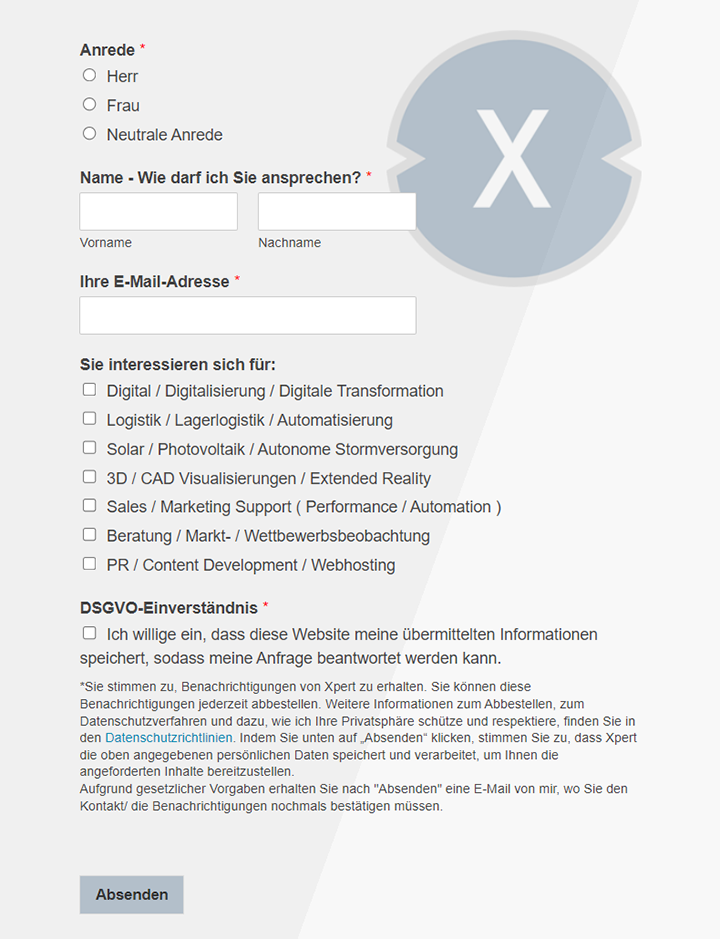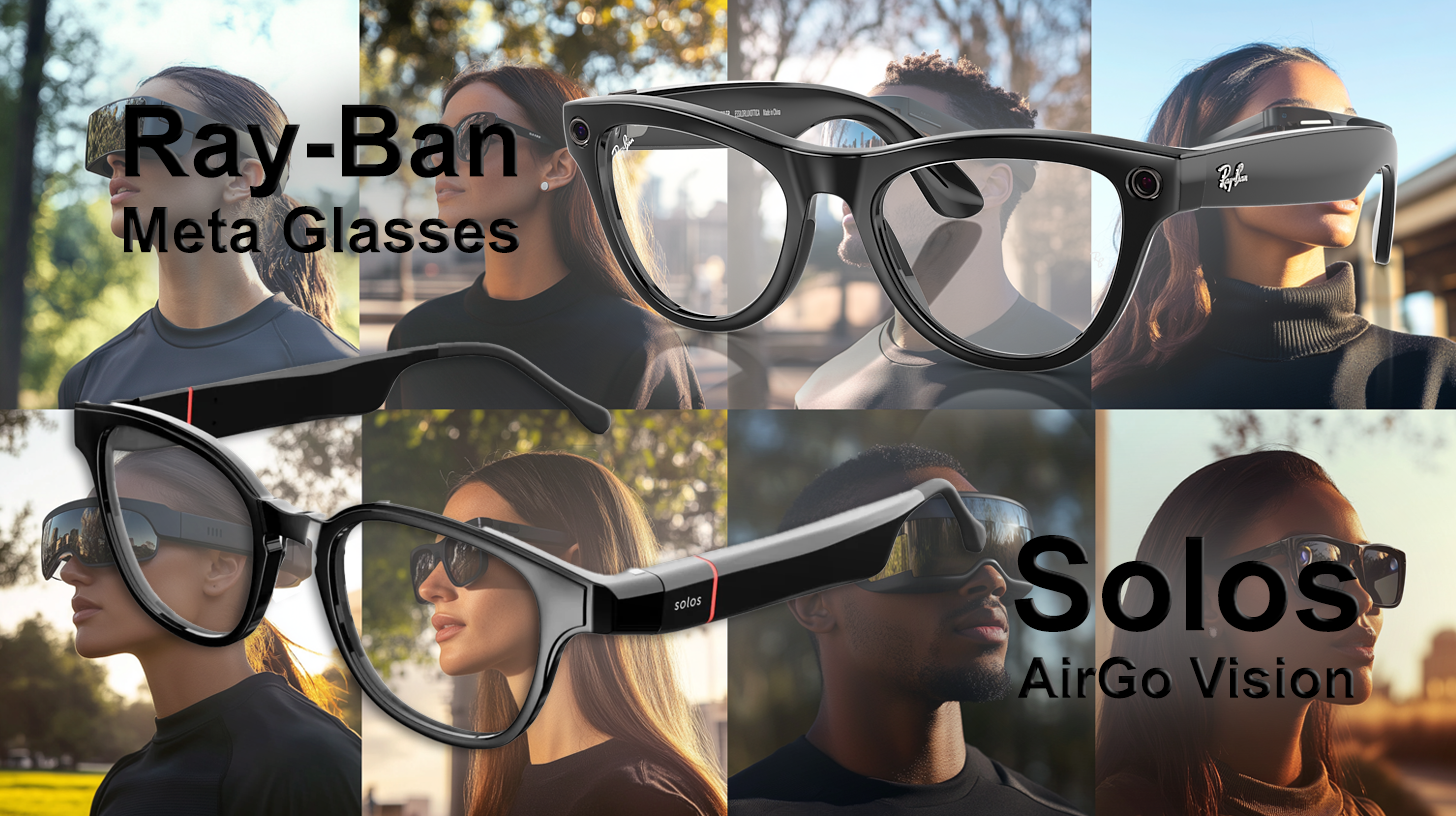
True smart glasses without Augmented & Mixed Reality XR functionality – Ray-Ban Meta Glasses and Solos AirGo V (Vision) – Image: Xpert.Digital
Innovative smart glasses – the intelligent glasses of the future? What the AirGo V and Ray-Ban Meta Glasses can really do
The development of smart glasses that go beyond simple photo and video recording is progressing steadily. Both Solos, with its new AirGo V (Vision) smart glasses, and Ray-Ban, in collaboration with Meta, have launched products that are causing a stir in wearable technology. Although neither pair of glasses is yet a fully-fledged augmented reality (AR) or mixed reality (MR) device, they represent a significant step towards a future where we can expect much more than just audio and camera functions. This comprehensive overview highlights the key features, differences, and similarities of the AirGo V and the Ray-Ban Meta glasses, while also providing a glimpse into potential future developments.
The Solos AirGo V (Vision) and Ray-Ban Meta Glasses – these two models are currently the talk of the town. Consumers and tech enthusiasts are constantly asking themselves: What can these glasses actually do? How does the AI integration differ? And how far are both products from true augmented reality? To provide a comprehensive overview, the following section will first examine the main features and outstanding functions of both models.
1. AI integration and assistants
The integration of artificial intelligence is considered by many to be the core feature of modern smart glasses, as it enables voice control, personal assistants, and other context-sensitive functions. In the future, anyone buying glasses will want not just a fashionable accessory, but also a practical, intelligent tool for everyday life. Both Solos and Meta address this need, but they take different approaches.
AirGo V
Solos' "AirGo V (Vision)" smartglasses focus on offering the broadest possible range of AI services. With built-in ChatGPT-4.0 and additional support for several AI frameworks such as OpenAI GPT-4, Anthropic's Claude, and Google Gemini, the glasses allow users to access a specific AI assistant depending on their personal preference and use case. This open platform approach is appreciated by many tech enthusiasts because it offers greater flexibility and future-proofing.
Solos also points to an adaptive function where the glasses can automatically select the appropriate AI service if the user so desires. This type of intelligent routing is designed to ensure that the best framework is used for each task. For example, users who need quick summaries can launch the optimal assistant with a simple voice command. These options can be a significant advantage for users who already have experience with various AI assistants or who have specific preferences.
Ray-Ban Meta
In contrast, Ray-Ban, in collaboration with Meta, is pursuing a more closed solution. "Ray-Ban Meta Glasses" utilize Meta AI, which is based on the large language model LLaMA 2. The advantage here is the deep integration into the Meta ecosystem, which is particularly appealing to users who already make extensive use of Meta's services (such as Facebook, Instagram, or WhatsApp). Requests, commands, and interactions can be seamlessly linked to Meta's platforms. Those who want to be active on social networks directly through their glasses will benefit from this integration. However, there is a lack of choice: Meta AI is practically the only option when it comes to AI assistants.
The question of which AI approach is better cannot be answered definitively. Both glasses have their advantages. While the AirGo V scores points for its openness, the Ray-Ban Meta Glasses impress with a particularly seamless connection to major social media platforms.
2. Hardware and Design
Smart glasses are both technological products and fashion accessories. Those who want to wear such glasses every day pay particular attention to comfort, weight, and discretion. Nothing is more bothersome than glasses that are too heavy or whose design looks too much like a "high-tech gadget." Both Solos and Ray-Ban have done their homework here, as both models offer relatively lightweight designs and are visually based on classic eyeglass shapes.
AirGo V
According to the manufacturer, Solos' "AirGo V" weighs only 42 grams. This is a remarkable weight for smart glasses, as they integrate a camera module, battery, speakers, and microphones. To address privacy concerns, the camera module is detachable. This means users can also use the glasses without the camera, reducing concerns about being recorded unnoticed in everyday life. In addition, the glasses feature a relatively powerful battery, capable of enabling around 2,500 AI interactions or photo captures. This significantly reduces the need for frequent charging – a crucial factor for anyone planning to use a wearable device daily.
Another interesting feature is the interchangeable frame system: Those who like to wear glasses in different styles can change the frame of the AirGo V without having to modify the actual technology. As long as the frames are compatible, the technical specifications remain the same.
Ray-Ban Meta
Ray-Ban, in collaboration with Meta, has developed a product that closely resembles the iconic Wayfarer design. Weighing in at around 50 grams, it's only a few grams heavier than the classic Wayfarer models. This understated look is a major advantage for many users, as it prevents them from immediately identifying as tech enthusiasts.
The camera module is permanently installed, meaning it cannot be removed or completely deactivated. This can be an advantage or disadvantage depending on the user's needs. For example, those who frequently wear their glasses in environments where photography is undesirable will have to rely on software solutions or other methods to prevent accidental recordings. Ray-Ban emphasizes the long battery life of approximately three to four hours with intensive use; additionally, a charging case is included, providing a convenient way to recharge the glasses multiple times on the go.
3. Functions and Benefits
A key distinguishing feature between the two models lies in the specific functions that the manufacturers have integrated. These include not only camera and voice assistants, but also convenience features such as translations, fitness tracking, and music streaming.
AirGo V
The AirGo V prioritizes a broad range of applications. In addition to its versatile AI integration (ChatGPT-4.0, OpenAI GPT-4, Anthropic's Claude, and Google Gemini), the real-time translation function (SolosTranslate) is particularly noteworthy. Those who frequently encounter foreign language texts in everyday life or while traveling can receive translations directly through the glasses. The fact that SolosTranslate can access various AI models to deliver precise results proves advantageous.
Furthermore, Solos integrates fitness tracking functions. Users who want to keep an eye on their vital signs while jogging, cycling, or at the gym can do so directly via the glasses. According to the manufacturer, simple yet reliable sensors are used to record basic health and activity data. Another highlight is the long battery life, which is said to allow up to 2,500 AI interactions or photo takes per charge. Additionally, around 10 hours of music streaming or 7 hours of talk time are specified, which is quite sufficient for everyday use for many users.
Ray-Ban Meta
The Ray-Ban Meta Glasses put social media interaction in the spotlight. They advertise live streaming features for Facebook and Instagram, allowing users to share their surroundings or experiences with their community in real time. Furthermore, an integrated memory function automatically links photos with notes or voice recordings. This allows users to capture spontaneous moments without having to take out their smartphone.
Another interesting feature is the support for music services like Spotify and Amazon Music. Users can start playlists, change songs, or adjust the volume using voice commands, without having to take their phone out of their pocket. For everyday users who are frequently active in Meta's social media world, this results in a fully connected experience.
4. Price and availability
Both glasses are priced similarly. Solos offers the AirGo V for €290 or $299, with delivery expected to begin on December 23, 2024. The Ray-Ban Meta Glasses are already available and start at $299 in the US, though prices may be higher depending on the model. Users will need to weigh up whether they find the advantages of Solos' open AI platform appealing or prefer to opt for the Ray-Ban Meta directly to take advantage of its extensive Meta integration.
5. Special features in direct comparison
A direct comparison often brings to light aspects that are lost in pure manufacturer specifications.
Openness vs. Ecosystem
“AirGo V” stands for the open platform approach, while the “Ray-Ban Meta” impresses with its strong connection to the Meta universe.
Removable camera module vs. permanently installed
Those who value data privacy or discreet use will appreciate the detachable camera module of the AirGo V. The Ray-Ban Meta, on the other hand, impresses with its sleek, slim design, but this does not allow for a detachable camera.
Translation vs. Social Media
With "SolosTranslate" and its fitness features, the AirGo V positions itself as an everyday companion for travel, sports, and general productivity. The Ray-Ban Meta focuses on streaming and social media – a perfect choice for influencers and users who enjoy sharing content in real time.
Weight vs. Style
The AirGo V weighs 42 grams, while the Ray-Ban Meta weighs around 50 grams – both glasses are comparatively lightweight. The Ray-Ban design has the advantage of already being iconic for many, while Solos focuses primarily on technical refinements and an interchangeable frame system for its glasses.
6. How far are they from true AR/MR?
Although Solos and Ray-Ban emphasize their advanced features in their marketing campaigns, neither model is yet comparable to true augmented reality or mixed reality headsets. This is particularly evident in the lack of visual projection of information into the user's field of vision.
Missing displays and overlays
Neither the AirGo V nor the Ray-Ban Meta Glasses have their own display that projects digital elements into the user's field of vision. Features such as route guidance superimposed directly onto the road or interactive games in the real-world environment are therefore not possible. Those who want to experience such features currently have to wait for specialized headsets like certain XReal models or other next-generation AR glasses.
Technology and energy requirements
AR/MR glasses that project true overlays in real time require advanced sensors, powerful processors, and high-quality displays. This demands significantly more energy than the comparatively "simple" camera and audio functions of current smart glasses. The form factor also suffers with full AR glasses: space is needed for projectors, batteries, and processors. This makes the glasses heavier, larger, and more conspicuous.
Step-by-step development
"We are moving towards AR and MR in small steps," could be a conclusion. Current smart glasses serve more as a link between traditional glasses and highly advanced AR headsets. They are a practical solution for people who want more comfort features and AI interactions in a form factor that is still suitable for everyday use, but who can still do without a visual display.
It is considered almost certain that both Solos and Meta will develop further generations of these glasses in the future. These could then successively integrate more AR functions as the technology matures and lighter, more energy-efficient components become available.
7. Outlook and future opportunities
Currently, the "AirGo V" and the "Ray-Ban Meta Glasses" are not equipped with holograms or complex 3D environments, but they clearly demonstrate how wearable technology can become part of everyday life. Whether one relies on an open platform with multiple AI frameworks or tightly integrated social networks – in both cases, numerous areas of daily life can be simplified
- Navigation: Future versions could already display simple visual instructions in the field of view.
- Enhanced voice control: Both ChatGPT-4.0 and Meta AI are evolving to make conversations more natural and to better recognize contextual information.
- Health and fitness functions: The recording of vital data could be expanded, e.g. by integrating pulse sensors in the nose bridge or by evaluating eye movements for stress measurements.
- Hand and gesture control: True AR glasses often rely on gesture recognition. This technology could also become established in smart glasses one day, enabling commands without voice input.
- Adaptive displays: While suitable technologies for invisibly integrating into the frame are still lacking, prototypes already exist. An unobtrusive projector that projects information onto the inside of the lens could soon become a reality.
With each new generation of hardware, components become smaller. Microdisplays become sharper and more energy-efficient, processors more powerful, and software frameworks more intelligent. It is therefore very likely that in the coming years we will see smart glasses that come ever closer to true AR functionality.
8. We are only at the beginning
The Solos AirGo V (Vision) Smartglasses and the Ray-Ban Meta Glasses are two exciting products that demonstrate the possibilities already achievable in the field of smart glasses. Both models offer a combination of camera, audio functions, and AI support, but differ primarily in their level of integration and openness.
- AirGo V: "More open platform" could be the guiding principle here. The glasses impress with broad AI compatibility, a practical real-time translation function, fitness tracking, and the option to detach the camera module. At 42 grams, they are pleasantly lightweight, and the battery promises a surprisingly long runtime.
- Ray-Ban Meta: For those already immersed in the Meta ecosystem and looking for a simple yet elegant way to livestream on Facebook or Instagram, this might be the perfect solution. The glasses boast their familiar, stylish Wayfarer design and strong social media integration. Meta AI, based on LLaMA 2, offers a solid voice assistant solution, though without the option of choosing other AI frameworks.
Both glasses are still far from providing true AR experiences with visual overlays or 3D object recognition. However, they do create a smooth transition between traditional glasses and future mixed reality devices. Anyone who wants to benefit from AI features right now and take photos or videos directly through the glasses will enjoy both products. Whether you value more freedom in choosing your assistant or prefer seamless social connectivity is ultimately a matter of personal preference.
"We're only at the beginning," one might say when looking at the future of smart glasses and AR technologies. The industry is learning quickly; components are becoming smaller and software is getting smarter. As a result, more models moving towards true augmented reality will be coming onto the market in the near future. If glasses are already available today that seamlessly support ChatGPT-4.0 or Meta AI, it's easy to imagine how powerful future generations will be once advanced displays and tracking functions are added.
While Solo's AirGo V (Vision) and Ray-Ban Meta Glasses differ in their technical implementation and focus, both bridge the gap to a future generation of AR/MR glasses. They meet the needs of many users seeking smart features, AI integration, convenient audio capabilities, and an appealing design. Whether and when they will catch up in terms of immersive visual technology remains to be seen. Until then, users can enjoy practical solutions like real-time translation, fitness tracking, live streaming, and intuitive voice control, and follow technological progress step by step.
🎯🎯🎯 Benefit from Xpert.Digital's extensive, five-fold expertise in one comprehensive service package | BD, R&D, XR, PR & Digital Visibility Optimization


Benefit from Xpert.Digital's extensive, five-fold expertise in a comprehensive service package | R&D, XR, PR & Digital Visibility Optimization - Image: Xpert.Digital
Xpert.Digital possesses in-depth knowledge across various industries. This allows us to develop tailored strategies precisely aligned with the requirements and challenges of your specific market segment. By continuously analyzing market trends and monitoring industry developments, we can act proactively and offer innovative solutions. The combination of experience and expertise generates added value and provides our clients with a decisive competitive advantage.
More information here:
We are here for you - Consulting - Planning - Implementation - Project Management
☑️ SME support in strategy, consulting, planning and implementation
☑️ Creation or realignment of the digital strategy and digitization
☑️ Expansion and optimization of international sales processes
☑️ Global & Digital B2B trading platforms
☑️ Pioneer Business Development

Konrad Wolfenstein
I would be happy to serve as your personal advisor.
You can contact me by filling out the contact form below or simply call me on +49 7348 4088 965 .
I'm looking forward to our joint project.
Write to me


Xpert.Digital - Konrad Wolfenstein
Xpert.Digital is a hub for industry focusing on digitalization, mechanical engineering, logistics/intralogistics and photovoltaics.
With our 360° Business Development solution, we support renowned companies from new business to after-sales.
Market intelligence, smarketing, marketing automation, content development, PR, mail campaigns, personalized social media and lead nurturing are part of our digital tools.
You can find more information at: www.xpert.digital - www.xpert.solar - www.xpert.plus
Keep in touch