


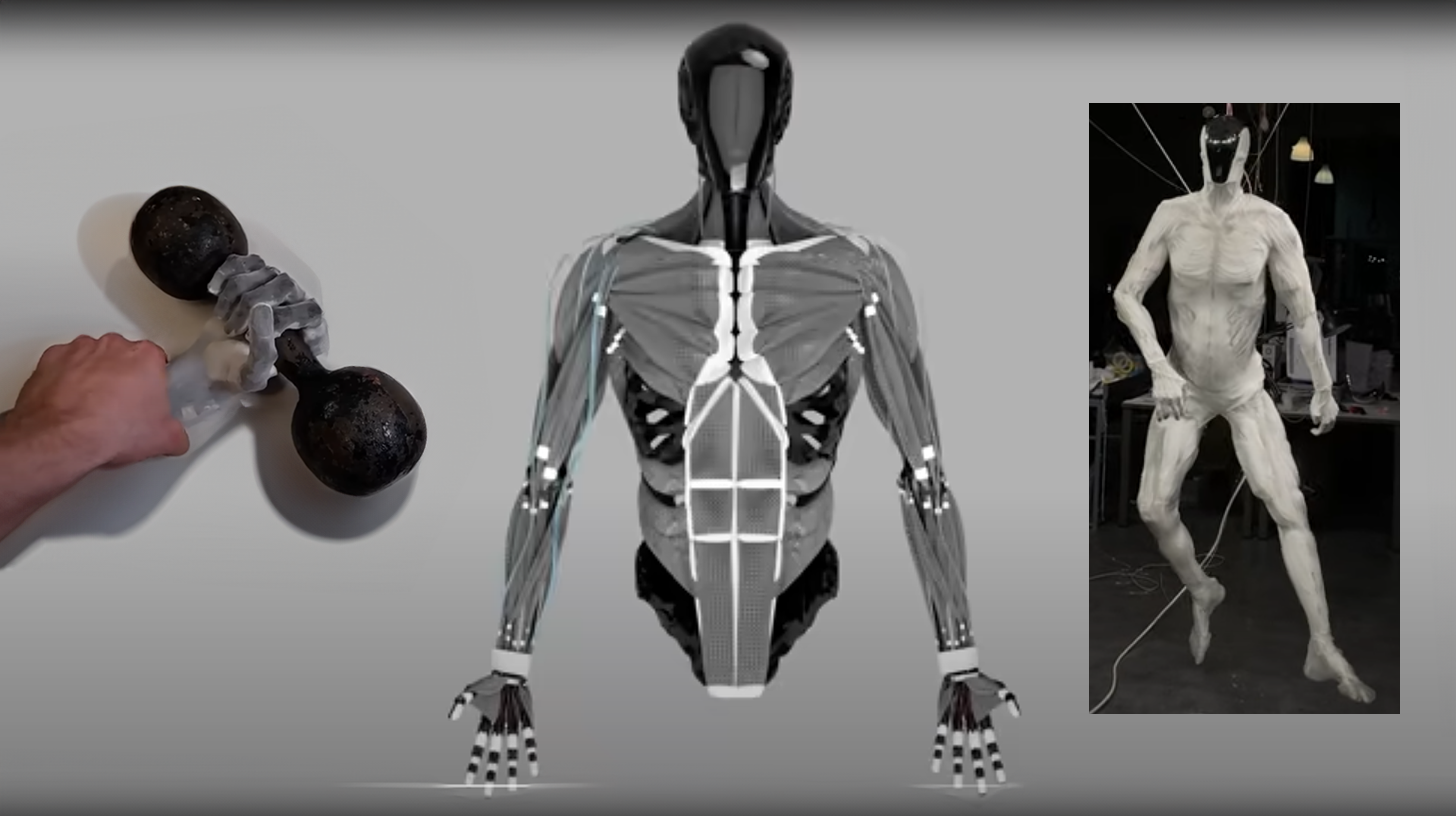
The Protoclone V1 robot from Clone Robotics overcomes the boundaries of humanoid robotics – more human than ever before – Image source: Clone Robotics / Creative image: Xpert.Digital
The future of robots is biomimetic: Protoclone V1 sets new standards
Protoclone V1: A new benchmark in humanoid robotics
In a world rapidly moving towards automation and artificial intelligence, Clone Robotics has set a remarkable milestone in robotics with the unveiling of its latest project, the Protoclone V1. This humanoid robot represents not only a technological advancement but also a fundamental reorientation in how we think about robotics and its integration into our lives. The Protoclone V1 is more than just a machine; it is a complex, biomimetic system designed to replicate human anatomy and movement with an unprecedented level of detail.
The unveiling of the Protoclone V1 marks the beginning of a new era in robotics. While traditional humanoid robots are often based on rigid, mechanical principles, Clone Robotics takes a radically different approach. The Protoclone V1 is the result of a profound understanding of human biology and the complex mechanisms that enable our movements and functions. Rather than simply replicating human *form*, Clone Robotics aims to replicate *function* – an approach that has the potential to redefine the boundaries of what is possible in robotics.
Related to this:
The concept of biomimicry (also bionics or biomimetics) in robotics
The Protoclone V1 embodies the principle of biomimicry in robotics. Biomimicry, derived from the Greek words "bios" (life) and "mimesis" (imitation), is a design approach that looks to nature to find innovative solutions to human problems. In robotics, this means drawing inspiration from biological systems to develop robots that are more efficient, adaptable, and intuitive.
The human body is a masterpiece of evolution, an incredibly complex and efficient system optimized over millions of years. Understanding and replicating it is an immense challenge, but also a way to create robots capable of performing tasks in ways that conventional robots cannot. The Protoclone V1 is a bold step in this direction, attempting to embody the subtle nuances of human anatomy and physiology in a machine.
Key features of the Protoclone V1: A look in detail
To realize the vision of biomimicry, the Protoclone V1 relies on a range of innovative technologies and design principles. These can be divided into several key areas:
1. Musculoskeletal system: The basis of human movement
The heart of the Protoclone V1 is its musculoskeletal system, which is unparalleled in its complexity and level of detail. Instead of conventional metal bones and rigid joints, Clone Robotics uses 3D-printed polymer bones modeled on human anatomy. These bones are not only lighter than metal, but also offer greater flexibility and allow for more natural movement.
Even more revolutionary is the use of over 1,000 artificial myofibril muscles. These synthetic fibers, which contract under pressure, mimic the function of human muscles at a microscopic level. Unlike conventional electric motors, which are often bulky and inefficient, these artificial muscles offer high force density while enabling smooth, fluid movements. The sheer number of these muscles—1,000 in the Protoclone V1—is impressive and underscores Clone Robotics' commitment to replicating human motor skills as accurately as possible.
With over 200 degrees of freedom, the Protoclone V1 far surpasses most conventional humanoid robots. Degrees of freedom refer to the number of independent movement possibilities a robot has. The more degrees of freedom, the more flexible and versatile the robot's movements. For comparison, a typical industrial robot arm has about 6 degrees of freedom, while highly advanced humanoid robots often have between 30 and 60 degrees of freedom. The Protoclone V1's 200 degrees of freedom open up entirely new possibilities for complex and human-like movements.
2. Drive system: Hydraulics and pneumatics in combination
To power the artificial muscles, the Protoclone V1 uses a hybrid hydraulic/pneumatic system. This system utilizes pressurized mesh tubes to supply the myofibril muscles with fluid or air, thus controlling their contraction. A 500-watt pump acts as the "artificial heart," providing the necessary high pressure to drive the entire system.
The choice of a hydraulic and pneumatic system is unusual in robotics, as most modern robots rely on electric motors. However, hydraulics and pneumatics offer crucial advantages, especially for biomimetic applications. Hydraulic systems can generate extremely high forces while enabling precise movements, while pneumatic systems are known for their fast response time and flexibility. The combination of both systems in the Protoclone V1 allows for both powerful and delicate movements, similar to those of the human musculoskeletal system.
3. Sensors and control: Real-time optimization and “sweating”
An advanced sensor system is crucial for giving the Protoclone V1 a sense of its own body and its environment. With 500 sensors distributed throughout the robot, the Protoclone V1 can measure and optimize force and position in real time. These sensors continuously provide data to the control system, which then adjusts the activation of the artificial muscles to execute the desired movement or action. This feedback system is comparable to the human proprioceptive system, which allows us to perceive our body position and movement in space without looking.
A particularly innovative feature of the Protoclone V1 is its integrated cooling system, which mimics human perspiration. Complex mechanical systems generate heat, especially during intensive use. To prevent overheating, many robots are equipped with fans or heat sinks. The Protoclone V1, however, goes a step further, utilizing a system that circulates fluid through porous materials on the robot's surface, where it evaporates, creating a cooling effect – just like human perspiration. This is not only a clever technical solution but also another example of Clone Robotics' biomimetic approach.
4. External appearance: Avoiding the “uncanny valley”
The Protoclone V1's external appearance is deliberately minimalist and functional. Instead of a detailed, human-like face, the robot features a faceless design with a black visor. This design choice is likely a response to the "uncanny valley" phenomenon. The uncanny valley describes the feeling of unease or even disgust that people can experience when humanoid robots or computer animations look very human but still exhibit subtle differences that make them seem "wrong" or "creepy." By foregoing a realistic face, Clone Robotics may be trying to avoid this effect and increase the robot's acceptance.
The rubber skin that conceals the Protoclone V1's internal mechanics also contributes to a cleaner and less "mechanical" appearance. It not only protects the sensitive internal components but also gives the robot a certain organic feel, in keeping with its biomimetic design.
Current restrictions and future developments
Despite its impressive capabilities, the Protoclone V1 is still in an early stage of development and has some limitations. However, these challenges are typical of groundbreaking technologies and offer room for future improvements and innovations.
1. Bipedal locomotion: The path to autonomous walking
Bipedal locomotion, or walking on two legs, is one of the greatest challenges in humanoid robotics. The Protoclone V1 currently requires external assistance and cannot walk autonomously. This is partly due to the complexity of human gait, which demands a precise interplay of balance, coordination, and strength. While the pneumatic actuators used in the Protoclone V1 offer advantages in terms of speed and flexibility, they can struggle with the rapid adjustments necessary for stable walking.
Clone Robotics is aware of this limitation and is actively working to overcome it. Future versions of the Protoclone could switch to hydraulic systems, which would allow for better responsiveness and more precise control. Advances in control technology and gait planning algorithms are also crucial for teaching the Protoclone V1 to walk autonomously.
2. Energy consumption: Efficiency as the key to autonomy
The Protoclone V1's high energy consumption is another challenge related to the complexity of its drive system. Hydraulic and pneumatic systems can be inefficient, especially when operating at high pressure. The high power demand limits the robot's autonomy and may necessitate an external power supply or very powerful batteries for mobile use.
Reducing energy consumption is a key development goal for Clone Robotics. This could be achieved through improvements in the efficiency of the artificial muscles, hydraulic and pneumatic components, or by using alternative energy sources. Advances in battery technology and energy management will also play a role in making the Protoclone V1 more energy-efficient and autonomous.
3. Real-time balance: The intricacies of stability
Real-time balance is closely linked to bipedal locomotion. To stand and walk stably, a robot must be able to constantly adjust its balance and react to external disturbances. As mentioned earlier, pneumatic actuators can struggle with the rapid adjustments necessary for dynamic balance. Hydraulic systems may offer advantages in this regard, as they allow for more precise and powerful control.
The development of advanced control systems and algorithms for balance control is crucial to enabling stable and safe movement for the Protoclone V1. This requires a deep understanding of human balance mechanisms and the ability to translate these into robotic systems.
Future plans and visions of Clone Robotics
Despite the current limitations, Clone Robotics has ambitious plans for the further development of the Protoclone and its integration into various application areas.
The alpha version “Clone α”: A first step towards commercialization
Clone Robotics plans to launch the alpha version of the Protoclone, dubbed "Clone α," in 2025. This limited production run of 279 units is intended to be a first step toward commercialization and will allow the robot to be tested and further developed in real-world environments. The alpha version will likely already feature improvements in bipedal locomotion, energy efficiency, and balance, even if it does not yet meet all of the company's long-term goals.
Integration of AI-supported control systems: Intelligence for the Protoclone
A key component of the Protoclone's future development is the integration of artificial intelligence (AI). AI-powered control systems can enable the robot to autonomously perform more complex tasks, adapt to changing environments, and even learn new skills. Fields such as machine learning, neural networks, and reinforcement learning could be used to improve the Protoclone's motion planning, object recognition, decision-making, and interaction with its environment.
Possible applications: Beyond the laboratory
Although the Protoclone V1 is still under development, potential areas of application are already emerging where its unique capabilities could offer added value.
domestic help
The Protoclone's humanoid form and mobility make it ideally suited for household tasks. It could be capable of performing everyday chores such as cooking, cleaning, laundry, and transporting objects. The integration of AI would allow it to navigate complex and unpredictable domestic environments and perform tasks autonomously.
Care and support
In an aging society, the need for care and support services is increasing. Humanoid robots like the Protoclone could play an important role in supporting elderly or vulnerable people in the future. They could assist with everyday tasks, provide companionship, and summon help in emergencies.
Industry and production
Humanoid robots also have applications in industry and manufacturing. The Protoclone could be capable of taking over complex assembly tasks, working in confined or hazardous environments, and relieving human workers of physically demanding or repetitive tasks.
Research and Development
The Protoclone itself is a valuable tool for research and development in robotics and related fields. It enables scientists to explore the boundaries of biomimetic robotics, develop new control techniques, and deepen their understanding of human movement and cognition.
Clone Robotics: A pioneer in biomimetic robotics
Clone Robotics distinguishes itself from other robotics companies through its consistent biomimetic approach. While many companies strive to make robots more efficient, faster, or stronger, Clone Robotics focuses on making robots more human-like, adaptable, and intuitive.
1. Biomimetic Design: Nature as a Model
The entire design of the Protoclone V1 is inspired by human anatomy and physiology. The use of polymer bones, artificial muscles, a hydraulic vascular system, and even a "sweating" mechanism demonstrates Clone Robotics' deep commitment to biomimicry. This approach goes beyond simply imitating the human form; it aims to understand the underlying principles and mechanisms of biological systems and translate them into robotic systems.
2. Artificial Muscles: Revolution in Actuators
The use of myofibril artificial muscles instead of conventional motors is a revolutionary step in robotics. These artificial muscles offer a range of advantages that make them ideal for biomimetic applications. Their fast reaction time, high efficiency, ability to move naturally, versatility, lightweight design, and integration into a holistic system make them a promising technology for the future of robotics.
3. Hydraulic system: Power and precision combined
The Protoclone's hydraulic vascular system, powered by a 500-watt pump, is another key aspect of its biomimetic design. It enables the efficient distribution of energy throughout the robot and the precise control of the artificial muscles. Hydraulic systems are known for their ability to generate high forces while allowing for sensitive movements, making them ideal for replicating human motor skills.
4. High mobility: Over 200 degrees of freedom for complex movements
The Protoclone V1's 200 degrees of freedom are a testament to Clone Robotics' commitment to creating robots with unparalleled agility. This high number of degrees of freedom enables the robot to perform complex, human-like movements that would be impossible with conventional robots. This opens up new possibilities for applications in areas that demand dexterity, flexibility, and adaptability.
5. Synthetic Organ Systems: A Look into the Future
The integration of synthetic organ systems that mimic human metabolic processes is a particularly futuristic aspect of the Protoclone V1. This suggests that Clone Robotics has long-term plans to develop robots that not only look and move like humans, but also function in a way that is, in a sense, "lifelike." This could lead to robots in the future that can operate autonomously for extended periods without constantly requiring external power or maintenance.
6. Advanced Sensor Technology: Proprioception for Robots
Equipped with 320 pressure sensors and dual cameras, Clone Robotics creates a proprioceptive feedback loop similar to the human nervous system. This advanced sensory system allows the Protoclone to perceive its own body position and movement in space, measure forces, and react to changes in its environment. This proprioceptive capability is crucial for developing robots that can move safely and efficiently in complex and unpredictable environments.
Advantages of myofibric artificial muscles in detail
The myofibric artificial muscles developed by Clone Robotics offer a variety of advantages over conventional motors in robotics:
1. Fast response time: dynamics and precision
The ability of these artificial muscles to contract by up to 30% within 50 milliseconds is impressive, enabling very fast and precise movement control. This reaction time is comparable to that of human muscles and surpasses that of many conventional electric motors. This is particularly important for applications requiring dynamic movements, rapid reactions, and fine adjustments.
2. High efficiency: Power and lightness
The force ratio of 3 grams to 1 kilogram demonstrates the high efficiency of the myofibril artificial muscles. They can generate considerable force with relatively little weight. This is a crucial advantage in robotics, where weight reduction is often a key factor for agility and energy efficiency. Lighter robots can move faster, require less energy, and are easier to handle.
3. Natural movements: Suppleness and organicity
Their biomimetic design allows artificial muscles to enable robots to perform smooth and natural movements that closely resemble those of the human body. Unlike the often jerky and mechanical movements of conventional robots, these artificial muscles can generate fluid, organic movements that appear more intuitive and less frightening to humans. This is particularly important for humanoid robots intended to work in direct interaction with people.
4. Versatility: Fine motor skills and whole-body movements
The artificial muscles are versatile and can perform both fine motor finger movements and dynamic full-body poses. This versatility opens up a wide range of applications, from precise assembly tasks in industry to complex interactions in the home or in care settings. The ability to perform both fine and gross motor movements is a crucial advantage for humanoid robots intended to operate in diverse and unpredictable environments.
5. Lightweight construction: Mobility and energy efficiency
Compared to conventional motors, the artificial muscles contribute to a significant weight reduction. This improves the robot's overall efficiency and agility. Lower weight not only means greater mobility but also reduced energy consumption, as less mass needs to be moved. This is particularly important for mobile robots that rely on battery power.
6. Integrated System: Holistic Functionality
The myofibril artificial muscles are part of a complex biomimetic system that includes a hydraulic vascular network and proprioceptive sensors. This integration enables holistic and natural-looking functionality. The various components work synergistically to give the robot human-like movement and perception capabilities. This integrated system is more than the sum of its parts and allows the Protoclone to function in ways that would be difficult to achieve with conventional robot designs.
Applications and societal impact
The technology of the Protoclone V1 and biomimetic robotics in general has the potential to transform a wide range of industries and aspects of human life. In addition to the previously mentioned applications in the home, care sector, and industry, humanoid robots like the Protoclone could also play a significant role in the following areas in the future:
Exploration and rescue
In dangerous or inaccessible environments, such as natural disasters, the deep sea, or space, humanoid robots could be deployed for exploration, search, and rescue. Their human-like form and mobility could enable them to navigate complex environments and perform tasks that would be too dangerous or impossible for humans.
Entertainment and education
Humanoid robots could be used in the entertainment industry, for example as actors, animators, or interactive characters in theme parks. In education, they could serve as interactive learning assistants or tutors, imparting knowledge to students in a personalized and engaging way.
A step towards a new robotic future
The Protoclone V1 from Clone Robotics is more than just another humanoid robot. It represents a bold step into a new era of robotics, where biomimicry and advanced technologies converge to create machines that not only perform tasks but are also capable of integrating naturally and intuitively into the human world. While the Protoclone V1 still faces challenges and is under development, it embodies a vision of robotics with the potential to fundamentally transform our lives. The question of how quickly Clone Robotics can overcome current limitations and develop a fully functional, autonomous, bipedal robot remains exciting. One thing is certain, however: the Protoclone V1 has set a new benchmark in humanoid robotics and significantly raised expectations for what will be possible in the future.
Related to this:
Your global marketing and business development partner
☑️ Our business language is English or German
☑️ NEW: Correspondence in your native language!

Konrad Wolfenstein
I and my team are happy to be available to you as your personal advisor.
You can contact me by filling out the contact form here wolfenstein@xpert.digital:or simply call me at +49 7348 4088 965. My email address is
I'm looking forward to our joint project.