How efficient are propane heat pumps compared to conventional heat pumps? – Image: Xpert.Digital
🌱🔥 Propane heat pumps: Efficiency, environmental benefits and technological comparison to conventional heat pumps
🌍✨ In times of rising energy prices and increasing environmental requirements, heat pumps are gaining importance as an alternative to fossil fuel heating systems. Propane heat pumps, which use the natural refrigerant R290, represent an advanced, efficient, and sustainable solution in many respects. The following text highlights the key advantages, efficiency indicators, technological advancements, and challenges of this technology. It also provides a detailed comparison to conventional heat pumps.
1. ⚡📊 Efficiency of propane heat pumps
The efficiency of heat pumps is indicated by the Coefficient of Performance (COP), which describes the ratio between electrical energy input and heat output. Propane heat pumps achieve impressive values in this regard. For example, a prototype from the Fraunhofer ISE achieved a COP of 4.7, meaning that 4.7 kilowatts of heat are provided with only 1 kilowatt of electrical energy. Further tests even measured values of 4.8.
Comparison to conventional heat pumps:
- Heat pumps that use synthetic refrigerants such as R32 or R410A achieve comparable COP values, but efficiency depends heavily on the design, the ambient conditions and the refrigerant used.
- The optimized design of propane heat pumps enables the same or even higher efficiency with a lower refrigerant requirement.
- Thanks to their high efficiency, propane heat pumps contribute to reducing electricity consumption and operating costs. This is particularly advantageous in regions with high energy prices.
2. 🌿🌎 Environmental friendliness: A future-proof refrigerant
A key advantage of propane heat pumps lies in their use of the natural refrigerant R290 (propane), which is characterized by a particularly low environmental impact. The most important aspects at a glance:
Low Global Warming Potential (GWP)
Propane has a global warming potential (GWP) of 3, which is almost negligible. In comparison, synthetic refrigerants such as R410A have a GWP of approximately 2088 and R32 a GWP of 675. Therefore, synthetic refrigerants contribute significantly more to the greenhouse effect.
No ozone depletion effect
Propane does not damage the ozone layer, whereas older refrigerants such as CFCs or HCFCs have significantly contributed to the depletion of the ozone layer through their release.
Reduced refrigerant requirement
Thanks to technological innovations, propane heat pumps require a significantly smaller amount of refrigerant.
- Current standard: Commercially available systems require approximately 60 grams of propane per kilowatt of heating power.
- Research projects: Through optimized technologies, the requirement has been reduced to 10–15 grams per kilowatt.
The combination of high efficiency and extremely low environmental impact makes propane heat pumps a future-proof heating technology. They already meet strict legal regulations and offer a long-term solution for the decarbonization of the heating sector.
3. 🔧🚀 Technological advances and innovations
Modern propane heat pumps are characterized by numerous technological improvements that optimize both efficiency and safety:
Optimized heat exchangers
The use of asymmetric plate heat exchangers minimizes refrigerant requirements without compromising heat transfer. This technology improves efficiency and enables more compact designs.
High flow temperatures
Another technological advancement is the ability of propane heat pumps to achieve flow temperatures of up to 75 °C. This is particularly relevant for replacing gas or oil heating systems in older buildings that require higher heating temperatures.
Conventional heat pumps usually only reach 50–60 °C, which limits their use in existing buildings.
Safety precautions
Because propane is flammable, special safety measures have been developed to minimize the risks. These include:
- Tightly closed systems to prevent leaks.
- Indoors, fill quantities are limited to a maximum of 150 grams to avoid explosion risks.
Reduced additional components
Optimizing oil and auxiliary components not only improves efficiency but also reduces maintenance requirements.
Challenges and solutions
Despite their advantages, propane heat pumps face some challenges, which are increasingly being solved through technological advancements:
Flammability of propane
Because propane is highly flammable, safety precautions are necessary. Especially indoors, the fill quantity must be limited to 150 grams. However, with proper installation and modern safety measures, this risk can be reduced to a minimum.
Cost
Propane heat pumps are currently often more expensive to purchase than conventional systems. However, the additional costs are offset by:
- Long-term energy savings through increased efficiency.
- Government funding programs that financially support the use of environmentally friendly heating technologies.
Acceptance and awareness
The advantages of propane heat pumps are not yet widely known. Increased education and advice for end users can help to spread the technology further.
💡🚨 Propane heat pumps as the heating technology of the future
Propane heat pumps offer an optimal combination of high efficiency, low environmental impact, and future-proof technology. With their ability to generate high flow temperatures, they are particularly suitable for older buildings and represent an environmentally friendly alternative to fossil fuel heating systems.
While propane's flammability initially appears to be a disadvantage, this risk is effectively minimized through technological safety precautions. The higher initial costs can be offset in the long term by energy savings and government subsidies.
In light of increasing demands for sustainability and efficiency, propane heat pumps will play a central role in the transition to environmentally friendly heating systems. They meet the criteria of modern heating technology and make a significant contribution to reducing CO₂ emissions – a crucial step towards climate neutrality.
📣 Similar topics
- 📣 Efficient and sustainable heating solutions: Propane heat pumps in focus
- 🌱 Why propane heat pumps are more environmentally friendly than conventional systems
- 🔧 Technological innovations: How propane heat pumps enhance your home
- 💡 Propane as the refrigerant of the future: Environmental and cost advantages compared
- 🌍 Reduce your CO₂ footprint with propane heat pumps
- 🏡 Heating old buildings sustainably: High flow temperatures with modern heat pumps
- 💰 Efficient and cost-saving: How propane heat pumps reduce your energy costs
- ⚡ Propane heat pumps vs. conventional systems: Which one is better for you?
- 🔥 Safety aspects of propane as a refrigerant: Myths and facts
- 🚀 The future of heating technology: Why propane heat pumps are the new must-have
#️⃣ Hashtags: #PropaneHeatPumps #Efficiency #Sustainability #RefrigerantR290 #ClimateNeutralHeating
Our recommendation: 🌍 Limitless reach 🔗 Connected 🌐 Multilingual 💪 Sales power: 💡 Authentic with strategy 🚀 Innovation meets 🧠 Intuition


From local to global: SMEs conquer the world market with a clever strategy - Image: Xpert.Digital
In an era where a company's digital presence determines its success, the challenge lies in creating an authentic, personalized, and far-reaching presence. Xpert.Digital offers an innovative solution that positions itself as the intersection of an industry hub, a blog, and a brand ambassador. It combines the advantages of communication and sales channels in a single platform and enables publication in 18 different languages. Cooperation with partner portals and the ability to publish articles on Google News and a press distribution list with approximately 8,000 journalists and readers maximize the reach and visibility of the content. This represents a crucial factor in external sales and marketing (SMarketing).
More information here:
💶🏡 Heating with propane: How environmentally friendly heat pumps are also economically convincing
⚡🌍 Efficient, sustainable, innovative: Why propane heat pumps are the future of heating technology
Propane heat pumps are widely regarded as a promising alternative to conventional heat pumps using synthetic refrigerants. They are characterized by high efficiency, a particularly environmentally friendly footprint, and technological features that make them suitable for use in various building types. Given the increasing demands on the climate compatibility of heating systems and ever stricter regulations for conventional refrigerants, the use of natural substances like propane (also known as R290) is gaining increasing attention. The following section will therefore provide a comprehensive explanation of how efficient propane heat pumps are compared to conventional heat pumps, what advantages they offer, what technological advancements characterize their development, and also what challenges they face. In addition, aspects such as long-term economic viability, integration into existing buildings, safety requirements, and potential future market trends will be examined in more detail.
🌬️💡 Features and efficiency of propane heat pumps
Propane is a naturally occurring gas that, as a refrigerant, exhibits a number of positive properties. One of the most important indicators for assessing the performance of a heat pump is the so-called COP (Coefficient of Performance), which indicates how much heat can be generated relative to the electricity input. Propane heat pumps can achieve impressive results in this regard. For example, performance figures observed in development projects and field tests indicate that for every kilowatt-hour of electricity used, more than four times the amount of heat can be produced. This puts them not only on par with many conventional heat pumps, but in some cases even surpasses their efficiency. This is particularly significant because, in addition to environmental friendliness, the long-term operating cost balance plays a crucial role for builders, homeowners, and businesses.
🔬⚙️ Technological progress and environmental benefits
The high efficiency of propane heat pumps results from several factors. Firstly, the chemical and thermodynamic properties of propane enable efficient heat transfer, which, in combination with optimized components, leads to very energy-efficient operation. Secondly, the technology has advanced significantly in recent years: Improved compressors, newly designed and flow-optimized heat exchangers, and the reduction of oil and auxiliary component quantities make it possible to significantly lower refrigerant requirements without compromising performance.
What makes propane particularly attractive, however, is its exceptionally low GWP (Global Warming Potential). With a GWP of only about 3, propane's impact on the greenhouse effect is practically negligible. This stands in stark contrast to many synthetic refrigerants, whose GWP values are often well over 500. Here, the ecological advantage is clear: Should a refrigerant leak occur, the environmental impact of propane is extremely low compared to synthetic alternatives. Furthermore, propane is neither ozone-depleting nor harmful to the climate in the long term.
🏠🔧 Practical Applications and Challenges
Another major advantage of propane heat pumps is their ability to deliver high flow temperatures. While many conventional heat pumps using synthetic refrigerants are often limited to flow temperatures of around 55 to 60 °C in practice, modern propane systems can reach temperatures of up to 75 °C. This is particularly important for the renovation of older buildings, which often still have old radiators or heating systems that require higher flow temperatures.
Despite all these advantages, the challenges should not be overlooked. A key issue is safety. Propane is a flammable gas, which means that special precautions must be taken when using it in enclosed spaces. Safety standards and technical norms therefore regulate the maximum permissible fill level of propane in indoor heat pump systems to virtually eliminate the risk of fires or explosions.
💰📉 Profitability and prospects
From an economic perspective, propane heat pumps are currently often more expensive than conventional systems. This is primarily because it is a relatively new technology whose market penetration is still in its early stages. However, subsidy programs and government incentives can help reduce the initial purchase costs. Furthermore, it should be considered that the high efficiency and low maintenance requirements have a positive impact on long-term operating costs.
Since propane is a natural refrigerant, its use requires a well-thought-out system design. Manufacturers are continuously working to improve the design to simplify service and maintenance. Less refrigerant in the system also means that potential leaks are easier to identify and repair. As technicians and specialist companies gain experience, this issue will become even less significant.
🌎💡 Future prospects for propane heat pumps
It is foreseeable that political and regulatory pressure on climate-damaging refrigerants will continue to increase in the coming years. Requirements already exist that restrict or increase the cost of using certain synthetic substances. This trend is expected to continue.
Looking ahead to the coming years, propane heat pumps are expected to further expand their market share. Improved production processes, increasing production volumes, and growing awareness among end users and specialist companies are likely to increase their share of the heating market. Anyone planning a comprehensive building renovation can consider propane heat pumps as part of a holistic energy concept.
Propane heat pumps are superior to conventional heat pumps in many ways. They offer a balanced combination of efficiency, environmental friendliness, durability, and adaptability, making them superior to conventional heat pumps in many respects. This makes them an important component in shaping a climate-friendly and resource-conserving energy future. 🌱
📣 Similar topics
- 📣 Propane heat pumps: The future of climate-friendly heating systems
- 🔋 Efficiency comparison: Propane heat pumps vs. conventional systems
- 🌿 Sustainability redefined: Propane as a natural refrigerant
- 🔧 Technological advances in propane heat pumps explained
- 💡 High flow temperatures: Ideal for renovations of old buildings
- 🔥 Safety of propane heat pumps: Risks and solutions
- 💰 Focus on the cost-effectiveness of propane heat pumps
- 🏡 Propane heat pumps: Suitable for new and existing buildings
- 🌍 GWP comparison: Why propane is overtaking conventional refrigerants
- ♻️ Future trends: Propane heat pumps and sustainable building technology
#️⃣ Hashtags: #PropaneHeatPumps #ClimateFriendly #EnergyEfficiency #Sustainability #HeatingSystems
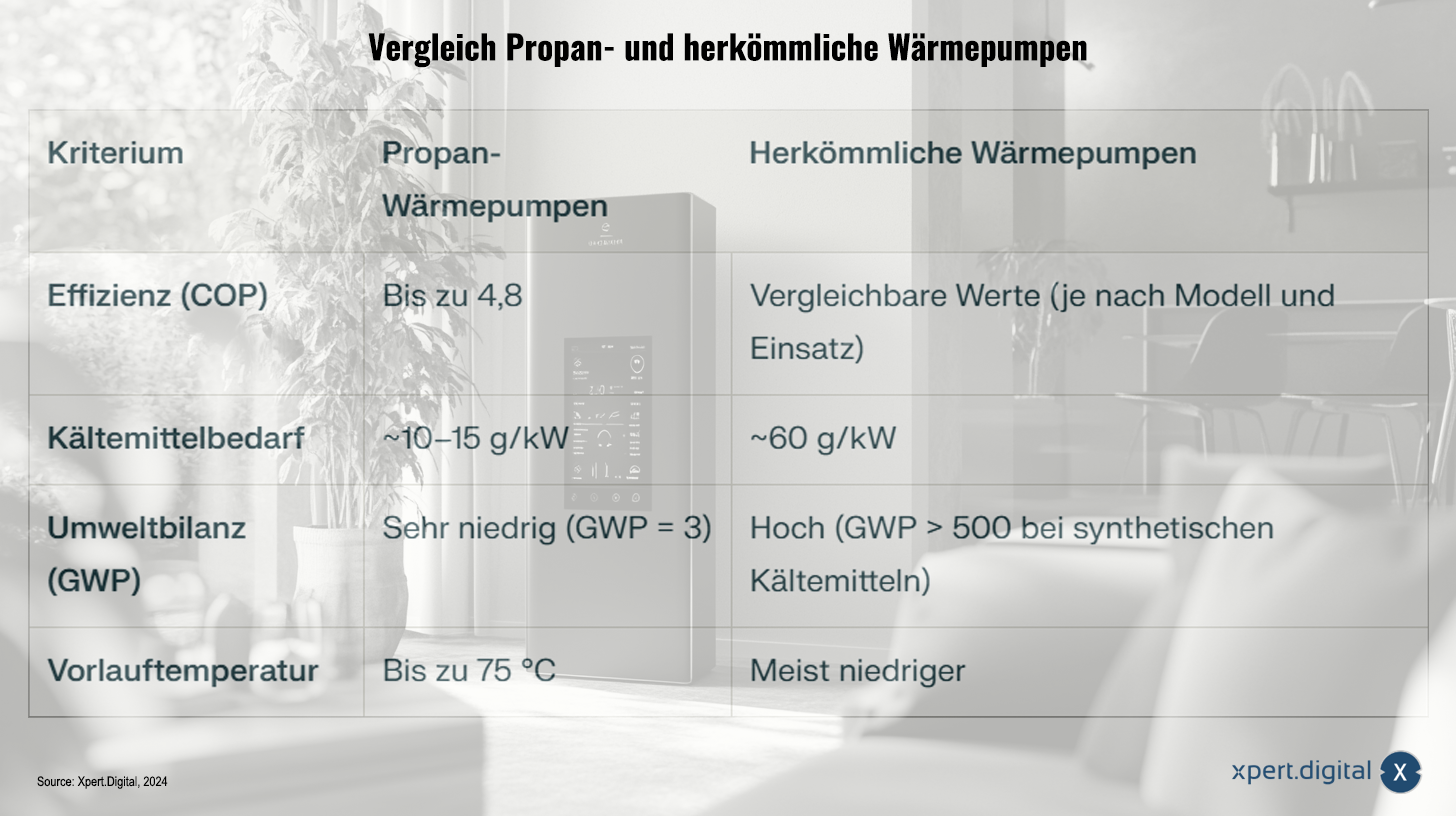
🌡️🌿 Comparison of propane heat pumps and conventional heat pumps
🔥 When comparing propane heat pumps and conventional heat pumps, the following differences emerge in various categories:
✨ Efficiency (COP)
Propane heat pumps achieve an efficiency of up to 4.8. This corresponds to comparable values of conventional heat pumps, which can have similarly high efficiencies depending on the model.
❄️ Refrigerant requirements
Propane heat pumps are characterized by a significantly lower refrigerant requirement. They only need about 10–15 g per kW, while conventional heat pumps require approximately 60 g per kW.
🌍 Global Warming Potential (GWP)
Propane heat pumps have an outstanding environmental footprint because the refrigerant propane has a very low global warming potential (GWP) of only 3. In comparison, many conventional heat pumps use a refrigerant with a GWP of over 500, which is significantly more harmful to the environment.
🌡️ Flow temperature
Propane heat pumps can achieve flow temperatures of up to 75 °C, making them particularly flexible. Conventional heat pumps, on the other hand, typically deliver flow temperatures in the range of 50–60 °C.
🏠 Suitable for old buildings
Due to their high flow temperatures, propane heat pumps are very well suited for use in older buildings, which often have radiators with higher temperature requirements. Conventional heat pumps are only of limited use in such cases.
⚠️ Safety
Because propane is a flammable refrigerant, the use of propane heat pumps requires special safety precautions. In comparison, conventional heat pumps that use synthetic refrigerants are considered safe.
Propane heat pumps are superior in many areas, both ecologically and technically, particularly in terms of efficiency, environmental friendliness, and suitability for use in older buildings. Limitations only arise with regard to safety requirements.
We are here for you - Consulting - Planning - Implementation - Project Management
☑️ SME support in strategy, consulting, planning and implementation
☑️ Creation or realignment of the digital strategy and digitization
☑️ Expansion and optimization of international sales processes
☑️ Global & Digital B2B trading platforms
☑️ Pioneer Business Development

Konrad Wolfenstein
I would be happy to serve as your personal advisor.
You can contact me by filling out the contact form below or simply call me on +49 7348 4088 965 .
I'm looking forward to our joint project.
Write to me



Xpert.Digital - Konrad Wolfenstein
Xpert.Digital is a hub for industry focusing on digitalization, mechanical engineering, logistics/intralogistics and photovoltaics.
With our 360° Business Development solution, we support renowned companies from new business to after-sales.
Market intelligence, smarketing, marketing automation, content development, PR, mail campaigns, personalized social media and lead nurturing are part of our digital tools.
You can find more information at: www.xpert.digital - www.xpert.solar - www.xpert.plus
Keep in touch