From 175 to 3,870 packages per person: This is how robots are unleashing a productivity explosion at Amazon – Creative image: Xpert.Digital
Amazon and the robot revolution: One million machines are changing the world of work
### Amazon's robot army is growing: 1 million machines – what that means for employees ### AI as the new boss: Why robots are now calling the shots at Amazon and Shopify ### Jobs at risk? Amazon's robot revolution is rolling towards Germany – here's what you need to know ### More than just warehouse work: How Amazon's super AI "DeepFleet" directs one million robots ###
Robots are coming, but jobs will remain? How Amazon is preparing 700,000 employees for the AI future
The news was a bombshell in the world of work and technology: Amazon has surpassed the milestone of one million active robots in its logistics centers. This impressive number is dangerously close to the human workforce of around 1.5 million and marks an irreversible turning point in automation. Controlled by a highly advanced generative AI called "DeepFleet," which acts as an intelligent traffic management system for the entire robot fleet, these machines are no longer just working alongside humans, but increasingly closely with them – or even replacing them.
But this technological milestone raises a pressing question that extends far beyond Amazon's warehouses: Is this the beginning of the end for millions of jobs, or the start of a new era of human-machine collaboration? On the one hand, there are unprecedented efficiency gains, the relief of employees from physically demanding tasks, and the creation of new, highly skilled jobs in maintenance and programming. On the other hand, there are the documented job losses per location and the growing concern that entire professions will be swept away by the wave of automation.
Focusing solely on Amazon, however, is too narrow a view. The e-commerce giant's approach serves as a blueprint for a development that is impacting the entire economy. Companies like Shopify are already making AI skills a basic requirement for their employees, demonstrating that the transformation is not limited to logistics. For the German economy, and especially the logistics sector, which is undergoing a major digitalization drive, Amazon's developments send a clear signal: the AI revolution is no longer a distant vision of the future, but is happening here and now. This transformation demands that employees, companies, and society urgently address the future of work.
What does Amazon's milestone of one million robots mean?
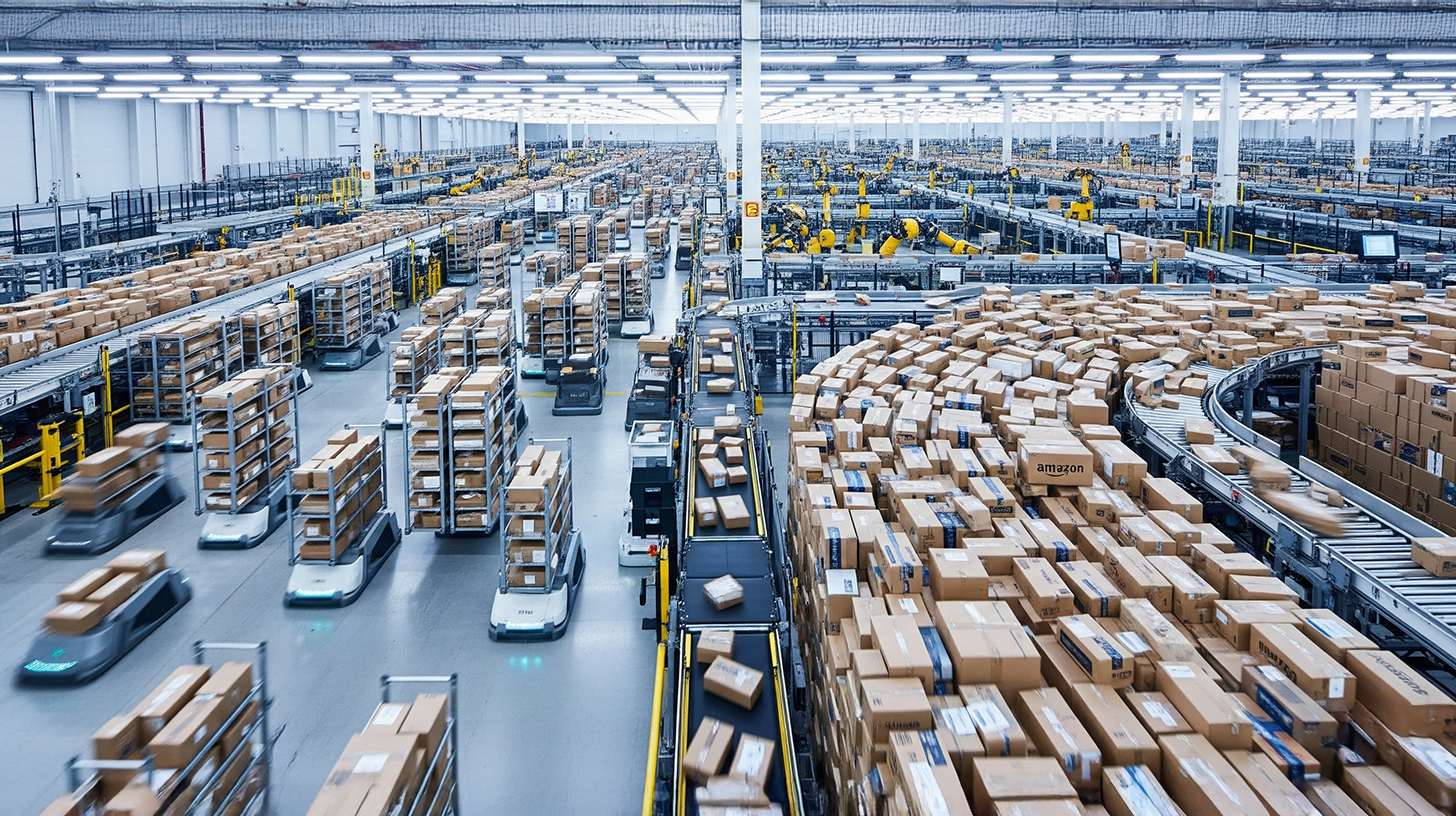
Amazon has reached a remarkable milestone: Over one million robots now work in the e-commerce giant's more than 300 fulfillment centers worldwide. This number is already approaching the number of human employees, which stands at approximately 1.56 million. The millionth robot was recently put into operation at a logistics center in Japan, marking a turning point in the automation of supply chains.
Since the first deployment of robots in 2012, when Amazon acquired Kiva Systems, the robotics landscape has changed dramatically. What began as simple shelf transporters has now become a complex ecosystem of diverse robot types. These machines perform tasks ranging from moving heavy loads to autonomously transporting customer orders through warehouses.
How does the DeepFleet AI system work?
At the heart of this new era is DeepFleet, a generative AI model that Amazon describes as "smart traffic lights for millions of warehouse routes." This foundational model was trained with extensive internal data on goods movement and coordinates the movements of the entire robot fleet in real time.
DeepFleet works similarly to a language model, generating the next sentence fragment based on previous words. However, instead of words, it generates movement patterns that fit the current situation in the warehouse. The system continuously calculates optimized routes for the robots, prevents congestion in the warehouse and reduces travel times by about ten percent. Scott Dresser, Vice President of Amazon Robotics, compares it to an intelligent traffic management system that continuously determines more efficient routes instead of rigid guidelines.
What different types of robots work in Amazon warehouses?
The variety of robots in Amazon's warehouses is impressive. The Hercules robot can move shelves weighing up to 570 kilograms and navigates using QR codes on the floor. The Pegasus robot replaces traditional conveyor belts and transports individual packages directly to the appropriate shipping points.
Particularly noteworthy is the Proteus, Amazon's first fully autonomous robot, which can move safely among human employees. Unlike other mobile robots, it is not restricted to separate work areas but can operate in open areas of the fulfillment centers.
The robotic arms Sparrow, Cardinal, and Robin perform precise gripping and sorting tasks. Sparrow can handle over 200 million different products using AI and computer vision. Cardinal lifts packages weighing up to 23 kilograms and precisely places them in transport carts. Finally, the Sequoia system is a multi-level storage system that can hold over 30 million items in the newest facility in Shreveport, Louisiana.
How is the work of Amazon employees changing?
Automation presents both opportunities and challenges for the workforce. Amazon emphasizes that the robots primarily take over heavy and monotonous tasks. At the new high-tech logistics center in Shreveport, the need for employees in the areas of reliability, maintenance, and engineering increased by 30 percent.
According to the company, over 700,000 employees have already been retrained for new roles. These training programs cover technical areas such as robotics maintenance, but also completely unrelated fields. Amazon invests up to €4,500 per employee in further training, ranging from IT support to truck driver training.
The new jobs require different skills. Instead of lifting heavy packages, employees now monitor complex robotic systems, perform maintenance, or program AI-supported processes. The workstations are more ergonomically designed, as robots deliver goods directly to employees, eliminating the need for them to walk through the warehouse.
What are the overall effects on employment?
Despite the emphasis on new jobs, the reality of job cuts remains. The average number of employees per Amazon location fell from nearly 1,000 in 2020 to about 670 in 2024. According to the Wall Street Journal, this is the lowest employment rate in 16 years.
CEO Andy Jassy made it clear in an internal memo that the massive deployment of AI will inevitably lead to job losses, particularly in traditional administrative, customer service, and development roles. Amazon is currently developing over 1,000 internal AI applications designed to automate various office tasks.
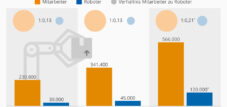
Productivity per employee has increased dramatically: While in 2015 approximately 175 packages were shipped per worker annually, today that number is around 3,870 packages. Approximately 75 percent of all Amazon deliveries worldwide are now supported by robots in some form.
Our recommendation: 🌍 Limitless reach 🔗 Connected 🌐 Multilingual 💪 Sales power: 💡 Authentic with strategy 🚀 Innovation meets 🧠 Intuition


From local to global: SMEs conquer the world market with a clever strategy - Image: Xpert.Digital
In an era where a company's digital presence determines its success, the challenge lies in creating an authentic, personalized, and far-reaching presence. Xpert.Digital offers an innovative solution that positions itself as the intersection of an industry hub, a blog, and a brand ambassador. It combines the advantages of communication and sales channels in a single platform and enables publication in 18 different languages. Cooperation with partner portals and the ability to publish articles on Google News and a press distribution list with approximately 8,000 journalists and readers maximize the reach and visibility of the content. This represents a crucial factor in external sales and marketing (SMarketing).
More information here:
Robots, Artificial Intelligence and the Future of Work
Which industries and professional groups are particularly at risk?
A recent Pew study identifies factory workers as particularly vulnerable to the advance of AI and robotics. Other studies confirm this trend: The Ifo Institute found that 27.1 percent of German companies expect job losses due to AI in the next five years. The manufacturing sector is particularly affected, with 37.3 percent of companies anticipating negative employment effects.
Besides logistics, jobs in accounting, customer service, and data processing are particularly at risk. Routine tasks that can be described by clear rules can increasingly be taken over by AI systems. Mathematicians, accountants, and administrative staff are under particular pressure.
How are other companies reacting to the AI revolution?
Amazon isn't alone in this development. Shopify CEO Tobi Lütke introduced an even more radical policy: Before teams are allowed to hire new employees, they must prove that AI cannot perform the tasks. "Reflexive AI use is now a fundamental assumption at Shopify," Lütke explained in an internal memo.
The Canadian e-commerce provider made AI skills a basic requirement for all employees. Lütke's clear message is that anyone not using AI today will be obsolete tomorrow. The company has already laid off 20 percent of its workforce and sold business units to focus more on AI-powered processes.
Other tech giants are following this trend. Microsoft, Google, and many other companies have drastically reduced their workforce in recent years. According to Layoffs.fyi, 551 companies worldwide had already cut around 153,000 jobs by 2024, many of them as a result of implementing AI.
What does this development mean for the German economy?
The German logistics industry is playing a pioneering role in the introduction of AI. 22 percent of logistics companies are already using artificial intelligence, and another 26 percent are planning or discussing its implementation. The industry sees itself as a digitalization pioneer and is investing heavily in automation technologies.
German companies anticipate similar upheavals to those in the US. The Fraunhofer Institute has identified numerous application areas for AI in logistics, ranging from route planning and demand forecasting to automated load planning. Transport robots that use optical patterns for navigation and AI-supported voice control are already being tested.
What new jobs will be created through automation?
Despite job cuts in traditional sectors, new career fields are emerging. Amazon has already posted 500 open positions in robotics on LinkedIn. They are looking for robotics technicians, AI specialists, data analysts, and systems integrators.
The new jobs often require higher qualifications, but also offer better pay and more interesting tasks. Instead of monotonous assembly line work, employees monitor complex systems, analyze data, or develop improvements for automated processes.
Amazon is training over 700,000 employees worldwide for these new roles. The company is investing billions in training programs ranging from robotics maintenance to completely unrelated fields. The goal is to open up career opportunities for employees beyond Amazon.
What does the future of warehouse logistics look like?
The trend is clearly moving towards complete automation. Amazon is already testing humanoid robots and working on voice control for robotic systems. In just a few years, robots could take over the majority of physical labor in warehouses.
The new fulfillment center in Shreveport offers a glimpse into this future. With ten times as many robots as conventional facilities, it demonstrates how logistics will fundamentally change. Employees will no longer work against the machines, but with them.
DeepFleet and similar AI systems will further increase efficiency. Continuous optimization through machine learning makes it possible to improve processes in real time and react to unforeseen situations.
What can employees do to prepare for the changes?
The most important recommendation is: further training and adaptation to new technologies. Anyone working in logistics should familiarize themselves with robotics and AI systems early on. Basic technical skills are becoming increasingly important, even in traditional professions.
At the same time, human skills such as creativity, problem-solving, and interpersonal communication remain valuable. While robots can take over many tasks, complex decisions and creative solutions still require human intelligence.
A willingness to learn throughout one's life is becoming a key skill. Those who continuously develop their skills and adapt to new technologies have good opportunities even in the automated world of work. Amazon and other companies are investing heavily in retraining programs that support this transformation.
What societal challenges does automation bring with it?
The AI revolution in logistics is part of a larger societal shift. While companies benefit from increased efficiency and lower costs, many workers face uncertain futures. The risk of growing inequality between highly skilled and low-skilled workers is real.
Politics and society must find answers to these challenges. Concepts such as a universal basic income, expanded continuing education programs, and new forms of work organization are being discussed. The taxation of automation to finance social change is also under debate.
The productivity gains from AI and robotics could theoretically benefit everyone. The crucial question is how these gains will be distributed and whether it will be possible to create new employment opportunities that correspond to the jobs lost.
Are the fears about job losses justified?
Concerns about massive job losses due to AI are not unfounded, but the reality is more complex. While many traditional jobs are disappearing, new professions are also emerging. The World Economic Forum predicts that while 92 million jobs will be lost by 2030, 170 million new ones will also be created.
The crucial question is not whether AI will change jobs, but how quickly and in what form this change will occur. Companies like Amazon demonstrate that the transformation is already well underway. The sooner employees and society adapt to this, the better the challenges can be met.
History shows that technological revolutions usually lead to greater prosperity and new jobs in the long run. In the short term, however, they can cause significant disruption. The challenge lies in making the transition phase socially acceptable and leaving no one behind.
Human vs. machine? No, human AND machine!
Amazon's one million robots mark a turning point in the history of work. The combination of advanced robotics and AI systems like DeepFleet is transforming not only logistics, but the entire economy. Companies that fail to adopt these technologies will fall behind the competition.
For employees, this presents both risks and opportunities. Those willing to learn and adapt can benefit from the new possibilities. Those who resist change will struggle. The message is clear: the future belongs to those who see humans and machines as partners.
The societal challenge is to shape this change in a way that benefits everyone. This requires investment in education, social security, and new forms of cooperation between policymakers, businesses, and workers. Only in this way can the technological revolution translate into social progress.

Xpert.Plus Warehouse Optimization - High-bay warehouses and pallet warehouses: Consulting and planning
We are here for you - Consulting - Planning - Implementation - Project Management
☑️ Our business language is English or German
☑️ NEW: Correspondence in your native language!

Konrad Wolfenstein
I and my team are happy to be available to you as your personal advisor.
You can contact me by filling out the contact form here wolfenstein@xpert.digital:or simply call me at +49 7348 4088 965. My email address is
I'm looking forward to our joint project.