
Production-ready AI development: How enterprise platforms bridge the gap between experiment and reality – Image: Xpert.Digital
From chance to precision: The radical transformation of enterprise AI architecture
No more errors: How security mechanisms and trust ratings can save enterprise AI
While the last few years have been characterized by a gold rush mentality and countless tests, reality is catching up with many organizations: A shocking 85 to 87 percent of AI initiatives never make the leap from the lab to real-world business operations. They remain stuck in the so-called "pilot trap"—technically fascinating, but economically without added value.
However, the problem no longer lies in a lack of intelligence in the models. The hurdle is structural in nature. Enterprise systems—unlike simple chatbots for private users—demand absolute reliability, strict adherence to rules, and seamless integration into existing IT landscapes.
This article highlights the fundamental shift currently underway: the transition from experimental playgrounds to reliable production systems. We analyze how new platform technologies, such as confidence engines, guardrails, and semantic layers, make the risk of AI deployments calculable. Learn how leading companies are transforming uncertainty into measurable business value, why control is suddenly becoming an accelerator, and what decisions are needed not only to test AI but also to profitably master it.
More information here:
From experiment to profit: How to finally bring AI safely into production
In 2026, enterprise AI will be at a turning point. Despite years of effort, 85 to 87 percent of projects never reach productive use and remain stuck in the "pilot phase." This gap between technical feasibility and everyday operations costs companies billions and erodes trust.
The obstacle is not the performance of the models, but the barrier between development and operation. Unlike consumer apps, enterprise software requires strict compliance, predictability, and the ability to communicate with legacy infrastructure. The platform updates of 2025 mark the shift from randomized experiments to well-defined production systems. The focus is shifting from pure model accuracy to control mechanisms, transparency, and security.
Trust through measurability: The Confidence Engine as the backbone of data collection
Errors during data transfer in production environments pose a significant risk. Error rates are often high in manual processes. While AI systems achieve 97 to 99 percent accuracy, without a confidence assessment, errors remain invisible until they cause damage.
Modern confidence engines check data at the field level. Values with low confidence automatically trigger re-checks or are forwarded for human review. This transforms uncertainty into a manageable process. Companies can thus use data directly in critical processes without incurring risks. One financial services provider was able to reduce its processing time by over 40 percent as a result. The strategic value lies in scalability: While manual costs increase linearly, the cost per document decreases with increasing volume for AI systems.
Controlled autonomy: Guardrails as a prerequisite for AI in sensitive areas
As AI responses increasingly reach customers directly, firm rules are essential. By 2025, 39 percent of companies reported AI agents accessing systems erroneously. "Guardrails" implement multi-layered safeguards that enforce rules and checks during execution.
Effective guardrails fulfill three functions: blocking malicious input (e.g., manipulation attempts), scanning for sensitive data (data protection), and filtering dangerous responses. This consistency of the rules—regardless of the AI model—allows for deployment in high-risk environments. One insurer reduced processing time by 60 percent with zero rule violations. Guardrails accelerate automation because they strengthen the trust of all stakeholders in system control.
Visibility as a basis for trust: Monitoring in production
AI systems rarely fail due to crashes, but rather through gradual quality loss (drift). Without comprehensive monitoring (observability), these problems go unnoticed. Enhanced monitoring analyzes the health of processes, trust trends, and human intervention.
An insurance company used AI-powered observability to reduce the time to error detection from two weeks to 15 minutes and prevent 40 incidents per month by identifying anomalies. Technically, these systems use content analysis to identify erroneous facts (“hallucinations”) and performance degradation. If quality falls below a threshold, models can be automatically readjusted. This enables continuous improvement and accelerates the deployment of new models fivefold.
Architectural freedom as a strategy: Flexibility in deployment
The deployment method must meet infrastructure requirements (data location, security). The solution lies in the flexibility to switch between cloud and local (on-premises) servers within a unified architecture.
The most widespread approach is the "split approach": training in the cloud (computing power), application on-premises (data security). This offers extremely fast response times on-site, while the cloud is used for intensive training. On-premises installations offer better latency (1–5 ms vs. 50–200 ms in the cloud), while the cloud excels during peak loads. Strategically distributing tasks based on cost and compliance enables scalability while maintaining full control.
🤖🚀 Managed AI Platform: Faster, safer & smarter to AI solutions with UNFRAME.AI

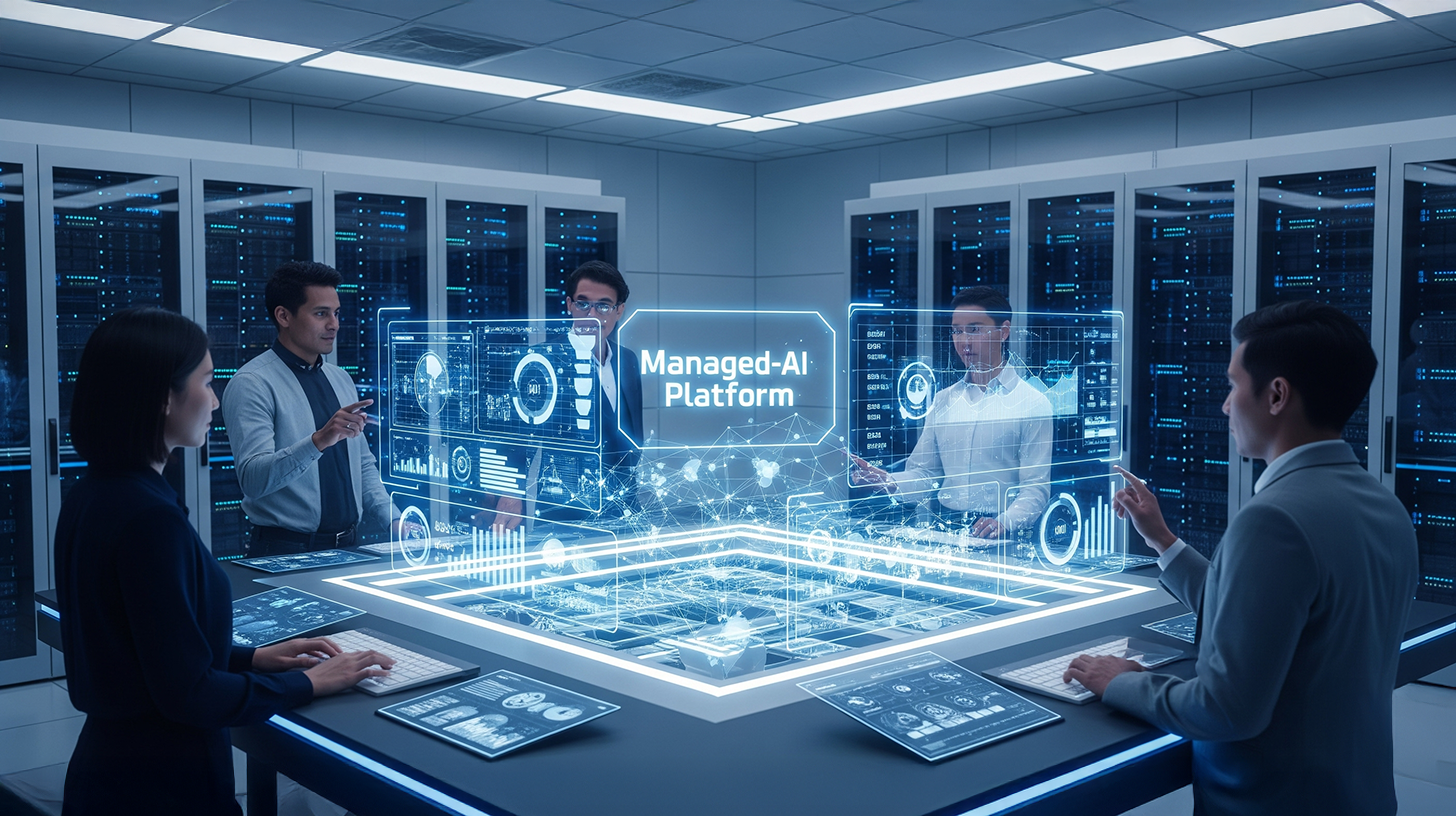
Managed AI Platform - Image: Xpert.Digital
Here you will learn how your company can implement customized AI solutions quickly, securely and without high entry barriers.
A managed AI platform is your all-inclusive, worry-free solution for artificial intelligence. Instead of dealing with complex technology, expensive infrastructure, and lengthy development processes, you receive a ready-made solution tailored to your needs from a specialized partner – often within just a few days.
The key advantages at a glance:
⚡ Rapid implementation: From idea to ready-to-use application in days, not months. We deliver practical solutions that create immediate added value.
🔒 Maximum data security: Your sensitive data stays with you. We guarantee secure and compliant processing without sharing data with third parties.
💸 No financial risk: You only pay for results. High upfront investments in hardware, software, or personnel are completely eliminated.
🎯 Focus on your core business: Concentrate on what you do best. We take care of the entire technical implementation, operation, and maintenance of your AI solution.
📈 Future-proof & scalable: Your AI grows with you. We ensure continuous optimization and scalability, and flexibly adapt the models to new requirements.
More information here:
After the hype: How to transition your AI from experiment to profitable, continuous operation
Security by design: Role rights as the foundation of scalable AI management
Informal access rights are insufficient in production environments. Role-based access control (RBAC) across data, workflows, and input commands is essential. Separating tenants and implementing granular rights management prevents data misuse and simplifies audits (e.g., for GDPR compliance).
RBAC minimizes the risk of unauthorized access and facilitates incident response by enabling the rapid isolation of affected accounts. Modern integrations leverage AI to detect anomalies in access patterns, transforming rights management from a static set of rules into an active security tool.
The business context as a competitive advantage: The semantic level as a translator
Directly relying on raw data for AI workflows is hardly scalable. A "semantic layer" acts as a translator, transferring technical data structures into business terms and decoupling workflows from changing databases.
This is crucial for language models: This layer provides the factual context and prevents errors that arise from querying raw tables. Companies that utilize this reduce redundant data work by 30 to 50 percent. This layer enables reusable AI processes that remain stable and consistent despite changes to the data sources.
Compliance as fuel: Governance from policy to execution
Governance is no longer just paperwork, but is directly embedded in workflows. Approval processes and audit protocols are becoming standard elements. The EU AI Act, with its high penalties, makes compliance mandatory anyway.
Implementation includes formal risk assessments and ensuring the traceability of AI results. Governance thus transforms from an obstacle to an enabler: clear boundaries and visible accountability increase trust and accelerate the adoption of AI within the company.
The economic dimension: From cost factor to value driver
The return on investment (ROI) of AI must be measurable. Companies achieve an average return of $3.50 for every dollar invested; top performers reach up to $8. Automation can increase productivity by 40 percent.
Key performance indicators (KPIs) include time savings, operational efficiency (faster lead times), revenue impact (better customer conversion), and cost reduction. One B2B company achieved a 410 percent ROI in the first year through intelligent customer evaluation. Crucially, success should not only be viewed retrospectively but also used as a management tool for investments.
The pilot trap: Why most AI projects fail
Many projects fail due to systematic hurdles such as the "showcase trap" (effect-free sensationalism), the "integration nightmare" (lack of connection to legacy systems), or incorrect goals.
Successful organizations (13–20 percent) treat AI as a business transformation, not just an IT project. They invest in change management and infrastructure in parallel. An example from the manufacturing sector shows how phased implementation and employee training have drastically reduced unplanned downtime. Remaining in the testing phase poses competitive risks, as AI-native competitors gain market share.
MLOps as a bridge: From prototypes to production systems
MLOps (Machine Learning Operations) is the technical solution to solve scaling problems. It establishes processes for continuous integration and training. Companies using MLOps reduce deployment cycles from months to weeks and prevent 99.9 percent of outages before they impact customers.
The merging of AI operations and traditional IT is the trend for 2025. Without these processes, initiatives will fail due to quality losses and integration bottlenecks. Investments in professional AI operations raise the success rate of projects from under 15 percent to over 60 percent.
The maturity curve: From awareness to an “AI-first” company
Five stages define the maturity level:
- Awareness: Vision without a clear plan (28% of companies).
- Experimentation: Isolated tests without breadth.
- Application: Operational value is created, business processes are established (34%).
- Integration: AI is deeply embedded in processes, governance is standard (31%).
- AI-driven company: Autonomous, learning systems and proactive decisions (7%).
Advancement requires not only technology, but also cultural change. AI maturity is not a final state, but a continuous capacity for adaptation.
Workflow automation as a value driver: From efficiency to intelligence
Intelligent workflow automation goes beyond rigid rules and uses real-time data for complex decisions. This leads to an almost 40 percent increase in employee productivity, as routine tasks are eliminated.
Besides cost savings and faster time to market, personalization improves the customer experience. In the financial sector, this is revolutionizing processes such as invoice processing and compliance. Those who use this technology effectively operate more cost-effectively and faster than their competitors.
The future of enterprise AI: Autonomous systems and beyond
The trend is toward "agent systems": By the end of 2026, 40 percent of enterprise apps will use autonomous agents that independently manage processes such as supplier negotiations. Specialized models will outperform general models in accuracy and rule compliance.
Companies will unify their AI infrastructure and implement real-time decision automation (e.g., in the supply chain). AI will transform software from a passive tool into an active driver of business outcomes.
The need for production-ready AI
The changes coming into effect in 2025 are not small steps, but a fundamental shift towards reliable systems. Investments in trust assessment, security mechanisms, monitoring, and governance are mandatory for operations.
The economic benefits are proven (34% efficiency gains, 27% cost reduction), but only organizations that bridge the gap between experimentation and production will profit. The window of opportunity is closing: companies must invest now in production-ready systems to help shape the AI-driven future, rather than being left behind.
Consulting - Planning - Implementation

Konrad Wolfenstein
I would be happy to serve as your personal advisor.
You can contact me at wolfenstein∂xpert.digital or
Just call me on +49 7348 4088 965 .
Our global industry and economic expertise in business development, sales and marketing

Our global industry and economic expertise in business development, sales and marketing - Image: Xpert.Digital
Industry focus areas: B2B, digitalization (from AI to XR), mechanical engineering, logistics, renewable energies and industry
More information here:
A thematic hub offering insights and expertise:
- Knowledge platform covering global and regional economies, innovation and industry-specific trends
- A collection of analyses, insights, and background information from our key areas of focus
- A place for expertise and information on current developments in business and technology
- A hub for companies seeking information on markets, digitalization, and industry innovations