Wearable robotics and the development of the WIM exoskeleton: Current advances in assistive technology – Image: Creative image: Xpert.Digital
Ultra-lightweight support: The wearable WIM system from WIRobotics in focus
WIM exoskeleton: Advances for healthy users and therapeutic applications
The development of wearable robotic systems is currently experiencing a significant upswing, with innovative exoskeletons like the WIM system from WIRobotics (not WeRobotics, as originally thought) setting new standards in mobility assistance. The South Korean company WIRobotics has developed an ultra-lightweight walking robot, WIM (We Innovate Mobility), which, at just 1.6 kilograms, enables impressive energy savings of up to 20% when walking on level ground. Studies show that the system reduces muscle fatigue in the calf muscles by 79.5% while simultaneously lowering oxygen consumption by 7.9%. These advances mark a turning point in the development of everyday assistive technologies, offering both performance-enhancing benefits for healthy users and therapeutic advantages for individuals with mobility limitations.
Related to this:

Technological foundations of wearable robotics
Development and design principles
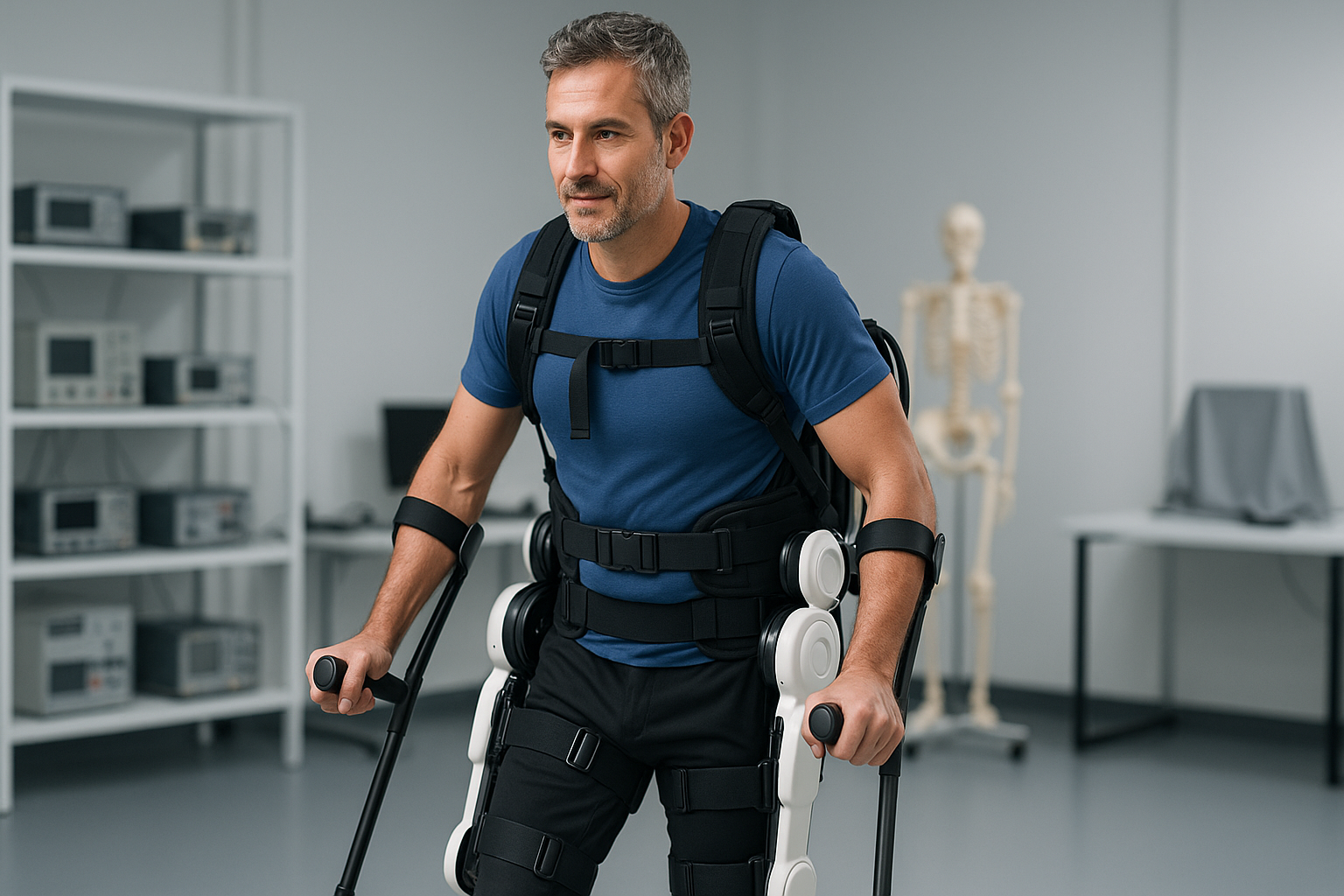
Modern wearable robotics is based on advanced biomechanical principles and materials science, enabling the creation of powerful support systems in a compact form. The WIM exoskeleton exemplifies this development through its innovative design, which differs significantly from conventional, heavy exoskeletons. Weighing only 1.6 kilograms and resembling a belt pouch, WIM breaks the traditional boundaries of exoskeleton technology. The system uses a single motor that supports both legs simultaneously via biomechanically optimized transmission elements, ensuring symmetrical force distribution.
The WIM system's technical specifications demonstrate advancements in miniaturization: The device delivers a maximum torque of 6 Nm with a battery life of two hours of continuous use. This performance is complemented by intelligent sensor systems that analyze the user's gait in real time and provide corresponding support. The compact design allows users of all body sizes, from average build to those over two meters tall, to wear the system securely using adjustable Velcro straps.
Artificial intelligence and adaptive systems
The integration of artificial intelligence into wearable robotic systems represents a significant advancement, enabling personalized support based on individual movement patterns. WIM utilizes advanced AI algorithms for gait analysis, evaluating parameters such as speed, agility, and symmetry in real time. The accompanying mobile application calculates an individual "gait age" and creates tailored training plans to improve mobility and fitness. This data-driven approach allows the system to continuously adapt to the user's needs and provide optimal support.
The AI-powered coaching functionality of the WIM system collects long-term musculoskeletal data and enhances gait performance through adaptive algorithms. This technology allows the system to offer various operating modes: an assisted mode for facilitated movement, a resistance mode for strength training, and specialized modes for hill work and rehabilitation applications. The system's ability to seamlessly switch between these modes demonstrates the versatility of modern wearable robotic systems.
Clinical validation and efficacy studies
Biomechanical and physiological effects
The scientific validation of wearable robotic systems requires comprehensive biomechanical and physiological studies that consider both objective measurement parameters and subjective user experiences. Studies on the WIM exoskeleton show significant improvements in several performance parameters: calf muscle fatigue is reduced by 79.5%, while oxygen consumption decreases by 7.9% and energy expenditure by 7.4%. These results were obtained in controlled treadmill studies and demonstrate the system's physiological effectiveness in relieving lower extremity stress.
The biomechanical benefits of the WIM system extend beyond mere energy savings. The system reduces energy expenditure by up to 20% when walking on level ground and by 14% when carrying loads, which corresponds to a weight reduction of 12 kilograms. These performance improvements are particularly noticeable during repetitive movements involving forward motion, such as climbing stairs or pushing weights. The even distribution of force across both hip joints ensures stability during movement, although this requires special attention for patients with gait asymmetries, such as certain stroke patients.
Application in the medical field
The validation of exoskeletons in medical settings shows promising results for various patient groups and applications. A four-week usability study with seniors demonstrated a 78% improvement in physical function, with participants experiencing increased walking speed, improved endurance, and strengthened lower extremity muscles. These results underscore the potential of wearable robotic systems in geriatrics and rehabilitation.
The use of exoskeletons in surgery reveals further avenues for medical validation. A study conducted by the Department of Orthopedics, Trauma Surgery, and Plastic Surgery at Leipzig University Hospital investigated the effects of SUITX exoskeletons on surgeons during and after operations. The results showed a significant reduction in neck, shoulder, and back pain, improved comfort, and increased endurance during lengthy procedures. This study, involving 25 participants and 50 surgical procedures, confirmed the feasibility and user acceptance of the exoskeleton, with 44% of participants indicating they would use it frequently and 48% occasionally.
Market development and commercial implementation
Global market expansion
The commercial development of wearable robotic systems is showing dynamic market expansion, with innovative companies like WIRobotics successfully transitioning from research prototypes to market-ready products. WIRobotics has already sold 500 units of its WIM system in South Korea and is now planning a market launch in the USA. This expansion is based on the success of the system, which received Innovation Awards in two categories at the 2024 Consumer Electronics Show (CES): Robotics and Accessibility & Aging Tech.
The success of the WIM system in the Korean market, where it sells for the equivalent of approximately US$2,330, demonstrates consumers' willingness to invest in wearable robotic technology. The planned US launch targets a broad audience, ranging from active young people and seniors with mobility needs to rehabilitation patients. This diversification of target groups reflects the versatility of modern exoskeleton technology and highlights its potential for widespread societal acceptance.
Technological differentiation and competitive advantages
WIM's positioning in the wearable robotics market is based on significant technological differentiation features compared to conventional exoskeletons. The significantly reduced weight of 1.6 kilograms, compared to conventional systems weighing 25 kilograms or more, represents a decisive competitive advantage. This weight reduction allows users to wear the system for extended periods without experiencing excessive strain.
The user-friendliness of the WIM system is evident in its intuitive design and ease of use. Unlike heavy, complex exoskeletons that require constant supervision by trained personnel, WIM can be put on and operated independently by users. Its water- and dust-resistant construction expands its application possibilities to various environments, making the system suitable for both indoor and outdoor use. This robustness, combined with a two-hour battery life and a replaceable battery system, positions WIM as a practical solution for everyday life.
Related to this:

Societal impacts and future prospects
Demographic change and assistive technologies
The increasing aging of society is creating a growing need for assistive technologies that help older people maintain their independence and mobility. Wearable robotic systems like WIM address this demographic challenge by providing affordable and user-friendly solutions that reduce the energy expenditure of walking and increase endurance. The system's ability to offer various operating modes—from assisting with normal walking to resistance training—enables older users to actively maintain and improve their physical fitness.
However, the societal implications extend beyond geriatrics. The concept of wearable robotics aims for a "one human, one robot" era, in which everyone has access to personalized robotic support. This vision could revolutionize how people with physical limitations participate in social life and create new opportunities for professional and social inclusion. The integration of advanced AI technologies into these systems promises continuous improvement in the quality of support and adaptation to individual needs.
Human Enhancement in Focus: What the German Armed Forces Study Shows
The development and implementation of wearable robotic systems raises important ethical questions regarding dependence on technology and its potential risks. The German Armed Forces study on human enhancement technologies highlights the need to carefully weigh both the benefits and risks of performance-enhancing technologies. With exoskeletons, there is a risk that improper use or excessive reliance on them could lead to musculoskeletal injuries, particularly in users with pre-existing gait asymmetries.
Safety considerations necessitate continuous monitoring and improvement of the systems. Studies show that exoskeletons for knee flexion support can increase joint angles, and if excessive torque is applied, undesirable consequences such as muscle strain, abnormal activity, and injury can occur. Therefore, the development of robust safety protocols and user training are essential for the safe implementation of these technologies. The two-hour battery life of the WIM system could be a limitation in professional applications and requires further technological improvements for use in work-intensive environments.
Artificial Intelligence and Robotics: The Future of Personalized Assistance
The development of wearable robotic systems like WIM from WIRobotics marks a significant advancement in assistive technology and demonstrates the potential for broad societal transformation. Scientific validation through studies demonstrating significant improvements in energy efficiency, muscle fatigue, and physical performance underscores the therapeutic and performance-enhancing efficacy of these technologies. Successful commercialization in South Korea and planned expansion into international markets show that wearable robotic systems are maturing from an experimental technology to practical, everyday solutions.
The future of wearable robotics will be significantly shaped by the further integration of artificial intelligence, improved energy efficiency, and the development of even lighter and more user-friendly systems. While technological advances are promising, ethical considerations, safety aspects, and accessibility issues must be carefully addressed. The vision of a society where everyone has access to personalized robotic assistance could revolutionize how we understand mobility, work, and quality of life, but it requires a balanced approach that harmonizes technological innovation with human needs and societal values.
Related to this:
Your global marketing and business development partner
☑️ Our business language is English or German
☑️ NEW: Correspondence in your native language!

Konrad Wolfenstein
I and my team are happy to be available to you as your personal advisor.
You can contact me by filling out the contact form here wolfenstein@xpert.digital:or simply call me at +49 7348 4088 965. My email address is
I'm looking forward to our joint project.