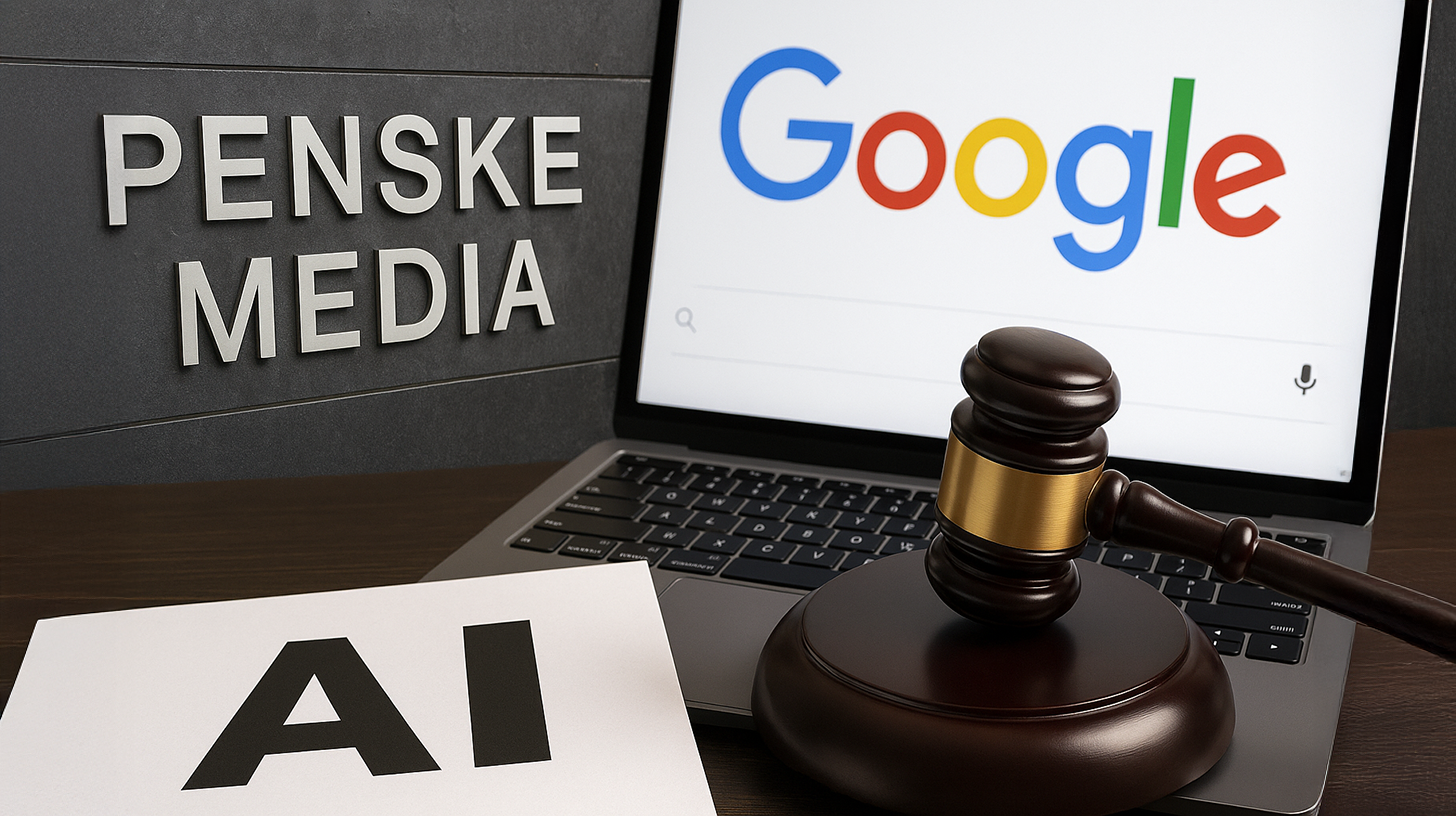
US media group Penske Media is suing Google over "AI Overviews" – What do they mean for publishers and the future of web search? – Image: Xpert.Digital
Rolling Stone's parent company is suing Google: Is the new AI search illegal?
### A Silent Death: How Google's AI is Destroying the Fundamental Principle of the Free Internet ### Google vs. Publishers: The War for Clicks Has Begun – Who Will Lose in the End ### The End of Clicking? Why Google's AI Answers Could Change the Internet Forever ###
No clicks, no revenue: Are thousands of websites facing extinction because of Google's AI?
Google revolutionized web search with its "AI Overviews," but this revolution threatens to devour its own children. What began as a user-friendly innovation, answering search queries directly with AI-generated summaries, is turning into an existential threat to the ecosystem that once made Google great. Traffic to news portals, blogs, and trade magazines is plummeting dramatically, as users get their answers directly from Google and no longer visit the original sources. This deprives publishers and content creators of their livelihood.
At the center of the storm is the landmark lawsuit filed by media conglomerate Penske Media Corporation (Rolling Stone, Variety), which accuses Google of abusing its overwhelming monopoly to "cannibalize" content for its AI without paying for it. This accusation is supported by alarming studies documenting a decline in click-through rates of up to 47 percent and showing that users are increasingly abandoning their internet searches without having visited a single website.
This development raises fundamental questions: Are we at the end of an era in which a decentralized network of websites is being replaced by a centralized information monopoly? Is Google's approach an illegal act that not only jeopardizes media diversity but also undermines the fundamental principle of the internet – the exchange of traffic for content? The conflict between Google and the publishers is more than just a legal dispute; it is a battle for the future of information distribution in the digital age.
Related to this:

What are Google AI reviews and why are they controversial?
Google's AI-generated summaries, officially called "AI Overviews," are at the center of a legal battle that raises fundamental questions about the future of the internet. These automatically generated answer boxes appear prominently above traditional search results and summarize information from various sources. But what initially seemed like a user-friendly innovation is evolving into an existential threat to many online media outlets.
The AI Overviews use artificial intelligence to answer search queries directly, without requiring users to visit the original websites. Google launched this functionality in the US in May 2024 and expanded it to Germany in March 2025. The technology promises faster answers but also brings profound changes to the entire online ecosystem.
Related to this:

Which media company is suing Google and on what grounds?
Penske Media Corporation, the parent company of renowned publications such as Rolling Stone, Billboard, Variety, and The Hollywood Reporter, became the first major American media company to file a lawsuit against Google in September 2025. This landmark lawsuit was filed in federal court in Washington, the same court that had already ruled in 2024 that Google had an illegal monopoly in web search.
The lawsuit is based on several serious allegations. Penske Media argues that Google is abusing its monopoly position to force publishers to make their content available for AI summaries. The central allegation is that Google presents website operators with an impossible choice: either they allow the use of their content for AI training and summaries, or their sites disappear completely from Google search results.
This practice constitutes a clear violation of US antitrust law, the argument goes. Google uses its dominant position not only to index websites but also to obtain training data for its AI systems free of charge. Without this monopoly, Google would be forced to pay licensing fees for using third-party content, as competing AI companies like OpenAI already do with various publishers.
How does AI summaries change user behavior?
Several scientific studies document dramatic changes in user behavior since the introduction of AI Overviews. The renowned Pew Research Center conducted a comprehensive analysis of nearly 70,000 Google searches by 900 American users. The results are alarming for content providers: When using AI Overviews, only 8 percent of users click on traditional search results, compared to 15 percent for conventional search results pages.
Even more striking is the low level of interaction with the sources linked in the AI Overviews themselves. Users click on the original sources linked within the AI summary in only one percent of all cases. This means that even websites appearing as sources in the AI Overviews generate virtually no traffic.
A German study by Wordsmattr shows similarly worrying trends since the introduction of AI Overviews in Germany in March 2025. German websites saw an average decline in clicks of 17.8 percent and in the click-through rate of 14 percent. Particularly noteworthy is that impressions only fell by 1.2 percent, meaning that while websites still appear in search results, they receive significantly fewer clicks.
The British SEO platform Authoritas documented even more drastic losses in its study. On desktop devices, the click-through rate dropped by 47.5 percent, and on mobile devices by 37.7 percent, when AI Overviews were displayed. These figures illustrate the extent of the disruption caused by Google's new technology.
Why do users end their browsing sessions more frequently?
A particularly significant aspect of this behavioral change is the tendency for users to end their internet sessions after viewing an AI overview. While 16 percent of users end their browsing session after viewing traditional search results, this figure rises to 26 percent after viewing AI overviews. This suggests that the AI summaries effectively satisfy users' information needs without requiring them to visit other websites.
This development is certainly positive from a user-friendliness perspective, but it poses a fundamental challenge for the entire web ecosystem. For decades, the internet was based on the principle of linking and traffic exchange between different websites. If users get their information directly from Google and don't visit any other sites, this system collapses.
Google implicitly confirms these trends through its own statements. The company emphasizes that users find AI-powered search results more helpful and use them more intensively. At the same time, Google argues that the new features lead to more diverse discoveries, but cannot provide convincing data for actual increases in traffic to third-party providers.
What impact do AI Overviews have on different industries?
The impact of AI Overviews is not evenly distributed across all industries. News media and publishers are particularly affected, as their content is frequently used for current information queries. According to an analysis by SimilarWeb, the share of news searches without clicking on results increased from 56 percent to 69 percent since the introduction of AI Overviews in May 2024. At the same time, traffic to news websites fell from a peak of 2.3 billion clicks in July 2024 to below 1.7 billion clicks.
Several media companies are reporting significant traffic losses. DMG Media, publisher of the Daily Mail, has seen a decline of up to 89 percent. Even renowned media outlets such as Business Insider, The Washington Post, and HuffPost have reported substantial losses. These developments have already led to layoffs at several US media companies.
A study by Digital Content Next, a lobbying group of major US publishers, documented an average traffic decline of 10 percent across 19 member companies in just eight weeks between May and June 2025. These figures refute Google's claims about "quality clicks" and confirm publishers' fears.
Related to this:

How is Google responding to the criticism and accusations?
Google vehemently denies all allegations in the lawsuit and presents a completely different view on the impact of AI Overviews. A Google spokesperson emphasized that the AI summaries make web searches more helpful for users and encourage them to use the service more. This creates new opportunities to discover content online, and Google forwards "billions of clicks" to other websites daily.
Google's argument that AI Overviews would diversify the range of linked websites is particularly interesting. The company claims that the new features give more diverse sources attention than would be the case with traditional search results.
Google also criticizes the methodology of the various studies that document negative impacts. The company argues that many claims about traffic losses are based on incomplete and biased data. Websites can experience traffic fluctuations for various reasons, including seasonal demand, user interests, and routine algorithm updates.
A Google spokesperson called a prominent Pew Research study "flawed and biased," arguing that the methodology and set of search queries used were not representative of actual search traffic. Google had not observed a significant decline in aggregated web traffic, as the study suggested.
Our recommendation: 🌍 Limitless reach 🔗 Connected 🌐 Multilingual 💪 Sales power: 💡 Authentic with strategy 🚀 Innovation meets 🧠 Intuition


From local to global: SMEs conquer the world market with a clever strategy - Image: Xpert.Digital
In an era where a company's digital presence determines its success, the challenge lies in creating an authentic, personalized, and far-reaching presence. Xpert.Digital offers an innovative solution that positions itself as the intersection of an industry hub, a blog, and a brand ambassador. It combines the advantages of communication and sales channels in a single platform and enables publication in 18 different languages. Cooperation with partner portals and the ability to publish articles on Google News and a press distribution list with approximately 8,000 journalists and readers maximize the reach and visibility of the content. This represents a crucial factor in external sales and marketing (SMarketing).
More information here:
AI Overviews are changing the web: Who wins, who loses?
What legal challenges exist?
Penske Media's lawsuit is just the beginning of a broader legal battle over AI technologies and copyright. As early as 2025, there were landmark rulings in similar cases that defined the legal limits for AI training with copyrighted material.
In the case of Thomson Reuters v. Ross Intelligence, the U.S. District Court of Delaware ruled in February 2025 that using copyrighted content to train an AI does not automatically fall under the fair use doctrine. The court found that Ross Intelligence, a legal research AI startup, had infringed Thomson Reuters' rights by using content from the Westlaw database for AI training without permission.
This ruling could serve as a precedent for the Google lawsuit, even though it involved non-generative AI. The judge completely rejected the fair use defense, emphasizing the commercial nature of the use and the lack of "transformativity." Ross had not creatively transformed the material but had merely used it as training material for a competitor's product.
What role does Google's monopoly position play in the debate?
Google's monopoly in the search engine market is the central point of contention in the entire debate. In August 2024, the federal court in Washington ruled that Google illegally holds a monopoly on internet search. Google controls approximately 90 percent of the US search market and 94.9 percent of online searches on mobile devices.
This monopoly allows Google to dictate terms that would be unthinkable without its market dominance. Publishers face an impossible choice: either they allow Google to use their content for AI summaries, or they risk disappearing completely from search results. This situation differs fundamentally from the starting point of smaller AI companies, which have to enter into licensing agreements with publishers.
The News/Media Alliance, which represents more than 2,200 US publishers, criticized Google for exploiting its market power. Unlike competitors such as OpenAI, which enter into licensing agreements with publishers, Google is not compelled to engage in such "healthy practices," explained association head Danielle Coffey.
What happened to the attempts to break up Google?
Parallel to the Penske lawsuit, a separate legal proceeding was underway concerning the potential consequences of Google's illegal monopoly. The US government had demanded far-reaching measures against Google, including the forced sale of the Chrome browser and the Android operating system.
However, in September 2025, Federal Judge Amit Mehta ruled that Google did not have to sell these business units. The government had gone too far with its demands, he wrote in his 230-page ruling. Google is allowed to keep the Chrome browser and Android, but must comply with other conditions.
The court nevertheless imposed significant restrictions. Google will have to share certain data from its search engine with competitors in order to strengthen competition. This data is intended to help competing search engines like Microsoft's Bing or DuckDuckGo, as well as AI companies like OpenAI, develop their products.
Furthermore, Google is no longer allowed to enter into exclusive agreements that would prevent device manufacturers from pre-installing competing products. However, the company can still pay other companies like Apple or Mozilla to prominently feature Google's services. According to information from the trial, Apple received billions for making Google Search the default app on iPhones.
Related to this:
How is the situation developing in Europe?
Europe is becoming a key arena in the battle to regulate AI overviews. In July 2025, the Independent Publishers Alliance, a London-based group of publishers, filed a comprehensive antitrust complaint with the European Commission. The complaint accuses Google of abusing its market power in the search engine sector and demands urgent measures to prevent "irreparable damage.".
The EU complaint is particularly explosive because it is based on several European laws. In addition to antitrust allegations, Google could be violating the Digital Markets Act by favoring its own AI summaries and suppressing competing content. The Digital Services Act requires transparent and comprehensible recommendation systems, which is questionable in the case of the opaque AI Overviews.
Particularly serious is the potential violation of the European Media Freedom Act, which is intended to protect media diversity. The EU fears that independent media outlets could be threatened with closure due to lost traffic, and that citizens could have less access to diverse sources of information.
The potential consequences are drastic. Under the Digital Services Act, the EU Commission can impose fines of up to six percent of global annual revenue, which would mean up to €20.2 billion for Alphabet. Under the Digital Markets Act, fines of up to €40 billion are even possible.
Related to this:

What structural measures are conceivable?
European regulators are considering various structural measures against Google. These include requiring Google to display AI Overviews less prominently or to label them more clearly as AI-generated. Google could also be forced to disclose and diversify its sources.
More extreme measures include opening the Google index to competitors or even temporarily suspending the AI Overview service. However, these steps would only be used in cases of particularly serious violations.
The EU competition authority and the UK's Competition and Markets Authority have already confirmed that they have received the complaints. This suggests that an official investigation could be launched, which could take years and have far-reaching consequences for Google's business model.
How do AI-powered reviews differ from traditional web searches?
The fundamental change brought about by AI Overviews lies in the reversal of the traditional internet paradigm. For decades, the web operated on the principle of "access for traffic"—search engines indexed content and, in return, redirected users to the original websites. This system enabled billions of websites to finance themselves through advertising and other monetization models.
AI Overviews disrupt this system by presenting information directly on the Google page. Users get their answers without visiting the original sources. This leads to traffic cannibalization and undermines the business model of many online media outlets.
The way AI Overviews are triggered is particularly problematic. The Pew Research study shows that only 8 percent of one- or two-word searches result in an AI summary, but this figure rises to 53 percent for queries with ten or more words. Questions containing question words like "who," "what," or "why" lead to an AI response in 60 percent of cases.
These patterns show that AI Overviews are particularly dominant in informative and complex content – precisely the area where many media outlets and publishers have their strengths and generate their revenue.
What alternatives do publishers and media companies have?
Faced with dramatic traffic losses, publishers are seeking alternatives to their dependence on Google. Some media companies are beginning to fundamentally rethink their strategies and develop alternative traffic sources. These include social media platforms, newsletters, proprietary apps, and direct traffic through brand building.
Developing proprietary channels is becoming increasingly important. Media companies are investing more heavily in newsletter marketing, podcast formats, and community building to establish a direct relationship with their target audience that is not dependent on Google's algorithm changes.
At the same time, publishers are experimenting with new approaches to search engine optimized content. The concept of "Generative Engine Optimization" is gaining importance – the optimization of content for AI search engines such as ChatGPT, Microsoft Copilot, Perplexity, and Claude, in addition to Google.
Some publishers are also considering legal action or collective negotiations with Google regarding licensing fees for the use of their content. OpenAI's model, which has concluded licensing agreements with various publishers, could serve as a blueprint.
Related to this:
How are monetization models on the internet changing?
The AI Overviews fundamentally challenge established monetization models. Advertising-based business models that rely on high visitor numbers are facing an existential threat due to the dramatic decline in traffic. Publishers must find new ways to monetize their content if they can no longer count on users visiting their websites.
At the same time, Google is beginning to integrate advertising into its AI Overviews. In May 2025, the company announced plans to embed ads directly into the AI summaries. This means that Google is not only siphoning traffic from other websites but also claiming the associated advertising revenue.
This dual trend – traffic loss for publishers and ad integration by Google – significantly exacerbates the economic problems of the media industry. Publishers are not only losing reach, but also the ability to monetize that reach, while Google is exploiting both aspects for its own benefit.
The development of subscription models and other direct monetization methods is therefore gaining importance. Publishers are increasingly investing in premium content, membership programs, and other forms of direct user financing that function independently of Google traffic.
What does this mean for the future of the internet?
The controversy surrounding AI Overviews raises fundamental questions about the structure and future of the internet. The decentralized system of the World Wide Web, based on linking and traffic exchange, is facing a potential transformation into a centralized system in which a few large platforms control the distribution of information.
If the trend of users obtaining their information directly from AI systems continues, this could lead to a drastic reduction in diversity on the internet. Smaller websites and specialized content could disappear if they can no longer generate enough traffic to finance themselves.
At the same time, new forms of information monopolies are emerging. When a few AI systems decide what information users receive and how it is presented, immense power over public opinion is concentrated in the hands of a few technology companies.
The legal and regulatory battles of the coming years will therefore not only determine the business models of individual companies, but also the fundamental structure of the information age. The lawsuit by Penske Media and the European antitrust complaints are first steps in a broader societal debate about the role of AI in the information landscape.
The answers that courts and regulators find to these challenges in the coming years will shape how people access information in the future and how the internet as a whole functions. The decision between an open, decentralized web and a system controlled by a few platforms is central to the discussion.
We are here for you - Consulting - Planning - Implementation - Project Management
☑️ SME support in strategy, consulting, planning and implementation
☑️ Creation or realignment of the digital strategy and digitization
☑️ Expansion and optimization of international sales processes
☑️ Global & Digital B2B trading platforms
☑️ Pioneer Business Development

Konrad Wolfenstein
I would be happy to serve as your personal advisor.
You can contact me by filling out the contact form below or simply call me on +49 7348 4088 965 .
I'm looking forward to our joint project.
Write to me


Xpert.Digital - Konrad Wolfenstein
Xpert.Digital is a hub for industry focusing on digitalization, mechanical engineering, logistics/intralogistics and photovoltaics.
With our 360° Business Development solution, we support renowned companies from new business to after-sales.
Market intelligence, smarketing, marketing automation, content development, PR, mail campaigns, personalized social media and lead nurturing are part of our digital tools.
You can find more information at: www.xpert.digital - www.xpert.solar - www.xpert.plus
Keep in touch