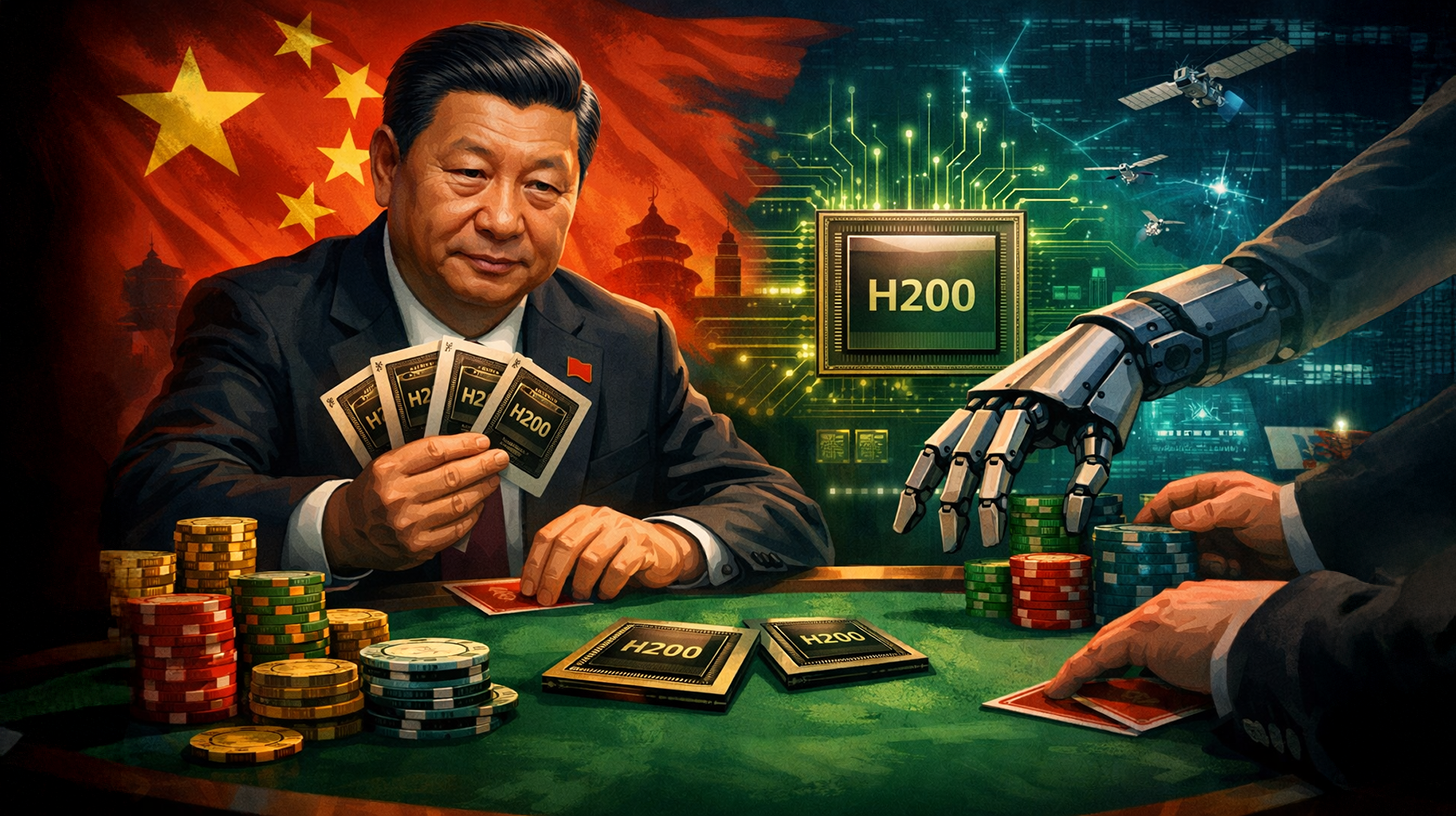
How Beijing is turning the tables again (not entirely voluntarily?) (Part 2) – Beijing's chip poker game over Nvidia's H200 AI processors – Image: Xpert.Digital
Alibaba, Tencent and ByteDance receive the green light to prepare orders for the US superchip
The invisible hand that guides two empires
A remarkable about-face. Alibaba, Tencent, and ByteDance received the green light to prepare orders for Nvidia's H200 chip, the very semiconductor that had been seized at Chinese customs just weeks earlier. This development marks far more than a mere footnote in trade policy. It reveals the fundamental tension between two competing imperatives that define China's technological future: the unwavering will to self-sufficiency and the brutal reality of technological dependence in a world where artificial intelligence increasingly determines economic and military supremacy.
In early January 2026, Chinese authorities initially blocked imports of Nvidia H200 chips at customs, even though the US had approved their export to China under strict conditions. Reuters and other media outlets reported that customs offices in Shenzhen and elsewhere were instructed not to accept customs declarations for the H200 or to "not allow the chips into the country." At the same time, Chinese tech companies were advised not to place orders for the time being, or only "if absolutely necessary.".
Since the end of January 2026, however, there have been reports that Beijing has in principle approved large Chinese companies such as Alibaba, Tencent and ByteDance being allowed to prepare H200 orders – meaning they can formally place orders again.
That means:
- Politically, the way has been cleared for China to order and import H200 chips again, but under restrictive conditions (e.g., the requirement to buy domestic chips in parallel).
- Operationally, this has not yet been fully "played through": The customs blockade from mid-January was a de facto stop, which is now apparently to be transformed into a controlled, limited import, not into a complete return to the status quo before 2022.
This is currently likely a politically driven, limited opening, not a simple return to free procurement as before the US export controls.
The Chinese leadership faces a dilemma that cannot be resolved through political rhetoric. On the one hand, Beijing has pursued an aggressive strategy of semiconductor self-sufficiency for years, supported by hundreds of billions of dollars in state investment and a national mobilization of the technology sector. On the other hand, the figures reveal a sobering truth: the technological gap with top-of-the-line American products remains substantial, and Chinese tech giants urgently need high-performance chips to avoid falling behind in the global AI race.
The decision to import American chips under restrictive conditions is not a capitulation, but rather calculated realpolitik. It reflects a sober assessment of China's own technological capabilities and the timeframes required to develop them. At the same time, it sends signals about the actual performance of Chinese alternatives and the strategic priorities of the leadership in Beijing.
Related to this:

The anatomy of a divided market
The Chinese semiconductor market for artificial intelligence will undergo a period of tectonic shifts in 2026. With a projected total demand of around four million AI chips, the market is facing a dramatic realignment of power. Nvidia, which still dominated with a 66 percent market share in 2024, is expected to plummet to just eight percent, according to analysts. This erosion is not primarily the result of voluntary purchasing decisions by Chinese companies, but rather the consequence of a dual constraint: American export controls on the one hand, and Chinese nationalism and industrial policy on the other.
Domestic suppliers are filling this gap with remarkable speed. Huawei plans to double production of its Ascend 910C chip to 600,000 units by 2026, which, together with other models in the Ascend line, will amount to a total of 1.6 million dies. Cambricon Technologies is targeting 500,000 AI accelerators, while startups like Moore Threads and MetaX are reporting impressive triple-digit percentage revenue growth. Moore Threads saw its share price rise by 425 percent after its IPO, and Cambricon's soared by over 500 percent. These valuations reflect not only market euphoria but also the strategic importance that investors attribute to the domestic chip industry.
Nevertheless, closer examination reveals significant structural weaknesses. Huawei's Ascend production is not limited by manufacturing capacity, but rather by the bottleneck in high-bandwidth memory (HBM). By 2026, only two million HBM stacks from CXMT, China's leading DRAM manufacturer, are expected to be available, sufficient for only 250,000 to 300,000 Ascend 910C chips. This discrepancy between theoretical chip production and actual assembly capacity illustrates the complexity of modern semiconductor supply chains, where a single bottleneck can cripple the entire value chain.
SMIC, China's most advanced contract manufacturer, plans to double its 7-nanometer capacity to approximately 30,000 wafers per month, but even this expansion operates at yields of 60 to 70 percent on a process node that TSMC had already mass-produced in 2018. The technological gap is not only measurable, it is widening, as American and Taiwanese manufacturers have long since moved on to 3-nanometer processes and are experimenting with 2-nanometer technology.
The $54 billion offer and its conditions
If Alibaba and ByteDance each intend to order over 200,000 H200 units, as sources indicate, this clearly reflects a fundamental assessment: the available Chinese alternatives are insufficient to meet the demands of advanced AI models. The H200 offers roughly six times the computing power of the H20, the chip Nvidia developed specifically for the Chinese market, which was banned in April 2025. With a Total Processing Performance score of 15,832 and an HBM bandwidth of 4.8 terabytes per second, the H200 falls just short of US export control thresholds, yet still provides ample performance for training large language models.
If Nvidia fulfills the estimated 1.4 to 1.5 million units ordered, it could theoretically generate $54 billion. After deducting the 25 percent levy for the US government, this would leave approximately $40 billion. This sum more than doubles Nvidia's total China revenue of $17.1 billion in 2024. However, the actual allocation will likely be considerably smaller, with experts predicting 400,000 to 500,000 units. This supply-demand imbalance reflects not only production capacity but also political calculations on both sides of the Pacific.
The American government has established a sophisticated control regime. Every H200 destined for China must be tested in an independent American laboratory. A quota system limits Chinese shipments to a maximum of 50 percent of the quantity delivered to American customers. Nvidia requires full prepayment with no return or cancellation options, shifting the entire financial risk to the buyers. Furthermore, the chips are explicitly prohibited from use in military contexts, sensitive government facilities, critical infrastructure, and state-owned enterprises, although the definition of these categories is deliberately vague.
Beijing, in turn, conditions its import permits on the requirement that companies simultaneously procure a certain quantity of domestically produced chips. This linkage clause serves several purposes: it secures markets for domestic industry, demonstrates political sovereignty, and establishes a basis for gradual substitution. The exact quotas remain unclear, but the principle is unambiguous: imported American cutting-edge technology is understood as a temporary bridging solution, not as a permanent dependency.
Industrial policy as a systemic conflict
The diverging approaches to semiconductor funding reveal fundamental differences between American and Chinese understandings of government. The American CHIPS and Science Act of 2022 authorized $280 billion for research and development as well as production incentives, distributed through complex application processes and project-specific approvals. Intel received $7.3 billion for fab expansions in Ohio, and TSMC is investing $40 billion in facilities in Arizona. This funding follows a logic of risk-sharing between the state and the private sector, embedded in the rule of law and legislative oversight.
China's approach operates on different principles. The National Integrated Circuit Industry Investment Fund, known as the Big Fund, has injected over $150 billion into the semiconductor industry since its inception, with a third tranche of an additional $70 billion in preparation. These funds flow directly to select national champions such as SMIC, Huawei HiSilicon, CXMT, and YMTC, bypassing the legislative hurdles of Western democracies. Tax exemptions, subsidized energy, privileged access to capital, and state-coordinated talent acquisition round out the arsenal.
The goal of 70 percent self-sufficiency by 2025, formulated in the Made in China 2025 initiative, proved overly ambitious. Realistic estimates place the actual self-sufficiency rate at around 30 percent, depending on the definition and measurement methodology. However, this gap is not motivating a revision, but rather an intensification of efforts. The 14th Five-Year Plan (2021-2025) elevated semiconductors to an explicit strategic priority and called for a society-wide effort. Electric vehicle manufacturers were instructed to increase their procurement of domestic automotive chips. Telecommunications providers were tasked with replacing all AMD and Intel chips in their infrastructure with Chinese alternatives by 2027.
This military-civil fusion strategy, centrally coordinated by Xi Jinping personally, creates synergies that would be unthinkable in Western systems. Breakthroughs in civilian AI research flow directly into military applications. The boundaries between academic research, commercial development, and defense innovation are systematically blurring. For the People's Liberation Army, this means accelerated access to cutting-edge technology; for Western security planners, it presents a significant challenge.
The economic logic of technological bifurcation
The development of two parallel technology ecosystems is no longer a future scenario, but a current reality. After decades of global integration and division of labor, the semiconductor industry is fragmenting along geopolitical fault lines. This bifurcation generates significant efficiency costs on both sides, but also creates new strategic options and dependencies.
For American companies, shrinking access to the Chinese market means the loss not only of revenue but also of economies of scale that help amortize research and development costs. Nvidia's revenue from China fell from over 20 percent of its data center business to almost zero before the recent H200 approval allowed for a partial revival. While the H20 model, specifically designed for China, generated $4.6 billion in revenue in the first quarter of fiscal year 2026, Nvidia had to write down $4.5 billion in inventory after the ban imposed in April 2025. Such abrupt policy changes increase planning uncertainty and raise risk premiums.
Chinese companies, on the other hand, are forced to invest in less efficient domestic alternatives, even if these have performance and energy efficiency disadvantages. ByteDance, Nvidia's largest customer in China in 2024, has budgeted capital expenditures of the equivalent of $22 billion for 2025, while Alibaba combined with Ant Financial has earmarked approximately $21 billion. These sums are not only being invested in chips, but also in building complete software stacks compatible with domestic hardware. This parallel development ties up resources that could otherwise be invested in application innovation.
Nevertheless, the speed of China's catch-up process should not be underestimated. DeepSeek, a Chinese AI startup, recently demonstrated that advanced language models can be developed with just 2,048 H800 GPUs and an estimated $5.6 million in training costs, although critics point to actual total costs of $100 million to $1 billion. Even so, this example shows that algorithmic innovation can partially compensate for hardware limitations. Chinese researchers make up about 50 percent of the world's AI scientists, and many leading open-source models originate in China, as Nvidia CEO Jensen Huang has repeatedly emphasized.
A new dimension of digital transformation with 'Managed AI' (Artificial Intelligence) - Platform & B2B solution | Xpert Consulting


A new dimension of digital transformation with 'Managed AI' (Artificial Intelligence) – Platform & B2B solution | Xpert Consulting - Image: Xpert.Digital
Here you will learn how your company can implement customized AI solutions quickly, securely and without high entry barriers.
A managed AI platform is your all-inclusive, worry-free solution for artificial intelligence. Instead of dealing with complex technology, expensive infrastructure, and lengthy development processes, you receive a ready-made solution tailored to your needs from a specialized partner – often within just a few days.
The key advantages at a glance:
⚡ Rapid implementation: From idea to ready-to-use application in days, not months. We deliver practical solutions that create immediate added value.
🔒 Maximum data security: Your sensitive data stays with you. We guarantee secure and compliant processing without sharing data with third parties.
💸 No financial risk: You only pay for results. High upfront investments in hardware, software, or personnel are completely eliminated.
🎯 Focus on your core business: Concentrate on what you do best. We take care of the entire technical implementation, operation, and maintenance of your AI solution.
📈 Future-proof & scalable: Your AI grows with you. We ensure continuous optimization and scalability, and flexibly adapt the models to new requirements.
More information here:
The grand scheme: Why the US is deliberately supplying China with older AI chips
Between trust and vulnerability: The strategic dimension
The H200 approval is more than trade policy; it is a projection of power through technological control. Washington is pursuing a strategy of tiered dependency: export controls restrict access to cutting-edge technology while simultaneously allowing the sale of less powerful variants. This maintains American market presence, generates revenue to fund domestic research, and delays the development of entirely independent Chinese architectures.
The H200 lags two generations behind Nvidia's current Blackwell chips and three behind the recently announced Vera Rubin line. This time lag is calculated: Chinese companies receive enough performance to avoid being completely left behind in the global AI race, but not enough to seriously threaten American leadership. At the same time, they remain integrated into the Nvidia ecosystem, creating lock-in effects through software compatibility, developer expertise, and existing infrastructure.
Critics see this as a dangerous balancing act. Senators from both parties warned that the H200 approval represents an economic and national security disaster. Republican Congressman John Moolenaar, chairman of the China Select Committee, argued that China would appropriate the technology, mass-produce it, and eliminate Nvidia as a competitor. Indeed, China's industrial policy history shows a consistent pattern: import, absorb, replicate, improve, substitute.
The military-civil fusion doctrine exacerbates these concerns. Every chip sold to commercial Chinese companies could theoretically end up in military applications. Autonomous weapon systems, drone swarms, improved reconnaissance and target identification, AI-powered cyber operations—all these domains benefit from the same computing power that drives commercial AI applications. The nominal export restrictions for military and security-related end users are difficult to enforce, especially since the lines between civilian and military are systematically blurred in China's system.
At the same time, proponents argue that outright export bans would be counterproductive. They would cut Nvidia off from the world's second-largest AI market, help Huawei consolidate its market position, and accelerate the development of Chinese alternatives. Jensen Huang described the idea of technological decoupling as naive and unrealistic. He emphasized the immense interdependence between the US and China and warned that excessive regulation would hinder American innovation rather than prevent Chinese progress.
Related to this:
Price signals and market distortions
The black market for H200 chips reveals the intensity of Chinese demand. Reports indicate that server bundles containing eight H200 chips are being traded in China for 50 percent above the official list price. Universities, data centers, and entities with military ties are attempting to acquire the chips through gray market channels, according to Reuters analysis of over one hundred tenders and academic publications. These premium prices signal not only scarcity but also an appreciation for performance differences that domestic alternatives cannot address.
Intense price competition is emerging within the legal market. Experts anticipate widespread price pressure in the Chinese AI chip segment by 2026. Government procurement is likely to trigger price wars, while large internet companies, with limited annual budgets, will reduce their purchases of domestically produced chips once they receive H200 allocations. To control overall costs amidst increasing volume requirements, these companies will inevitably demand price reductions.
This price dynamic is putting domestic manufacturers under pressure before they can realize economies of scale. Cambricon, Moore Threads, and MetaX are still operating at a significant loss. While Moore Threads reduced its net loss by about 40 percent in 2025, from 1.6 billion yuan to an estimated 950 million yuan, it remains unprofitable. The valuations of these companies reflect future expectations, not current profitability. Should market access for American chips be permanently eased, these valuations could correct significantly.
Energy policy as an invisible variable
An often overlooked factor in the AI infrastructure equation is energy. China has structural advantages in electricity generation and pricing. Analysts at Bernstein project that renewable sources will generate 5,500 terawatt-hours of electricity annually by 2030, 40 percent of total generation. This is enough to meet the estimated data center demand of 479 terawatt-hours, at lower costs than in the US or Europe.
Jensen Huang lamented in interviews that while US states are considering over 50 new AI regulations, China is subsidizing energy costs for local companies developing Nvidia alternatives. This asymmetric regulatory landscape exacerbates competitive disadvantages for American companies. At the same time, China is investing heavily in capacity expansion to meet growing electricity demand, which has outpaced GDP growth over the past five years. Data centers are projected to account for only three percent of total consumption by 2030, leaving ample room for expansion.
This energy policy dimension strengthens China's long-term competitive position. Even if domestically produced chips are initially less energy-efficient, lower electricity costs can partially offset this disadvantage. Furthermore, state control over energy infrastructure allows for the targeted prioritization of strategic industries, regardless of market mechanisms.
Time window and strategic patience
The central question is not whether China will achieve technological self-sufficiency in high-performance AI chips, but when and at what cost. Optimistic scenarios from Chinese planners anticipate significant breakthroughs within three to five years. Skeptical Western analysts expect ten to fifteen years, assuming continued export controls on critical production technologies such as EUV lithography.
ASML, the Dutch monopolist for EUV systems, remains a key player. China's inability to procure these machines forces SMIC to use older DUV systems with multiple patterning for 7-nanometer production. This approach is technically feasible but inefficient and expensive. Breakthroughs to 5-nanometer processes remain experimental, with yields below 20 percent. Even if SMIC achieves pilot production in 2026, commercial mass production is years away.
In parallel, China is investing heavily in alternative lithography technologies and attempting to close the technological gap through talent acquisition, industrial espionage, and massive resource allocation. Its successes in 7-nanometer production despite export controls demonstrate that China's capabilities have been underestimated. Each additional process node becomes more challenging, but linear extrapolation of past delays ignores the nonlinear effects of state mobilization and growing technical expertise.
For Chinese tech giants, this means difficult trade-offs. Massive investments in H200 procurement tie up capital and create dependencies, but enable competitive AI services in the short term. Investments in domestic alternatives may only pay off in the medium term, but are strategically essential. The likely solution is a dual-track strategy: H200 for training advanced models, and domestic chips for inference and less demanding workloads.
Consequences for global power relations
The H200 saga is a microcosm of a broader geopolitical realignment. It illustrates the limits of American technological hegemony as well as the persistence of Chinese structural deficits. Both superpowers are investing hundreds of billions in AI infrastructure, but are pursuing fundamentally different approaches.
America's strategy relies on ecosystem dominance: control over chip architectures, software frameworks, cloud platforms, and developer communities. China responds with vertical integration, state coordination, and a willingness to accept short-term inefficiencies for long-term autonomy. Both models have intrinsic strengths and weaknesses.
For third countries, this bifurcation presents both opportunities and risks. Europe, Japan, South Korea, and others must navigate between American export compliance requirements and the allure of the Chinese market. Taiwan, home to TSMC, finds itself in a particularly precarious position: indispensable to both sides, yet vulnerable to both.
The economic costs of this technological fragmentation are substantial. Duplication of research efforts, incompatible standards, fragmented markets – all of this reduces global efficiency. At the same time, security experts argue that the costs of uncontrolled technology proliferation would be even higher. The debate remains unresolved because it ultimately rests on differing assessments of risk, time preferences, and fundamental normative assumptions.
The next moves in chess
Several developments will be crucial in 2026 and beyond. First, will Beijing actually approve H200 imports on a significant scale, and under what conditions? The vaguely worded tying requirement for domestic chips could be effectively made prohibitive. Second, how will the US Congress react? Bipartisan legislative initiatives for stricter controls and two-year Blackwell bans indicate that the Trump administration could face parliamentary opposition.
Third, will CXMT achieve the breakthrough to HBM3 mass production by the end of 2026? This would eliminate Huawei's biggest bottleneck and enable the production ramp-ups that justify capacity expansions at SMIC. Fourth, what unexpected technological breakthroughs could change the equation? DeepSeek's demonstration of efficient training methods suggests that algorithmic innovation can modulate hardware requirements.
Fifth, how is the overall economic and geopolitical relationship between Washington and Beijing developing? The H200 approval was granted in the context of temporary trade truces and diplomatic thaw signals. A deterioration in the overall relationship would inevitably have repercussions for the technology sector.
In the long term, a scenario of dual ecosystems seems likely, with the boundary between them being more permeable than during the Cold War. Commercial interests, scientific collaborations, and the sheer complexity of global supply chains create interdependencies that policymakers cannot or do not want to completely resolve. The question is not binary—complete integration or complete decoupling—but rather gradual: How much interdependence, in which areas, and under what controls?
This presents Germany and Europe with the challenge of building their own technological capacities without being forced into the binary logic of American-Chinese rivalry. European semiconductor production accounts for only ten percent of global capacity, with a limited presence in advanced nodes. Initiatives such as the European Chips Act, with its €43 billion in funding, are steps in the right direction, but they are nowhere near the scale of Chinese or American production.
In retrospect, Beijing's H200 decision in January 2026 will appear either as a pragmatic bridging solution that bought China time for technological development, or as a strategic error that cemented dependencies that were later difficult to overcome. The answer will only become clear years from now, when today's investments bear their technological and economic fruit—or not.
Your global marketing and business development partner
☑️ Our business language is English or German
☑️ NEW: Correspondence in your native language!

Konrad Wolfenstein
I and my team are happy to be available to you as your personal advisor.
You can contact me by filling out the contact form here wolfenstein@xpert.digital:or simply call me at +49 7348 4088 965. My email address is
I'm looking forward to our joint project.