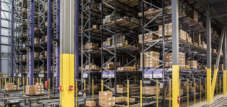
The future and what's to come: Digital technologies such as AI in logistics with sensor technology, robotics and smart shelves – Image: Xpert.Digital
🌐🚛 Survey: Which digital technologies or applications does your company use in logistics?
🚀 Digital technologies in logistics: An overview and outlook
Digitalization is revolutionizing the logistics industry in numerous ways. Companies are increasingly relying on modern technologies to optimize their processes, reduce costs, and increase customer satisfaction. This text highlights some of the most important digital technologies and their applications in logistics, with a particular focus on artificial intelligence (AI), sensor technology, robotics, and smart shelving. These technologies offer potential not only for efficiency gains but also for innovations throughout the entire supply chain.
☁️ Cloud Computing
Cloud computing plays a central role in modern logistics. It enables companies to store their data centrally and access it from anywhere. This facilitates collaboration between different departments and locations and offers flexible scalability of IT resources. According to a survey, 68% of the logistics companies surveyed are already actively using cloud computing, while 16% are planning or discussing it.
🌐 IoT and sensor technology
The Internet of Things (IoT) and sensor technologies are key to monitoring and controlling logistics processes. IoT devices can be installed in vehicles, warehouses, and even in the goods themselves to collect real-time data on location, temperature, humidity, and other relevant factors. This data helps companies increase efficiency, minimize losses, and proactively address potential problems. Currently, 61% of companies use these technologies, and another 23% plan to implement them.
🏢 Warehouse Management Systems (WMS)
Warehouse Management Systems (WMS) are specialized software solutions that automate and optimize all aspects of warehouse management. These systems offer features for inventory control, order processing, and storage space optimization. They help streamline workflows and reduce warehousing costs. With 59% of companies using WMS and 25% considering it, this technology demonstrates widespread acceptance in the industry.
📊 Big Data and Analytics
Big Data analytics is particularly valuable in logistics for identifying patterns and trends that can be used to optimize processes. By analyzing historical data, companies can better predict when and where resources will be needed. This not only improves efficiency but also enables personalized customer communication. 41% of companies already use Big Data and analytics, while 29% are considering these technologies.
🤖 Artificial Intelligence (AI)
Artificial intelligence (AI) has diverse applications in logistics, ranging from route optimization and delivery time prediction to the automation of customer service interactions. AI algorithms can analyze large amounts of data and identify patterns that might escape human analysts. However, the use of AI in logistics is not yet as widespread as other technologies, with only 22% of companies actively using AI and 27% considering it.
🤖 Robotics
Robotics is playing an increasingly important role in the automation of warehousing and distribution processes. Robots can be used for order picking, packing, and transporting goods, significantly increasing efficiency and reducing labor costs. Currently, 11% of companies use robots, and 36% are planning or discussing their use.
🖥️ Digital Twins
Digital twins are virtual models of physical objects or systems that use real-time data to simulate their behavior. In logistics, digital twins can be used to model warehouses and test different scenarios without making any physical changes. This can help identify bottlenecks and improve efficiency. 14% of companies already use digital twins, while 25% are considering implementing them.
📦 Smart Shelves
Smart shelving systems are equipped with sensors that automatically monitor and update inventory. This technology allows for real-time tracking of stock levels, preventing shortages or overstocking. Despite its great potential, this technology is currently only used by 6% of companies, while 25% are considering implementation.
🚁 Drones
Drones offer innovative solutions for last-mile delivery, especially in hard-to-reach or remote areas. They can also be used for inventory management in large warehouses or for monitoring transport routes. However, the use of drones in logistics is still in its early stages, with only 4% of companies currently using this technology and 26% discussing its use.
🚀 Outlook and future prospects
The logistics industry faces an exciting future in which the integration and further development of digital technologies will play a key role. The increased use of AI, IoT, and big data will enable companies to make their supply chains even more efficient and flexible. The challenge will be to implement these technologies securely and responsibly, particularly with regard to data protection and cybersecurity.
Digital technologies will profoundly transform the logistics industry, offering a wealth of opportunities for innovation. Companies investing in these technologies can gain a competitive edge and better respond to evolving market demands. The role of these technologies will continue to grow in the coming years, promising exciting developments for the industry.
📣 Similar topics
- 📦 Logistics revolution through digital technologies
- ☁️ Cloud computing in modern logistics
- 🔗 IoT and sensor technology: Networking logistics
- 🏢 Warehouse Management Systems: Efficiency in the warehouse
- 📊 Big Data and Analytics: Optimizing Logistics Processes
- 🧠 Artificial intelligence in logistics: A look into the future
- 🤖 Robotics: Automation in the logistics industry
- 🌀 Digital Twins: Virtual Models for Real-World Optimization
- 🛒 Smart Shelves: Automation of Inventory Management
- 🚁 Drones: Innovation on the last mile
#️⃣ Hashtags: #DigitalTechnologies #Logistics #ArtificialIntelligence #IoT #Robotics
🎯🎯🎯 Benefit from Xpert.Digital's extensive, five-fold expertise in one comprehensive service package | BD, R&D, XR, PR & Digital Visibility Optimization


Benefit from Xpert.Digital's extensive, five-fold expertise in a comprehensive service package | R&D, XR, PR & Digital Visibility Optimization - Image: Xpert.Digital
Xpert.Digital possesses in-depth knowledge across various industries. This allows us to develop tailored strategies precisely aligned with the requirements and challenges of your specific market segment. By continuously analyzing market trends and monitoring industry developments, we can act proactively and offer innovative solutions. The combination of experience and expertise generates added value and provides our clients with a decisive competitive advantage.
More information here:
🌐📦 The ongoing digitalization and its impact on the logistics industry
📦🤖 The ongoing digitalization has permeated almost all areas of our society and is revolutionizing the logistics industry. In a world where efficiency and accuracy are paramount, digital technologies are paving the way for optimized and future-proof logistics. Artificial intelligence (AI), sensor technology, robotics, and intelligent racking systems play key roles in this transformation.
🧠 Artificial Intelligence – Giving Logistics an Intellectual Upgrade
Artificial intelligence has the potential to fundamentally transform the logistics industry. By enabling the analysis of large volumes of data in real time and the extraction of valuable insights, companies can design their logistics processes more precisely and efficiently. AI applications make it possible, for example, to create demand forecasts, optimize inventory, and dynamically adjust supply chains.
One of the most remarkable applications of AI in logistics is route optimization. Traditionally, route planning relies on rigid algorithms and empirical data that often fail to adequately account for unforeseen events such as traffic jams or weather conditions. AI, on the other hand, can analyze data in real time through machine learning and calculate the most efficient route. This reduces not only delivery times but also transport costs and CO2 emissions.
👂👁️ Sensor technology – The eyes and ears of modern logistics
Sensor technology plays a central role in monitoring and controlling logistics processes. Sensors can monitor various environmental factors such as temperature, humidity, and vibrations in real time, thus ensuring that sensitive goods such as food or pharmaceutical products are transported under optimal conditions.
One example of the use of sensor technology in logistics is the so-called "Internet of Things" (IoT). By networking freight sensors, warehouse racks, and transport vehicles, intelligent systems are created that can operate and communicate autonomously. This allows for the automatic management of inventory and the timely initiation of reorders in the event of supply bottlenecks. This networking significantly contributes to reducing downtime and improving supply chain efficiency.
🤖🎛️ Robotics – Automation and efficiency improvements in logistics
Robotics and automation are key drivers of modern logistics. Many warehouses and distribution centers already use autonomous robots to handle tasks such as order picking, packing, and transporting goods. These robots not only work faster and more precisely than human workers, but also relieve them of physically demanding tasks.
A prime example of the use of robots are autonomous vehicles that operate between warehouses and production facilities. These vehicles navigate autonomously using AI and sensors, and can detect and avoid obstacles. This optimizes the internal flow of goods and reduces throughput times.
📦🧩 Intelligent shelving systems – The backbone of the modern warehouse
Intelligent racking systems are an integral part of automated warehousing. These systems consist of modular, flexibly adaptable racking units controlled by software, providing real-time data on inventory levels and goods movements. Through the integration of AI and sensor technology, these systems can optimize warehouse operations by, for example, automatically assigning storage locations based on the type and frequency of goods.
A particularly innovative example is the "goods-to-person" system. Here, required items are automatically transported to warehouse workers, eliminating the need for them to walk long distances within the warehouse. This drastically reduces travel times and increases productivity throughout the entire warehouse process.
🚀🔮 Further developments and future prospects
In addition to the technologies mentioned, numerous other innovations will have a lasting impact on the logistics industry. Blockchain technology is a particularly promising area, as it can provide transparent and tamper-proof documentation in supply chains. The decentralized and immutable storage of transaction data significantly improves the traceability of goods, which is especially important in the food and pharmaceutical industries.
The development of drones and autonomous delivery robots is also progressing. In the near future, these could play a central role in urban delivery traffic by efficiently and environmentally friendly delivering packages directly to customers. The use of drones could not only shorten delivery times but also reduce traffic congestion in urban areas.
Finally, sustainability is playing an increasingly important role in logistics. Companies are striving to improve their carbon footprint and utilize environmentally friendly technologies. Electric vehicles, energy-efficient warehouses, and the increased use of recycled materials are just a few examples of initiatives that contribute to the ecological optimization of logistics processes.
💡🔧 Integration of digital technologies in logistics
The integration of digital technologies in logistics is inevitable and offers the industry enormous potential for increasing efficiency and performance. Artificial intelligence, sensor technology, robotics, and intelligent racking systems are at the heart of this transformation. They enable more precise planning, faster throughput times, and overall greater efficiency. At the same time, they offer companies the opportunity to react more flexibly to market changes and make their supply chains more resilient. As these technologies continue to advance, the vision of a fully networked and automated logistics system remains a fascinating and achievable future.
📣 Similar topics
- 🚀 The logistics revolution through digitalization
- 🤖 Artificial Intelligence in Logistics – An Intellectual Upgrade
- 🔍 Sensor technology: The eyes and ears of modern logistics
- 📦 Increasing efficiency through robotics and automation in logistics
- 🏗️ Intelligent shelving systems – The backbone of the modern warehouse
- 🌐 The Internet of Things and its importance for logistics
- 📡 Future prospects: Drones and autonomous delivery robots
- 💼 Blockchain technology: Transparency and security in supply chains
- ♻️ Sustainability in logistics: Green technologies in use
- 🔄 Integration of digital technologies and their impact on logistics
#️⃣ Hashtags: #Digitalization #Logistics #ArtificialIntelligence #Robotics #Sustainability
We are here for you - Consulting - Planning - Implementation - Project Management
☑️ Industry expert, here with his own Xpert.Digital industry hub featuring over 2,500 specialist articles

Konrad Wolfenstein
I would be happy to serve as your personal advisor.
You can contact me by filling out the contact form below or simply call me on +49 7348 4088 965 .
I'm looking forward to our joint project.
Write to me


Xpert.Digital - Konrad Wolfenstein
Xpert.Digital is a hub for industry focusing on digitalization, mechanical engineering, logistics/intralogistics and photovoltaics.
With our 360° Business Development solution, we support renowned companies from new business to after-sales.
Market intelligence, smarketing, marketing automation, content development, PR, mail campaigns, personalized social media and lead nurturing are part of our digital tools.
You can find more information at: www.xpert.digital - www.xpert.solar - www.xpert.plus
Keep in touch