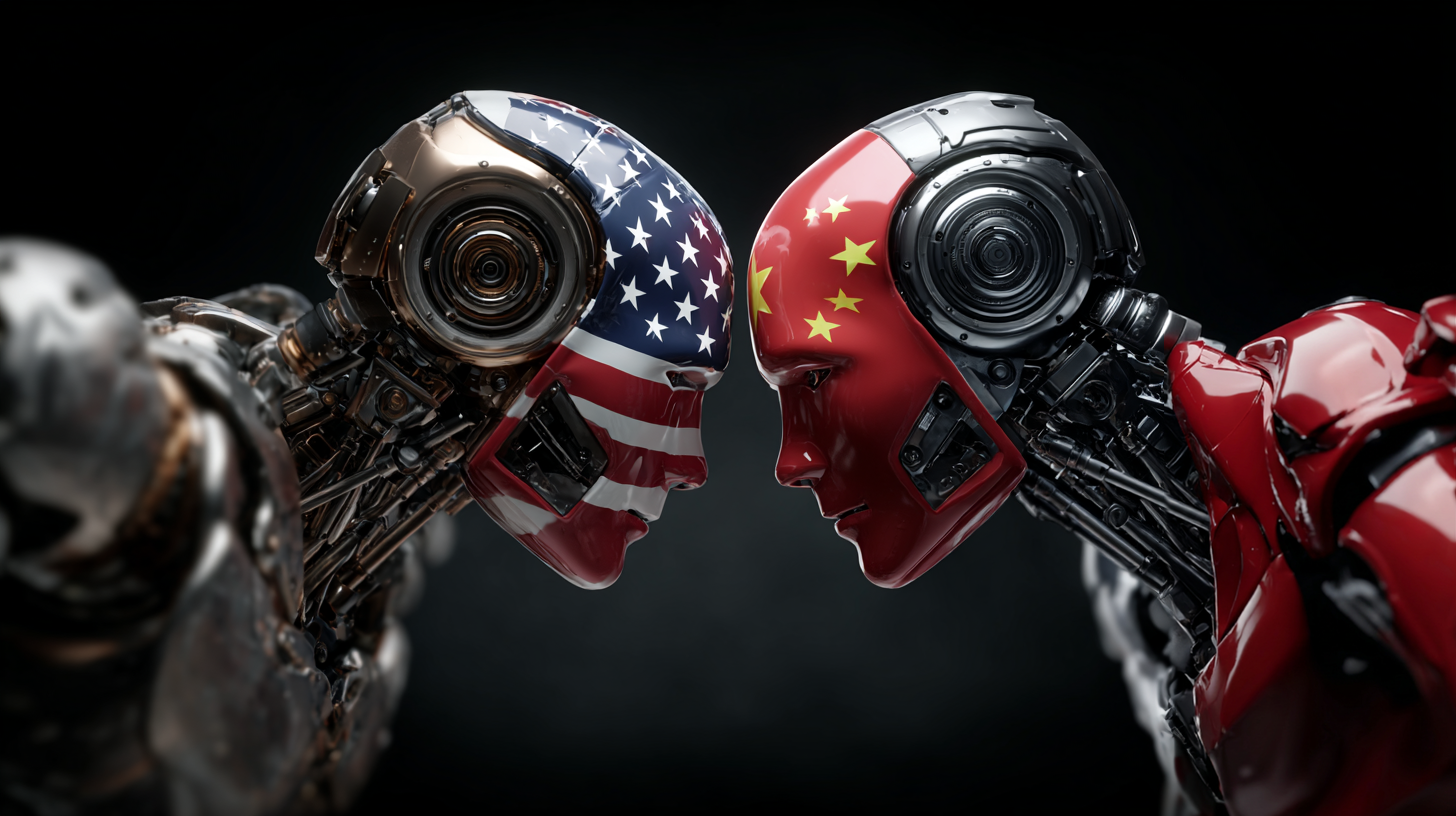
Open vs. closed artificial intelligence – The turning point in global AI geopolitics: China's open-source vs. US dominance – Image: Xpert.Digital
30 times cheaper than OpenAI: How the "DeepSeek" model is revolutionizing the market
End of US dominance? China's open-source strategy breaks the Silicon Valley monopoly
The End of Exclusivity: How the Rise of Open AI Models is Reshaping the Global World Order
The year 2025 marks a historic turning point in the world of artificial intelligence. For a long time, Silicon Valley, with its philosophy of closed, high-priced systems, was considered the undisputed center of technological progress. But this hegemony is crumbling. Driven by US trade restrictions and the pressure for efficiency, Chinese developers have initiated a quiet revolution that is now reverberating loudly across the global market: the era of "Open Intelligence.".
With models like DeepSeek and Qwen, Chinese tech companies are no longer focusing on sheer computing power, but on radical cost efficiency and widespread availability. When a model achieves the performance of OpenAI's flagship models but costs only a fraction to operate, the economic landscape shifts dramatically. It's a paradoxical effect: the sanctions intended to slow China down have triggered a wave of democratization, suddenly making AI accessible to everyone – from small startups in Berlin to development teams in Bangalore.
But this transformation doesn't only bring opportunities. While prices fall and innovation increases, the downsides grow: lack of transparency, censorship risks, and geopolitical uncertainties accompany the new, open super-models. The following article analyzes in depth how the balance of power between the US and China is shifting, why Meta is suddenly becoming the beneficiary, and what this new reality means for the European economy and data security.
Related to this:


The democratization of artificial intelligence is redefining power relations
A fundamental shift is currently underway in the global artificial intelligence landscape, one that extends far beyond technological metrics and has profound economic, strategic, and geopolitical consequences. For the first time in modern AI history, Chinese developers have surpassed their American competitors in the number of downloads of open-source models. This is not merely a statistical shift, but rather a symptom of a fundamental restructuring of how artificial intelligence is developed, disseminated, and commercialized. The long-standing US hegemony in the AI sector, which was based on the control of proprietary, high-performing, closed-source systems, is being challenged by a new logic: that of open, scalable, and cost-effective models.
The empirical data is unequivocal. According to the report "Economies of Open Intelligence," which analyzes download statistics from the Hugging Face platform, over 44 percent of downloads of popular new models in 2025 originated in China. American developers, once undisputed market leaders, are continuously losing market share. Alibaba's Qwen and DeepSeek model families are experiencing massive growth, leaving formerly dominant US competitors like Meta and Google behind. These two Chinese model families alone account for 14 percent of all downloads. By comparison, Meta's Llama models, which still dominated the market in 2024, only achieved 500 million downloads in the same period, while Alibaba's Qwen family reached over 750 million downloads.
Strategic openness as a response to US sanctions
This shift, however, is not solely the result of technological superiority, but rather the consequence of a deliberate strategic realignment by Chinese technology companies. While American giants like OpenAI and Google guard their most advanced AI technologies behind costly paywalls and closed APIs, China has pursued a diametrically opposed strategy. More than twenty Chinese companies and universities have released open-source models, representing a coordinated, if not formally directed, message to the global market. This openness strategy is not altruism, but a calculated response to the export restrictions and technological sanctions imposed by the United States on Chinese technology companies. Under the US AI Diffusion Framework, advanced AI chips are blocked for China, forcing Chinese developers to work with less expensive hardware and more efficient algorithms.
Paradoxically, this technological limitation has led to an innovation that could prove more costly for the American AI industry in the long run: the mass democratization of AI technology. By making their models openly available, Chinese companies are dramatically lowering the barrier to entry for small teams, startups, and research institutions worldwide. They are ensuring that AI development is no longer the exclusive privilege of a few megacorporations with multi-billion-dollar budgets. This strategic choice, born out of necessity, is becoming the most powerful weapon against the closed AI philosophy of the USA.
Efficiency instead of brute force: The economic superiority of new architectures
The economic core of this shift lies in the radical cost efficiency of Chinese models. DeepSeek-R1, for example, achieves technical performance that is equal to or surpasses that of OpenAI-o1, while operating costs are only about five percent. The cost metric is concrete: DeepSeek charges $2.19 per million output tokens, while OpenAI-o1 costs $60 per million tokens. This is not a marginal difference, but rather a cost saving of approximately 30 times for comparable or better output quality. This cost structure is based on a fundamental methodological innovation. While OpenAI employs a three-stage process consisting of supervised fine-tuning, reward modeling, and PPO optimization, DeepSeek uses pure reinforcement learning without upstream supervision. The model learns through trial and error, correcting itself and solving complex problems through algorithmic experimentation, rather than through expensive human guidance.
The training budget underscores the economic disparity: DeepSeek invested roughly twelve million dollars in its R1 training. OpenAI now spends an estimated seven billion dollars annually on training and inference, with individual training runs reportedly costing hundreds of millions of dollars. A Wall Street Journal report suggests that OpenAI budgets about five hundred million dollars per six-month training cycle for GPT-5. These figures not only highlight the cost-efficiency gains but also a deeper shift in technological logic: Chinese developers have discovered that size and computing power are not the sole determinants of model performance. Intelligent architecture, efficient training methods, and optimized hardware utilization can yield enormous cost savings.
This technological innovation has a direct impact on the economic accessibility of AI. Albaba's Qwen long model, for example, saw its price reduced by 97 percent, making it accessible to millions of developers, startups, and entrepreneurs who cannot compete with OpenAI's pricing. At the same time, it's clear that Chinese models are gaining market momentum through more frequent updates and faster version cycles. Each model update typically generates an increase in user base and adoption. Because Chinese vendors release new versions far more frequently, their user base grows faster than that of American vendors, who update less often but with larger leaps in performance and functionality.
Silicon Valley's answer: Between infrastructure dominance and Meta's open-source turnaround
The transition from a monopoly to a fragmented landscape should not be understood as a simplistic David-versus-Goliath narrative. Rather, it is a coexistence of different economic logics. The US retains structural advantages. With approximately 500,000 AI specialists, American industry possesses the world's largest talent pool. Investments in venture capital and research amount to roughly 502 billion dollars annually. US data center capacity stands at 45 gigawatts, the highest in the world. This infrastructural superiority allows American companies to continue training the most powerful closed-source models, which outperform open-source alternatives in many highly specialized applications. OpenAI models are valued for their reliability and consistency, Meta-Llama has developed a robust community, and Google Gemini offers multimodal capabilities with proprietary scalability.
At the same time, Meta, one of the most important US technology companies, is becoming the biggest apostate of the American closed-source model. Under the leadership of Mark Zuckerberg, Meta has launched an aggressive open-source program, releasing its most powerful open model to date, Llama 4. With 400 billion parameters, Llama 4 positions itself as a direct competitor to OpenAI and Google, but with one fundamental difference: it is freely available. This decision by Meta represents a conscious reversal of its previous strategy and signals that even an established tech giant has recognized that the future of the AI market lies in openness. Gartner's forecast confirms this trend: open-source language models will account for approximately 50 percent of the enterprise market by 2027, a doubling compared to today.
A new dimension of digital transformation with 'Managed AI' (Artificial Intelligence) - Platform & B2B solution | Xpert Consulting


A new dimension of digital transformation with 'Managed AI' (Artificial Intelligence) – Platform & B2B solution | Xpert Consulting - Image: Xpert.Digital
Here you will learn how your company can implement customized AI solutions quickly, securely and without high entry barriers.
A managed AI platform is your all-inclusive, worry-free solution for artificial intelligence. Instead of dealing with complex technology, expensive infrastructure, and lengthy development processes, you receive a ready-made solution tailored to your needs from a specialized partner – often within just a few days.
The key advantages at a glance:
⚡ Rapid implementation: From idea to ready-to-use application in days, not months. We deliver practical solutions that create immediate added value.
🔒 Maximum data security: Your sensitive data stays with you. We guarantee secure and compliant processing without sharing data with third parties.
💸 No financial risk: You only pay for results. High upfront investments in hardware, software, or personnel are completely eliminated.
🎯 Focus on your core business: Concentrate on what you do best. We take care of the entire technical implementation, operation, and maintenance of your AI solution.
📈 Future-proof & scalable: Your AI grows with you. We ensure continuous optimization and scalability, and flexibly adapt the models to new requirements.
More information here:
How open AI models strengthen Europe's SMEs and enable true data sovereignty
New opportunities for SMEs and European data sovereignty
The rise of open-source AI models has immediate consequences for small and medium-sized enterprises (SMEs). Entrepreneurs and developers can now integrate AI capabilities into their products without spending millions on proprietary APIs. Startups founded in Europe, Asia, or other regions have, for the first time, achieved true technological parity with the giants. The French company Mistral AI, for example, which develops open-source models and recently completed a major funding round with a valuation of six billion euros, benefits directly from this new landscape. Similarly, the German startup Aleph Alpha, which focuses on European data sovereignty, can build on powerful open-source foundations instead of developing from scratch.
At the same time, open-source models open up new deployment options that are crucial for data privacy and security-conscious organizations. Instead of sending data to OpenAI, Google, or even Chinese servers, companies can run models locally on their own hardware. This is not just a technical possibility, but an economically and regulatory necessity. In August 2025, the European Union implemented its AI Regulation for General Purpose AI models, which entails extensive transparency requirements. Providers of large language models must disclose in detail how their models work, what data they were trained on, and how they manage risks. Some exceptions are provided for open-source models, giving European and global developers a regulatory advantage over closed systems.
Related to this:
The transparency paradox and geopolitical security risks
However, the quality and transparency of these open models are showing a worrying decline. In 2022, around 80 percent of popular models openly disclosed the data they were trained on. By 2025, this figure had dropped to only 39 percent. What is actually emerging is not true open source with complete transparency, but rather a new category: semi-open models that are free to download, but whose internal workings and training data cannot be traced. This is a kind of democratization without transparency, availability without understanding. It allows many people to use and integrate AI systems, but at the same time creates new uncertainties about the true origins and biases of these systems.
This lack of transparency becomes particularly problematic when it comes to Chinese models. While Chinese developers aggressively disseminate their models, these operate under the influence of state censorship guidelines. DeepSeek and other Chinese AI systems are known to suppress or falsify information when queries are made on sensitive topics such as Taiwan or the Tiananmen Square massacre. This is not a coincidence, but a manifestation of the Chinese control framework in which all technology companies operate under state supervision. The security implications are subtle but significant: While open-source models from Western sources can, at least theoretically, be reviewed by the research community, Chinese models are influenced by opaque mechanisms of political control without any transparency.
A second security concern relates to data privacy and government surveillance. DeepSeek stores user data on servers in China without offering users an opt-out option. This provides the Chinese government with potential access to the data. Reports indicate that DeepSeek implementations are also prone to issuing insecure code when queries become politically sensitive. This raises not only privacy concerns but also questions about the security and reliability of systems used in critical infrastructure or government agencies. The German Federal Government and European institutions are rightly cautious about the deployment of Chinese AI systems in sensitive contexts.
Paradoxically, this geopolitical tension could enable Europe, long a passive observer in the US-China AI race, to take on an independent role. Europe's traditional mistake has been to regulate while others innovated and to innovate while the US scaled. This historical pattern resulted in European inventions like the internet being monopolized by American companies. However, the EU's AI regulation could pave a different path. Instead of merely reactively regulating, Europe can proactively focus on transparency, data sovereignty, and local processing. This not only creates regulatory clarity but also a competitive environment for European developers specializing in trust, security, and compliance.
The geopolitical reality, however, remains nuanced. The US continues to hold absolute leadership in the most powerful systems, though increasingly not through OpenAI, but through Meta and, to some extent, Anthropic. China is not on the path to technologically overtaking the US, but rather to making technological competition more cost-effective and democratic. This changes the rules of the game for millions of actors, but not necessarily for organizations with unlimited budgets. The long-term implication, however, is that a future with readily available, cost-effective AI technology for all actors will redistribute global opportunities and risks.
Disruption of business models and the reality of usage figures
The economic consequences of this shift are profound. For companies, this means that traditional business models based on proprietary AI technology are coming under pressure. Eighty-five percent of the companies surveyed in a recent study see generative AI as a major opportunity to transform their business models. At the same time, about one-fifth warn of significant disruption risks to existing business models. Areas such as software development, design, content creation, and traditional consulting could be massively transformed if high-performance AI systems become accessible to everyone.
This also applies to labor market dynamics. If AI systems are no longer limited to expensive proprietary technology but are accessible to any developer, tasks that currently require specialized expertise could become massively automatable. A web design agency, for example, could be replaced by a small team with good AI support. Service centers, programmers, design offices, and administrative departments could be fundamentally transformed due to the availability of powerful open models. However, this is not an automation event in the classic sense, but rather a redistribution of value creation: Instead of a large company with a large budget providing AI services, medium-sized or small businesses can do the same.
Empirical usage metrics confirm this fundamental shift. The situation becomes even clearer when considering actual token generation—the amount of AI output users actually produce—rather than download numbers. At the end of 2024, Chinese models accounted for only about 1.2 percent of global token generation. By 2025, this share had risen to almost 30 percent in just a few weeks, averaging around 13 percent throughout the year. This is an even more dramatic shift than download figures suggest. DeepSeek alone generated approximately 14.37 trillion tokens between November 2024 and November 2025, significantly more than Qwen's 5.59 trillion tokens, and together they surpass the total output of all other open-source models combined.
In other words, this is not just a shift in availability or interest, but a real shift in usage. Millions of people and organizations are already actively using Chinese open models for their daily tasks, software development, research, and content creation.
In conclusion, it can be stated that the empirical reality of 2025 presents a fundamentally different AI landscape than it did three years prior. The transition from a US-dominated, closed-source-centric architecture to a multipolar, open-source-driven landscape is no longer a prediction or a potential, but a lived reality. Chinese developers have not technically overtaken the US, but have established a different economic logic that prioritizes cost-efficiency, accessibility, and speed. This competition will not be won through absolute technological superiority, but through market logic: Whoever offers affordable, readily available, and regularly updated models will gain larger market shares, regardless of whether their system performs a tenth of a percentage point higher in every single benchmark.
The year 2025 thus marks the transition from an era of AI exclusivity to an era of AI proliferation. The implications for the economy, governance, security, and global power dynamics are significant and require a fundamental reorientation of strategic considerations in politics, business, and science. The free or inexpensive availability of high-performance AI systems is not problematic in itself, but it creates new responsibilities: transparency regarding the origin, training data, and potential biases becomes essential. At the same time, this opens up a new opportunity for countries like Germany and the European Union to function not merely as regulators, but as independent players in the global AI market.
Your global marketing and business development partner
☑️ Our business language is English or German
☑️ NEW: Correspondence in your native language!

Konrad Wolfenstein
I and my team are happy to be available to you as your personal advisor.
You can contact me by filling out the contact form here wolfenstein@xpert.digital:or simply call me at +49 7348 4088 965. My email address is
I'm looking forward to our joint project.
☑️ SME support in strategy, consulting, planning and implementation
☑️ Creation or realignment of the digital strategy and digitization
☑️ Expansion and optimization of international sales processes
☑️ Global & Digital B2B trading platforms
☑️ Pioneer Business Development / Marketing / PR / Trade Fairs
🎯🎯🎯 Benefit from Xpert.Digital's extensive, five-fold expertise in one comprehensive service package | BD, R&D, XR, PR & Digital Visibility Optimization

Benefit from Xpert.Digital's extensive, five-fold expertise in a comprehensive service package | R&D, XR, PR & Digital Visibility Optimization - Image: Xpert.Digital
Xpert.Digital possesses in-depth knowledge across various industries. This allows us to develop tailored strategies precisely aligned with the requirements and challenges of your specific market segment. By continuously analyzing market trends and monitoring industry developments, we can act proactively and offer innovative solutions. The combination of experience and expertise generates added value and provides our clients with a decisive competitive advantage.
More information here: