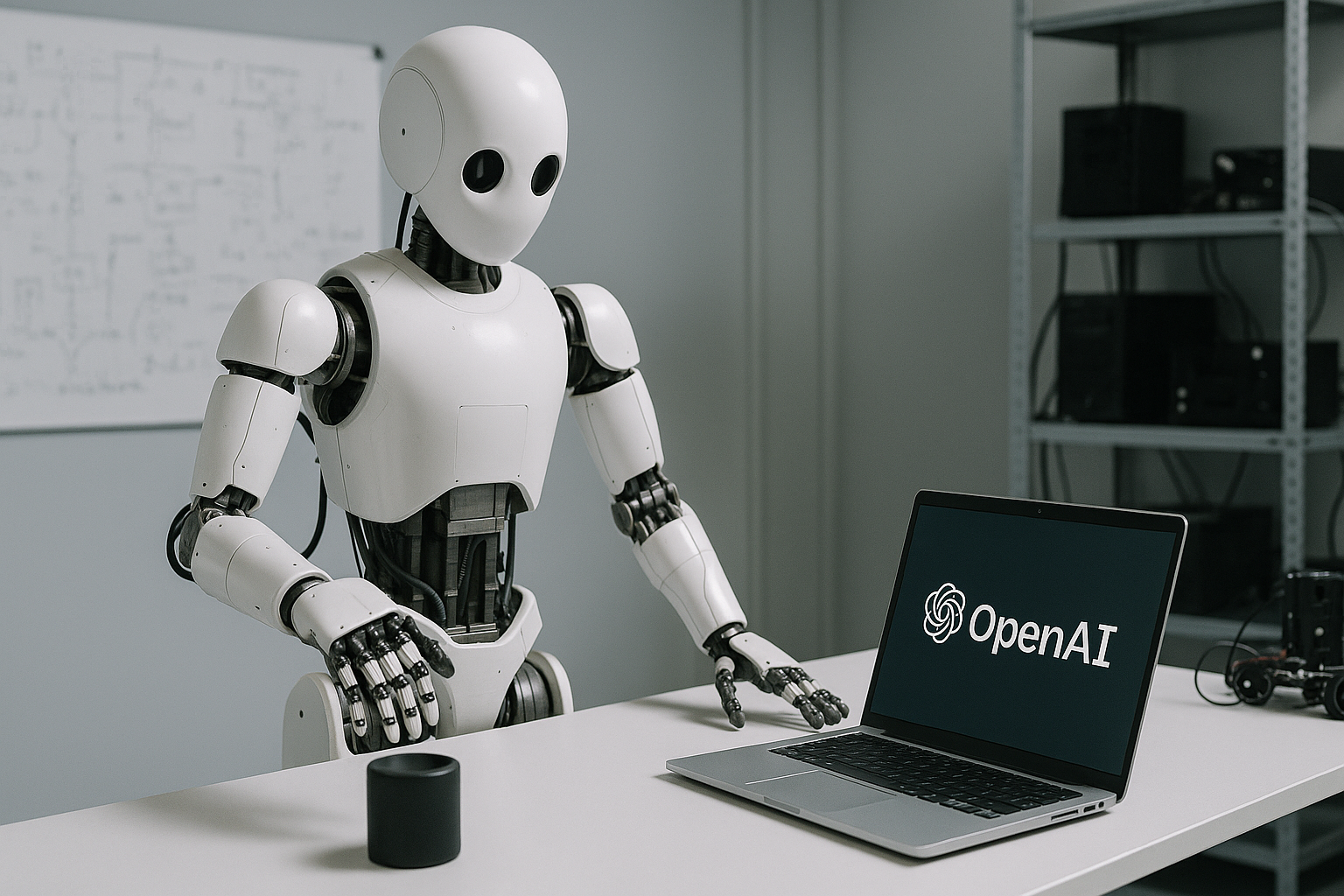
OpenAI's growing interest in robotics: Focus on open-source startup K-Scale Labs – Creative image: Xpert.Digital
Open Source in Robotics: OpenAI's Strategic Reorientation
K-Scale Labs: The next big step in AI-driven robotics
OpenAI's recent interest in the open-source robotics startup K-Scale Labs marks a significant milestone in the ongoing convergence of artificial intelligence and robotics. As AI research and development progress rapidly, the focus is increasingly shifting to the physical embodiment of this intelligence. OpenAI's approach to K-Scale Labs not only underscores the potential of open-source approaches in robotics but also signals a strategic realignment for one of the world's leading AI companies. This report analyzes the background and potential impact of this development, as well as its broader implications for the emerging field of AI-driven robotics.
Related to this:


OpenAI's re-entry into robotics
OpenAI has revived its robotics team after a multi-year hiatus, marking a strategic shift. The company had dissolved its original robotics division in 2020, primarily due to a lack of progress and insufficient training data, as OpenAI co-founder Wojciech Zaremba explained at the time. This decision was made despite the team achieving notable successes, such as developing a robotic arm capable of solving a Rubik's Cube.
OpenAI's relaunch of its robotics initiative is based on several crucial factors. First, technological advancements, particularly in multimodal AI models, have opened up new possibilities for robotics. These models can process various types of input, such as sensor data and voice commands, enabling robots to interact more intelligently with their environment. Second, the market dynamics for humanoid robots have surged, with impressive progress from companies like Figure AI and 1X Technologies.
OpenAI is actively recruiting research engineers for its new robotics team, with job postings emphasizing that selected candidates will be among the team's first members. Unlike previous efforts, OpenAI is focusing this time on collaborating with existing robot manufacturers rather than competing with them. The company plans to develop technologies that manufacturers can integrate into their own systems. This collaborative model could help address one of the main problems that led to the closure of the original robotics division: the lack of training data.
K-Scale Labs: Open-source revolution in robotics
K-Scale Labs, a startup selected from the Winter 2024 batch of the prestigious Y Combinator program, has caught the attention of OpenAI. The company pursues a bold mission: to democratize robotics through open-source technology. Their flagship project, Stompy, is being touted as the world's first open-source, universally applicable humanoid robot.
What makes Stompy particularly remarkable is its innovative design: a 1.20-meter (4-foot) tall humanoid robot designed so that every part can be manufactured on a 256 × 256 mm 3D printer bed. The robot features a gripping mechanism based on Universal Manipulation Interface research and can be built with a total material cost of under $10,000. K-Scale Labs is using carbon fiber PAHT for the prototype, but emphasizes that in principle, any sufficiently strong plastic could be used.
Stompy's technical specifications are impressive: The actuators are quasi-direct drives with reduction ratios between 6:1 and 8:1, resulting in joints with low inertia and retractability, delivering nominal torque values of 3-12 Nm. Each robot is equipped with a replaceable 48V 15Ah battery pack, enabling an operating time of over one hour.
In addition to Stompy, K-Scale Labs also plans to release a metal-based robot design called Zeroth Bot V2, described as "the world's most accessible humanoid robot for developers" to "bring AI into the physical world." This continuous pace of innovation underscores the company's commitment to advancing open-source robotics.
The convergence of AI and robotics
The increasing convergence of artificial intelligence and robotics represents a significant trend in the technological landscape. OpenAI's interest in K-Scale Labs exemplifies this broader trend, often referred to as the "Great Convergence." This convergence manifests itself in the integration of advanced AI models into physical robotic systems, creating new applications and functionalities.
OpenAI has already made significant investments in the robotics sector, most notably with a $100 million investment in 1X, a Norwegian company at the forefront of AI and robotics innovation. This funding was crucial for the development of Neo, an advanced humanoid robot that bridges the gap between modern robotics and artificial intelligence. Furthermore, 1X recently acquired the California-based robotics startup Kind Humanoid, reflecting the consolidation and growth within the sector.
OpenAI's revived robotics team is focused on developing multimodal Large Language Models (LLMs) specifically designed for robotic applications. This integration could revolutionize how robots interact with their environment and tackle complex tasks. Caitlin Kalinowski, a member of OpenAI's technical staff and formerly head of AR glasses at Meta, announced that the company is filling its first hardware robotics roles. These positions include an electrical systems integration engineer, a mechanical product engineer for robotics, and a TPM manager within the robotics team.
Potential of the open-source approach in robotics
The open-source approach to robotics, as pursued by K-Scale Labs, has the potential to fundamentally transform the field by lowering barriers to entry and democratizing innovation. In an industry traditionally characterized by proprietary technologies and high barriers to entry, this approach represents a paradigm shift. K-Scale Labs' vision is to "enable a world with a billion humanoid robots" by reducing barriers and creating opportunities for everyone to participate in this "robotic revolution.".
Other companies in the open-source robotics field include Evezor, Clearpath Robotics, NVIDIA, Husarion, and PickNik Robotics. These companies contribute to the growing community that recognizes the value of open technologies in robotics. The "open-core" business model, which offers a free, open-source version for hobbyists and small developers while commercial companies pay for premium features, has proven viable. However, Andrew Wingate of Evezor emphasizes that robotics developers should prioritize sustainability and that commercial users should always contribute financially or otherwise to the project.
K-Scale Labs has not only disclosed hardware designs but also developed a complete ecosystem. This includes an operating system for humanoid robots that differs from ROS (Robot Operating System) by offering simpler installation and operation. The software infrastructure also includes tools for generating URDF (Unified Robot Description Format) files from CAD models, as well as libraries for training control algorithms in simulation environments.
The founders of K-Scale Labs bring impressive credentials: CEO Benjamin Bolte worked at Tesla and Meta AI, hardware lead Matt Freed has experience at General Dynamics Electric Boat, and software lead Paweł Budzianowski holds a PhD in dialogue systems from the University of Cambridge. This collective expertise drives the ambitious goal of integrating humanoid robots into everyday life.
Related to this:


Importance for the industry
OpenAI's collaboration with K-Scale Labs and the general resurgence of interest in robotics could have profound implications for the entire technology sector. The combination of advanced AI models with physical robotic systems opens up new possibilities for applications across diverse fields, from industrial manufacturing to household tasks.
K-Scale Labs' vision of enabling a world with a billion humanoid robots reflects the belief that robots will be ubiquitous in the future. This democratization of robotics technology could lead to an explosion of innovation, similar to what we have seen with the democratization of software development through open-source movements. K-Scale Labs' approach of making fully functional humanoid robots accessible to everyone could fundamentally change the way we think about and develop robotics.
OpenAI's involvement in this area is particularly significant, as the company is at the forefront of AI research. Integrating its AI models into robotics systems could lead to a new generation of robots better able to understand and execute complex tasks. The collaborative model OpenAI is pursuing could also help overcome one of the major obstacles in robotics: the lack of training data.
In the long term, the convergence of AI and robotics could lead to profound changes in various fields. In industry, AI-powered robots could become more flexible and adaptable, opening up new production possibilities. In the home, universally applicable humanoid robots could take over everyday tasks, changing the way we live and work.
The open-source transformation in robotics: Visions from OpenAI and K-Scale Labs
OpenAI's growing interest in K-Scale Labs and robotics in general marks a significant turning point in the development of intelligent machines. The convergence of AI and robotics, fostered by open-source approaches, has the potential to expand the boundaries of what robots can do and make the technology accessible to a wider audience.
The combination of OpenAI's expertise in AI with K-Scale Labs' innovative, open approach could lead to groundbreaking advancements. The focus on collaboration and open exchange could accelerate development and result in more robust, versatile robotic systems. This brings the vision of a future where intelligent robots are ubiquitous and accessible a step closer.
While the technological challenges remain significant, developments point to a future where the boundaries between the digital and physical worlds are increasingly blurred. The next few years will be crucial in seeing how this convergence unfolds and what new opportunities it opens up for society. The commitment of companies like OpenAI and K-Scale Labs underscores the enormous potential inherent in this emerging field.
Related to this:
Your global marketing and business development partner
☑️ Our business language is English or German
☑️ NEW: Correspondence in your native language!

Konrad Wolfenstein
I and my team are happy to be available to you as your personal advisor.
You can contact me by filling out the contact form here wolfenstein@xpert.digital:or simply call me at +49 7348 4088 965. My email address is
I'm looking forward to our joint project.