
Omnipresence: Why constant visibility ruins your reputation – Why constant presence on LinkedIn & Co. just annoys us – Image: Xpert.Digital
The Paradox of Omnipresence: The Illusion of the Expert
Being found instead of imposing: The secret to genuine credibility in the digital noise
Media fatigue: Why we suddenly actively ignore brands and opinions
"More is better" – this misconception dominates modern digital communication. Whether on LinkedIn, in news media, among influencers, or in corporate communications: the motto is constant presence. The common assumption is that those who are constantly visible and have an opinion on every topic build trust and inevitably establish themselves as experts. But this strategy has a massive blind spot. Psychological research and current studies on media consumption paint a completely different picture: Beyond a certain threshold, media omnipresence has precisely the opposite effect. It generates skepticism, reactance, and sheer exhaustion among the audience.
When authentic thought leaders suddenly become ubiquitous commentators, painstakingly built credibility erodes rapidly. Closeness turns into intrusiveness, expertise into diffuse background noise. This article explores the paradox of familiarity and explains why, in a world flooded with information noise, it's not the volume that matters. Rather, it's "strategic rarity" and the shift from push to pull communication that create genuine trust. Those who understand the secret of "being discovered" have found the key to the most sustainable form of credibility.
Related to this:


When presence becomes a burden: The paradox of media omnipresence
Those who are everywhere are heard nowhere — on the silent erosion of trust and integrity
The attention economy of the digital age fosters a misconception deeply ingrained in the strategies of companies, politicians, influencers, and experts: that visibility guarantees being heard, and constant visibility guarantees trust. However, empirical evidence paints a far more nuanced picture—one that can sometimes even be counterproductive. Omnipresence in the media is no guarantee of credibility. On the contrary, under certain conditions, it can actively undermine it, even for individuals and brands that initially enjoy a favorable public image.
The paradox of familiarity: When closeness becomes distance
From a psychological perspective, there is a well-researched phenomenon known as the mere-exposure effect: Repeated exposure to a stimulus—a face, a brand, an opinion—initially increases emotional preference for it. People tend to perceive familiar things as safer, more reliable, and more pleasant. This effect explains why established media brands have built trust over decades and why consistency in branding is considered a fundamental principle.
However, this effect has a critical limit. Scientific studies explicitly show that extremely high media presence correlates with a poorer reputation for companies—even when the coverage is predominantly positive. A subsequent meta-analysis of the research concludes that exposure leads to ambivalence because it generates a large number of associations that inevitably take on both positive and negative connotations. What initially appears to be an advantage—visibility, awareness, omnipresence—turns into its opposite with increasing density.
In advertising psychology, this pattern is known as the overexposure curve: Initial contact with a stimulus increases interest and recognition, moderate exposure reinforces trust and message, but beyond a certain threshold, desensitization sets in—followed by irritation, rejection, and negative associations. The brain reacts to this sensory overload with protective and defensive mechanisms, including repression and information blocking. Thus, what was intended as a communication strategy activates the self-defense reflexes of the recipients.
Reactance: The psychological resistance to intrusiveness
One of the most robust theories explaining this phenomenon is the theory of psychological reactance, which is extensively discussed in communication studies and media psychology. Reactance describes the defensive posture that arises when people feel their freedom—whether in forming opinions, behaving, or making decisions—is restricted or threatened by external influences. This defensive posture is not a conscious decision, but rather an automatically triggered psychological protection mechanism.
Attempts at persuasion, such as advertising, but also the intensive media presence of individuals or brands, can be perceived as a threat to autonomous action. The more challenging media use or inconsistencies in content become, the more difficult it is for individuals to make decisions that allow them a long-term sense of freedom. This mechanism explains why health campaigns that are too intrusive not only fail but can produce the opposite of their intended effect. The target audience rejects the message not because of its content—but because of the way it is conveyed.
Applied to the logic of media omnipresence, this means: anyone who constantly pushes their opinion, thesis, or personality to the forefront activates precisely this defensive reflex. The audience feels pressured, overwhelmed, co-opted—and withdraws emotionally. The substantive quality of what is said hardly matters at this point. The discomfort is directed at the form, not the content. It is noteworthy that this effect occurs even with people one actually regards favorably. Friendly overwhelm remains overwhelm.
Push versus pull: A fundamental difference in effect
The tension between push and pull communication is not a new concept, but it gains particular analytical depth in the context of media omnipresence. Push communication relies on assertiveness: one's own ideas, opinions, and positions are actively promoted, presented to the audience, and even practically forced upon them. Pull communication, on the other hand, creates conditions under which the audience engages with content of its own volition and responsibility—because it perceives the content as valuable, relevant, and tailored to its individual needs.
Communication studies recommend maintaining a ratio of approximately 2:1 between pull and push elements—that is, twice as much empathetic engagement with the other person as assertive self-positioning. This rule of thumb reflects a profound truth about human communication: people want to feel understood before they can be persuaded. Those who reverse this ratio and operate primarily in push mode risk losing their effectiveness over time, even as competent voices.
The crucial qualitative difference lies in the audience's experience: pull communication creates a sense of personal choice. The recipient has actively sought out the content, stumbled upon the source independently, and therefore feels like an active participant, not a target of a campaign. This psychological difference is fundamental. What I discover myself, I perceive as authentic. What is imposed upon me, I view with suspicion.
Commentary versus entertainment: When the lines blur
Within push communication, it's worthwhile to make another, often overlooked distinction: that between argumentative commentary on the one hand and entertainment on the other. Commentary—in the classic journalistic sense—claims credibility through substantive content. It analyzes, contextualizes, and takes a clear stance. The audience knows what it's getting: a clearly identifiable opinion, supported by argumentation and demonstrable expertise. Entertainment, on the other hand, follows a different logic: it excites, captivates, and amuses—not primarily through accuracy, but through emotional appeal.
The problem arises where the two forms blur together and the audience loses the distinction. Infotainment—that hybrid form which merges information and entertainment—often achieves higher reach than factual commentary, but systematically loses credibility in the process. Studies clearly show that while emotionally charged, dramatized presentations generate attention, they measurably lower the audience's assessment of the content's credibility—even when the factual content of the statements is identical. The format thus devalues the message, regardless of its veracity.
Especially in the digital realm, the boundaries between news, commentary, and entertainment have become blurred. On social media platforms, opinions and factual information are juxtaposed without editorial labeling, and many users transfer this blurred line to traditional media, where they then find themselves lost. Anyone who consistently switches between these formats online—sometimes offering factual commentary, sometimes provocative entertainment, sometimes a humorous interlude—risks being categorized by their audience not as an expert or an entertainer, but as an unpredictable voice without a clear profile. This very unpredictability, however, is one of the strongest forces eroding lasting credibility—perhaps even more so than mere overexposure.
Entertainment operates according to its own logic of credibility—it doesn't even necessarily need one, because the audience consciously doesn't expect a claim to truth. But anyone who tries to build trust with a commentary while constantly switching to entertainment mode pays a double price: they lose the depth of the factual argument and, at the same time, the emotional loyalty that genuine entertainment fosters. That's the trap of hybrid formats in the digital battle for attention.
The Illusion of the Thought Leader: When Quantity Crowds Out Quality
In the B2B environment, a term has become established in recent years that particularly highlights the ambivalence of media omnipresence: Thought Leadership. As a concept, it was once reserved for true thought leaders—people with genuine expertise, proven depth, and the courage to pursue unconventional ideas. Today, the term has degenerated into a flood of content that has more to do with strategic visibility than with intellectual contribution.
Edelman and LinkedIn's study on B2B Thought Leadership Impact found that 38 percent of decision-makers believe the market is oversaturated with content—and only 15 percent rated the quality of available content as good or excellent. Nearly 40 percent stated that there is more content than they can handle. This is a stark assessment of a strategy originally designed to build trust through competence.
LinkedIn, originally a platform for professional networking, has evolved into a medium where visibility often simulates credibility—rather than embodies it. "Confident generalists with high-volume posting," who discuss topics far outside their expertise, dilute the perception of genuine expertise through their omnipresence. The result is growing skepticism toward those who claim to comment on everything. The message: If you're an expert on everything, you're not really an expert on anything.
The exhaustion phenomenon: Media overload as a structural problem
The individual overexposure of people and brands occurs against a structural backdrop that massively exacerbates the problem: the general phenomenon of media overload. Around 71 percent of German internet users state that they actively avoid news at least occasionally—more than ever before. The main reasons they cite are the negative effects on mood (48 percent) and simple exhaustion from the sheer volume of information (39 percent).
This exhaustion is not a weakness of the audience, but an understandable reaction to a structurally overloaded information ecosystem. The human brain is evolutionarily designed for selective attention, not for processing a constant stream of information. Negative news captures attention more strongly than positive news—the brain is wired to identify danger. However, in an environment where this alarm mechanism is permanently activated, the psyche reacts with a strategy of isolation.
Media psychologists refer to phenomena such as doomscrolling, headline anxiety, and media saturation overload in this context. Those striving for omnipresence in this already oversaturated environment are not only fighting against the competition from other voices—they are fighting against the protective mechanisms of their own audience. Social media algorithms exacerbate this problem: they reward emotionally charged and sensationalized content, thereby distorting social perception and creating a kind of funhouse mirror effect, in which a small, vocal minority seems to define the public norm.
🎯🎯🎯 Data-driven B2B industry hub as a quasi-in-house solution

The quasi-in-house solution: How Xpert.Digital closes operational gaps in B2B marketing and sales – Smart Content-Driven Business - Image: Xpert.Digital
Xpert.Digital is a data-driven B2B industry hub led by Konrad Wolfenstein . The company acts as an external, quasi-in-house solution for industrial partners, closing operational gaps in marketing, content, and sales – without requiring additional resources on the client side.
More information here:
Authenticity vs. omnipresence — the credibility conflict
Parasocial relationships and their fragile tipping point
Another analytical framework that describes the phenomenon of overexposure is the concept of parasocial relationships. Parasocial relationships are non-reciprocal, socio-emotional connections between media personalities and their audience. They are not real relationships, but they feel real to the audience—with all the psychological consequences that real relationships entail.
Precisely because parasocial relationships are based on intimacy, they are particularly vulnerable to what researchers call "eroded reciprocal intimacy": the erosion of mutual closeness through the perception that the relationship is being exploited or instrumentalized. When influencers or opinion leaders appear too frequently, too intrusively, or increasingly commercially, the positive parasocial bond tips into a negatively charged one—even leading to active rejection or anti-fan sentiment. The audience consciously breaks off the connection when the opinion leader violates their expectations.
This tipping point is all the more significant because it can occur even with people who were initially well-disposed towards you. Loyalty is not a guarantee against oversaturation. It merely slows down the erosion process—it doesn't prevent it. This makes managing media presence an ongoing, strategically demanding task, not a problem that can be solved once and for all.
Related to this:


Authenticity under the pressure of visibility
In a world saturated with curated identities, authenticity has become one of the most valuable qualities in the communication landscape. It builds trust because it connects with audiences on a human level—beyond strategy, staging, and message discipline. But authenticity and omnipresence are often structurally contradictory.
Anyone who is constantly present, who expresses an opinion on every topic, who broadcasts on every channel and at all times, can hardly remain authentic—simply due to capacity constraints. The pressure to constantly deliver content almost inevitably leads to a dilution of the substantive content. The focus shifts from deep expertise to strategic visibility. The credible expert becomes a commentator—and the commentator a familiar face without any identifiable core competence.
According to a PR analysis, message dilution is a key warning sign of overexposure: When journalists and the public increasingly ask a person about topics far removed from their core expertise, their profile has lost its edge. The brand becomes associated with constant activity, not with concrete competence. The initial impression of an expert gives way to that of a ubiquitous commentator—and this impression is difficult to reverse.
The loss of trust in the German media context
The issue of trust also has a societal dimension that extends beyond individual communication strategies. According to the long-term study "Media Trust" by the University of Mainz, only 44 percent of the German population now trusts the statement that the media can be trusted on truly important issues—a significant decline compared to the pandemic peak of 56 percent in 2020. Trust has reverted to pre-pandemic levels.
Media skepticism doesn't occur in isolation: those who distrust the media also tend to hold a critical stance towards political institutions—the two are closely intertwined. The perception of moral pressure exerted by media or political debates, the feeling of being pushed towards certain opinions, significantly intensifies this distrust. Here, the push logic reveals itself in its most socially destructive form: a media sphere perceived as a collective push mechanism that dictates opinions instead of fostering discourse loses the foundation of its social mandate.
The Reuters Institute Digital News Report 2025 confirms that while general interest in news has remained stable in Germany, active news avoidance has reached historic highs. The paradox is obvious: we have more content than ever before, more channels, more voices—and at the same time, the longing for calm, for filtering, for substance is growing.
The power of strategic scarcity
From all these considerations arises a conclusion that initially seems counterintuitive: In a world of information overload, rarity is a strategic advantage. Those who are not constantly present stand out when they do speak up. The audience comes voluntarily—and thus with a completely different quality of attention and openness.
The principle of genuine scarcity differs fundamentally from artificial scarcity. Artificial absence—the staged silence followed by the marketing of a reappearance as an event—is transparent and itself breeds distrust. Genuine rarity, on the other hand, arises from deep commitment: those who only speak when they have something substantial to contribute; those who are willing to delegate topics outside their own expertise to others; those who prioritize substance over visibility. This form of rarity acts as a natural quality filter.
In inbound marketing, this principle has been known for years: Organic growth through relevant content that target groups seek out on their own generates more sustainable relationships than pure push campaigns. The likelihood of visitors becoming high-quality leads and long-term customers is significantly higher with pull-driven interaction. Applied to personal credibility, this means: Someone who is discovered is accorded a completely different level of trust than someone who constantly seeks out others.
The lasting effect of being discovered
The crucial qualitative difference between push and pull communication lies in the ownership structure of attention. Those who force attention through push communication don't truly own it—they've merely borrowed it. The audience can switch off, change channels, or block communication at any time. However, those who are found through pull communication have achieved something more fundamental: The audience has invested. They have searched, asked questions, compared information—and in doing so, have decided to trust that voice.
This self-earned trust is more robust than any sense of familiarity forced by frequency. It withstands criticism better, is less susceptible to reactance, and forms the basis for genuine loyalty. The moment someone is searching for an answer to a specific problem and encounters a particular person or source is when their attention is at its most focused and their receptiveness to persuasion is at its highest. This is the ideal moment for communication—and it cannot be forced by frequency, but only earned through relevance.
In the long term, the rediscovery effect is a particularly powerful phenomenon: Anyone who reappears after a period of absence, triggered by a specific problem or a search query from the audience, benefits from a double trust bonus—firstly, through the memory of previous positive perceptions, and secondly, through the renewed enthusiasm of rediscovery. They are not perceived as omnipresent background noise, but as the answer to a specific question. This perception carries a different weight, is more deeply rooted, and more lasting.
Integrity as a calibration tool
The question of how much presence is beneficial cannot be answered abstractly—it is a question of integrity. Integrity in media communication means congruence between what one says, what one knows, and how one presents oneself. It is not merely a moral category, but a strategic one: people perceive incongruity, even if they cannot explicitly name it. The feeling that someone claims to be more than they are; that someone takes a position on every topic without the necessary depth—this feeling gradually undermines trust, long before a breakdown occurs.
The Dunning-Kruger effect offers an illuminating perspective from a different angle: people with limited expertise tend to overestimate their own competence, while true experts often underestimate theirs. In practical communication, this means that the most confident and vocal voices can be the least reliable—and that true expertise is often expressed through restraint and acknowledging limitations. In the long run, credibility and humility often go hand in hand in the public eye.
Credibility arises not only from correct facts, but also from attitude, transparency, and a willingness to face criticism. This definition precisely describes what has become the scarcest of all resources in the digital age: the willingness to acknowledge limitations, to defer to others, and to reserve one's voice for those moments when it truly has something to contribute.
Visibility beyond algorithms: Strategy as an attitude
It would be wrong to interpret the recommendation for greater restraint as a blind call to silence. The question is not whether one should be present, but how and for what purpose. A nuanced presence—deeply rooted in a clearly defined thematic area, consistent in quality, courageous in the positions represented, and selective in frequency—has a more lasting impact than a ubiquitous, diluted one.
Those who have fallen into the PR trap of overexposure won't find the solution in even more content, but rather in a strategic retreat to their core competencies. Audience research consistently shows that brands and individuals who cultivate a selective media presence enjoy stronger message recall and deeper trust among their target audience. Less can be more—not as a tactical maneuver, but as an expression of genuine substance.
While social media has dramatically altered the dynamics of visibility, it hasn't established any new psychological principles. Reactance, parasocial relationships, mere-exposure effects, and the perception of authenticity—these are all mechanisms that have been studied for decades, and their fundamental principles haven't been invalidated by digitalization. They have merely been amplified, accelerated, and thus their consequences intensified. Understanding them provides a significant advantage in building lasting credibility.
Discovery as a strategic goal
An economic analysis of media credibility ultimately reveals a clear picture: the competitive advantage lies not in the loudest signal, but in the most relevant one. In a saturated information market, attention is a scarce resource—and as with all scarce resources, the price the public is willing to pay increases when the offering is selective and of high quality.
The most profound impact doesn't come from being *able* to be found—almost everyone can do that in the age of search engines. The most profound impact comes from being *sought out*. From the audience coming with a specific question and finding in the answer a voice they already trust, or one they want to trust in the act of discovery. This moment of perceived discovery—*I found this voice because I needed it*—is the foundation of the strongest form of credibility possible in the media world.
Omnipresence cannot replace this moment. It cannot buy it, force it, or simulate it. It can, however, destroy it—by flooding the audience with its own signal to such an extent that the moment of discovery can no longer arise, because it has already been anticipated by the constant presence. Those who are always there cannot be discovered. And those who cannot be discovered lose the deepest level of trust that makes genuine communication possible.
Your global marketing and business development partner
☑️ Our business language is English or German
☑️ NEW: Correspondence in your native language!

Konrad Wolfenstein
I and my team are happy to be available to you as your personal advisor.
You can contact me by filling out the contact form here wolfenstein@xpert.digital:or simply call me at +49 7348 4088 965. My email address is
I'm looking forward to our joint project.
☑️ SME support in strategy, consulting, planning and implementation
☑️ Creation or realignment of the digital strategy and digitization
☑️ Expansion and optimization of international sales processes
☑️ Global & Digital B2B trading platforms
☑️ Pioneer Business Development / Marketing / PR / Trade Fairs
📈🔵 Ambidexterity or doom: The only management concept that still works in the triple crisis💡


When proven strategies fail: Organizational adaptability in the digital transformation of ambidexterity - Image: Xpert.Digital
We are currently experiencing a period of economic turmoil that differs fundamentally from previous recessions. A deceptive silence prevails in the boardrooms of European and international companies – broken only by the sound of failing strategies that were considered a guarantee of success just yesterday. This is not merely a cyclical downturn, but a profound structural break. The tools with which companies achieved growth for over two decades simply no longer work.
More information here:
📈🔵 Market knowledge vs. marketing knowledge: Why SMEs block their own growth 💡
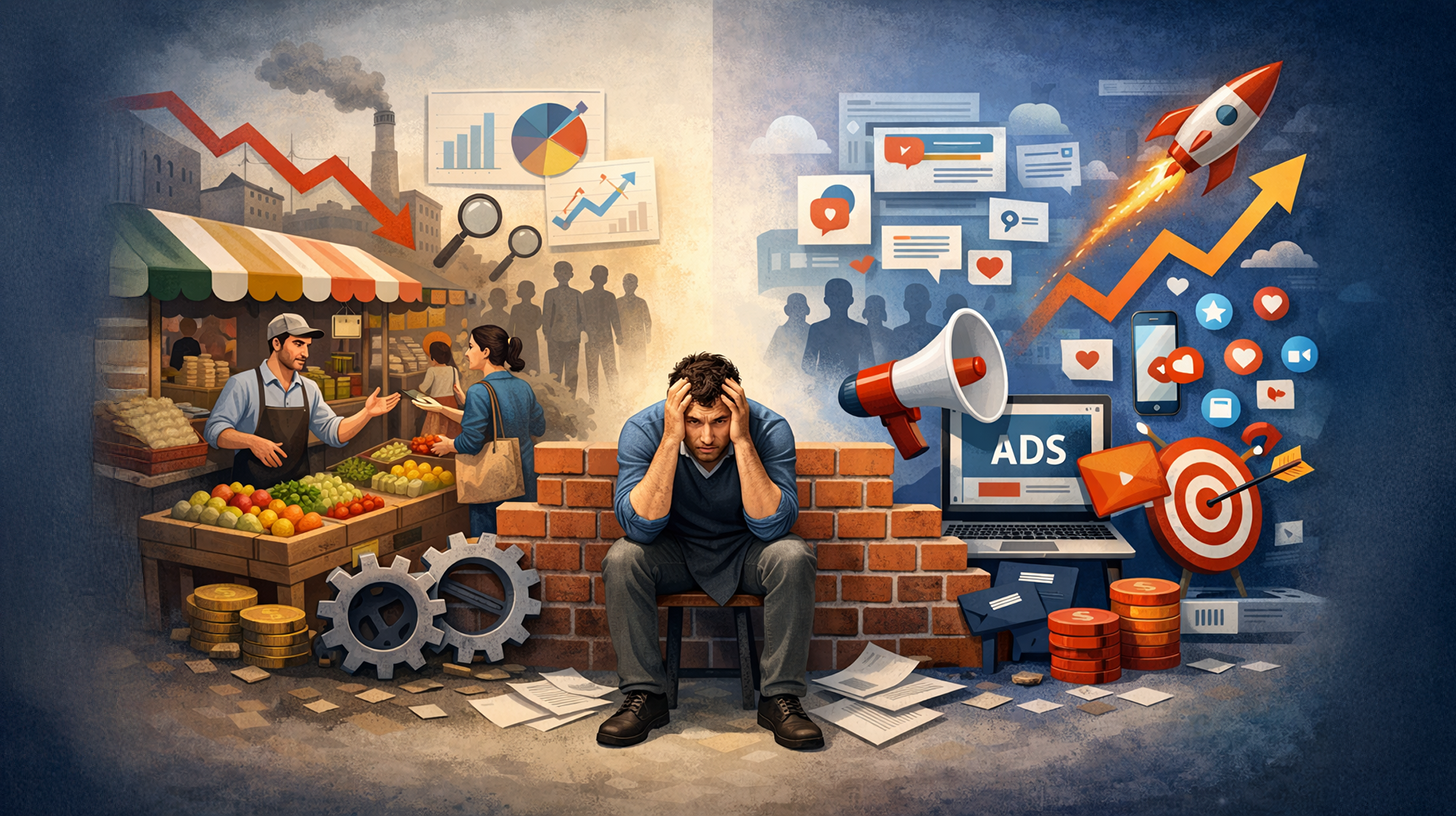
Market vs. Marketing Knowledge: Why SMEs Block Their Own Growth - Image: Xpert.Digital
A persistent, pragmatic misconception exists among small and medium-sized enterprises (SMEs): that those who know their customers and the market also know how marketing works. However, this very equation is increasingly becoming a strategic trap for many SMEs.
The following article analyzes the often overlooked tension between operational market knowledge (looking in the rearview mirror) and strategic marketing knowledge (the high beam for future market share). Learn why a sole focus on sales targets leads to interchangeability in the long run and how SMEs can mature from "short-distance runners" to distinctive brands by consciously separating and realigning these two disciplines. Because those who understand marketing merely as "colorful pictures for sales" surrender 95 percent of tomorrow's potential customers to the competition without a fight.
More information here: