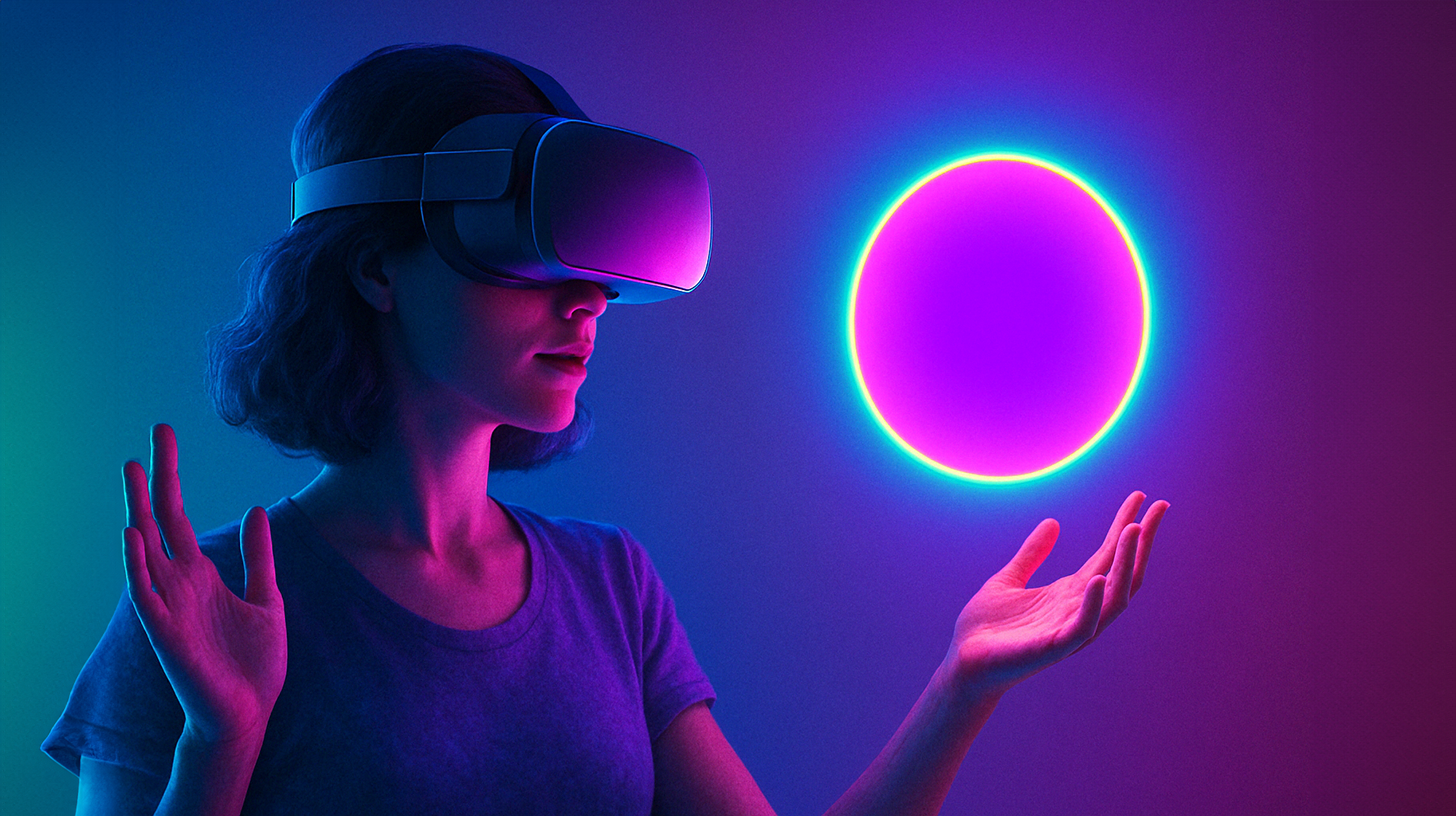
Extended Reality | The discovery of “Olo”: A new color and its potential for virtual reality – Image: Xpert.Digital
Olo – The color of the future? How a new shade could change our world
Unknown color delights: Scientists unveil spectacular innovation
A research team at the University of California, Berkeley, has made a groundbreaking discovery: a completely new color they've named "Olo." This color exists outside our natural perceptual spectrum and could have significant implications for the future of virtual reality. Through a special method of stimulating specific retinal cells, a color perception is created that has been described as "unimaginably saturated" and "breathtaking." Researchers see this as having the potential to increase the intensity of virtual reality experiences and open up new avenues in display technology.
The origin and perception of “Olo”
Our color perception is based on three types of cone cells in the retina: S-cones (short-wavelength, e.g., blue), M-cones (medium-wavelength, greenish), and L-cones (long-wavelength, reddish). These enable us to perceive millions of hues. Normally, the response ranges of these cones overlap, especially in the case of the M-cones, which means that some theoretical colors remain unattainable for our visual system.
The research team developed a method called "Oz" that circumvents this limitation. Instead of creating colors by mixing light waves, the Oz system selectively stimulates thousands of M-cones with tiny, safe laser pulses. The name "Oz" is a reference to the Emerald City from "The Wizard of Oz," where everything appears in radiant green.
For this precise stimulation, each user's retina must be mapped in detail. Special cameras capture the positions of individual cone cells and then track them in real time to precisely align the laser beams. This process creates a stimulation pattern that does not occur in the natural environment, resulting in a completely new color perception.
The name "Olo" is derived from the coordinates "0,1,0" in three-dimensional color space – zero stimulation of the L and S cones, full stimulation of the M cones. All participants in the experiment reported an extremely saturated blue-green color, so intense that it could not be compared to any known hue. Ren Ng, one of the researchers involved, describes the color as "unimaginably saturated" and "breathtaking," reminiscent of a bright turquoise.
Related to this:

The exclusivity of the new color
So far, only five people with normal vision have ever seen "Olo". Perceiving this color is extremely exclusive, as it requires a special experimental setup in which laser light must be focused precisely into the eye – a process that is both impractical and potentially unpleasant.
To verify the uniqueness of "Olo," the researchers conducted color matching tests. In these tests, "Olo" was compared to a nearly monochromatic laser color, one of the most saturated naturally visible hues. The result: To closely match "Olo," its saturation had to be reduced—a clear indication that this new color lies beyond our normal spectrum.
It is important to emphasize that "Olo" cannot be represented by natural light sources or on conventional displays. "There is no way to reproduce this color in an article or on a monitor," explains Austin Roorda, a scientist on the team. The turquoise representation shown in some reports gives only a vague impression that "pales in comparison to the experience of... Olo.".
Potential for virtual reality
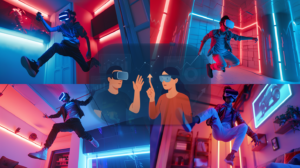
The discovery of "Olo" opens up fascinating possibilities for the future of virtual reality. Although the technology is still in its infancy, experts see several promising areas of application:
Increased visual intensity
Future virtual reality experiences could gain significantly in intensity through this method. The ability to perceive colors outside the natural spectrum could create VR experiences that are dramatically more vivid and immersive than anything possible with conventional technology.
The intensity of VR displays could be significantly increased by the targeted stimulation of specific retinal cells. This would considerably enhance immersion – the feeling of truly being in a virtual world – and could represent a quantum leap in the development of VR technologies.
New display technologies
The findings from the "Olo" research could drive the development of entirely new display technologies. Instead of relying on traditional RGB color mixing, future displays could potentially communicate more directly with our retinal cells, thus enabling a broader spectrum of color perception.
Related to this:

Limits of basic research: Why Olo is not yet suitable for everyday use
Despite its exciting potential, there are significant hurdles to overcome. Ren Ng tempers exaggerated expectations: "This is basic research. We won't be seeing Olo on smartphone displays or televisions anytime soon. And this is very, very far beyond VR headset technology.".
The current method for perceiving "olo" requires precise laser stimulation of the retina, which is impractical for everyday applications. Before this technology can be used in commercial VR systems, safer and more practical methods for stimulating the relevant retinal cells must be developed.
Medical applications and further research perspectives
In addition to VR applications, the “Olo” research offers significant medical perspectives:
Treatment of color blindness
These findings could contribute to the treatment of color blindness or enhance color perception. By specifically stimulating certain cone cells, it might be possible to develop compensatory mechanisms that could help people with color vision deficiencies.
Hannah Doyle, co-author of the study, is already planning a follow-up project: Using Oz, she wants to simulate what happens in retinal diseases where cones fail. This would allow symptoms of vision loss to be artificially created in healthy individuals and studied more effectively.
Expansion of human color perception
Another exciting research approach: Could the cones be stimulated in such a way as to create the impression of a fourth type of cone? This could allow humans to see colors that are normally only found in certain animal species. This would not only revolutionize our understanding of visual perception but could also lead to entirely new forms of artistic and design expression.
Discovering unknown colors: The fascinating world beyond our color space
The discovery of "Olo" marks a significant milestone in our understanding of human color perception. For the first time, a color outside the natural human color space was made visible – not by manipulating light waves, but by specifically stimulating sensory cells.
Although we are still far from practical applications in virtual reality, research shows its enormous potential for the future. The ability to expand the boundaries of our perception could lead to VR experiences that are more intense and immersive than anything we can currently imagine.
The researchers hope that one day we will be able to experience for ourselves what "Olo" and other undiscovered shades of color feel like – an expansion of our perception beyond what was previously possible. Until then, "Olo" remains a fascinating example of how scientific experiments can change our understanding of the world around us.
Related to this:
Your global marketing and business development partner
☑️ Our business language is English or German
☑️ NEW: Correspondence in your native language!

Konrad Wolfenstein
I and my team are happy to be available to you as your personal advisor.
You can contact me by filling out the contact form here wolfenstein@xpert.digital:or simply call me at +49 7348 4088 965. My email address is
I'm looking forward to our joint project.