Nationwide solar panel mandate – Image: New Africa|Shutterstock.com
The current nationwide situation summarized:
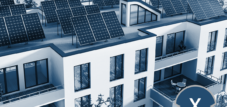
Introduction of a solar/photovoltaic obligation for new buildings:
- Berlin (Solar obligation begins in 2023)
- Hamburg (Solar obligation begins in 2023)
- Bremen (start date of solar obligation not yet known)
- Baden-Württemberg (Solar obligation starts in 2022)
- Lower Saxony (Solar Mandatory Act Draft)
- Rhineland-Palatinate (draft solar obligation law)
- Schleswig-Holstein (draft solar obligation law)
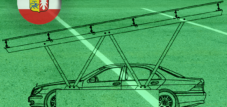
Introduction of a solar carport requirement / obligation to install a solar parking space canopy for new open parking spaces above a certain size:
- Baden-Württemberg (Solar carport obligation starting in 2022)
- North Rhine-Westphalia (Solar carport obligation starting in 2022)
- Rhineland-Palatinate (draft law on mandatory solar carports)
- Schleswig-Holstein (draft law mandating solar carports)
📣 Solar obligation consulting for industry, retail and municipalities
Everything from a single source, specifically designed for solar solutions for large parking areas. Refinance or offset your future costs with your own electricity generation.
🎯 Solar obligation consultation for solar installers, plumbers, electricians and roofers
Consultation and planning including a non-binding cost estimate. We connect you with strong partners in photovoltaics.
👨🏻 👩🏻 👴🏻 👵🏻 For private households
We have a regional presence throughout the German-speaking world. We have reliable partners who will advise you and implement your wishes.
President of the Federal Environment Agency in favor of nationwide solar panel mandate
According to several media reports, the president of the German Federal Environment Agency, Dirk Messner, has spoken out in favor of mandatory solar panels. "It's a good idea and, according to an expert report, also feasible for us," Messner is quoted as saying. If Europe raises its climate protection targets, then Germany must follow suit with its 2030 targets. He cited the mandatory solar panels in Baden-Württemberg, which will be in effect from 2022, as an example and a good idea. This applies to both new commercial and public buildings.
Dirk Messner has been President of the German Environment Agency since January 2020. From 2004 to 2019, he was a member of the German Advisory Council on Global Change (WBGU), serving as Vice Chairman from 2009 and as Co-Chairman from 2013.
The German Federal Environment Agency (UBA) is the central environmental authority of the Federal Republic of Germany. Together with the Federal Agency for Nature Conservation, the Federal Office for the Safety of Nuclear Waste Management, and the Federal Office for Radiation Protection, it falls under the purview of the Federal Ministry for the Environment, Nature Conservation and Nuclear Safety. The agency's tasks primarily include providing scientific support to the Federal Government (including the Federal Ministries for the Environment, Health, Education and Research, Transport and Digital Infrastructure), enforcing environmental laws (e.g., emissions trading, the authorization of chemicals, pharmaceuticals, and plant protection products), and informing the public about environmental protection based on independent research. With approximately 1,600 employees, the German Federal Environment Agency is the largest environmental authority in Europe.
According to the Basic Law, responsibilities are divided between the federal government and the states. In some areas, environmental protection is a federal matter, while in others the federal government only has the authority to issue framework legislation for the states. Therefore, some environmental protection tasks are carried out by the state environmental agencies in the federal states, while others are handled by the Federal Environment Agency.
As early as October 2020, the Federal Environment Agency advocated for a nationwide solar obligation on new buildings and roof renovations: solar obligation with a leasing register.
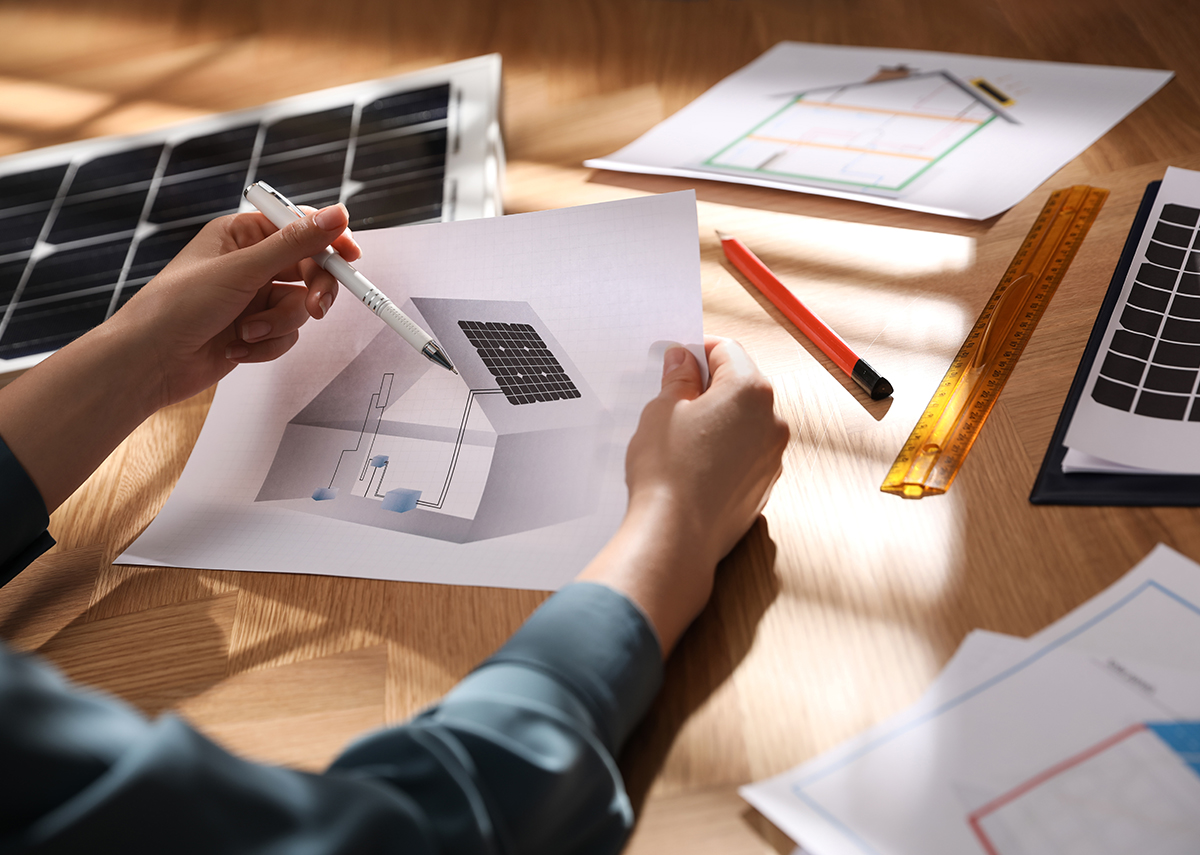
The aim of the report was to examine and evaluate various design options for a solar power mandate (PV mandate). Often, solar power systems (PV systems) are not built even though they would be economically viable. In other cases, smaller PV systems are installed even though more roof space is available. A PV mandate could help to unlock the large available potential and make the use of roof space for solar power generation commonplace.
In the proposed option, the obligated property owners can choose to install and operate a photovoltaic (PV) system themselves, or to register their roof area in a leasing register so that the area can be leased to third parties for the operation of a PV system. The economic viability of the area would be demonstrated by the installation and commissioning of a PV system – either by the owner or by a third party: Thus, a usage or registration obligation is proposed.
A lease register would create transparency between supply and demand and help to mediate between the various stakeholders. The economic benefit that those obligated to operate a photovoltaic system or lease out building space would generate would increase public acceptance of this measure.
More information here:

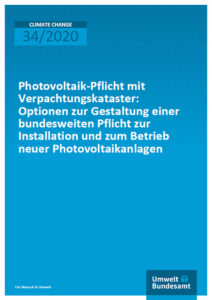
Photovoltaic obligation with leasing register – Federal Environment Agency PDF Download
Authors: Sebastian Palacios, Dierk Bauknecht, David Ritter, Markus Kahles, Nils Wegner, Carsten von Gneisenau
Cadastral solution for the introduction of a photovoltaic obligation
In its press release of November 23, 2020, the 'Öko-Institut e. V. – Institute for Applied Ecology' wrote the following:
A nationwide obligation to install and operate photovoltaic (PV) systems on the roofs of new buildings and after roof renovations is to be structured as a usage or cadastral requirement. This would allow owners to choose: either they install and operate a PV system themselves, or they register their roof area in a cadastre, which can then be leased to third parties for the operation of a PV system.
Such a design ensures the economic viability of the systems and can increase public acceptance. The mandate would allow more roofs than before to be used for solar power generation. By the end of 2017, only about twelve percent of available roof space had been developed.
Scientific report
The recommendations are based on a joint expert report by scientists from the Öko-Institut and the Foundation for Environmental Energy Law, commissioned by the German Federal Environment Agency. The aim was to examine and evaluate various design options for a nationwide photovoltaic mandate (PV mandate). Economic and legal aspects were comprehensively considered. Potential conflicts with other obligations, such as those under the Building Energy Act regarding the use of solar thermal systems, were taken into account, as were the concepts of existing and planned solar mandates in the German states – for example, in Baden-Württemberg and Hamburg.
Economically feasible, little bureaucracy
“The PV mandate should only apply if it is economically feasible for building owners,” says Sebastian Palacios from the Öko-Institut (Institute for Applied Ecology). To achieve this, the study's authors propose a usage or cadastral requirement. “This type of obligation eliminates the need for time-consuming and labor-intensive economic feasibility studies,” says Dr. Nils Wegner from the Foundation for Environmental Energy Law.
Combining the PV mandate with a leasing register can ensure that PV systems are only installed on profitable roof surfaces. Whether a surface is economically suitable becomes clear as soon as either the owners or third parties install and operate a system via the register.
Public acceptance
The lease register is intended to create transparency between supply and demand and help mediate between the various stakeholders. "The economic profit that those obligated to operate a PV system or lease building space generates increases public acceptance of this measure," says Sebastian Palacios from the Öko-Institut (Institute for Applied Ecology). In any case, rooftop PV systems already face fewer acceptance issues and rarely conflict with nature conservation – unlike, for example, onshore wind energy.
EEG subsidies and loans for larger plants
Another question the researchers investigated concerns potential financial support for construction and operation. A larger system covering the entire roof is more conducive to the energy transition than a smaller system that, while optimized for self-consumption and costs, only utilizes a small portion of the roof area. "According to our analysis, the electricity generated by photovoltaic systems could continue to be subsidized under the Renewable Energy Sources Act (EEG) even with a mandatory PV requirement," says Dr. Nils Wegner of the Foundation for Environmental Energy Law. "Subsidized loans, for example from the KfW (German Development Bank), could also be combined with EEG subsidies for private homeowners."
Obligation as an incentive instrument
The instrument can be designed as a mandatory measure. However, several options remain: In addition to the register, it is proposed that non-compliance should initially not be excessively penalized. This keeps the enforcement effort low and allows for an assessment of the instrument's effectiveness in a less stringent form. The study also demonstrates how the instrument could be made more stringent, for example, by setting a maximum number of rejected bids.
Xpert.Solar offers consulting services regarding the nationwide solar panel and solar carport requirements in Germany for new buildings and new open parking lots above a certain size

Konrad Wolfenstein
I would be happy to serve as your personal advisor.
You can contact me by filling out the contact form below or simply call me on +49 7348 4088 965 .
I'm looking forward to our joint project.
Write to me



Xpert.Digital – Konrad Wolfenstein
Xpert.Digital is a hub for industry focusing on digitalization, mechanical engineering, logistics/intralogistics and photovoltaics.
With our 360° Business Development solution, we support renowned companies from new business to after-sales.
Market intelligence, smarketing, marketing automation, content development, PR, mail campaigns, personalized social media and lead nurturing are part of our digital tools.
You can find more information at: www.xpert.digital – www.xpert.solar – www.xpert.plus
Keep in touch