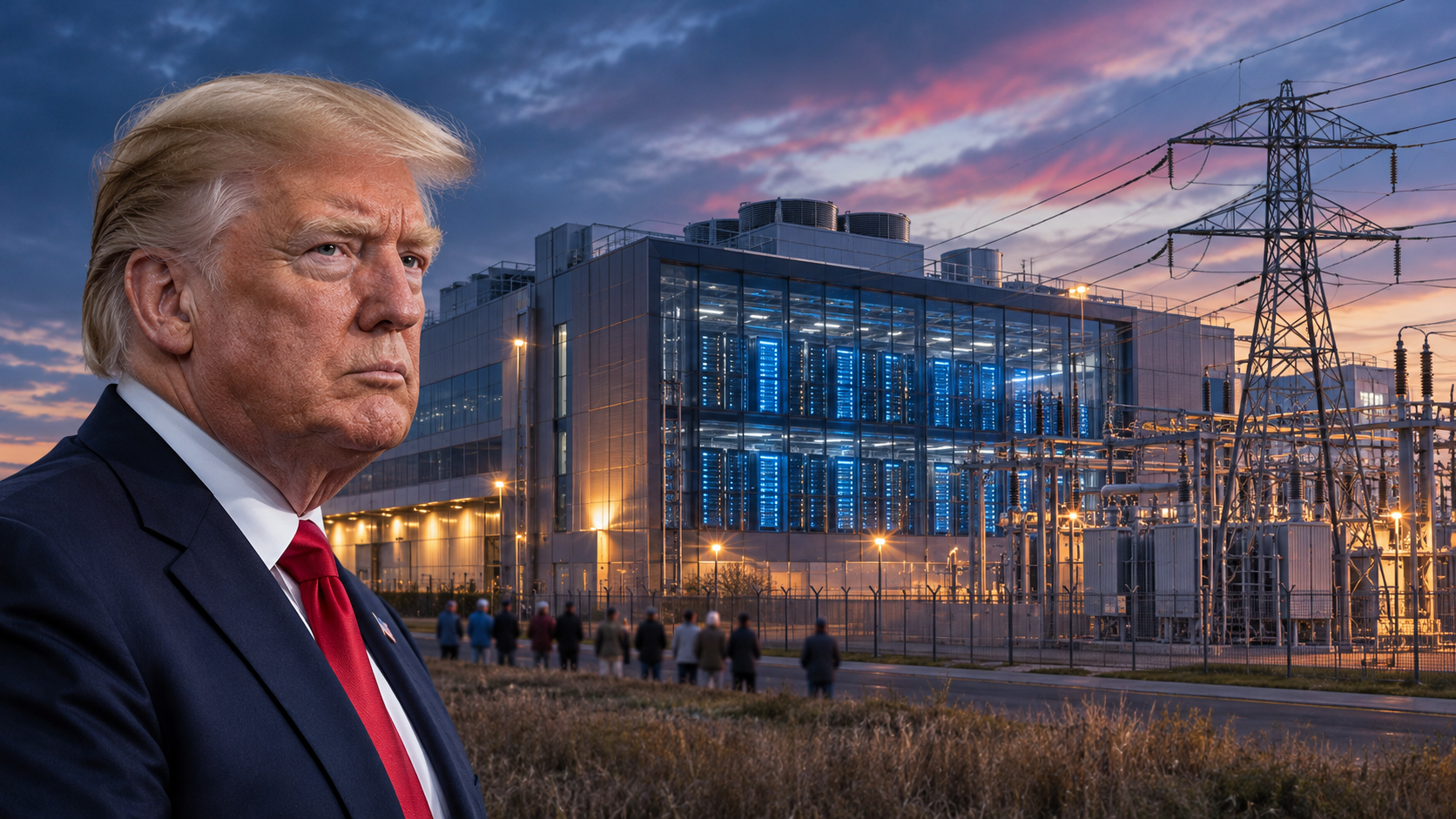
Why tax threats won't solve energy problems: Trump demands more data centers in the US – but residents resist – Creative image on the topic, with AI: Xpert.Digital
Trump's data center policy: How the battle for AI dominance is becoming a location risk – billions for AI, dispute over electricity
Trump wants to keep AI data centers in the US – but electricity is becoming a problem
Data centers instead of abroad: Can Trump really secure America's AI lead?
Donald Trump wants to secure American dominance in artificial intelligence. He is threatening companies that build data centers abroad with substantial financial penalties. The political message is clear: if American companies develop the most powerful AI systems, the necessary infrastructure and as many economic benefits as possible should remain in the USA. But this calculation is too simplistic. Technological strength doesn't arise solely from having as many servers as possible within national borders. A reliable energy supply, efficient power grids, capital, research, international markets, and public acceptance are also crucial.
It is precisely in these circumstances that the contradiction in Trump's strategy becomes apparent. While Washington demands a rapid expansion of AI infrastructure, resistance is forming in the US against rising electricity costs, land use, noise, and environmental pollution. At the same time, companies are being urged to forgo foreign locations that could alleviate bottlenecks and facilitate access to international markets. However, a blanket threat of penalties will create neither additional power lines nor faster approval processes. On the contrary, it can increase investment costs and create uncertainty for companies.
The crucial question, therefore, is not just how many data centers the US needs. It's also about where they should be built, who bears the costs of energy and network expansion, and whether the additional computing power will be used productively in the long term. Trump's initiative thus highlights a fundamental problem with American AI policy: A leading position cannot be secured solely through political pronouncements. Infrastructure, energy supply, economic incentives, and societal interests must all be aligned.
America is supposed to dominate the AI world – but nobody wants to pay the electricity bill
Donald Trump wants to secure American dominance in artificial intelligence by threatening companies with massive financial penalties if they build data centers outside the United States. Behind this lies a remarkably simple industrial policy idea: if American companies develop the most powerful AI systems, then the necessary facilities, investments, and economic benefits should also remain in the US. But this calculation overlooks a crucial connection. Digital leadership is not solely achieved through the geographical concentration of servers. It relies on a complex interplay of energy supply, capital, research, international markets, reliable regulations, and societal acceptance.
The threat issued on November 20, 2026, is therefore more than just another protectionist announcement. It exposes a fundamental contradiction in the American AI strategy: Washington demands the fastest possible expansion of infrastructure, while resistance is forming at the designated locations due to electricity costs, land use, noise, and environmental impacts. At the same time, companies are being asked to forgo foreign locations that could alleviate certain bottlenecks. A policy that restricts geographical options without addressing domestic expansion challenges can increase the cost of a country's technological lead instead of securing it.
The economically decisive factor is therefore not whether the United States needs more data centers. What matters is under what conditions additional capacity is created, who bears the associated costs, and whether the investments will enable sufficiently productive applications in the long term. The success of an AI strategy cannot be measured solely by announced billions of dollars or installed megawatts. It is demonstrated by whether companies and society derive greater benefits from the infrastructure than it ties up in capital, energy, and political conflicts.
A tax threat is not yet a sound location policy
First, a distinction must be made between political intent and the existing instrument. Trump announced substantial taxes or penalties against American companies that build data centers abroad. However, he did not present any concrete details, a fixed tax rate, or a comprehensible enforcement mechanism. The legal basis also remained unclear. Therefore, this threat should not be confused with a special tax that has already been passed and is immediately applicable.
This distinction is economically significant. A levy on foreign investment spending would create different incentives than higher taxes on future profits. Restrictions on certain chip exports would, in turn, have different consequences than conditions for government subsidies or limitations on security-relevant projects. Equally important is whether only new facilities would be affected, or also expansions, long-term leases, and investments through foreign subsidiaries.
Without such stipulations, companies cannot reliably calculate the actual burden. Nevertheless, even the mere announcement can influence investment decisions. A corporation choosing between several locations considers not only land prices, electricity tariffs, and construction costs, but also the likelihood of future interventions. If this political risk increases, the expected minimum return on a project rises. Some projects are postponed, others scaled back, or made subject to additional conditions.
Especially with data centers, delays can be costly. Buildings, power connections, and technical equipment must be coordinated. If one component is delayed, other, already financed parts can remain unproductive. A surprise political intervention therefore not only affects the eventual site selection. It can also devalue existing plans, supply agreements, and financing models. A credible industrial policy should reduce such uncertainties, rather than exacerbating them with vague threats of punishment.
Why computing power has become a strategic power resource
The fact that data centers are moving into the spotlight of economic policy is fundamentally understandable. Artificial intelligence requires powerful computers, reliable data connections, and large amounts of electrical energy. Those who possess these prerequisites can develop models, provide applications, and export digital services on a significant scale. Computing power is thus becoming a production factor whose importance extends far beyond the traditional IT sector.
The scale of this expansion illustrates this transformation. Global investments in data centers reached approximately US$500 billion in 2024, nearly doubling compared to 2022. In the same year, data centers worldwide consumed about 415 terawatt-hours of electricity. This represented roughly 1.5 percent of global electricity consumption. The US accounted for approximately 45 percent of this consumption, China for about 25 percent, and Europe for roughly 15 percent. These figures reflect the electricity demand of the entire data center industry, not just that of AI applications.
This distinction is important because data centers also run traditional cloud services, enterprise software, search engines, video services, and numerous other digital offerings. Not every additional server is an AI server, and not every announced data center investment can be fully attributed to training new, cutting-edge models. A sound analysis must therefore differentiate between general digitalization and the additional demand driven by AI.
Strategic importance does not automatically arise from the location of a building. Equally relevant are ownership structures, control over chips and software, access to skilled personnel, and the legal framework governing its operation. An American provider can continue to export American technology and generate revenue with a facility located abroad. Conversely, a data center on American soil does not guarantee that all components, inputs, and economic returns will remain within the country.
Competition with China is real; the geopolitical either-or is too simplistic
Trump justifies his position with the competition for global AI leadership. In his narrative, the United States is in first place, followed by China, while other countries lag far behind. He also referred to alleged recognition of American AI achievements by Chinese President Xi Jinping and to shared ideas for industry guidelines. However, such political pronouncements must be distinguished from verifiable agreements and reliable technological benchmarks.
A single ranking can only inadequately reflect the international AI competition. Cutting-edge models, semiconductor development, industrial applications, research, energy supply, and digital infrastructure represent diverse competitive arenas. One country might excel in publicly accessible models, another in industrial automation, or in the cost-effective deployment of specific applications. Furthermore, large computing capacities are only economically valuable if companies can utilize them productively.
Furthermore, the relationship between American foreign investment and Chinese influence is not necessarily negative. If an American cloud provider establishes a data center in an allied country, this can strengthen its market position against Chinese competitors. Customers then gain access to American platforms without having to process all data and computing operations through locations in the USA.
A blanket ban on foreign investment could therefore backfire. If American companies are less able to serve certain foreign markets, it creates space for other suppliers. Treating projects with security concerns and economically sound investments in partner countries equally would be a gross oversimplification. A targeted strategy would have to differentiate between sensitive technologies, different states, ownership structures, and concrete monitoring options.
The real bottleneck lies in the electricity system
The most significant material limitation to AI expansion is not political will, but the availability of suitable infrastructure. A data center doesn't simply require a theoretically sufficient annual amount of electricity. It needs a reliable power supply at its specific location, high-performance connections, and a network capable of safely handling heavy loads.
In the International Energy Agency's baseline scenario, global electricity consumption by data centers is projected to rise to approximately 945 terawatt-hours by 2030. This would more than double the 415 terawatt-hours recorded in 2024. AI is considered the most important driver of this growth, alongside other digital services. In the US, data centers are expected to account for nearly half of the additional electricity demand by 2030. It's important to note that this is a projection with considerable uncertainties, not a fixed consumption trajectory.
The problem is exacerbated by differing investment speeds. Digital business models can grow rapidly, while power lines, substations, and power plant capacity require lengthy planning and construction phases. New transmission lines often take four to eight years to build in advanced economies. The International Energy Agency estimates that without countermeasures, around 20 percent of planned data center projects could face delays due to energy-related bottlenecks.
Penalizing foreign locations with taxes won't create an additional transformer or shorten transmission lines. It will initially only increase the pressure on the remaining domestic locations. If the grids there are already operating at capacity, such a policy could drive up the cost of land, connection rights, and available electricity volumes. The economic benefit might then accrue less to AI users than to the owners of scarce infrastructure.
Why a small global share of consumption triggers large local conflicts
The argument that data centers consume only a limited share of the world's electricity does not explain away local resistance. Electricity supply is spatially determined. An additional large consumer can trigger significant adjustments in a particular region, even if its demand appears manageable on a global scale.
In addition, there is a pronounced geographic concentration. Nearly half of the American data center capacity is located in five regional clusters. Around half of the capacity currently under development in the US is situated within already existing large clusters. This concentration offers economic advantages because skilled workers, network connections, service providers, and technical expertise are readily available. However, it can also exacerbate existing bottlenecks.
The economic logic is similar to other industrial conurbations. Companies initially benefit from their proximity. However, with increasing concentration, land prices, infrastructure costs, and land use conflicts rise. Beyond a certain point, additional facilities can become more expensive for society, even though they may still appear attractive from the perspective of the individual operator.
Therefore, a purely national approach is insufficient. A country may have sufficient overall potential electricity generation and yet lack readily available connection capacity at specific locations. The decisive factors are the actual location, the timing of commissioning, and the additional strain on the respective grid. Sound location policy must highlight these differences instead of obscuring them with a blanket expansion mandate.
Ohio shows why promises of billions don't guarantee approval
The resistance in Ohio illustrates that even very large investment announcements do not guarantee local support. In the November midterm elections, voters there backed 21 initiatives aimed at slowing the expansion of data centers. Among those affected are three planned Amazon projects with a total investment volume of more than $17 billion. These projects are thus exposed to significant development risks; however, this does not automatically mean that all investments have been definitively abandoned.
This scale makes the conflict particularly revealing. Regions typically compete for billions of euros in investment. When such projects nevertheless encounter resistance, the benefits and burdens must be examined more closely. A large investment sum initially only indicates how much capital is to be deployed. It does not directly show how many long-term, well-paid jobs will be created, what additional tax revenue will be generated, or what costs will be borne by municipal budgets and electricity customers.
Data centers are capital-intensive facilities. A large part of their economic value consists of buildings, electrical systems, cooling, and IT equipment. Therefore, high investments do not automatically translate into a correspondingly large, long-term employment impact. For a municipality, a technically impressive project may be less attractive than the headline about the investment sum might suggest.
This disparity is politically exacerbated when national actors emphasize the strategic advantages while local residents experience the immediate burdens. The benefits of modern AI services are spread across many regions and user groups. Construction traffic, additional utilities, or nighttime noise, on the other hand, are concentrated in a specific location. Without convincing local compensation, this distribution remains a structural problem of public acceptance.
Behind the dispute over electricity prices lies an unresolved cost issue
Rising electricity prices are among the biggest concerns surrounding new data centers. However, it would be an oversimplification to assume that every additional facility inevitably increases electricity prices for all households. The actual effect depends on how new generation, grid reinforcements, and connection costs are financed.
A large, reliable long-term consumer can enable additional investments and improve the utilization of certain facilities. Under suitable conditions, this can lead to advantages. Conversely, new large consumers can incur significant costs if grids need to be reinforced, reserve capacity provided, or additional power plants required. If these expenses are spread broadly among other customers, households and small businesses indirectly subsidize the expansion.
The polluter-pays principle is therefore economically crucial. Those who require additional capacity should bear the resulting specific costs appropriately. This can include connection fees, long-term purchase commitments, and security deposits. Particularly important is protection against the possibility that a planned project will later be smaller or closed earlier than expected.
Without such rules, a problematic asymmetry threatens: The operator retains the chance of high returns, while the power grid assumes part of the investment risk. If, on the other hand, costs are allocated transparently, a data center can be economically viable without unduly burdening other consumers. The crucial question, therefore, is not only how much electricity the facility requires, but also who pays for its integration.
A new dimension of digital transformation with 'Managed AI' (Artificial Intelligence) - Platform & B2B solution | Xpert Consulting


A new dimension of digital transformation with 'Managed AI' (Artificial Intelligence) – Platform & B2B solution | Xpert Consulting - Image: Xpert.Digital
Here you will learn how your company can implement customized AI solutions quickly, securely and without high entry barriers.
A managed AI platform is your all-inclusive, worry-free solution for artificial intelligence. Instead of dealing with complex technology, expensive infrastructure, and lengthy development processes, you receive a ready-made solution tailored to your needs from a specialized partner – often within just a few days.
The key advantages at a glance:
⚡ Rapid implementation: From idea to ready-to-use application in days, not months. We deliver practical solutions that create immediate added value.
🔒 Maximum data security: Your sensitive data stays with you. We guarantee secure and compliant processing without sharing data with third parties.
💸 No financial risk: You only pay for results. High upfront investments in hardware, software, or personnel are completely eliminated.
🎯 Focus on your core business: Concentrate on what you do best. We take care of the entire technical implementation, operation, and maintenance of your AI solution.
📈 Future-proof & scalable: Your AI grows with you. We ensure continuous optimization and scalability, and flexibly adapt the models to new requirements.
More information here:
The challenges of power supply for data centers
Environmental pollution and noise are not fringe issues of digitalization
Besides electricity costs, environmental impact and noise are key sources of resistance. These objections cannot be reliably assessed without knowing the technical specifications of a particular system. Cooling, emergency power supply, building design, and site conditions can vary considerably. Consequently, the resulting impacts will also differ significantly.
For example, cooling systems present a conflict of objectives between energy consumption, water requirements, and investment costs. A process that operates particularly efficiently under certain climatic conditions may be unsuitable at another location. Similarly, the potential use of waste heat depends on whether suitable consumers are available nearby and whether the required temperature can be provided economically. Therefore, a general commitment to waste heat recovery does not replace a concrete technical and economic assessment.
A similar situation exists with electricity procurement. A calculated coverage of annual consumption by renewable energies does not fully answer the question of which power plants can actually meet consumption at any given hour. For grids and emissions, it is relevant when and where electricity is generated and consumed. Annual balances and physical supply are linked, but not identical.
A sustainable location policy would therefore have to formulate measurable requirements: permissible noise levels, verifiable water balances, robust supply concepts, and a realistic assessment of additional emissions. Such requirements are not automatically detrimental to innovation. They can prevent poorly planned projects from damaging public support for an entire industry.
Texas, California, and West Virginia are not interchangeable electrical outlets
Trump's call for companies to build their facilities in Texas, California, or, failing that, West Virginia, illustrates the political search for domestic alternatives. Economically, alternative regions can indeed make sense. However, this is contingent on their location characteristics being suitable for the specific project.
A suitable plot of land alone is not enough. Available grid connections, a reliable power supply, data connections, technical service providers, and a sufficient number of qualified personnel are required. Construction capacity, cooling conditions, insurability, and the question of how quickly a plant can actually be commissioned must also be considered. A seemingly inexpensive location can become costly if its infrastructure development takes years.
The requirements of different applications also vary. Training large models presents different challenges than the daily provision of time-critical services to customers. Some computing tasks can be organized with relative flexibility in terms of location. Others must be performed closer to users, data repositories, or industrial processes. Location policy should leverage these differences.
For structurally weaker regions, data centers can offer opportunities, such as construction contracts, increased demand for technical services, and modernized infrastructure. However, this does not automatically create a broad technology ecosystem. Sustainable regional development requires complementary training, business development, and productive connections to the existing economy. A server location is a possible foundation, but not a complete development model.
Why American companies also need to build abroad
The notion that foreign data centers are primarily an escape from American costs or permits is too simplistic. International providers also build facilities outside their home markets because that's where their customers are located. Digital services are global, but their provision remains subject to technical, legal, and economic location factors.
For certain applications, short response times are crucial. Other customers require specific security guarantees, regional resilience, or clearly segregated data processing. Companies must also meet diverse regulatory and contractual requirements. Therefore, a global network of data centers can be part of a competitive offering and not merely a cost-shifting strategy.
Foreign investment can also support domestic value creation. If an American company acquires international customers, this can generate revenue for software development, research, management, and other activities. The proportion that actually remains in the home country depends on the business model. However, the blanket equation of foreign investment with national loss is not economically tenable.
A punitive tax could negatively impact these relationships. If American services become more expensive or less available in certain countries, customers may switch to regional or other international providers. The US would then potentially weaken part of the global market position that makes its AI and cloud companies so economically significant. Strategic control and international expansion are not inherently contradictory; often, they complement each other.
The greatest danger is not capital flight, but misallocation
A politically enforced concentration of investment changes where capital is deployed. However, it does not guarantee that this capital will become more productive. If companies choose a location not for its economic suitability, but to avoid penalties, additional costs may arise.
These costs are not only reflected in higher electricity bills. Later commissioning, more complex cooling systems, longer grid connections, or less favorable proximity to customers can also reduce profitability. As a result, more capital is needed to provide the same usable computing power. From a macroeconomic perspective, this is a misallocation of resources.
A policy that simultaneously restricts private location choices and heavily subsidizes domestic projects would be particularly problematic. Investments could then be driven doubly by political signals rather than actual demand. Companies would have an incentive to announce the largest possible projects, while public authorities compete for high-profile locations.
This does not mean that all government support is wrong. Research, network infrastructure, and security-related capabilities can affect public interests. However, funding should be tied to verifiable objectives. Crucial factors are the additional benefits created, actual commissioning, and an appropriate distribution of risk. The sheer size of an announcement is not a suitable measure of success.
Anthropic's IPO illustrates the tension between future value and present risk
Alongside the debate about location, the valuation of AI companies is under scrutiny. Anthropic went public that week; subsequently, its stock came under pressure amid a broader sell-off of American technology stocks. Trump praised the company and its co-founder, Dario Amodei. This event illustrates how closely political attention, the capital market, and expectations for future AI returns are now intertwined.
A short-term decline in share prices does not necessarily indicate the failure of a company or the unprofitability of an entire technology. Share prices react to changing profit expectations, interest rates, risk appetite, and many other factors. Therefore, a broad sell-off cannot be definitively attributed to a single political announcement.
What is economically relevant is the valuation logic. Large investments are made today, while a significant portion of the anticipated returns lies in the future. The more uncertain these returns become, or the higher the required rate of return, the lower their present value. Political risks can therefore hit companies particularly hard whose valuations include far-reaching growth expectations.
The infrastructure issue and the capital market issue reinforce each other. More expensive or delayed computing capacity can negatively impact profitability. Weaker financing options, in turn, can hinder expansion. Therefore, policies aimed at strengthening AI companies should not only promote investment volume but also improve the predictability of their economic framework.
Amodei's regulatory position does not fit into the simple camp mentality
Trump's praise for Dario Amodei is particularly noteworthy because the Anthropic co-founder is among the prominent advocates for stronger safeguards for powerful AI systems. This includes calls for independent cybersecurity risk assessments and a more cautious approach to publishing particularly powerful models.
This does not necessarily contradict the economic development of the industry. Regulation can incur costs, delay market launches, and place high demands on companies. However, it can also reduce risks and build trust. For business users, it is not only crucial how efficient a system is under ideal conditions. Equally important is whether it can be used reliably, securely, and transparently.
However, a distinction must be made between different regulatory areas. Security audits for high-performance systems are different from building regulations for data centers. Data protection requirements differ from grid connection regulations. A political debate that treats all requirements as a uniform burden overlooks these differences.
There is also a risk that burdensome regulations will favor large providers because smaller companies will find it more difficult to bear the fixed costs. Good regulation must therefore be risk-appropriate and proportionate. The sensible choice is not between innovation and control. Rather, it is: Which rules reduce real damage without unnecessarily hindering competition and productive applications?
Social acceptance is becoming scarce infrastructure
Trump has repeatedly and vehemently rejected criticism of the expansion. As early as August, he portrayed opponents of AI infrastructure as, in essence, an obstacle to prosperity and modernization. Such an escalation may generate political mobilization, but it does not resolve the economic conflicts on the ground.
If residents fear increased burdens, they need comprehensible answers. How loud will the plant be? What additional costs will it incur on the electricity grid? How much water will be needed? What revenue will the municipality actually receive? What obligations remain if the project's economic performance differs from what was projected?
Those who treat such questions merely as technophobia increase mistrust. This makes even fundamentally approvable projects more difficult to implement. Political toughness can thus slow down the very expansion it is intended to accelerate. The conflict is not merely cultural; it also affects the functioning of investment processes.
Acceptance should therefore be understood as a location factor in its own right. It arises from early information, verifiable commitments, and a fair distribution of benefits and burdens. A project with somewhat higher initial planning costs can be economically superior if it can be reliably implemented. Conversely, a seemingly inexpensive project can lose its cost advantage through years of conflict.
Europe's opportunity does not lie in the automatic profit of American investments
For Europe, the American debate presents both risks and potential opportunities. A comprehensive ban on foreign companies could complicate European expansion plans. At the same time, political uncertainty in the US and the demand for regionally controlled products and services could strengthen alternative providers. Which effect prevails depends on the specific design of American measures and on Europe's own business environment.
However, Europe should not derive a convenient narrative of victory from this. Here too, electricity supply, grid connections, permits, and economic capacity utilization must align. One location does not become competitive simply because another becomes politically less secure. Local bottlenecks will remain.
A key European perspective lies in the connection between AI and industrial applications. According to an analysis by the International Energy Agency, European companies hold more than half of the market for industrial automation solutions. This presents an opportunity to integrate AI into existing production systems, machinery, energy facilities, and operational processes.
For Germany and other industrial locations, this results in a different focus than simply imitating large-scale American projects. Not every economically valuable AI system needs its own top-of-the-line model or a gigantic training cluster. Often, industry-specific data, integration, process knowledge, and reliable operation are crucial. Computing capacity remains necessary, but it should be understood as a means to increase productivity and not as an end in itself.
Increased efficiency can slow down expansion while simultaneously creating new demand
Energy demand forecasts are subject to considerable uncertainty. More powerful chips, better models, and more efficient use can reduce the power required per task. At the same time, falling costs could lead to AI being used more frequently and for additional purposes.
This relationship prevents simple conclusions. A more efficient model does not automatically lead to a decrease in overall consumption. If a single application becomes cheaper and its use multiplies, the total demand for resources can still increase. Conversely, sustained explosive growth is by no means guaranteed. Lack of profitability, technical limitations, or bottlenecks can slow expansion.
The International Energy Agency illustrates this uncertainty in various scenarios. For 2035, the range of global data center electricity consumption is estimated at approximately 700 to 1,700 terawatt-hours. The baseline scenario projects around 1,200 terawatt-hours. In a scenario with particularly strong efficiency improvements, consumption in 2035 is about 20 percent lower than the baseline scenario.
This presents investors and energy planners with a challenging task: they must create capacity in a timely manner without treating every projection as a certainty of demand. Phased expansion plans, robust customer relationships, and a clear distinction between reserved and actually required capacity can help limit misinvestments. Conversely, a political fixation on maximum size makes the necessary adjustments more difficult.
A viable AI industrial policy must address risks in a targeted rather than a blanket approach
A consistent economic policy perspective can be derived from the conflicts described. The United States has a legitimate interest in maintaining a high-performing AI infrastructure domestically. However, this does not mean that every foreign investment is harmful or should be prevented by a punitive tax.
A differentiated approach to security-relevant projects would be sensible. Particularly sensitive technologies and problematic control structures can justify targeted restrictions. Investments in reliable partner states, on the other hand, should be assessed according to different criteria. Such a distinction would pursue strategic goals more effectively than a blanket geographical ban.
Domestically, policymakers should primarily address the bottlenecks that actually hinder businesses. These include electricity grids, predictable connection procedures, and the coordination between additional demand and supply. Acceleration should not mean ignoring costs or environmental impacts. It should make processes clearer, more reliable, and better coordinated.
Equally important is a robust cost structure. Data centers should bear the specific costs they generate appropriately. At the same time, network operators and authorities should enable economically viable locations and flexible operating models. Furthermore, verifiable security standards for AI systems and regulatory frameworks that maintain competition are essential.
Such a strategy would be less spectacular than the threat of an enormous tax. However, it would improve actual production conditions. This is precisely the difference between a political show of force and effective industrial policy.
Technological leadership is determined by productivity, not server nationalism
Trump's initiative touches on a legitimate strategic concern: those who become permanently dependent on an economically significant technology risk losing their room for maneuver. However, the response must be tailored to the technology's structure. AI emerges from international supply chains, is financed through global markets, and derives its economic value from its application in highly diverse industries.
National infrastructure concentration can create resilience in certain areas. However, if it is imposed across the board, it can also increase costs, weaken international market positions, and exacerbate bottlenecks. Therefore, the crucial factor is not maximum isolation, but rather the ability to secure strategically important capacities while simultaneously maintaining productive international connections.
The resistance to new facilities also demonstrates that technological leadership ambitions must be financed domestically and supported by society. The population does not automatically accept every burden simply because it is justified by competition with China. Those who promise benefits must also explain how costs will be shared and risks mitigated.
Ultimately, the strength of an AI economy will not be measured by the number of its largest data centers. What matters is whether the computing power deployed enables better products, more efficient companies, scientific progress, and sustainable business models. A policy that loses sight of these outcomes can tie up billions domestically and still lose economic ground. The more convincing strategy lies in linking infrastructure, energy, competition, and social acceptance in such a way that technological capability actually translates into lasting prosperity.
🎯🎯🎯 Data-driven B2B industry hub as a quasi-in-house solution


The quasi-in-house solution: How Xpert.Digital closes operational gaps in B2B marketing and sales – Smart Content-Driven Business - Image: Xpert.Digital
Xpert.Digital is a data-driven B2B industry hub led by Konrad Wolfenstein . The company acts as an external, quasi-in-house solution for industrial partners, closing operational gaps in marketing, content, and sales – without requiring additional resources on the client side.
More information here:
Your global marketing and business development partner
☑️ Our business language is English or German
☑️ NEW: Correspondence in your native language!

Konrad Wolfenstein
I and my team are happy to be available to you as your personal advisor.
You can contact me by filling out the contact form here wolfenstein@xpert.digital:or simply call me at +49 7348 4088 965. My email address is
I'm looking forward to our joint project.