
Meta's "Model Capability Initiative": AI surveillance and the betrayal of trust – Image: Xpert.Digital
Leaked meeting reveals: How Meta monitored its best employees – and then replaced them with AI
When AI becomes the "angel of death": The unscrupulous strategy behind Meta's wave of layoffs
Imagine your employer installing software on your computer without your consent, software that meticulously records every click, keystroke, and mouse movement. The official explanation: they simply want to train their internal AI systems. But just a few weeks later, a wave of layoffs ensues. What sounds like the plot of a dystopian science fiction thriller became a brutal reality at the tech giant Meta. With its so-called "Model Capability Initiative," the company ruthlessly demonstrated just how far corporations are willing to go in the global AI race. Highly qualified employees are reduced from creators to mere raw material, their implicit knowledge extracted before they are shown the door. But this seemingly efficient ruthlessness has a massive blind spot: it destroys the most valuable asset of any organization – trust. Our comprehensive analysis sheds light on what really happened in the Meta scandal, why using AI as a "death knell" has fatal economic consequences, and what an AI transformation must look like if it is to succeed in the long term.
Covert surveillance for AI data: The real reason for the dismissal of 8,000 Meta employees
When a company systematically monitors its best employees, extracts their knowledge, distills it into AI models, and then lays them off, it's no longer dystopian fiction. It's the documented corporate practice of one of the world's most valuable companies in 2026. What Meta did with its so-called "Model Capability Initiative" is exceptionally direct in its brutality and strategic consequences—and yet it represents a developmental logic that redefines the entire relationship between business, technology, and human labor. This analysis examines what actually happened, the underlying economic and psychological mechanisms, why the strategy is suboptimal in the long run, and what companies should do instead if they truly want to win the AI transformation.
What really happened: Surveillance as a corporate strategy
On April 21, 2026, it was revealed that Meta had installed tracking software called Model Capability Initiative (MCI) on the computers of its US employees. This software logged mouse movements, clicks, keystrokes, and periodically took screenshots of screen content. There was no opt-out option. According to official company communications, the collected data was intended solely for training AI models and not for performance evaluations.
Nine days later, on April 30, Mark Zuckerberg held an internal all-hands meeting. An audio recording of this meeting, released by the labor organization More Perfect Union, revealed the true rationale behind the program. Zuckerberg openly explained that Meta was monitoring employee activity in Gmail, Google Chat, the internal tool Metamate, and the development environment VS Code. The goal: to teach the AI how well smart people use computers. "The way that you get a system to be good at using computers is by having it watch really smart people use computers," Zuckerberg is quoted as saying in the recording. He continued: Meta's own engineers were better training data than external contractors because they were among the most skilled people in the industry.
On May 20, 2026—the same day the audio recording was made public—Meta began laying off approximately 8,000 employees, representing about ten percent of its then-current workforce of nearly 79,000. Simultaneously, another 7,000 employees were transferred to newly created AI focus teams. In total, roughly 20 percent of the entire workforce was directly affected by layoffs or internal transfers. European employees were exempt from the tracking program due to the requirements of the General Data Protection Regulation (GDPR).
More than 1,000 employees had previously signed a petition against the surveillance program. Leaflets calling for resistance against the tracking practices were reportedly posted in the offices. It was all to no avail. The layoffs proceeded as planned.
The business model behind it: Capital replaces labor with data
To properly understand what's happening at Meta, it's necessary to grasp the economic context in which it's taking place. Meta initially announced capital investments of $115 billion to $135 billion for 2026 – a forecast revised upwards to $125 billion to $145 billion at the beginning of 2026. By 2025, the company had already invested $72 billion, primarily in expanding its AI infrastructure and data centers. These figures reflect a strategic priority decision that is crucial for understanding the wave of layoffs.
From a classical economic perspective, Meta is undergoing a massive substitution process: human labor is being replaced by automated AI systems whenever this is more efficient. In this model, MCI data is not merely a byproduct, but a factor of production. It serves to improve the quality of AI models so that they can autonomously handle more complex cognitive tasks. In this logic, employees are not just workers, but raw material – and particularly valuable raw material at that: unlike externally acquired training data, experienced Meta engineers represent highly specific, company-relevant knowledge. When the AI learns how these people work, it learns not generic coding, but Meta-specific coding.
This approach is understandable from a purely technical-economic perspective. Implicit experiential knowledge—that is, knowledge residing in people's minds but not explicitly documented—has been considered the very core of entrepreneurial competence since Michael Polanyi and the organizational theory work of Ikujirō Nonaka and Hirotaka Takeuchi. In the 1990s, Nonaka and Takeuchi described how the transformation from implicit to explicit knowledge and back again is the true driving force behind organizational innovation. The externalization phase—converting implicit knowledge into explicit, documented form—has always been the most difficult bottleneck. Meta is now attempting to circumvent this bottleneck with AI: Instead of asking people to document their knowledge, the AI simply observes.
By 2036, around 12.9 million people in Germany alone will retire. With them, an enormous amount of implicit experiential knowledge will be lost. The question of how to preserve this knowledge is therefore not just a meta-problem, but a challenge for the economy as a whole. AI-based knowledge preservation thus has legitimate applications – provided it is implemented with the consent and trust of those affected.
The paradox of knowledge extraction: The agent as angel of death
But this is precisely where the real problem begins. Reports from within companies – not just Meta – indicate how knowledge transfer initiatives using AI are being systematically misused internally. At a large IT service provider, AI agents were developed to make employees' implicit knowledge explicit. So far, a sensible and necessary task. However, management's decision regarding who received these agents revealed the true intention: they were preferentially assigned to employees whose dismissal had already been decided internally.
The pattern was transparent enough to be noticed. Within a few weeks, the workforce knew: anyone assigned a knowledge transfer agent would be laid off in the foreseeable future. The agent became a death knell. Three months after the agent's dismissal, the termination came—with alarming regularity. The consequence was predictable: no one voluntarily shared their knowledge anymore. Those still working with AI did so outside the official company infrastructure—via shadow IT, meaning with unauthorized, privately used AI tools. The official transformation initiative was thus effectively dead.
This case illustrates a fundamental dilemma affecting all companies that want to use AI for knowledge management: The success of these initiatives depends entirely on whether employees are willing to actively contribute their knowledge. And this willingness is not a technical variable, but a social one. It is directly tied to trust.
Shadow AI as a seismograph of loss of trust
The shift to shadow IT and shadow AI is not a fringe phenomenon. According to a Software AG study on how German knowledge workers use AI, 54 percent of German knowledge workers use shadow AI – that is, AI tools not provided by their company. Even more remarkable: 49 percent of respondents would not give up these tools even if their company were to completely prohibit them. A recent study by XM Cyber shows that more than 80 percent of the companies surveyed exhibit signs of unauthorized AI activities. A Microsoft survey found that 78 percent of AI users utilize their own tools in the workplace.
These figures are not a sign of disobedience, but of rationality. Employees who experience their employers using AI as a tool for dismissal are behaving in a perfectly rational, economic way when they avoid official AI platforms and resort to unofficial ones. The loss of trust caused by cases like Meta or the IT service provider described above is not limited to individual companies. It radiates to the entire industry. If the narrative takes hold that the introduction of AI in a company is a harbinger of layoffs, every AI transformation initiative will be viewed with suspicion.
The economic consequences are severe: Shadow AI creates compliance risks, data breaches, and a loss of data sovereignty. According to an IBM report, one in five companies has already experienced a security incident related to shadow AI. Companies that destroy the trust of their employees through their own actions drive them into the very uncontrolled behaviors that create these risks in the first place.
Psychological safety: The underestimated prerequisite for any transformation
The research literature on this topic is unequivocal. The concept of psychological safety—developed by Harvard professor Amy Edmondson, who has been researching it since 1992—describes a work environment in which employees can express their opinions, ideas, and concerns without fear of negative consequences. Edmondson's early studies in hospitals revealed a seemingly counterintuitive result: the highest-performing teams appeared to make more mistakes than poor-performing teams. The explanation was that well-managed teams communicated mistakes more openly because they felt safe enough to do so. As a result, the entire team learned from its members' errors—and improved as a result.
This finding is crucial for AI transformation. Without psychological safety, employees will tend to avoid experimentation, refrain from asking questions, and conceal mistakes. In the context of AI adoption, this means they won't report vulnerabilities in AI systems, contribute innovative application ideas, or share their experiential knowledge—precisely the knowledge needed for effective AI training. A global report by Infosys and MIT Technology Review Insights confirms this: 83 percent of surveyed executives are convinced that psychological safety directly impacts the success of AI initiatives. At the same time, the fear of failure remains one of the biggest obstacles to AI adoption—even when all the technical prerequisites are in place.
The relationship between trust and AI transformation is therefore not a soft-skill issue, but a hard economic productivity problem. Destroying psychological safety destroys the prerequisite for successful transformation. The formula is simple, but its implications are profound: technology without trust remains ineffective.
Our US expertise in business development, sales and marketing


Our US expertise in business development, sales and marketing - Image: Xpert.Digital
Industry focus areas: B2B, digitalization (from AI to XR), mechanical engineering, logistics, renewable energies and industry
More information here:
A thematic hub offering insights and expertise:
- Knowledge platform covering global and regional economies, innovation and industry-specific trends
- A collection of analyses, insights, and background information from our key areas of focus
- A place for expertise and information on current developments in business and technology
- A hub for companies seeking information on markets, digitalization, and industry innovations
Transparency, participation, protection: The formula for success for AI in business
The works council as a rational veto player
Against this backdrop, it is entirely understandable that works councils react with alarm to the introduction of AI. In Germany, works councils have extensive co-determination rights under the Works Constitution Act, which apply to the introduction of AI systems. Section 87, paragraph 1, number 6 of the Works Constitution Act is central here, granting the works council a right of co-determination regarding technical equipment that is capable of monitoring the behavior or performance of employees. The Federal Labor Court has interpreted the term "capable" broadly for decades: it is sufficient if the equipment is objectively capable of monitoring – regardless of the employer's intention.
In practice, this means that virtually every AI system that works with employee data triggers co-determination rights under Section 87. Furthermore, works councils have co-determination rights under Section 95 of the Works Constitution Act (BetrVG) regarding selection guidelines for dismissals – even if these selection guidelines were created using AI. Since the Works Council Modernization Act of 2021, works councils are also explicitly permitted to consult experts when AI is used.
In a ruling from January 2024, the Hamburg Labour Court determined that employers can allow employees to voluntarily use AI tools via private accounts without the consent of the works council. However, this explicitly concerns the narrow case of voluntary use via personal accounts – not the systematic installation of tracking software as with Meta. Such infringements on employee privacy are broadly vulnerable to challenge under European law.
Works councils that oppose unreflective AI implementations are not acting out of technophobia or as obstructionists of progress. They are reacting rationally to real risks, concretely demonstrated by cases like Meta. They are institutional guardians of trust – and this trust, as has been shown, is an economically significant variable.
The technology ethics dilemma: What is possible and what is wise
Behind this entire discussion lies a deeper dilemma that isn't limited to individual companies or industries. Technology creates opportunities. Companies are under pressure to seize these opportunities—not least because of competition. If a competitor is willing to monitor employees and use this knowledge for its AI, it creates a competitive advantage that puts pressure on other companies to do the same. This mechanism generates a race to the bottom in ethical terms.
In the leaked audio, Zuckerberg himself explained his reasoning: because Meta is competing in one of the most competitive technology races in history and cannot afford to hold back. This rationale is internally consistent for a company that invests between $125 and $145 billion annually in AI. However, it overlooks the fact that the short-term gains in training data must be weighed against the long-term damage to trust and reputation.
Not everything that is technologically possible is strategically sound. This seemingly banal statement carries considerable analytical weight. The short-term productivity gain resulting from extracted knowledge is real. However, so are the long-term costs: declining employee morale, increased turnover, reputational damage in the recruiting market, loss of customer trust, and regulatory risks. The mere fact that more than 1,000 employees signed an internal petition against the MCI program illustrates that this approach lacked internal legitimacy.
How successful AI transformation really works
Companies that want to successfully implement AI must understand that technical excellence alone is not enough. The research is clear: AI transformation succeeds where skills and trust come together. In concrete terms, this means several things.
First, transparency must be established regarding the purpose and limitations of AI systems. Employees must understand why data is collected, who has access, which decisions are made based on the data, and which are not. This is not a mere concession to communication, but a strategic necessity. Unclear communication about AI systems breeds mistrust – and mistrust breeds shadow IT.
Secondly, the introduction of AI systems must be participatory. Employees involved in the design process know the procedures, weaknesses, and potential for improvement best. Their knowledge is not only valuable for the technical implementation but also fosters acceptance. Participation here is not a democratic luxury but a key factor for efficiency.
Thirdly, there needs to be a clear assurance that AI systems will not be used to prepare for layoffs without transparent communication. Where restructuring is unavoidable, companies must communicate this openly – and must not choose to use AI as a seemingly neutral tool that, in reality, serves as a pretext. The social dynamics within workforces are sensitive enough to recognize such patterns. Anyone who tries to conceal layoffs behind technological measures accelerates the loss of trust.
Fourth – and this is perhaps the most important point – companies must understand that implicit knowledge can only be successfully transferred to AI systems if employees actively cooperate. Forced knowledge extraction yields poorer data than voluntary participation because employees who know they are being monitored and threatened with dismissal will change their behavior. The training quality of the data decreases precisely because the data collection method influences behavior. From a purely technical perspective, this approach is therefore suboptimal.
The systemic dimension: A pattern beyond meta
What makes Meta so visible is the combination of its size, its directness, and the audio leak. But the pattern described—introducing AI to prepare for layoffs without transparent communication—is not an isolated incident. It's a structurally widespread approach that occurs in many companies, just less visibly.
The economic logic behind this is understandable: companies are under pressure to refinance the costs of AI investments through staff reductions. The equation is: AI investments generate automation potential; automation potential justifies staff reductions; staff reductions finance AI investments. This model is internally consistent – as long as one doesn't factor in the costs of lost trust, the decline in the quality of knowledge extraction, and the systemic effects on corporate culture and innovation capacity.
There is also a regulatory dimension. In Europe, the GDPR protects against precisely the practices that Meta employed in the US. European employees were excluded from the MCI program—not for ethical reasons on the part of the company, but because of legal risks. This demonstrates that regulation functions as a protective instrument. At the same time, it highlights that employees are significantly more vulnerable in markets without comparable protection.
The pace of AI development is putting considerable pressure on the regulatory framework. The EU AI Regulation, which is being phased in, will impose stricter requirements on transparency and employee protection in the use of AI. For companies that are already committed to trust-based AI transformation, this is a competitive advantage – they won't have to retroactively adapt their practices.
Trust as an economic resource
The final analytical point is this: Trust is not a soft resource. It is an economically quantifiable prerequisite for functioning organizations – and in the context of AI transformation, more so than ever. Companies that treat trust as a one-time consumable resource are destroying precisely the foundation upon which successful transformation is built.
The paradox of knowledge extraction lies in the fact that those companies that most aggressively extract employee knowledge not only gain better AI training data in the short term, but also dry up the source of that knowledge in the long run. When employees know that their knowledge can be used against them, they stop sharing it—both with AI systems and with each other. The company's knowledge culture collapses. What remains is a technologically advanced organization that possesses less and less genuine, differentiated experiential knowledge.
The contrast to another model is instructive: Companies that introduce AI as a collaborative tool to help employees be more productive—and that communicate transparently about how data is used and what guarantees are in place to protect jobs—consistently achieve better results in AI adoption. They do this not because they are less ambitious, but because they understand the economic logic of trust.
What Meta has demonstrated in recent weeks is not a picture of a successful AI transformation. It is a picture of a company trading short-term gains for long-term substance in a technological race. The AI advantage Meta gains through the MCI data is real. So are the costs—in the form of lost trust, cultural damage, regulatory risks, and the precedent this approach sets in the industry. The history of technology teaches us that it is not the companies that most aggressively optimize for the short term that win, but those that understand the long-term sustainability of their models. AI transformation is not a sprint. It is a marathon—and it is won with trust, not without it.
🎯🎯🎯 Data-driven B2B industry hub as a quasi-in-house solution

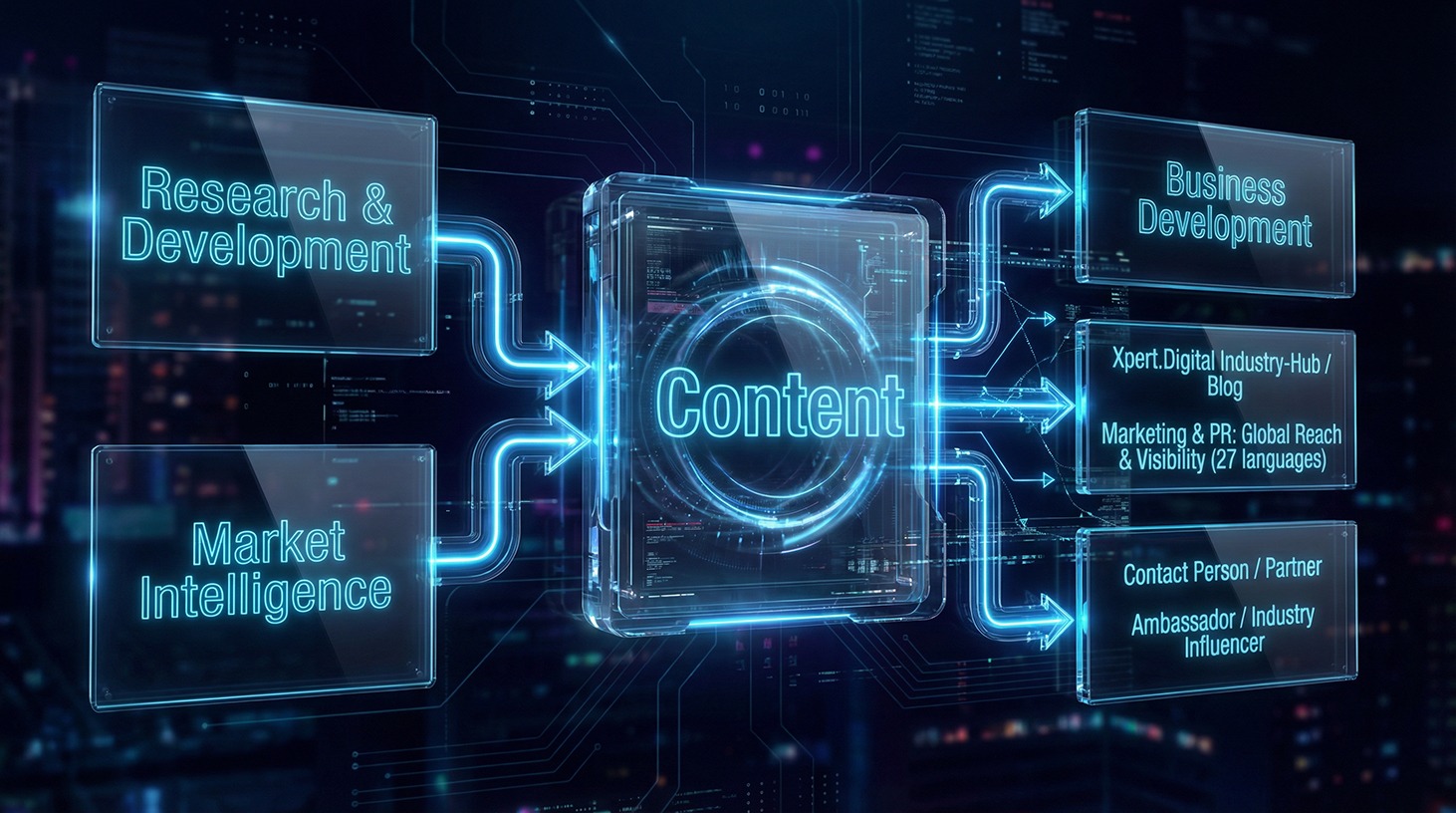
The quasi-in-house solution: How Xpert.Digital closes operational gaps in B2B marketing and sales – Smart Content-Driven Business - Image: Xpert.Digital
Xpert.Digital is a data-driven B2B industry hub led by Konrad Wolfenstein . The company acts as an external, quasi-in-house solution for industrial partners, closing operational gaps in marketing, content, and sales – without requiring additional resources on the client side.
More information here:
Your global marketing and business development partner
☑️ Our business language is English or German
☑️ NEW: Correspondence in your native language!

Konrad Wolfenstein
I and my team are happy to be available to you as your personal advisor.
You can contact me by filling out the contact form here wolfenstein@xpert.digital:or simply call me at +49 7348 4088 965. My email address is
I'm looking forward to our joint project.