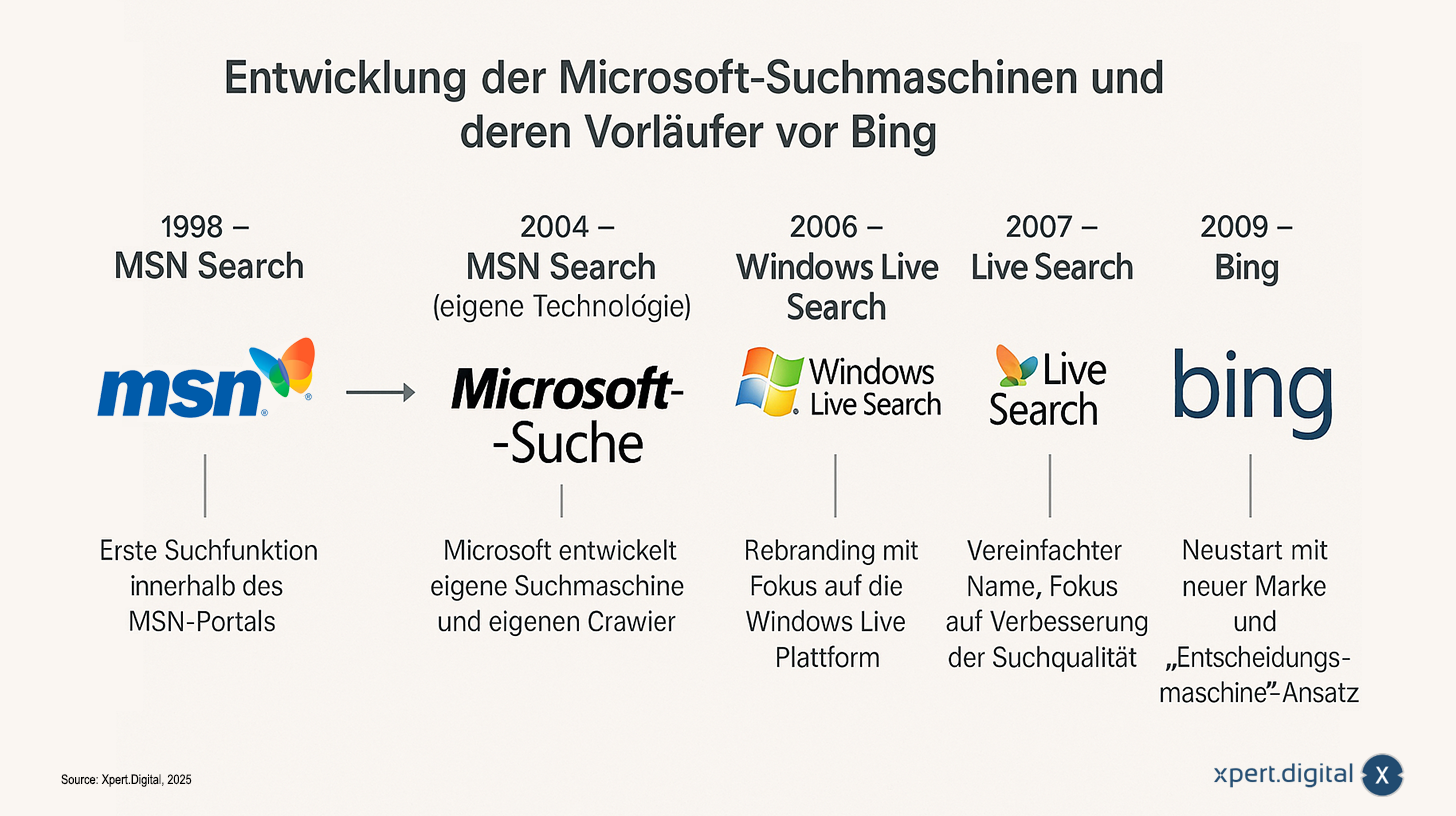
Evolution of Microsoft search engines and their predecessors before Bing – Image: Xpert.Digital
Microsoft's search engine history: From MSN Search to Bing – an overview
Innovation in focus: The story of Microsoft's search technologies
Microsoft's search engine evolution has been marked by several strategic realignments and technological innovations. From MSN Search in the 1990s to Bing in 2009, Microsoft's journey reflects the race for accurate and user-friendly search. The following is a detailed chronological analysis of this development, including the names and features of earlier search engines.
Related to this:


1. MSN Search (1998–2006): The Beginnings
Microsoft's first foray into the search engine market began in 1998 with MSN Search, which was initially based on partnerships with third-party providers such as LookSmart and Inktomi. This solution allowed users to search web content via the MSN platform, but remained dependent on external technologies.
Technological limitations and market entry
MSN Search was initially not a standalone search service, but rather used aggregated results from other providers. This changed in 2003 when Microsoft decided to develop its own search engine. The project began with an index of 24 documents and gradually grew to 5 billion indexed pages. Development was carried out in close collaboration with Microsoft Research and involved continuous prototype testing and iteration.
Market positioning and weaknesses
Despite its integration into Internet Explorer (IE), MSN Search remained largely unsuccessful outside the US. This was due to its focus on American search queries and competition from Google, which offered faster, more relevant search results. The decision to develop its own technologies marked a turning point, culminating in 2005 with the release of its first in-house developed index.
2. Windows Live Search (2006–2007): From portal to vertical search
With the introduction of Windows Live Search in 2006, Microsoft began prioritizing its own search technologies. The service became part of the Windows Live Suite and integrated features such as image and video search, as well as news and blog search. A key feature was contextual search, which analyzed the search behavior of other users to optimize results.
Mobile integration and extensions
To strengthen its mobile presence, Microsoft released Live Search for Windows Mobile and Java in 2007. These apps offered local search, map views, and traffic information – a pioneering role in mobile search engine development. At the same time, the Live Local Search feature was launched in the US and UK, using location data to deliver targeted results.
Hiring of specialized services
In parallel, niche projects such as Live Search Academic (academic literature) and Live Search Books (book indexing) were discontinued in 2008. This decision reflects the focus on core functions before the next rebranding.
Related to this:

3. Live Search (2007–2009): The transition to Bing
In 2007, the company was renamed Live Search, coinciding with the separation of the search team from the Windows Live Suite. The new brand was intended to emphasize the decoupling from the MSN portal and create an independent identity. Live Search introduced customizable start pages that integrated weather data, news, and charts.
Technological advances and partnerships
Microsoft's acquisition of Powerset in 2008 brought semantic technologies that were later integrated into Bing. At the same time, Microsoft partnered with Yahoo! to process its search queries via Live Search – a strategic move to gain market share.
Weaknesses and market pressure
Despite these efforts, Live Search remained in Google's shadow. The relevance of the search results and user-friendliness were identified as critical weaknesses. The decision to completely revamp the service culminated in the launch of Bing in 2009.
4. Bing (2009–present): The decision engine
Bing launched on June 3, 2009, as the successor to Live Search. Microsoft positioned the search engine not as a pure search engine, but as a decision engine designed to support users with complex queries such as travel planning or product comparisons.
Core innovations and design
- Optimized user interface: A clear homepage with daily changing background images and a clear navigation structure.
- Search suggestions and Explore pane: Real-time suggestions during typing, as well as an "Explore pane" with related topics.
- Integration of Ciao: Results from the price comparison portal Ciao were initially integrated as a link, later directly into the search results.
AI integration and current developments
In 2023, Microsoft introduced Bing Chat (later Microsoft Copilot), an AI-powered chat feature based on GPT-4. This innovation boosted user numbers to 100 million active users and marked a milestone in AI-powered search. Today, with a market share of 3.64% (as of 2024), Bing is the second-largest search engine worldwide.
5. Comparison of Microsoft search engines
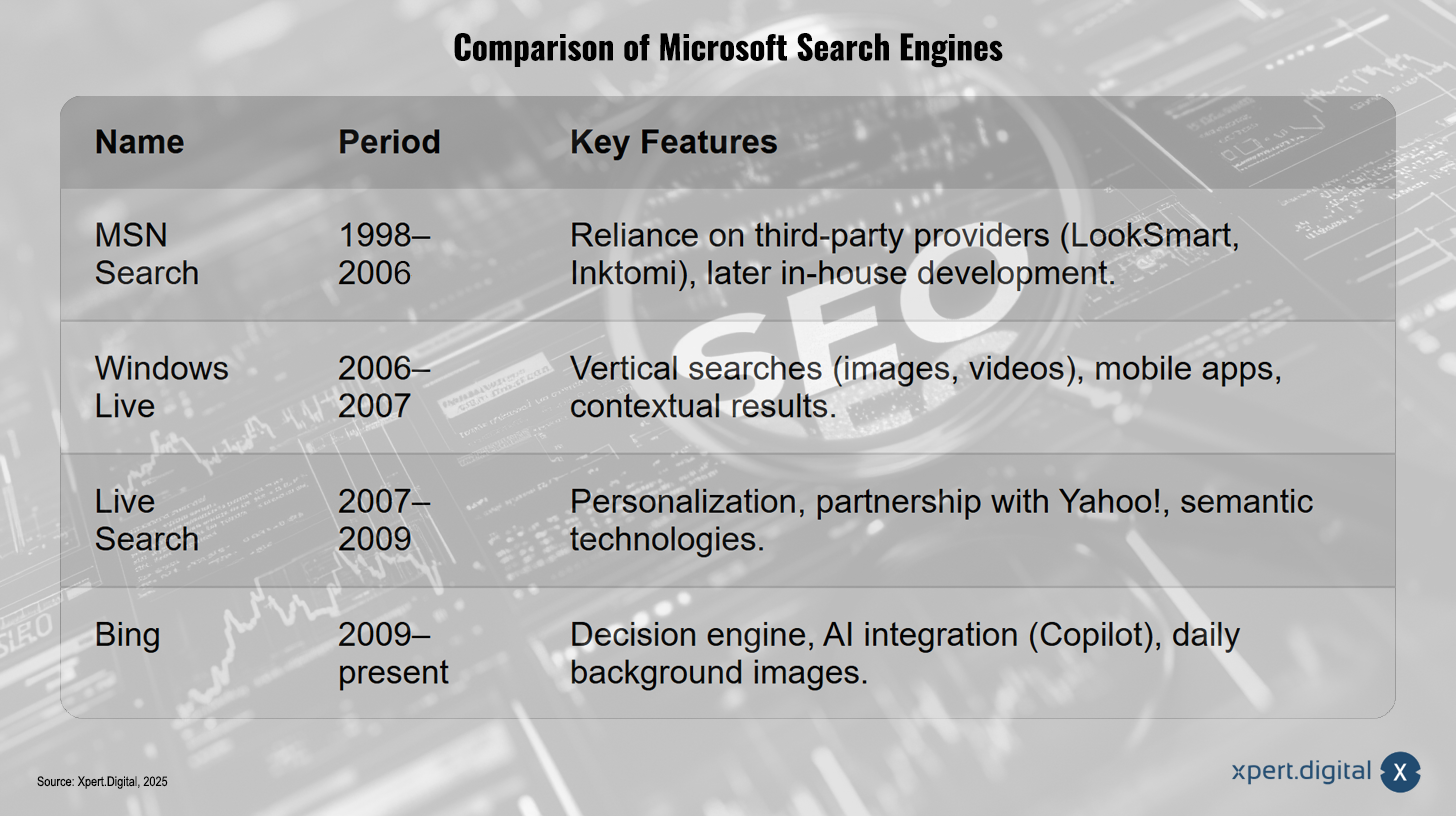
Comparison of Microsoft search engines – Image: Xpert.Digital
Microsoft's search engine development can be divided into four phases. From 1998 to 2005, MSN Search was used, initially based on third-party technologies such as LookSmart and Inktomi, but later employing its own developments. Between 2006 and 2007, Windows Live was introduced, characterized by vertical searches (e.g., for images and videos), mobile apps, and contextual search results. This was followed by Live Search from 2007 to 2009, which was marked by personalization, a partnership with Yahoo!, and the use of semantic technologies. Since 2009, Bing has been active, serving as a decision engine, offering AI integration (e.g., via Copilot), and generating attention with daily wallpapers.
Related to this:

6. Bing and Copilot: Microsoft's path to the future of AI search
Bing remains a central part of Microsoft's ecosystem, particularly through its integration with Windows and Microsoft Edge. The AI development with Copilot demonstrates Microsoft's continued commitment to search innovation. Nevertheless, the challenge remains to compete with Google, which continues to dominate with a 90.91% market share.
Microsoft's search engine development reflects the dynamics of the internet age: from dependence on external technologies (MSN Search) to a focus on niche markets (Windows Live) to AI-powered decision support (Bing). Each step was characterized by adaptation to user behavior and market trends, with Bing now established as an independent alternative to Google.
Related to this:
Your global marketing and business development partner
☑️ Our business language is English or German
☑️ NEW: Correspondence in your native language!

Konrad Wolfenstein
I and my team are happy to be available to you as your personal advisor.
You can contact me by filling out the contact form here wolfenstein@xpert.digital:or simply call me at +49 7348 4088 965. My email address is
I'm looking forward to our joint project.