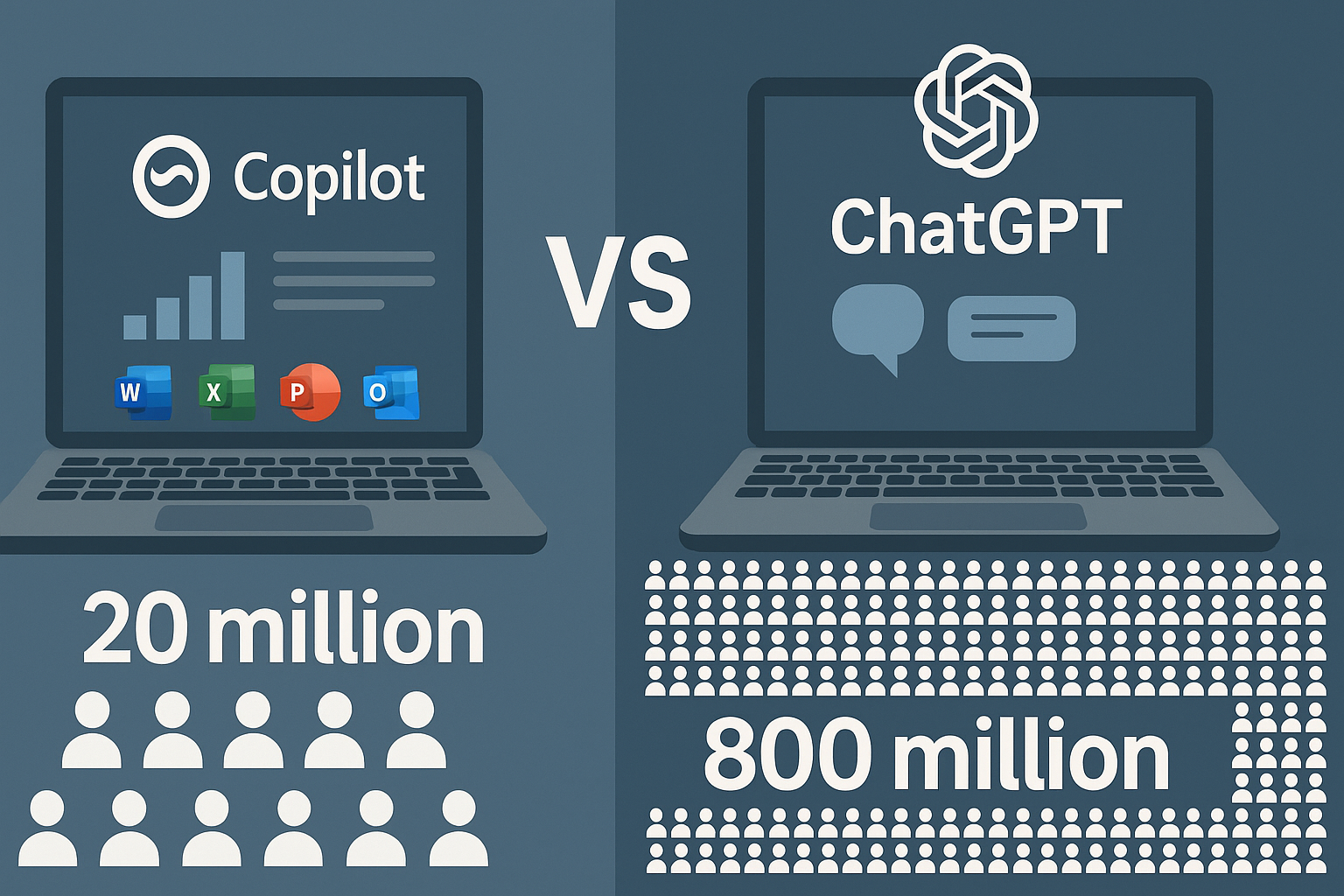
800 vs. 20 million users: The brutal truth about Microsoft's AI problem in the office with Copilot versus OpenAI's ChatGPT – Image: Xpert.Digital
Despite billions in investment: This is why employees are ignoring Microsoft's Copilot and using ChatGPT instead
The power of habit: The surprisingly simple reason why ChatGPT is outperforming Microsoft's Copilot
The integration of artificial intelligence into everyday work has taken a remarkable turn: Although Microsoft has invested billions in its Copilot platform and seamlessly integrated it into the Microsoft 365 suite, employees worldwide still prefer ChatGPT. This preference persists even when companies have already purchased expensive Copilot licenses.
Related to this:


The sobering figures: A significant competitive disadvantage
The statistics speak volumes about the current state of the AI assistant market. ChatGPT dominates with an impressive 800 million weekly active users and has increased its business customer base by 50 percent to three million paying enterprise customers within just a few months. This growth rate underscores OpenAI's strong position in the enterprise AI solutions market.
Microsoft Copilot, on the other hand, presents a completely different picture. With only 20 million weekly users, the platform has stagnated at the same level for over a year. These figures are particularly remarkable considering that Microsoft has over 1.5 billion Windows users worldwide – meaning that only about one percent of these users regularly use Copilot.
Its spread across the corporate landscape
The differences in enterprise adoption are even more pronounced. While around 60 percent of Fortune 500 companies have at least evaluated Microsoft Copilot, most organizations limit its use to small groups of hundreds or a few thousand employees. In contrast, OpenAI reports deeper market penetration with three million paying business customers, many of whom switched to ChatGPT after initial experimentation with Copilot.
A striking example is the pharmaceutical company Amgen, which announced in the spring of 2024 that it would acquire 20,000 Copilot licenses for its employees. Thirteen months later, however, the majority of Amgen employees were using ChatGPT for their daily tasks, while Copilot was primarily used for Outlook and Teams functions.
The roots of the problem: familiarity and habit
The main reason for ChatGPT's popularity lies in its early launch and viral spread. ChatGPT was introduced at the end of 2022 and immediately captured public attention. Its simple web interface, fast response times, and surprisingly good results led to millions of people using the tool, initially at home and later at work.
When Microsoft introduced Copilot for businesses, many employees were already familiar with ChatGPT and used it for email drafting, document summaries, brainstorming, or even coding. This early adoption led to a kind of "habit inertia"—people preferred to stick with the tool they knew rather than switch to something new, even if it was better integrated with the company's systems.
Perceived quality and user-friendliness
Many users report that ChatGPT simply "works." It delivers fast, clear answers and can handle a wide range of queries without complex setup. For research, drafts, and summaries, employees say the results are often more "natural" and useful than what Copilot offers.
Another key factor is the reduced friction associated with using ChatGPT. It's not restricted by company policies like Copilot, which, while raising data security concerns, means employees can use it with fewer barriers. Access is simple – you just open a browser tab, no additional software or login steps required.
The role of organic dispersal
Because ChatGPT spread organically, much of the training and know-how happened informally. Employees taught each other tips and tricks, shared prompts, and integrated ChatGPT into their own workflows—often faster than IT departments could create official Copilot guides.
This bottom-up adoption contrasts with typical top-down implementations of enterprise software. While Microsoft relies on structured introductions and IT-driven rollouts, ChatGPT gained popularity through spontaneous use and word-of-mouth recommendations.
Mixed landscapes: When companies operate both systems in parallel
A growing number of large companies are responding to this situation by implementing both Copilot and ChatGPT and running both AI assistants in parallel. New York Life Insurance Company, for example, uses both tools for all 12,000 employees, with the final decision on whether to implement both on a regular basis depending, among other things, on employee acceptance.
At Bain & Company, the ratio is approximately 16,000 ChatGPT jobs to 2,000 Copilot jobs. These figures illustrate that even in organizations offering both tools, employee preference strongly leans towards ChatGPT.
Related to this:

Microsoft's countermeasures: Pricing strategy and integration
Microsoft is attempting to counter with aggressive pricing. Copilot costs $30 per month per user, while ChatGPT Enterprise can cost up to $60 per workstation. This price difference is substantial and should theoretically represent a competitive advantage.
However, OpenAI is already countering with more flexible usage-based pricing models and discounts for customers who purchase additional AI products. Furthermore, OpenAI has aligned its strategy to evolve ChatGPT from a standalone AI assistant into a comprehensive business platform.
OpenAI's integration strategy
OpenAI has strategically worked to integrate ChatGPT into existing business applications. Through direct connections to enterprise applications such as GitHub, Google Docs, Gmail, Microsoft SharePoint, Outlook, OneDrive, HubSpot, and Dropbox, OpenAI has significantly expanded its market reach.
This strategy aims to remove the barriers that previously prevented ChatGPT's widespread enterprise implementation, making access to OpenAI technology as seamless as possible for business people.
🎯📊 Integration of an independent and cross-data-source AI platform 🤖🌐 for all business needs


Integration of an independent and cross-data-source AI platform for all business needs - Image: Xpert.Digital
AI Game Changer: The most flexible AI platform - Tailor-made solutions that reduce costs, improve your decisions and increase efficiency
Independent AI platform: Integrates all relevant company data sources
- This AI platform interacts with all specific data sources
- From SAP, Microsoft, Jira, Confluence, Salesforce, Zoom, Dropbox and many other data management systems
- Rapid AI integration: Tailor-made AI solutions for businesses in hours or days, instead of months
- Flexible infrastructure: Cloud-based or hosting in your own data center (Germany, Europe, free choice of location)
- Maximum data security: its use in law firms is irrefutable proof
- Deployment across a wide variety of enterprise data sources
- Choice of own or different AI models (DE, EU, USA, CN)
Challenges that our AI platform solves
- Lack of fit of conventional AI solutions
- Data protection and secure management of sensitive data
- High costs and complexity of individual AI development
- Shortage of qualified AI specialists
- Integration of AI into existing IT systems
More information here:

The AI Assistant Battle: How ChatGPT Outshines Microsoft Copilot with Organic Growth
Challenges in Copilot Implementation
The introduction of Microsoft Copilot presents several specific challenges that hinder its adoption. One of the biggest hurdles is the cost and complexity of licensing. At $30 per user per month, in addition to existing Microsoft 365 subscriptions, this represents a significant investment for many organizations.
Furthermore, there is often a lack of awareness among employees. Many organizations activate licenses without a proper onboarding or communication plan, leaving employees unprepared and unable to integrate the tool into their routines.
The Importance of Prompt Engineering
Another critical factor is that Copilot requires users to master prompt engineering – the ability to shape inputs to produce meaningful and accurate results. Without this fundamental knowledge, employees may become frustrated or perceive Copilot as unreliable, reducing their motivation to use it.
Microsoft responded by launching the Copilot Academy to equip users with better prompt engineering skills. This response demonstrates that the company has recognized the usability challenges.
Related to this:

Security and compliance challenges
Integrating AI tools like Microsoft Copilot into enterprise workflows presents unique and complex security challenges. According to a 2024 Gartner survey, 57 percent of organizations opted for limited rollouts to low-risk or trusted users to mitigate initial security risks.
Additionally, 40 percent of organizations experienced significant delays in the rollout of Microsoft 365 Copilot due to concerns about security and oversharing. These challenges underscore the importance of carefully assessing potential vulnerabilities when integrating AI tools.
The role of corporate culture
The adoption of AI assistants is also heavily influenced by company culture. While ChatGPT has built a strong following through its organic spread and ease of use, Copilot struggles with the perception of being just another imposed corporate tool.
The fact that 68 percent of employees want their employers to use more AI technology, and that 56 percent already use AI daily, shows that there is a willingness to adopt AI. The challenge lies in channeling this willingness in the right direction.
Industry-specific adoption
The adoption of AI assistants varies considerably across different industries. In the technology sector, 50 percent of employees frequently use AI at work, followed by professional services at 34 percent and finance at 32 percent.
These differences reflect the fact that some industries are more open to technological innovation, while others require more time for evaluation and implementation. Regulated sectors such as healthcare and finance face additional compliance challenges that can slow adoption.
Success stories and potential
Despite the challenges, Microsoft has achieved considerable success. Large clients like Barclays, Accenture, and Volkswagen each have over 100,000 paying Copilot users. These examples demonstrate that with proper implementation and support, Copilot can indeed be successful.
Studies also show that 77 percent of early Copilot adopters in corporate organizations report that Copilot has made them more productive. In corporate environments, 78 percent of organizations experienced positive productivity changes with Copilot, with users claiming a 10-15 percent increase in productivity and a 19 percent reduction in burnout.
The future of AI assistants in the workplace
This development shows that the future of AI assistants in the workplace will not necessarily be dominated by a single tool. Instead, an ecosystem of various AI tools, optimized for different use cases, appears to be emerging.
CEO Satya Nadella has made it clear that Microsoft needs to win over "hundreds of millions of people" to its AI apps. This statement underscores the urgency with which Microsoft is trying to improve Copilot's market position.
Strategic implications for companies
This development raises several strategic considerations for companies. First, they should monitor the actual usage of their AI tools instead of relying solely on license sales. Second, it is important to understand and consider employee preferences, as the best technology is useless if it is not adopted.
Third, companies should develop a balanced strategy between top-down governance and bottom-up innovation. While structured rollouts are important for security and compliance, organic adoption by employees can provide valuable insights into practical use.
Related to this:

A race for user acceptance
The development of the AI assistant market shows that technical superiority or integration alone is not enough to gain user acceptance. ChatGPT's success is based on a combination of early market entry, organic growth, ease of use, and the ability to quickly adapt to user needs.
Despite its technical capabilities and deep integration with the Microsoft product suite, Microsoft Copilot struggles with fundamental user adoption challenges. The stagnation at 20 million weekly users, compared to ChatGPT's explosive growth to 800 million, demonstrates that the AI assistant market is still far from consolidating.
The future will show whether Microsoft can turn the tide through price adjustments, improved usability, and better training programs, or whether ChatGPT will further consolidate its dominant position. For businesses, this means they should remain flexible and closely monitor the development of both platforms to make the best possible decisions for their digital transformation.
B2B procurement: Supply chains, trade, marketplaces & AI-powered sourcing


B2B procurement: Supply chains, trade, marketplaces & AI-powered sourcing with ACCIO.com - Image: Xpert.Digital
More information here:
We are here for you - Consulting - Planning - Implementation - Project Management
☑️ SME support in strategy, consulting, planning and implementation
☑️ Creation or realignment of the digital strategy and digitization
☑️ Expansion and optimization of international sales processes
☑️ Global & Digital B2B trading platforms
☑️ Pioneer Business Development

Konrad Wolfenstein
I would be happy to serve as your personal advisor.
You can contact me by filling out the contact form below or simply call me on +49 7348 4088 965 .
I'm looking forward to our joint project.
Write to me


Xpert.Digital - Konrad Wolfenstein
Xpert.Digital is a hub for industry focusing on digitalization, mechanical engineering, logistics/intralogistics and photovoltaics.
With our 360° Business Development solution, we support renowned companies from new business to after-sales.
Market intelligence, smarketing, marketing automation, content development, PR, mail campaigns, personalized social media and lead nurturing are part of our digital tools.
You can find more information at: www.xpert.digital - www.xpert.solar - www.xpert.plus
Keep in touch