


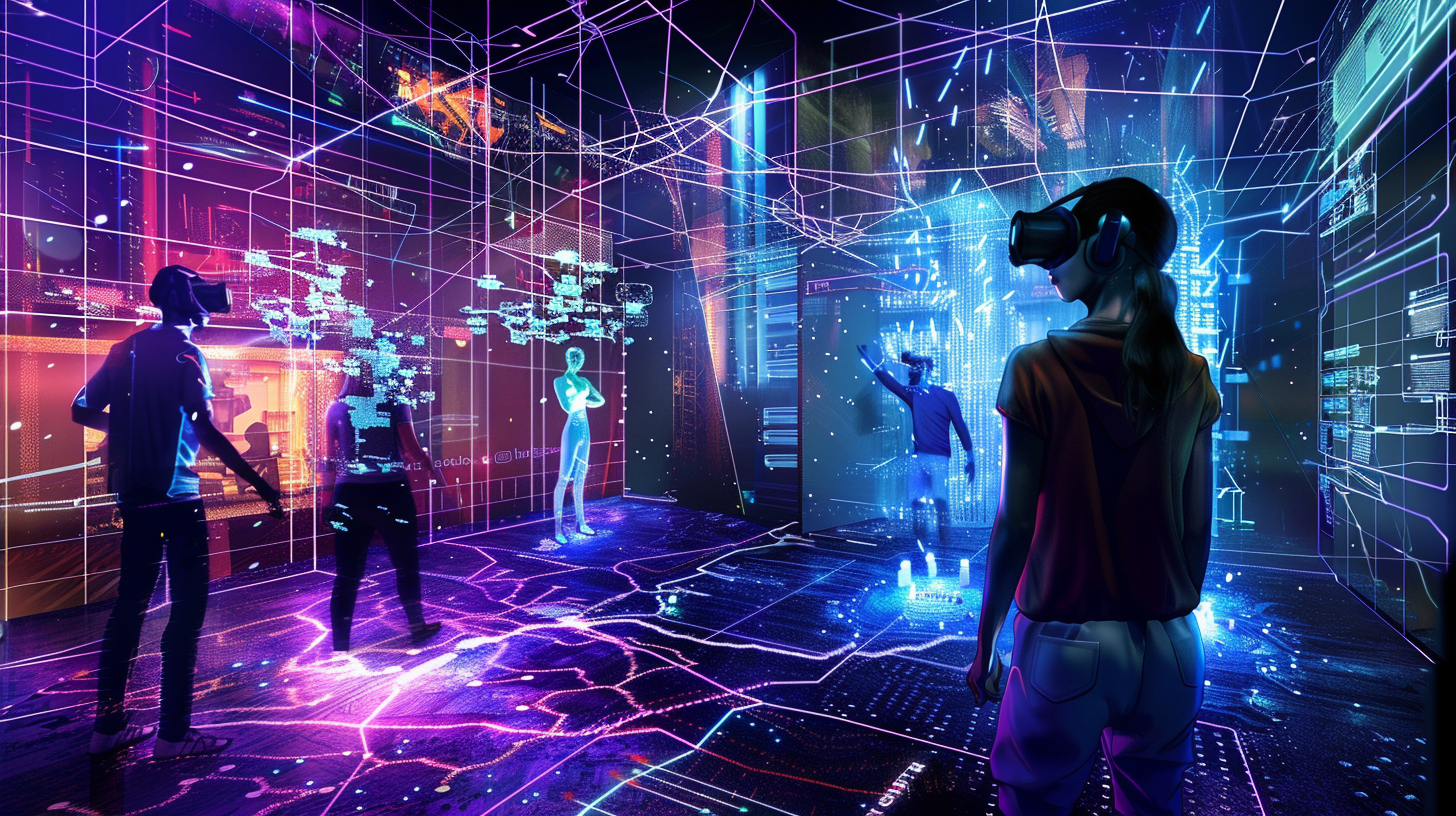
Metaverse Update: Why Extended Reality and Digital Twins Are Shaping the Future of Product Development – Image: Xpert.Digital
Technology trio of innovation: What augmented reality, the metaverse, and digital twins make possible
Extended Reality (XR) in the metaverse, together with digital twins, marks a profound shift in product development. Companies are using these technologies not only to develop products faster and more cost-effectively, but also to create entirely new forms of collaboration and customer interaction. The following will illustrate how these innovations are already transforming entire industries and what perspectives they offer for the future. This text demonstrates why XR and digital twins are becoming one of the most important drivers for the next generation of product design and manufacturing – far beyond the automotive or fashion industries.
“Extended Reality in the metaverse is far more than just a futuristic gimmick.” Indeed, it is becoming increasingly clear that XR, in combination with digital twins, holds enormous potential for seamlessly connecting real and virtual worlds. For example, virtual prototypes can be projected precisely into real-world work environments. Engineers and designers can thus examine their designs in real time, giving them unprecedented flexibility when making design changes or during early prototyping phases. These novel possibilities not only drastically reduce development times but also increase product quality, as potential problems are identified much earlier.
Virtual prototyping and product design: A paradigm shift
A particularly impressive example of progress in product development is the automotive industry. "Virtual prototyping has already become widely established in the modern development centers of major automotive manufacturers." Companies like BMW and Hyundai use digital twins to design vehicle components in a highly realistic digital environment. Engineers wear XR glasses, allowing them to view components in 3D and adjust them immediately. The advantages are obvious: expensive physical prototypes no longer need to be produced in every development phase. Instead, design changes can be made directly on virtual models, accelerating testing phases and saving resources.
The fashion industry has also recognized that digital twins are ideally suited for faster and more flexible development. Designers at renowned brands, including Nike, create both physical and digital versions of their products—for example, sneakers—and test their aesthetics in various virtual contexts. With the help of XR, designers can see how a shoe looks in different environments or under varying lighting conditions. This not only fosters greater creativity but also allows them to involve customers and gather feedback during the design phase.
In both cases – the automotive and fashion industries – the use of XR and digital twins proves to be a crucial factor, as it optimally integrates the real and virtual worlds. Production and design teams can identify much earlier how a product will perform in practice, which materials are best suited, or how specific design decisions will affect ergonomics or aesthetics. Instead of complex, separate simulations in isolated departments and programs, this creates a networked system in which all stakeholders can access the same digital models simultaneously.
Related to this:
Collaborative product development: Boundless teamwork
The rapid development of XR technology is having a significant impact on how teams collaborate. "Digital meetings become so realistic thanks to XR capabilities that geographical distances are virtually irrelevant." Engineers, designers, and other stakeholders can use XR-enabled devices to view the same virtual 3D model, edit it collaboratively, and make adjustments as the process unfolds. This form of global teamwork opens up new horizons for companies that rely on fast, agile work.
In practice, this means that experts from different disciplines – from materials science to marketing – can work on a project simultaneously. This not only saves enormous costs previously incurred through travel or physical model modifications, but also fosters team creativity, as ideas and feedback can be exchanged immediately.
XR tools that show colleagues on the other side of the world exactly where a change should be made significantly increase efficiency. Anyone who has ever participated in a video conference knows that presentations or complex engineering drawings are often difficult to convey on screen. XR makes all the difference here: Instead of complicated descriptions and explanations, all project participants see live on the virtual model what needs to be changed. This merges the physical reality of one's own workplace with the virtual object, and it feels as if everyone is sitting together in the same room.
Related to this:
- What advantages do collaborative platforms offer compared to traditional work models?
- How can collaborative platforms improve cooperation between different departments within a company?
Immersive simulations: Anticipating reality
Another milestone enabled by XR and digital twins is realistic simulations. "Errors and bottlenecks can be identified much faster in a virtual environment than in complex test setups in the real world." This proves to be a particularly valuable tool in production. For example, automotive manufacturers can digitally build an entire production line and simulate the process before purchasing a single machine. This allows potential bottlenecks or problem areas to be identified at a very early stage. The necessary adjustments, such as to the arrangement of robots or the material flow, can also be made directly in the virtual environment.
This approach reduces the risk of costly misinvestments and provides crucial competitive advantages. Companies that virtually map their production processes can implement changes to products or procedures much faster and thus react more flexibly to market demands. Furthermore, the ability to quickly simulate different scenarios increases innovation capacity. Complex ideas no longer need to be painstakingly tested in expensive prototypes, but can first be optimized in an immersive environment.
Furthermore, quality assurance is a key beneficiary of these new technologies: If the critical parameters of a product or process are identified in the digital twin, the actual end product can be optimized for high quality from the outset. This leads to less scrap and reduces the need for rework.
Customized adaptations: More individualization thanks to XR
A major advantage of XR in the metaverse becomes apparent when it comes to individual customer needs. "Consumers increasingly expect products to be tailored to their personal preferences." This is a crucial purchasing criterion, especially in e-commerce and the furniture industry: Furniture manufacturers already offer XR apps that allow potential buyers to project a virtual 3D model of a piece of furniture into their own home. This way, they can see exactly whether a sofa or table fits with the rest of their decor before they even order it.
This form of personalized presentation increases customer satisfaction and can prevent costly returns. Customers who have virtually tested a piece of furniture make much more targeted purchases. In other sectors as well – from fashion and electronics to the automotive industry – companies are increasingly relying on XR-based purchasing advice. Customers can virtually try on or test clothing, accessories, or even a new sports car, thus making more informed decisions.
In the long term, this principle can be expanded indefinitely. Even complex building structures or components can be visualized using XR. Clients can virtually inspect the position of windows, roof lines, or walls before construction begins. This significantly reduces misunderstandings and planning errors.
Maintenance and training: Knowledge at a glance
XR, in conjunction with digital twins, is revolutionizing not only development processes but also maintenance and training. "Technicians wearing XR glasses receive real-time information about the condition of a machine or system." This means they can see directly on the object which components need to be replaced or serviced, and what steps are required. Instructions appear directly in their field of vision, indicated by arrows or other symbols superimposed onto the real environment.
This method improves efficiency because technicians no longer need to search through thick manuals or consult external advisors. At the same time, errors are reduced because XR visually indicates precisely which component is affected. Maintenance and repair tasks can thus be carried out faster and more safely, even on highly complex machines.
A similar picture emerges in training, for example in medicine. More and more hospitals are now using XR to teach surgical techniques. Surgeons can view virtual patient conditions and the corresponding surgical field and learn step by step before working on a real patient. This intensive pre-operative practice can improve the quality of medical procedures and increase patient safety.
Urban planning and architecture: Preparing the digital city
A particularly exciting application area for digital twins in combination with XR is urban planning and architecture. "A digital copy of a city or building can be superimposed onto the real environment using XR to realistically assess the impact of construction projects." Urban planners and architects can use this to simulate how new buildings or transport infrastructure integrate into the existing cityscape.
Thanks to this innovative approach, they can identify potential problems or conflicts with existing structures in advance. Whether it's traffic management, connection to the public network, or the impact of light and shadow – all of this can be researched and improved in a digital modeling environment before actual construction costs are incurred. This not only accelerates approval processes but also reduces the planning effort required for corrections.
Another advantage is that citizens and other stakeholders can be involved in the planning process much more transparently. With the help of a digital twin, they can see early on how their city will change and voice suggestions or concerns long before the first sod is turned. This participatory component increases public acceptance of large construction projects and enables a far more effective collaboration between citizens, administration, and politicians.
Revolutionary changes and continuous innovation
The examples described here vividly illustrate how XR, in conjunction with digital twins, is already revolutionizing product development in the metaverse. Thanks to the seamless integration of virtual and physical elements, companies can not only produce significantly faster and more cost-effectively, but also operate more creatively and with a greater focus on customer needs.
"The next generation of product development has the potential to fundamentally change existing processes." This is reflected in many industries: from large corporations to small design studios. The increasing prevalence of powerful XR devices, 5G networks, and cloud solutions will ensure that more and more companies integrate a digital twin into their operations.
Furthermore, new business opportunities are opening up for service providers who create and maintain digital twins. Simulation experts, XR developers, and data analysts are already in high demand. At the same time, integration with the Internet of Things (IoT) will further increase the accuracy and timeliness of digital twins. Sensors that deliver real-time data from machines or products are automatically updated in the twin, allowing engineers or maintenance teams to access the current status at any time.
A key factor here is the future availability of artificial intelligence (AI), which will make XR applications even smarter. For example, a system could automatically suggest changes to the digital twin based on previously collected data, thus further refining human-machine collaboration.
The question of whether XR in the metaverse, together with digital twins, is merely a short-lived hype or a true game-changer is hardly relevant for many experts anymore. Given the rapid development and the almost limitless potential applications, it is obvious that these technologies will play a central role in the industrial value creation of the future.
Those who fail to address this issue promptly risk falling behind in global markets within a few years. Companies already utilizing XR applications and digital twins are taking a pioneering role and, based on experience, are significantly more agile and adaptable in a world of constant change.
The key to success lies in developing a strategy that intelligently combines technology, skilled personnel, and business models. This requires the courage to experiment, open collaboration with external partners and startups, and a vision for the company's digital future.
The next generation of product development will not be ushered in solely by individual measures or tools, but by a holistic integration of digital and physical resources. Extended reality in the metaverse and digital twins provide the foundation for this. Companies that lay this foundation early on will be able, in the long run, to implement product innovations faster, interact more closely with their customers, and react more flexibly to market changes overall.
This is precisely where the great opportunity lies: The merging of the real world with advanced digital technology brings a surge of innovation that many industries urgently need to remain competitive. The path to success leads through consistent experimentation, investment in new technologies, and the willingness to break down rigid processes. Ultimately, it is the symbiosis of extended reality, the metaverse, and digital twins that fundamentally transforms product development, maintenance, training, and customer experience—with the promise of redefining the future of industry and the service sector.
Related to this:
We are here for you - Consulting - Planning - Implementation - Project Management
☑️ Our business language is English or German
☑️ NEW: Correspondence in your native language!

Konrad Wolfenstein
I and my team are happy to be available to you as your personal advisor.
You can contact me by filling out the contact form here wolfenstein@xpert.digital:or simply call me at +49 7348 4088 965. My email address is
I'm looking forward to our joint project.