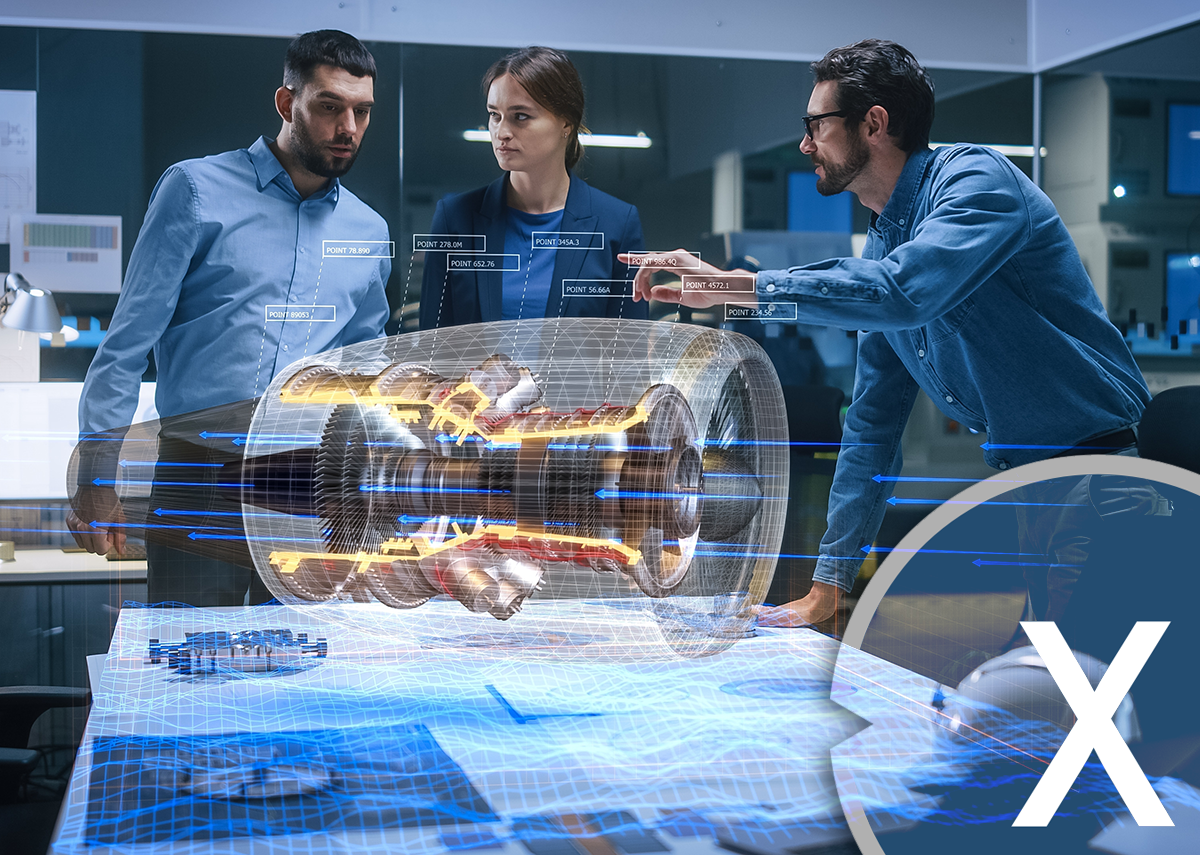
Industrial Metaverse and Mixed Reality companies and providers – Image: Xpert.Digital / Gorodenkoff|Shutterstock.com
Top Industrial Metaverse and Mixed Reality companies and providers
To identify top industrial metaverse and mixed reality companies and providers, there are some criteria you can consider.
Experience and expertise
Pay attention to how long the company has been active in the field of industrial metaverse and mixed reality. Companies with many years of experience often have the knowledge and expertise to offer high-quality solutions.
References and case studies
Review the company's references and case studies. What projects have they already completed, and which clients have they worked for? Reviews and experiences from existing clients can also provide useful information.
Technological know-how
Make sure the company has in-depth technological expertise, especially in the field of mixed reality. They should be familiar with the latest technologies and platforms and be able to develop customized solutions for your specific requirements.
Industry-specific solutions
Check whether the company offers industry-specific solutions and applications tailored to the needs of your industry. A company specializing in industrial metaverse and mixed reality in your specific field can offer valuable expertise and customized solutions.
Team competence
Research the company's team. Check if they have a multidisciplinary team with expertise in augmented reality (AR), virtual reality (VR), 3D modeling, software development, and UX design. A qualified team can influence the quality and success of the solutions.
Partnerships and networks
Check whether the company has strong partnerships or networks with other companies, technology providers, or research institutions. Collaborations and partnerships can indicate a strong market position and access to the latest innovations.
Customer support and service
Pay attention to the customer support and service the company offers. A reliable provider will assist you with the implementation and maintenance of the solutions and provide good customer service.
Scalability and flexibility
Ask about the scalability of the company's solutions and whether they are flexible enough to adapt to your future needs. The ability to tailor solutions to different company sizes and requirements is important.
Innovation and research
Pay attention to whether the company prioritizes innovation and research. Companies that continuously explore new technologies and approaches and invest in research and development are often leaders in their field.
Costs and budget
Consider the costs and your budget when choosing a company. Compare the pricing structures of different providers and check whether they are in line with the expected services and benefits.
➡️ It is advisable to evaluate several companies, obtain quotes, and check references before making a final decision. Thorough research and evaluation of potential providers can ensure that you are working with a top-tier industrial metaverse and mixed reality company.
➡️ As experts with many years of experience in the field of Extended Reality, Xpert.Digital you in this future-oriented technology!
The agency's online metaverse configurator
For media professionals, 3D artists, online, media and advertising agencies, and other service providers: Take advantage of the opportunity to offer your clients their own metaverse by leveraging the expertise of Xpert.Digital and its partners. Furthermore, you can integrate our metaverse configurator into your service portfolio as a white-label solution.

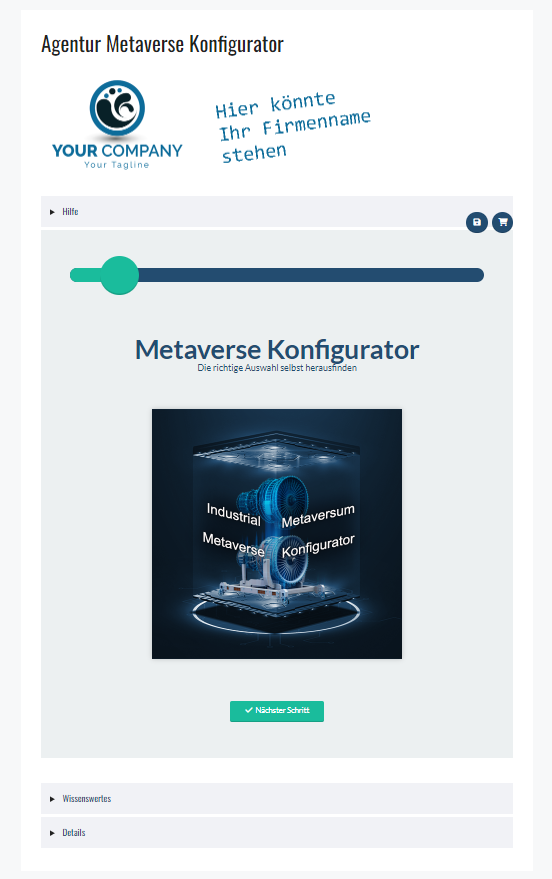
Agency Metaverse Configurator - Image: Xpert.Digital
More information here:
Is the metaverse more than just virtual reality?


Augmented & Extended Industrial Metaverse – Xpert Reality / Showrooms Agency – Planning Office
Yes, the metaverse extends beyond virtual reality (VR). While VR can be an important part of the metaverse, the metaverse encompasses a broader conception of a comprehensive, interconnected virtual reality.
The metaverse is defined as an extended virtual world inhabited and explored by humans. It is a digital ecosystem comprised of various interconnected virtual environments, platforms, and content. Within the metaverse, users can not only interact with computer-generated environments but also communicate and collaborate with other users.
While VR places users in an immersive virtual environment, the metaverse goes further, allowing users to move around in a persistent, networked space and interact with other users in real time. The metaverse can encompass various technologies such as VR, augmented reality (AR), mixed reality (MR), blockchain, artificial intelligence (AI), and more.
The metaverse offers potential for diverse applications and uses beyond entertainment and games. It can serve as a platform for social interactions, virtual meetings, education, commerce, virtual travel, creative expression, and much more. It strives to create a comprehensive and immersive digital experience that complements and expands real life.
➡️ It is important to note that the concept of the metaverse is still evolving, and various visions and interpretations exist. There is currently no unified definition or standardized implementation of the metaverse. It is expected that further developments and innovations in the coming years will advance the concept of the metaverse, making it an even more diverse and inclusive digital space.
➡️ Learn more here: Augmented & Extended Industrial Metaverse
Difference between Mixed Reality and Extended Reality


Metaverse know-how: Mixed Reality and Extended Reality – Image: Xpert.Digital
10 Examples of the Use of Industrial Metaverse
The Industrial Metaverse has the potential to transform and improve various areas of industrial applications. Here are 10 examples of how the Industrial Metaverse can be used:
Virtual product development
Companies can use the Industrial Metaverse to create virtual prototypes and simulations of products, leading to accelerated product development and more efficient design processes.
Factory planning and optimization
Using the Industrial Metaverse, companies can create virtual factories to plan production lines, optimize processes and identify bottlenecks before making physical investments.
Training and further education
The Industrial Metaverse enables immersive and interactive training for employees by creating virtual training environments. Employees can simulate real-world scenarios and learn practical skills.
Maintenance and servicing
By using Augmented Reality (AR), technicians can obtain detailed instructions and information directly on-site using the Industrial Metaverse to perform maintenance and repair work more efficiently and accurately.
Supply chain management
The Industrial Metaverse enables companies to achieve greater transparency and monitoring across the entire supply chain. Real-time data allows for the identification of bottlenecks, tracking of shipments, and improved risk assessment.
Quality control
Companies can use the Industrial Metaverse to improve quality assurance processes. Virtual inspections and sensor integrations enable early detection and correction of errors.
Virtual collaboration
The Industrial Metaverse enables teams to collaborate across geographical boundaries. Employees can interact in virtual spaces, exchange ideas, and work together on projects.
Internet of Things (IoT) integration
The Industrial Metaverse can capture and analyze IoT data in real time. This enables data-driven decisions and increases the efficiency of industrial processes.
Remote inspection and remote monitoring
The Industrial Metaverse allows experts to perform inspections and monitoring remotely. This saves travel costs and enables rapid response times to any problems that arise.
Production visualization
Companies can use the Industrial Metaverse to visualize real-time data on production progress, machine performance, and other relevant metrics. This allows them to increase productivity and identify bottlenecks.
➡️ These examples demonstrate how the Industrial Metaverse can help optimize industrial processes, reduce costs, increase efficiency, and improve collaboration. However, there are many more use cases and ways the Industrial Metaverse can transform industry.
10 examples of the use of a metaverse in the field of business metaverse
The business metaverse offers numerous opportunities for companies to improve business processes and unlock new business opportunities. Here are 10 examples of how a metaverse can be used in the business metaverse:
Virtual conferences and trade fairs
Companies can hold virtual conferences and trade shows in the Business Metaverse to engage global participants, reduce costs, and provide access to high-quality networking opportunities.
Virtual offices and workspaces
Companies can set up virtual offices and workspaces in the Metaverse to provide remote teams with an immersive and collaborative work environment.
Product presentations and demos
The Business Metaverse enables interactive product presentations and demos where customers can experience products in a virtual environment without being physically present.
Virtual training and courses
Companies can use the Business Metaverse to train and educate their employees virtually. Immersive experiences allow complex tasks to be taught and learned more effectively.
Virtual sales and customer service teams
Companies can set up virtual sales and customer service teams in the metaverse to serve customers, conduct sales conversations, and offer support.
Market research and focus groups
The Business Metaverse enables companies to conduct virtual market research studies and focus groups to gather customer feedback and opinions and to test new products and services.
Virtual collaboration and project management
The Business Metaverse enables teams to collaborate in virtual spaces, exchange ideas, plan projects and track progress.
Virtual recruiting and job interviews
Companies can hold virtual recruiting events and conduct job interviews in the metaverse to identify and hire potential candidates more efficiently.
E-commerce and virtual stores
The Business Metaverse offers companies the opportunity to set up virtual stores and use e-commerce platforms to offer products and services in a virtual environment.
Collaboration with external partners and suppliers
Companies can use the Business Metaverse to collaborate with external partners, suppliers and contractors, exchange data and work together on projects.
➡️ These examples illustrate how the Business Metaverse can help companies expand their business activities, improve collaboration, increase efficiency, and create new opportunities for customer interaction. The use cases within the Business Metaverse are diverse and offer companies the chance to develop innovative solutions and successfully position themselves in the digital world.
10 examples of the use of a metaverse in the field of e-commerce metaverse
The e-commerce metaverse offers exciting opportunities for online retailers to expand their sales activities and create a unique shopping experience for customers. Here are 10 examples of how to use a metaverse within the e-commerce metaverse:
Virtual stores
Companies can set up virtual stores in the e-commerce metaverse where customers can browse, select and buy products virtually.
Virtual fitting rooms
Customers can use avatar technologies and augmented reality (AR) to virtually try on clothes, shoes and accessories to check the fit and appearance before buying.
Interactive product presentations
In the e-commerce metaverse, companies can create interactive product presentations that offer customers an immersive experience and allow them to see, explore, and understand products in action.
Virtual trade fairs and pop-up shops
Companies can host virtual trade fairs and temporary pop-up shops in the Metaverse to showcase their products to a wide audience and offer special deals.
Personalized shopping experiences
The e-commerce metaverse enables personalized shopping experiences where customers receive tailored recommendations and offers based on their preferences and purchase history.
Social Shopping
In the e-commerce Metaverse, customers can interact with friends and other shoppers, share experiences, exchange opinions, and shop together.
Virtual customer support
Companies can offer virtual customer support services in the e-commerce metaverse, where customers can ask questions, receive support, and get personal advice from virtual assistants or employees.
Live events and product launches
Companies can hold live events and product launches in the e-commerce metaverse, where customers have the opportunity to receive exclusive offers and interact directly with brand ambassadors or influencers.
Gamification and rewards
By integrating gamification elements and reward systems, companies can motivate customers to actively interact in the e-commerce metaverse, collect points, and receive exclusive benefits.
Virtual payments and currencies
In the e-commerce metaverse, virtual payment systems and cryptocurrencies can be implemented to enable secure and seamless transactions for the purchase of virtual and physical products.
➡️ These examples demonstrate how the e-commerce metaverse can revolutionize online shopping by creating an interactive, immersive, and social shopping experience. By leveraging the possibilities of the metaverse, companies can improve customer loyalty, reach new target groups, and develop innovative sales strategies.
Consulting, planning and implementation of augmented reality, webAR and industrial applications | B2B | Business Metaverse
Xpert.Plus is a project by Xpert.Digital. We have many years of experience in supporting and consulting for (Extended) Augmented Reality and warehouse optimization, which we combine under Xpert.Plus in a large network.

Konrad Wolfenstein
I would be happy to serve as your personal advisor.
You can contact me by filling out the contact form below or simply call me on +49 7348 4088 965 (Munich) .
I'm looking forward to our joint project.
Write to me


Xpert.Digital – Konrad Wolfenstein
Xpert.Digital is a hub for industry focusing on digitalization, mechanical engineering, logistics/intralogistics and photovoltaics.
With our 360° Business Development solution, we support renowned companies from new business to after-sales.
Market intelligence, smarketing, marketing automation, content development, PR, mail campaigns, personalized social media and lead nurturing are part of our digital tools.
You can find more information at: www.xpert.digital – www.xpert.solar – www.xpert.plus
Keep in touch