Entering the Metaverse – Entry points into virtual reality – Image: Xpert.Digital / CKA|Shutterstock.com
The most well-known paths into virtual reality and the metaverse
Virtual reality (VR) has gained immense popularity in recent years, offering users a fascinating experience beyond the boundaries of the physical world. There are various ways to get started with this exciting technology and explore the limitless possibilities of the virtual world. This article presents the most popular ways to enter the world of virtual reality and provides essential information about each option.
Standalone VR headsets
Standalone VR headsets offer a self-contained VR experience without the need for a PC or smartphone. These headsets are equipped with integrated displays, sensors, and processors, giving users the freedom to move around the virtual world. Popular models like the Oculus Quest 2 offer high image quality and a wide selection of VR games and applications.
PC VR headsets
PC VR headsets are powerful devices that connect to a computer to deliver high-quality VR experiences. By connecting to a powerful PC, these headsets offer impressive graphics and a wide range of interactive content. Some of the most well-known PC VR headsets include the Oculus Rift and the HTC Vive.
Mobile VR
Mobile VR uses smartphones to enable VR experiences. By inserting the smartphone into a VR headset, the user can immerse themselves in the virtual world. Apps and games for mobile VR platforms like Google Daydream and Samsung Gear VR offer a wide range of content, from 360-degree videos to interactive games.
VR arcades
VR arcades are specialized facilities where visitors can enjoy high-quality VR experiences without having to purchase expensive equipment. VR arcades often offer multiple VR setups, providing a wide range of VR experiences, including action-packed games, interactive simulations, and creative applications. This is a great option for those who want to try VR without investing in costly equipment.
360-degree videos and virtual reality experiences
Another way to immerse yourself in virtual reality is through 360-degree videos and VR experiences. This content can be accessed via various platforms such as YouTube VR and VR apps, offering an immersive experience where the user can look around and interact within the virtual environment.
The agency's online metaverse configurator
For media professionals, 3D artists, online, media and advertising agencies, and other service providers: Take advantage of the opportunity to offer your clients their own metaverse by leveraging the expertise of Xpert.Digital and its partners. Furthermore, you can integrate our metaverse configurator into your service portfolio as a white-label solution.

Agency Metaverse Configurator - Image: Xpert.Digital
More information here:
Apple Vision Pro mixed reality headset
Apple's WWDC keynote this year was packed with exciting announcements, but one particular unveiling dominated the coverage: the Apple Vision Pro mixed reality headset. Planned for release in early 2024 and priced at $3,500, the headset is primarily aimed at the productivity market. In this article, we'll take a close look at the Apple Vision Pro and its key features.
A milestone for mixed reality
The Apple Vision Pro marks a milestone for mixed reality (MR) technology. It combines the capabilities of virtual and augmented reality to offer users an immersive and interactive experience. With sophisticated sensors, advanced graphics, and a wide range of features, it is designed to boost productivity in a virtual environment.
Focus on productivity
Unlike many other VR headsets, the Apple Vision Pro focuses primarily on productivity. It offers features and applications specifically designed for collaboration, creativity, and professional use. Users can set up virtual workspaces, edit files, hold meetings, and create 3D designs. The headset integrates seamlessly with Apple's productivity suite, including Keynote, Pages, and Numbers.
Advanced technology
The Apple Vision Pro will be equipped with a range of advanced technologies to deliver an immersive mixed reality experience. These include high-resolution displays, precise spatial tracking sensors, advanced cameras for environmental sensing, and a powerful processor. The headset will also feature advanced audio capabilities to create a realistic sound environment.
Design and comfort
Apple places great emphasis on design and comfort, and the Apple Vision Pro is no exception. The headset is expected to have a slim and lightweight design to ensure long-term wearing comfort. Apple will also offer customizable fit and adjustment options to provide an optimal fit for every user.
Price and availability
The Apple Vision Pro will not be cheap, priced at $3,500, and is aimed more at professional users and businesses. The headset is scheduled for release in early 2024, and Apple is expected to offer a limited number of units.
Popularity of VR and AR headsets: Big brands are no guarantee
Although large companies are active in the VR and AR headset market, this doesn't automatically translate into widespread brand recognition. A graphic illustrates that even companies like Meta (formerly Facebook) and Microsoft don't achieve high levels of awareness for their products. Only 36 percent of respondents indicated they were familiar with the Meta Quest, despite Mark Zuckerberg's media company being one of the largest and most well-known in the world. The situation is similar with Microsoft's HoloLens, which only half of the survey participants said they had at least heard of. However, in the gaming context, one of the main application areas for virtual reality, the topic appears to be significantly more prevalent. 70 percent of survey participants were familiar with PlayStation VR, the second iteration of which was released in February 2023.
The challenge of fame
The low awareness of VR and AR headsets, even among large companies, can be attributed to several factors. Firstly, the VR and AR market is still relatively new and constantly evolving. Many people may not yet have personal experience with this technology and are therefore less familiar with it. Secondly, the marketing and communication strategies of companies also play a role in raising awareness and generating interest in their products.
The Meta Quest
Although Meta (formerly Facebook) is one of the world's most well-known companies, its VR headset, the Meta Quest, hasn't achieved the same level of recognition. This could be because VR technology isn't yet widespread in the mass market and is used primarily by a specific target group. Additionally, it's possible that the product's marketing efforts weren't sufficient to generate broader awareness.
Microsoft's HoloLens
Microsoft is another major company that has entered the mixed reality field. However, its HoloLens AR headset has only achieved a certain level of recognition among half of the survey respondents. This could indicate that AR technology has not yet reached the same level of widespread adoption and accessibility as other technologies. Furthermore, the perception of AR as a rather specialized and industrially oriented tool may have contributed to its limited awareness.
Popularity in the gaming context
In the gaming sector, however, interest in and awareness of VR headsets appears to be higher. The PlayStation VR, particularly with the release of its second iteration in February 2023, was recognized by 70 percent of survey participants. Gaming offers a close proximity
Graphic: The most well-known paths into virtual reality

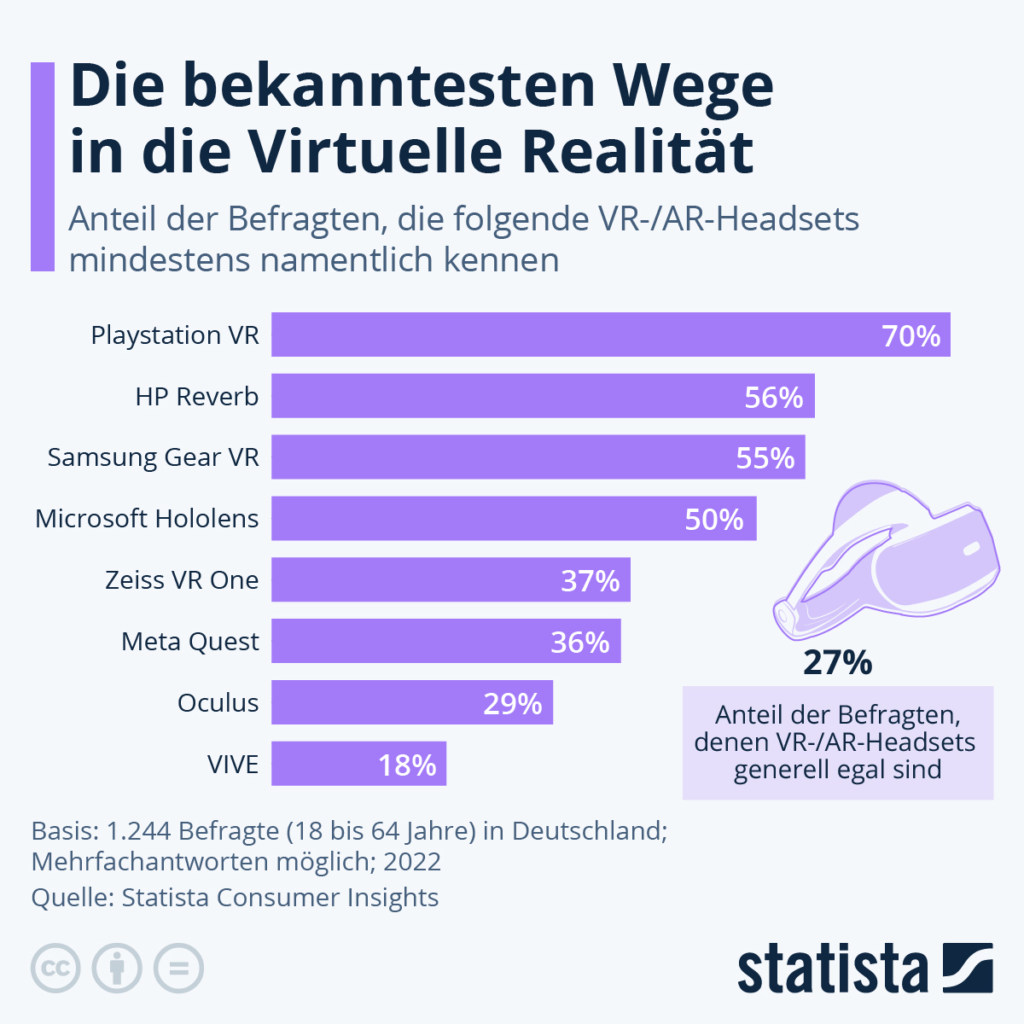
The most popular ways to enter virtual reality – Image: Statista
Growth potential of the VR market: Revenue forecasts and distribution of VR headsets
The VR market saw significant revenue of approximately $12 billion worldwide in 2022 across both consumer and enterprise segments, according to analysis by AR Insider. Forecasts for 2026 indicate further strong growth, with expected revenue reaching nearly $30 billion. Despite this, VR headsets are still far from becoming mainstream products. Analyst estimates suggest that only about 19 million VR headsets were in circulation in 2022.
Revenue development in the VR market
The VR market has experienced steady growth in recent years, both in the consumer and enterprise segments. In 2022, global revenue from VR technology reached approximately US$12 billion. This revenue includes sales of VR headsets as well as income from VR applications and content. The strong growth of the VR market is expected to continue in the coming years, with a revenue forecast of nearly US$30 billion by 2026.
Challenges to the mainstream success of VR glasses
Although sales in the VR market are increasing, VR headsets are still not widespread and have not yet reached the mainstream. Analyst estimates show that only about 19 million VR headsets were in circulation worldwide in 2022. There are several reasons for this limited adoption. For one, VR headsets are still relatively expensive and often require powerful computers or consoles to provide an optimal user experience. Secondly, many consumers are still unfamiliar with the technology or have concerns about comfort and potential health effects.
Growth potential of the VR market
Despite current challenges, the VR market offers enormous growth potential. With continuous technological advancements, falling prices, and increasing availability of content and applications, VR headsets are becoming attractive to a broader audience. The projected revenue of nearly $30 billion in 2026 underscores the VR market's potential to further establish itself and create new opportunities in various sectors, including gaming, entertainment, education, and enterprise applications.
Drivers for future growth in the VR market
The future growth of the VR market depends on a combination of factors to make the technology more accessible, appealing, and useful for consumers and businesses. With the right strategic direction and a stronger focus on user needs, VR can become an integral part of our future everyday lives.
Technology improvement
Continuous development of VR technology is crucial to improving the performance, image quality, motion tracking, and user-friendliness of VR headsets. Advances in wireless connectivity, battery life, and comfort are also important for optimizing the user experience and overcoming potential obstacles.
Price reduction
A price reduction for VR headsets and accessories is a crucial factor in making the technology accessible to a wider audience. Lower production costs and increased market competition can lead to more affordable prices and increase the adoption of VR headsets.
Content and applications
The availability of high-quality and diverse content is a crucial factor for the success of VR headsets. The development of immersive games, interactive applications, virtual training environments, creative tools, and other innovative content will increase interest in and demand for VR headsets.
Industrial applications
Besides gaming, VR headsets also offer great potential for applications in fields such as education, medicine, architecture, simulation, and training. The integration of VR technology into various industries and professional areas can drive the growth of the VR market and open up new business opportunities.
Consumer education and experience
Comprehensive consumer education about the benefits and uses of VR headsets is crucial to raising awareness and understanding of the technology. Providing opportunities for potential buyers to try out VR headsets and gain firsthand experience can further increase interest and acceptance.
Partnerships and collaboration
Collaboration between VR headset manufacturers, software developers, content creators, companies, and other relevant stakeholders is crucial to driving the growth of the VR market. Joint efforts enable the development of innovative solutions, the establishment of standards, and the opening of new markets.
The Metaverse - The Future of the Digital Cyber-Virtual World?
The concept of the metaverse has gained considerable attention in recent years and promises groundbreaking developments in virtual reality. It is a comprehensive digital cyber-virtual world where people can interact, communicate, and create content. In this article, we will examine the concept of the metaverse in more detail and provide key information about it.
Definition of the metaverse
The metaverse can be described as a comprehensive digital ecosystem consisting of virtual worlds, augmented reality (AR), mixed reality (MR), and other technologies. It is an enhanced form of virtual reality where users can not only immerse themselves in a virtual environment but also interact with each other and collaboratively shape the virtual world.
Interaction and communication
In the Metaverse, users can represent their physical presence through avatars or digital identities. These avatars allow users to move freely within the virtual world, communicate with each other, and perform activities. Interaction can occur in real time, enabling people from different parts of the world to connect and collaborate on projects.
Creative content and business
The Metaverse provides a platform for creating and sharing creative content. Users can create and share digital artwork, games, films, music, and much more. This content can be used not only for personal purposes but also as a basis for economic activities. Within the Metaverse, businesses can open virtual stores, offer virtual services, and use digital currencies.
Technological challenges
Although the concept of the metaverse is promising, several technological challenges remain. These include the development of advanced VR/AR headsets, the creation of a seamless and stable network infrastructure, and ensuring user safety and privacy. Collaboration between technology companies, developers, and regulators will be crucial to overcoming these challenges.
Impacts on society and the economy
The metaverse has the potential to fundamentally change the way we live, work, and interact. It could open up new possibilities for education, collaboration, entertainment, e-commerce, and social interaction. At the same time, there are concerns about the digital divide, social isolation, and the impact on privacy. A balanced and responsible development of the metaverse will be crucial.
Related to this:
Consulting, planning and implementation of augmented reality, webAR and industrial applications | B2B | Business Metaverse
Xpert.Plus is a project by Xpert.Digital. We have many years of experience in supporting and consulting for (Extended) Augmented Reality and warehouse optimization, which we combine under Xpert.Plus in a large network.

Konrad Wolfenstein
I would be happy to serve as your personal advisor.
You can contact me by filling out the contact form below or simply call me on +49 7348 4088 965 (Munich) .
I'm looking forward to our joint project.
Write to me



Xpert.Digital – Konrad Wolfenstein
Xpert.Digital is a hub for industry focusing on digitalization, mechanical engineering, logistics/intralogistics and photovoltaics.
With our 360° Business Development solution, we support renowned companies from new business to after-sales.
Market intelligence, smarketing, marketing automation, content development, PR, mail campaigns, personalized social media and lead nurturing are part of our digital tools.
You can find more information at: www.xpert.digital – www.xpert.solar – www.xpert.plus
Keep in touch